

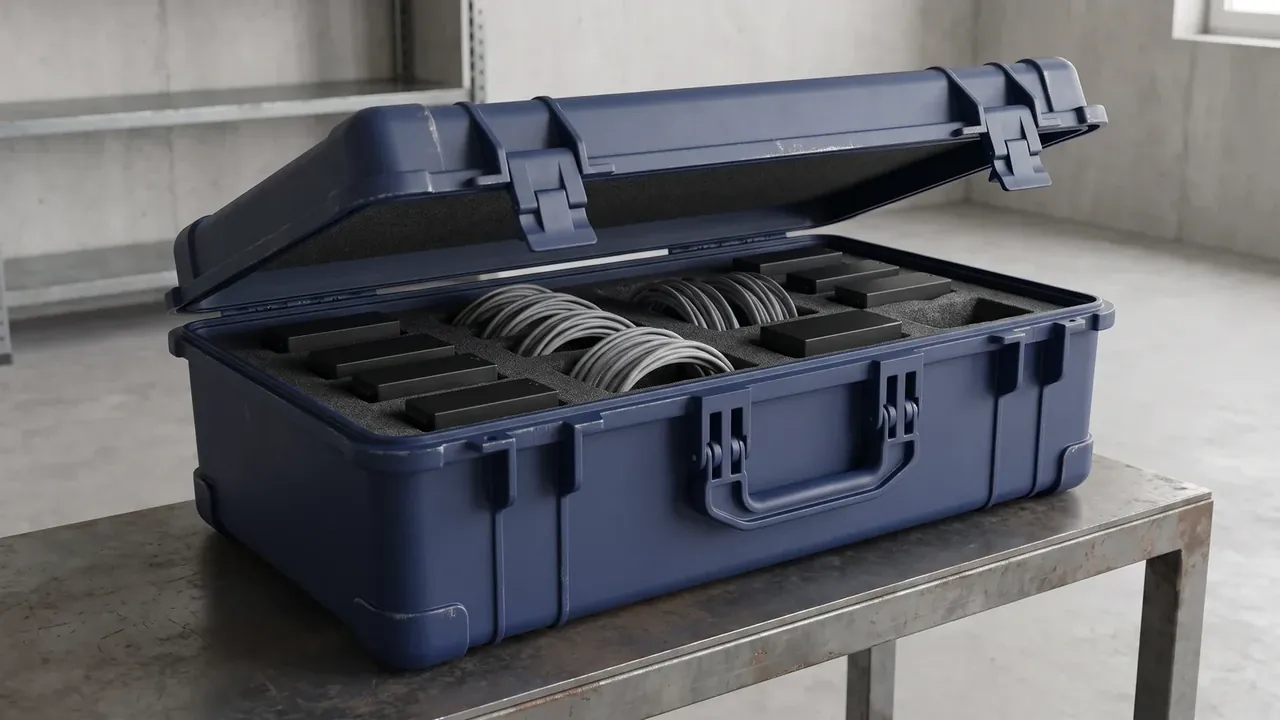
Quick answer: Where an emergency equipment case is used decides how it is built. A station splits it by task, a vehicle sizes it to the cabinet, a public point sizes it to mounting height, a site sizes it to dust and turnover.
Table of contents
- How an Emergency Equipment Case Is Split at a Station
- Emergency Equipment Case Fixing Inside a Vehicle
- Wall-Mounted Public Access Points
- Temporary Setups on Sites and at Events
- Comparing the Four Configurations
- FAQ
1. How an Emergency Equipment Case Is Split at a Station
At a response station the emergency equipment case is rarely one general unit. It splits by action into three: resuscitation, trauma, airway, following the largest item and the pick order.
| Task | Largest item (mm) | Loaded (kg) | Insert | Body (mm) |
|---|---|---|---|---|
| Resuscitation | 320×240×90 | 9.5 | flat cavity | 470×350×200 |
| Trauma | 280×200×80 | 7.0 | two offset layers | 430×330×180 |
| Airway | 380×260×110 | 6.5 | vertical dividers | 500×360×230 |
A cavity 5 mm deeper than the item is enough; 30 mm extra adds a dig to every pick. Foam at 45 kg/m³ holds shape, below 35 kg/m³ the walls collapse after six months loaded. Stations keep three in use and one spare, empty at 60 percent of a loaded footprint.
2. Emergency Equipment Case Fixing Inside a Vehicle
A 600 mm cabinet is common in a vehicle. An emergency equipment case built to 560 mm leaves 20 mm of finger room each side, and depth runs 30 mm under the clear depth so the lid edge clears the bulkhead.
Loads arrive lengthwise under braking, sideways in turns, and vertically from the road. Two 25 mm straps over the middle of the body plus a 3 mm anti-slip mat hold it; strapping the lid bows it permanently. Latches need a second detent: only a lever drop past closed means locked.
Lid to the aisle, hinge to the bulkhead, so one hand lifts it. A vehicle reaches minus twenty in winter and polypropylene turns brittle, so the latch tongue is thickened to 2.5 mm.
3. Wall-Mounted Public Access Points
A wall bracket sets the emergency equipment case with its lid edge 1200 mm above the floor, the height a standing adult's hand reaches. The bracket carries the base only, so the case seats under its weight and lifts off after 15 mm.
Failure shows up in inspection more than in use: a panel with 30 percent clear area reveals a disturbed insert without opening.
| Location | Daily footfall | Cases | Mounting | Inspection |
|---|---|---|---|---|
| Metro concourse | 30,000 | 2 | wall bracket | 30 days |
| Community centre | 800 | 1 | floor cabinet | 90 days |
The busier the point, the shorter the interval: the cycle follows the chance of being touched.
4. Temporary Setups on Sites and at Events
Site dust works in along the parting line, so an emergency equipment case used there is specified at IP65, with a double-lip gasket, a lid rated for 80 kg of stacked load, and a storage range from minus ten to fifty-five. Orange is worth more than lettering: it is seen across a heap of rebar.
Numbers scale with people, one case per 300 workers and two rotating through a half-day event. A pallet lifts the base 100 mm, since the floor contact face is where rain reaches first.
Handling is the other weak point: a flat base stays put on broken stone, but two cases need one trip, so add a 600×400 mm trolley plate with recesses for the feet.
5. Comparing the Four Configurations
| Setting | Cases per point | Insert | Fixing | Key dimension |
|---|---|---|---|---|
| Station | 4 | layered by task | cabinet | 600 mm clear width |
| Vehicle | 1 | flat cavity | two straps | 560 mm body |
| Public point | 1 to 2 | vertical dividers | wall bracket | 1200 mm lid height |
| Site or event | 1 to 2 | removable boards | pallet | 100 mm off floor |
Provisioning runs at 1.4 times the number in use, so no point goes empty while an emergency equipment case is away for service.
The settings pull against each other: vehicles want a shallow body, walls height, sites sealing, stations compartments. When one unit covers three, take the tightest seal and the smallest body, then make up the rest with inserts and brackets.
Conclusion
Setting drives configuration. Stations want compartments, vehicles a shallow body, wall points height, sites sealing. List cases, inserts, fixing and inspection against each setting and selection becomes matching conditions, which is how an emergency equipment case should be chosen.
This article discusses only the container (case body) side of specifications and design intent, and does not cover any handling, loading or use of the contents.
Related Reading
- First aid kit case specifications
- First aid kit case versus alternatives
- Medical case configurations by setting
- Emergency supply case deployment
Related Products
- 8 Series — Gun Cases; Military Equipment Cases; Camera Equipment Cases; Drone Cases; Watch Cases; Knife Cases; First Aid Cases; Electronics Equipment Cases
- WL8-2812 PP Gun Case — model WL8-2812
- All protective cases and toolboxes: 7 series, 158 models