

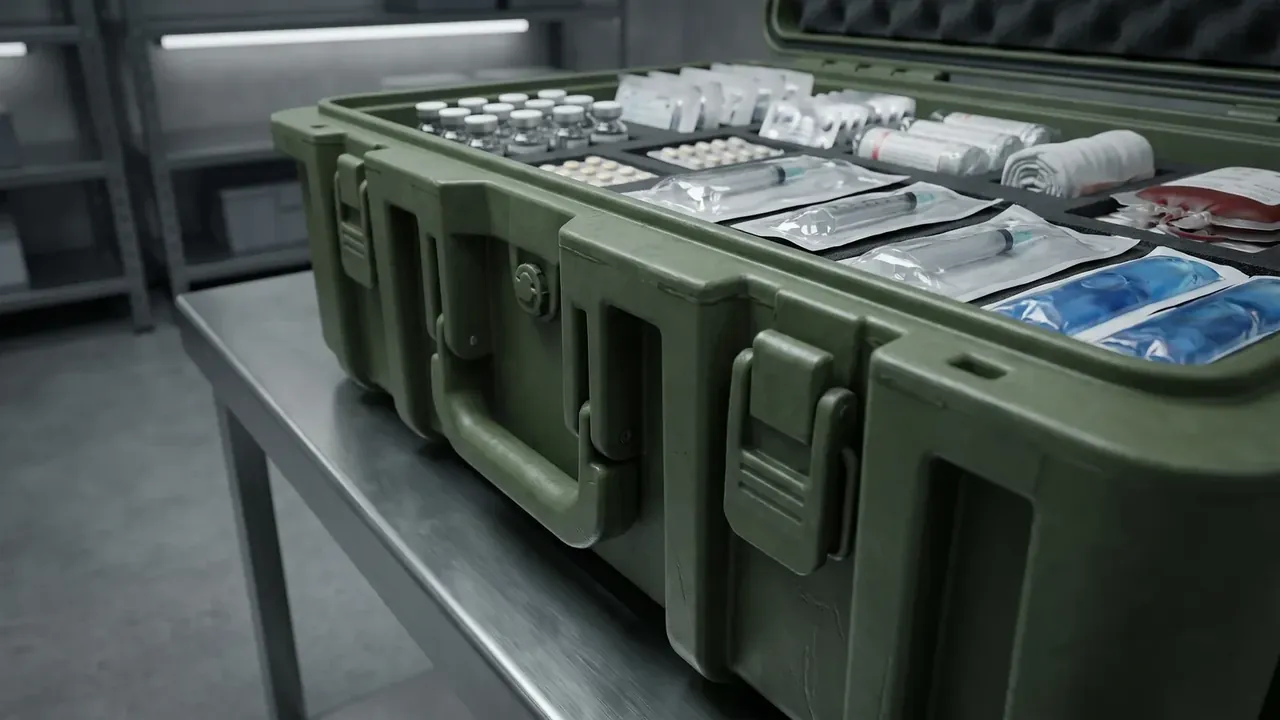
Quick answer: An Emergency Rescue Equipment Case is built around pick time: two 12 mm trays, a 105° lid stop and 2×180 N struts keep a single item under 15 s.
Table of contents
- Pick Route in an Emergency Rescue Equipment Case
- Layered Trays and the Lid Rest Angle
- Label Positions and Recognition in the Dark
- Gas Struts and One-Handed Lifting
- Pick-Time Values for a Response Crew
- FAQ
1. Pick Route in an Emergency Rescue Equipment Case
The alarm sounds and the truck leaves within minutes, so how the lid opens matters more than a millimetre of wall. An Emergency Rescue Equipment Case is opened at the tailgate by a standing, gloved operator whose eyes are half on the crew leader. The route therefore follows four moves — lift, scan, reach, reset — rather than a product family. At 560 × 420 × 230 mm outside, 510 × 370 × 190 mm inside, 4.2 mm wall and 6.8 kg, one person sets it down without strain; after that the lid stop and the eye's first landing point set the pace.
Three steps sit between the latch and the first item: the label on the lining, the cells of the tray, the hand. An Emergency Rescue Equipment Case keeps all three on one vertical line, so nobody stoops. Move the labels to the floor and cut cells unevenly, and the eye folds twice — a twelve-second pick drifts past thirty. Placement shifts the labels: flat on the tailgate the view is a plan view, against a bulkhead it is level.
2. Layered Trays and the Lid Rest Angle
The 12 mm upper tray is the quietest part of an Emergency Rescue Equipment Case. Grouped items sit below, single picks above; the upper tray rests on two ledges when raised, so it cannot drop back mid-pick, and the gap takes a gloved finger.
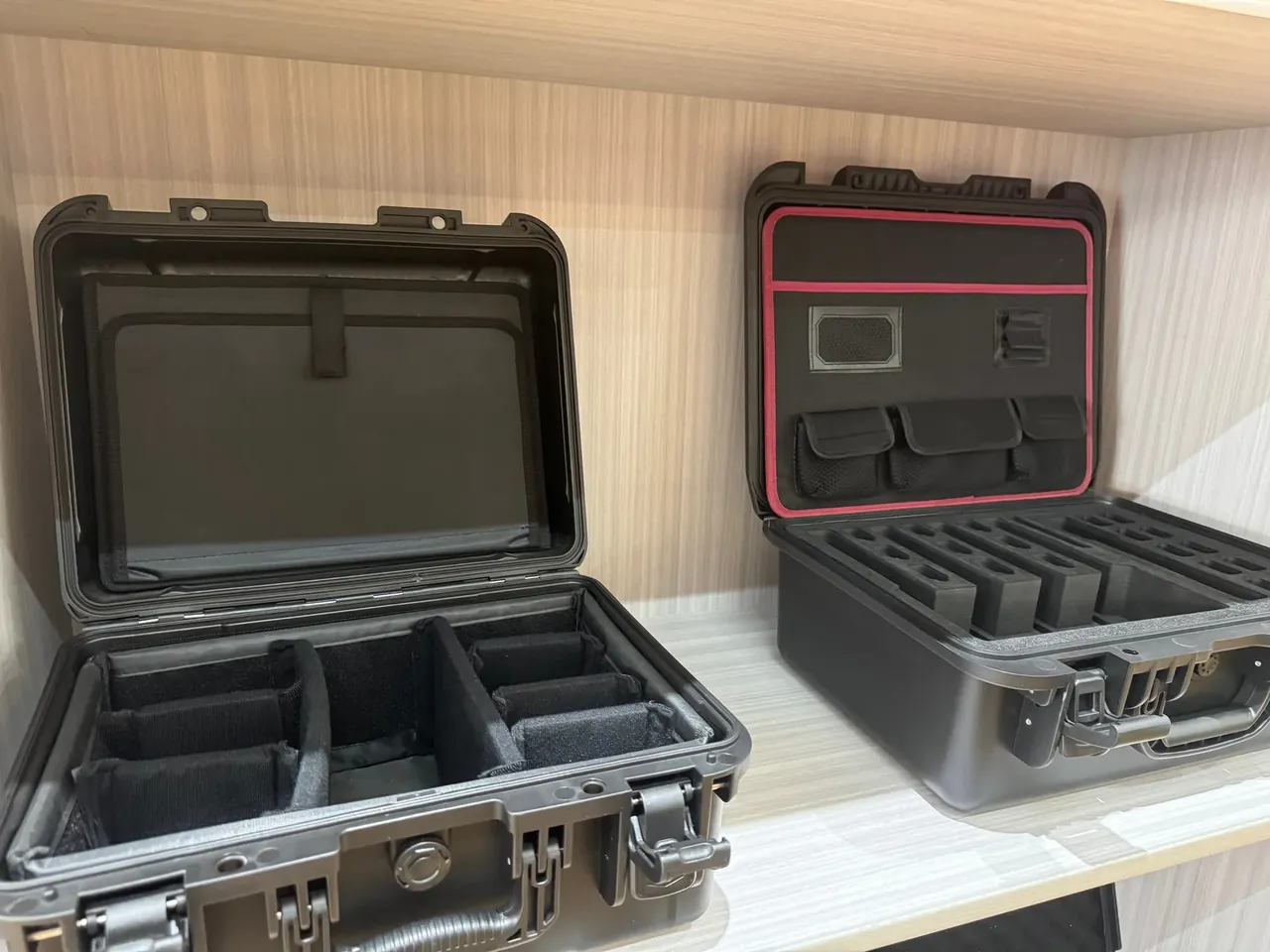
The lid stops at 105°, fifteen degrees past the usual 90°. At 90° the centre of gravity sits directly over the hinge and a nudge tips the lid backwards; at 105° it passes the hinge and the lid leans onto its stop. Open further and the labels tilt out of sight.
| Tray level | Height taken | First item | Where it suits |
|---|---|---|---|
| Single tray | Under 12 mm | Eye sweeps every cell | Fewer than 6 cells |
| Two trays | 12 mm plus lift space | First row visible | The 12-label build |
| Three trays | 24 mm and above | Two lifts before a pick | Fixed bench only |
Two layers halve the scan but cost height: the 12 mm tray plus its lift space leaves about 160 mm of the 190 mm cavity, so an Emergency Rescue Equipment Case in this format cannot be shorter.
3. Label Positions and Recognition in the Dark
Twelve label positions match twelve cells, numbered across in 8 mm characters. Legible character height runs near 1/300 to 1/200 of viewing distance, so 8 mm holds a little past 2 m while a standing pick puts the eye about 0.6 m away. Numbering runs hinge to free edge because the wrist pushes that way, putting the everyday six cells first.
Retroreflective strip returns lamp or torch light, and the letterforms sort the cells. An Emergency Rescue Equipment Case carries 25 mm strip around the lid, half the 50 mm common on high-visibility workwear, because the shell needs recognition within 8 m rather than in traffic. The strip sits on the lid edge, which still faces outward when open.
4. Gas Struts and One-Handed Lifting
The 2×180 N pair follows lid mass, hinge-to-centre distance and mounting angle. Toolbox lids usually run 80 to 150 N per strut, and a tray-carrying lid opened one-handed moves above 150 N. Two struts at 180 N give 360 N, enough torque to hold the lid anywhere without letting a gust close it.
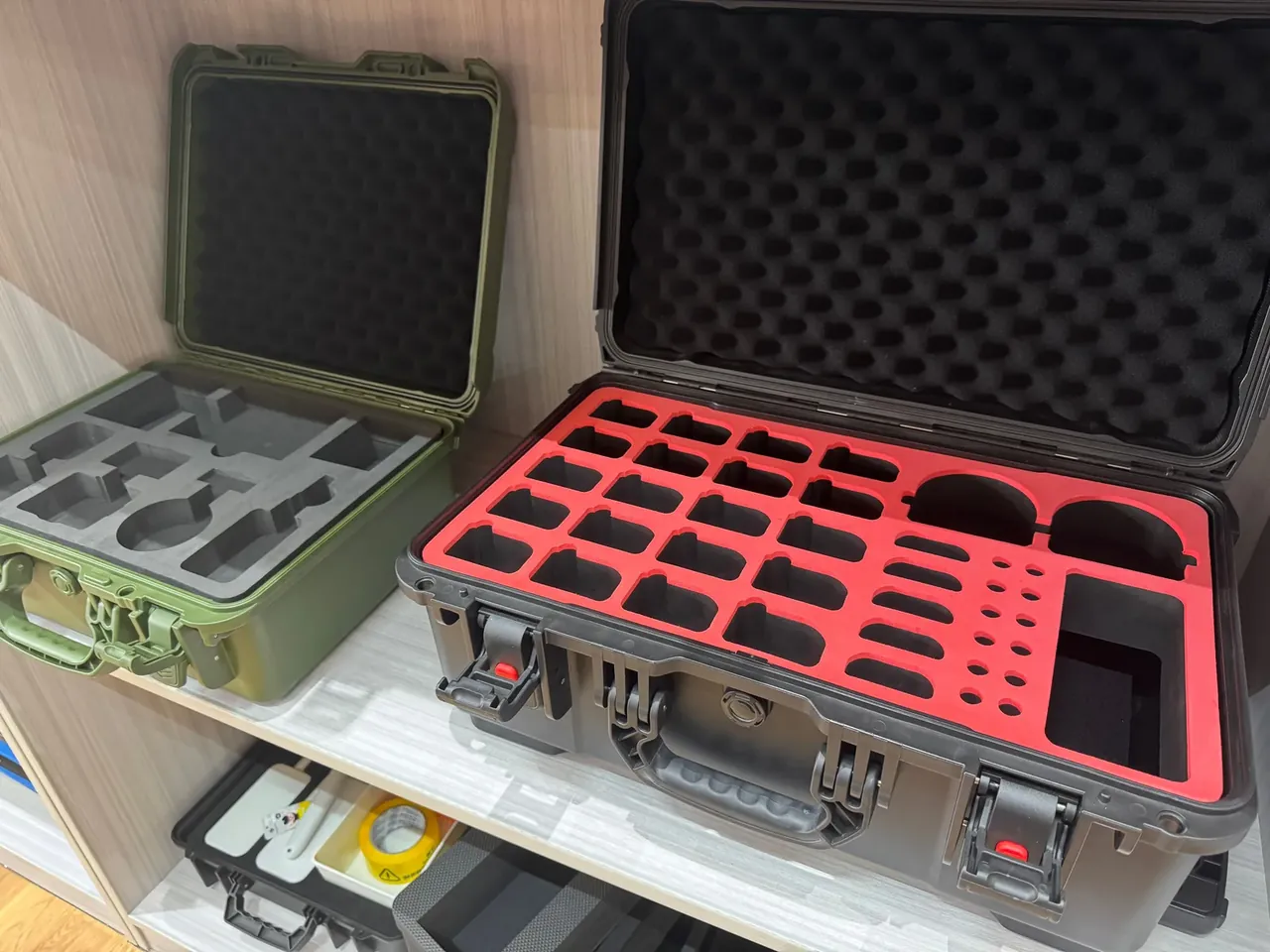
Force tracks temperature at roughly 0.35% per °C, so the 45 K between +20 °C and −25 °C costs about 16% and leaves near 300 N. Annual loss of 3% to 5% is quieter: after three years an Emergency Rescue Equipment Case pushes a tenth less than new.
| Pick round | Action | Time | What goes wrong |
|---|---|---|---|
| First | Lift lid, scan row one, take | 8 to 12 s | Label pinched by the tray edge |
| Second | Raise the tray, take from row two | 12 to 15 s | Tray not seated on return |
| Check | Count before closing, press latches | Over 20 s | Cell out of position |
Four latches at 320 N each hold 1280 N against 360 N of strut force, so a closed Emergency Rescue Equipment Case cannot be pushed open from inside; after 5000 cycles the tongue still needs 1.5 mm of engagement.
5. Pick-Time Values for a Response Crew
Two trays stay only while the first item comes out inside 15 s; add a third and the upper tray has to become a half-open type.
Fifteen seconds covers one pass through each round, so no more than one tray lift follows the open lid. A third tray adds a second lift, and two lifts plus resetting push a pick past 20 s — in the first minutes of a call, long enough for a crew to take two items each.
| Locate time | Crew reading | Action |
|---|---|---|
| 10 s or less | Route is clean | Keep the layout |
| 10 to 15 s | Acceptable | Check for a label behind the tray |
| Over 15 s | Route has failed | Drop a tray or go half-open |
At 6.8 kg the Emergency Rescue Equipment Case sits at the carry limit; five-high stacking is the storage limit; −25 °C to +60 °C is the band for shell and seals. IP67 means 1 m of static water for 30 min, so a pressure washer falls outside it — printed inside the lid to stop a rinse replacing a wipe.
Conclusion
In the minutes before a call, an Emergency Rescue Equipment Case is judged by what the eye finds, not by wall thickness. Fix the two 12 mm trays, the 105° stop, the 2×180 N struts and the 12 label positions, and a pick stays inside 15 s. A pick route is designed, not acquired by habit.
Related Reading
- Loading Scenarios for Emergency Equipment Cases
- Hard Case and Carton in Transit
- The Usable-Volume Calculation
Related Products
- 8 Series — Gun Cases; Military Equipment Cases; Camera Equipment Cases; Drone Cases; Watch Cases; Knife Cases; First Aid Cases; Electronics Equipment Cases
- WL8-2812 PP Gun Case — model WL8-2812
- All protective cases and toolboxes: 7 series, 158 models