

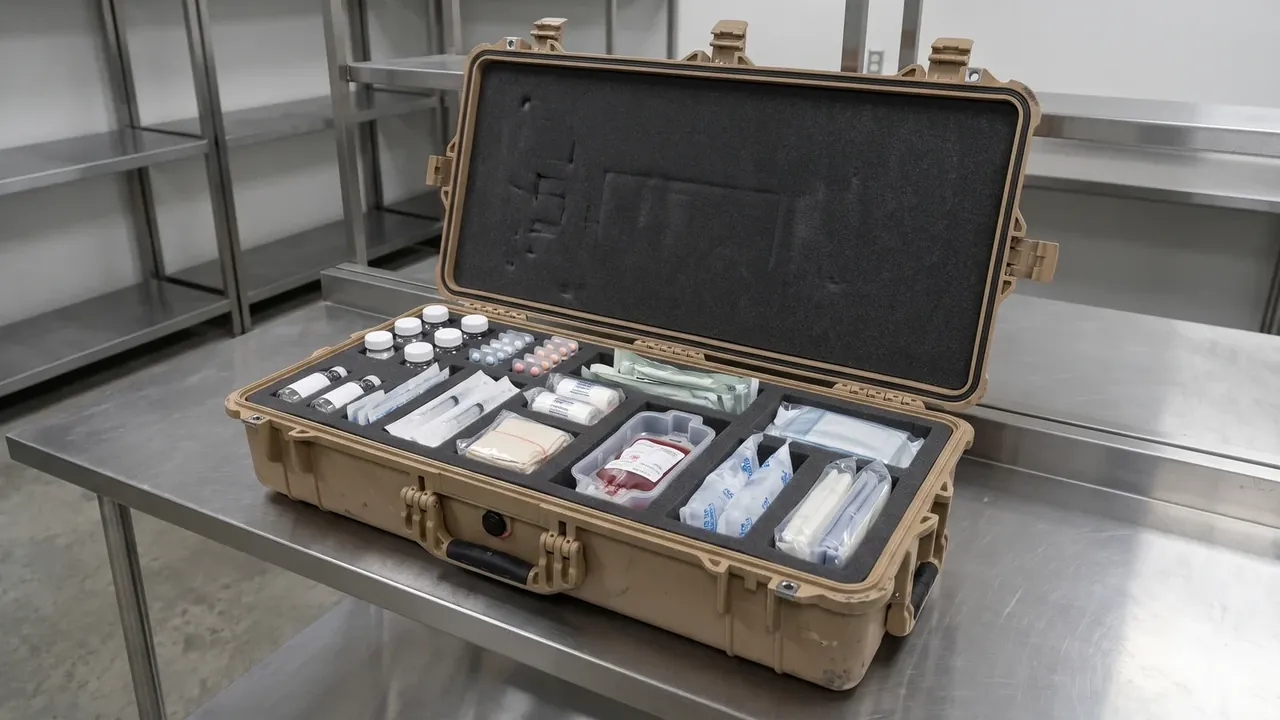
Quick answer: An emergency command case works when its compartments follow the job order: four zones for comms, power, video and lighting, 15 mm and 30 mm foam depths for light and heavy gear, and colour strips plus eight-character codes that make the reset path obvious.
Table of contents
- Four zones inside an emergency command case
- EVA trays and PP dividers: depth against cell width
- Retrieval order, colour codes, 180-second setup
- Lid panel, stacking and vehicle tie-down
- FAQ
1. Four zones inside an emergency command case
The case arrives empty, and whoever packs it first fixes the layout; a later change means cutting fresh foam. Site work runs comms, power, video, then lighting, so the zones stack in that order from the lid down. A 520 × 380 × 190 mm interior gives each zone 25 to 35 percent of the floor and leaves 10 percent for cables.
Power sits low against the hinge for one reason: mass. A lithium iron phosphate pack weighs 4 to 8 kg, and weight at the bottom keeps a one-handed carry from tipping. Comms take the upper bay beside the handle, where a radio is drawn 20 times in a 3-hour task. Video runs down the centre for a 400 to 900 mm mast, and lighting rides on the lid, where a torch under 2 kg needs no floor space.
| Zone | Position | Floor share | Limit |
|---|---|---|---|
| Comms | Upper bay | 25 to 30 percent | 3 kg |
| Power | Lower bay | 30 to 35 percent | 8 kg |
| Video | Centre | 20 to 25 percent | 4 kg |
| Lighting | Lid panel | None | 2 kg |
Zone walls are 5 mm PP hollow sheet, not foam: foam softens after 6 hours in a 40 °C van, while the sheet sits in slots on a 25 mm pitch.
2. EVA trays and PP dividers: depth against cell width
Linings are cut from EVA at 60 to 80 kg/m³, Shore A25 to A35, firm enough to hold shape without bruising a hand. EVA locates an item and PP divides the floor; one material doing both jobs does neither well. Foam runs 2 to 3 mm above the item, with 15 mm cells for light gear and 30 mm cells for packs.
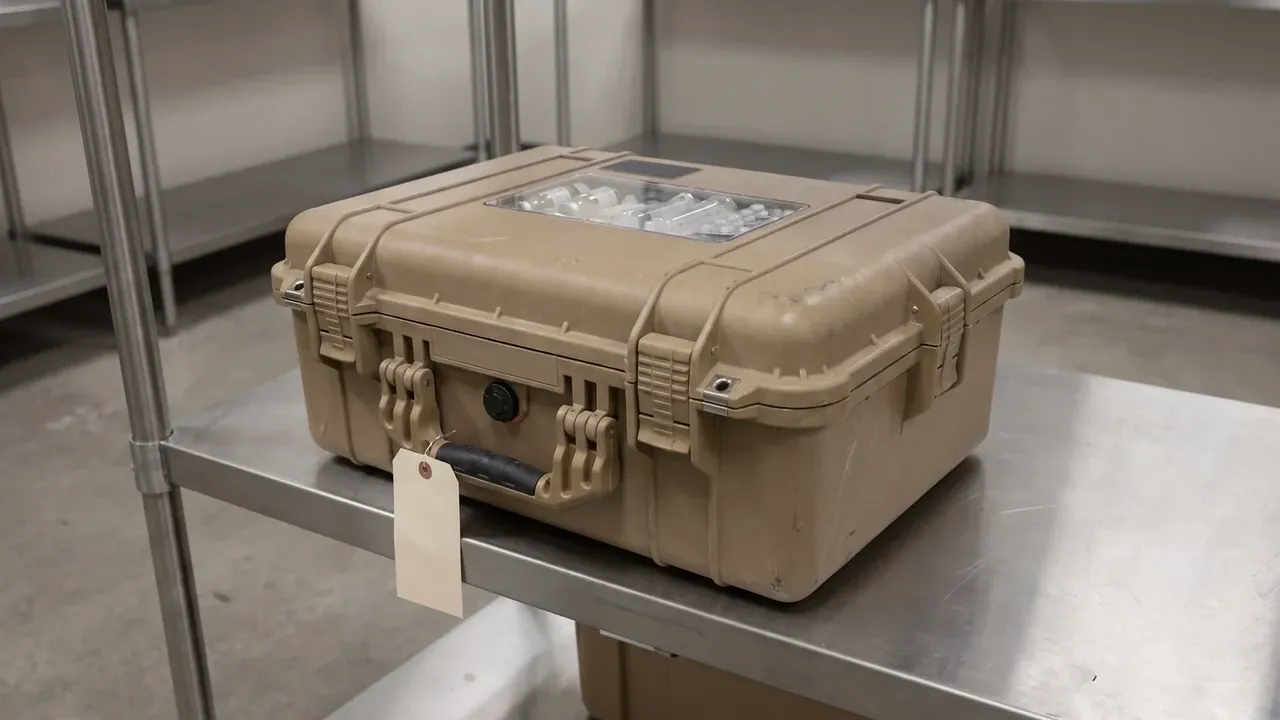
Cells run 40 to 120 mm wide, and nothing goes below 40 mm: under that a gloved finger cannot enter. Tolerance is plus or minus 1 mm with a 3 mm wall, or the edge frizzes after 200 picks. A 2 mm pad absorbs part of a 1 m drop.
| Layer | Material | Thickness | Job |
|---|---|---|---|
| Lid | EVA sheet | 10 to 15 mm | Presses top |
| Middle | Cut EVA | 15 mm | Cradles light items |
| Base | Cut EVA | 30 mm | Locks power |
| Dividers | PP sheet | 5 mm | Adjustable zoning |
Mixing depths has a side effect worth calculating. A shallow cell beside a deep one has only 15 mm of foam beneath it, and a heavy neighbour crushes that floor; a 5 mm pad fixes it at 4 percent of the floor, or 7,900 mm². With 190 mm of height, a 30 mm cell plus 10 mm lid foam leaves 150 mm clear, so a tall power unit lies on its side, which turns top access into side access and pushes setup past 4 minutes.
3. Retrieval order, colour codes, 180-second setup
A 3-minute setup splits into four moves: 15 seconds to open, 30 seconds to pull comms, 90 seconds to raise the mast and connect power, 45 seconds to stow. The arithmetic holds only when zones and colours agree.
- Red: comms bay, 20 mm strip
- Yellow: power bay
- Blue: video bay, at the antenna slot
- Green: lighting, beside the lid panel
Colour is half of it; the reset depends on numbering. Each cell carries an eight-character code, two for the case, two for the zone, four for the cell, at 8 mm height and legible at 1.5 m. Outdoor adhesive holds 12 months, and a moulded code outlasts any print. Hand the case to someone who did not pack it and time the reset: a slow first attempt shows an emergency command case zoned by habit.
4. Lid panel, stacking and vehicle tie-down
The lid panel carries 1.5 kg on six M4 screws at 1.2 N·m, standing 12 mm off the shell for airflow and finger clearance. Only daily items belong there.
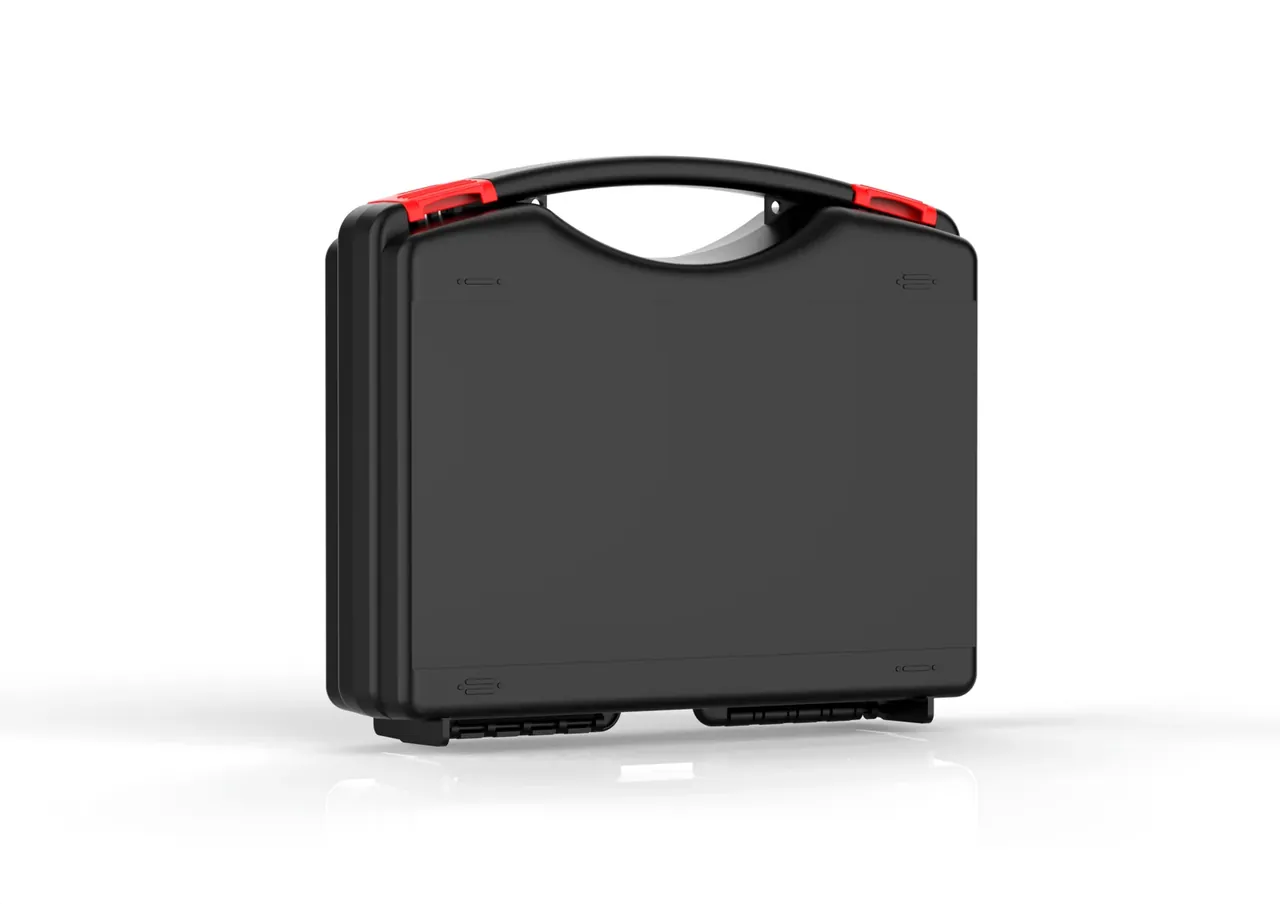
Stack no more than 3 cases and keep the pile under 1.2 m. A bottom case carries two empty units at 14 kg, or 46 kg fully loaded, so its four ribs must land on pallet beams rather than span open air. Tie-down uses two 25 mm straps at 2.5 kN, hooked into slots on both sides and tensioned with 5 mm of slack.
The shell is built to IP65, sealed against dust and water jets but not immersion, rated from −20 to 60 °C with a 2.5 mm wall and a vent opening near 8 kPa. That vent earns its place on temperature: move the case from a 35 °C vehicle into a 5 °C tent and internal vacuum clamps the lid shut.
| Check | Criterion | Interval |
|---|---|---|
| Latch effort | 60 to 90 N | Quarterly |
| Lid gap | 0.4 mm closed | Monthly |
| Straps | No cuts, 2 kN | 6 months |
| Screws | 6 present, 1.2 N·m | Monthly |
Conclusion
An emergency command case earns its price when four things line up: zones that follow the order of the job, a 15 mm and 30 mm foam pair that cradles light gear and pins heavy gear, colour strips and eight-character codes that keep the reset independent of memory, and a three-high stack held by two 2.5 kN straps. Write those four into the packing procedure and a new crew reproduces the layout of an emergency command case on the first attempt.
This article discusses only the container (case body) side of specifications and design intent, and does not cover any handling, loading or use of the contents.
Related Reading
- How an emergency command case is divided into modules
- Case formats and layouts for emergency kits
- Selection criteria for emergency supply cases
- Protection requirements for medical emergency equipment cases
Related Products
- 8 Series — Gun Cases; Military Equipment Cases; Camera Equipment Cases; Drone Cases; Watch Cases; Knife Cases; First Aid Cases; Electronics Equipment Cases
- WL8-2812 PP Gun Case — model WL8-2812
- All protective cases and toolboxes: 7 series, 158 models