

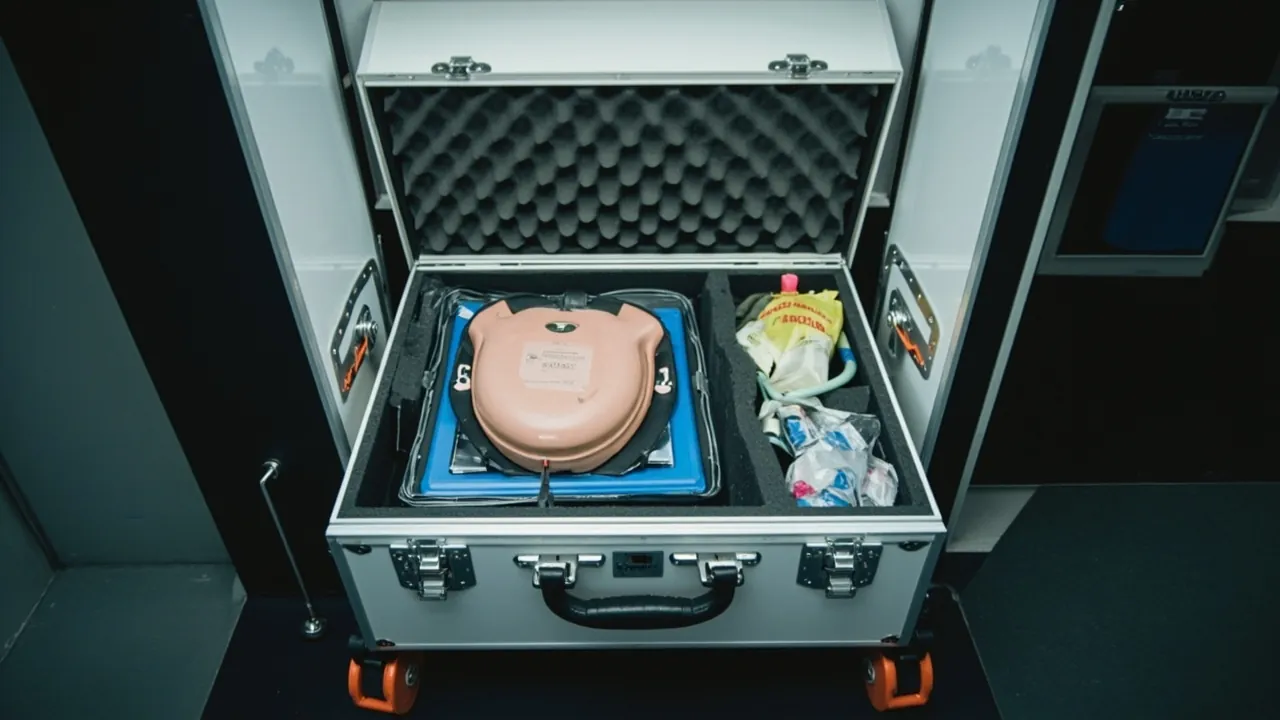
The core requirements of a medical emergency equipment case can be summed up in three sentences: protect the equipment in a bumpy, humid and temperature-swinging pre-hospital environment; let the responder reach the right item within seconds; and allow thorough cleaning and rapid restocking after every call. Unlike industrial or photographic use, a pre-hospital case carries defibrillators, monitors, portable ventilators, oxygen cylinders, intubation instruments and emergency drugs. These combine the shock and moisture sensitivity of precision electronics with strict layered categorization and expiry management, and they have to stay reliable through hard braking, field conditions, rain and poor night lighting. A qualified emergency case therefore has to satisfy four dimensions at once: physical protection, access efficiency, cleanability and identification management. Below we work through this in the order of scenario requirements, layout and access, cleaning and infection control, equipment securing, vehicle and field conditions, and common mistakes.
Table of Contents
- The Four Real Demands of Pre-Hospital Care on a Protective Case
- Internal Layout and Fast Access: Zoning, Layering and Checklist Management
- Cleaning and Infection Control: Cleanable Surfaces, Sealing and Consumables
- Securing and Shock Protection for Defibrillators, Monitors and Drugs
- Vehicle and Field Conditions: Securing, Temperature, Sealing and Power
- Frequently Asked Questions (FAQ)
- Conclusion
- Further Reading
The Four Real Demands of Pre-Hospital Care on a Protective Case
To understand why an emergency case is different from an ordinary box, look first at the real working conditions of pre-hospital care.
Demand One: Reliable Access Under Time Pressure
The treatment window in pre-hospital care is extremely short. Responders usually work in gloves, crouched inside a vehicle or at the scene, with sightlines limited by the lid opening angle and by scene lighting. In that situation "visible the moment you open it, reachable the moment you extend your hand" matters far more than "holds more." A case that stacks items in layers will simply be tipped out during a real resuscitation, and every later use then requires re-sorting, which raises the chance of error.
Demand Two: Continuous Vibration and Shock in Motion
Hard braking, speed bumps and cornering on urban roads produce continuous vibration and sudden shocks. Defibrillators and monitors contain precision circuit boards, displays and connectors; long-term vibration loosens connectors, fatigues display ribbon cables and backs out screws. Glass drug vials that knock together break and contaminate.
Demand Three: Cleanliness and Protection in Complex Environments
Pre-hospital scenes may be rainy, muddy, at a traffic collision or inside an industrial site. The outside of the case picks up contamination while the inside must stay usable and clean. That requires a rinseable and disinfectable outer surface, a wipeable liner, and sealing that blocks external spray and dust.
Demand Four: Verifiable Status Management
Emergency drugs and consumables carry expiry dates, batteries carry charge, and oxygen carries pressure. A sound emergency case system makes checking easy: open the lid and see the checklist, the expiry dates and the equipment status rather than digging item by item.
String these together and the statement becomes: a medical emergency protective case equals reliable physical protection plus an access-oriented layout plus a cleanable and disinfectable structure plus a verifiable management interface. Missing any one dimension amplifies risk during an actual call.
Internal Layout and Fast Access: Zoning, Layering and Checklist Management
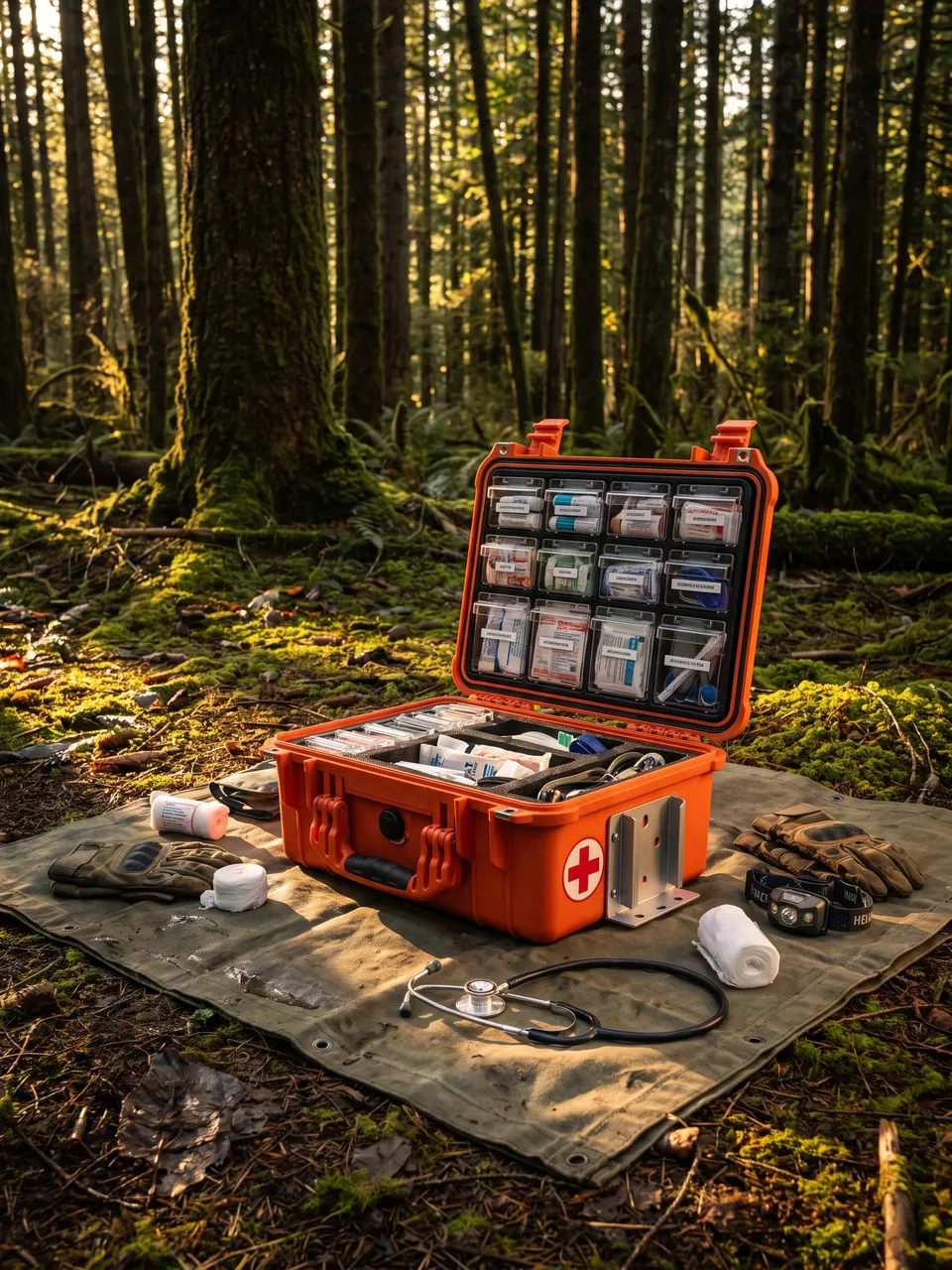
Layout is the soul of emergency case design. A good layout lets a responder complete retrieval without having to think.
Layering by Frequency and Workflow
| Layer | Contents | Rationale |
|---|---|---|
| --- | --- | --- |
| Lid interior mesh | Checklist card, gloves, shears, tape, pen, record forms | Visible on opening, used first |
| Top layer | Defibrillator or monitor, airway instruments | First-priority equipment and instruments |
| Middle layer | Drug zone, syringes, infusion supplies | Boxed by category, labels facing up |
| Bottom layer | Spare consumables, spare batteries, oxygen fittings | Low frequency, also acts as ballast |
| Side pocket | Cables, electrodes, blood pressure cuffs | Long items stored separately |
Three Principles of Zoning
- Zone by function, not by shape: Airway, circulation, breathing, drugs, trauma and consumables should each be their own zone rather than grouping items that merely look alike. Functional zoning lets people retrieve by position memory under stress.
- Dual coding with color and label: Give each functional zone a different liner or pouch color and apply a uniformly formatted label outside. Color provides fast location, text provides accurate confirmation, and the two complement each other.
- Fixed positions build muscle memory: Once the layout is set, stop changing it. Team training should include blind retrieval drills so members can find items with gloves on or in the dark.
Checklist and Expiry Management
- In-case checklist card: Placed on the lid interior, listing contents, quantity and expiry for each zone, used to restock after every call.
- Expiry-forward placement: Sort drugs of the same type by expiry date, keeping the nearest expiry in the easiest position, following first-in first-out.
- Seals and inspection records: Fit a single-use seal or inspection tag, and record date and responsible person after each check for traceability.
- Restraint on weight and volume: Carry only what is essential. More contents mean slower access, harder restocking and higher vehicle load.
Structural Details That Speed Access
- Lid opening angle: The lid should open fully and stay stable with one hand, without springing back onto the operator's hands.
- One-hand-operable latches: Spring latches or over-center two-piece latches are common choices, and they must work while wearing gloves.
- Shallow-bay liners: Items laid flat in shallow bays are far easier to reach than items buried in foam; deep cavities should be reserved for spares.
- Transparent pouches: Packing consumables into clear zip bags aids both identification and remaining-quantity checks.
Cleaning and Infection Control: Cleanable Surfaces, Sealing and Consumables
Cases encounter blood, body fluids, soil and road dust in pre-hospital work, so cleaning and disinfection are mandatory after every call.
Design Points for a Cleanable Structure
- Keep the outer surface as flat as possible: Minimize deep grooves, blind holes and crevices where soil collects. The exterior should be wipeable as a whole with a damp cloth or disinfectant wipe.
- Use wipeable liner material: Liners should be closed-cell, non-absorbent and tolerant of routine cleaning agents. Open-cell sponge absorbs liquid and becomes a contamination source, so it has no place in an emergency case.
- Make the liner removable where possible: A tray or pouch that lifts out as a unit can be thoroughly cleaned or replaced.
- Plan for drainage and drying: If the case will be rinsed, the structure should let water drain and dry easily. Always dry completely before closing for storage so the interior does not become a growth environment.
- Specify corrosion-resistant hardware: Latches, hinges and screws repeatedly meet disinfectant, so use stainless steel or properly treated materials; rust is both unhygienic and hard to clean.
Sealing and External Protection
When a case has full-perimeter sealing and IP67 capability, it protects equipment and consumables in rain, mud and rinse-down situations. Points worth understanding:
- Sealing is two-way: It keeps external contamination out, and it also confines any internal spill to the case so it can be dealt with in one place.
- Sealing is not a substitute for cleaning: Every opening exchanges air and carries contamination potential, so the interior still needs regular inspection and cleaning.
- Latch compression determines the seal: Check regularly that latches seat fully and that the gasket is neither aged nor dirty; that is the precondition for keeping the protection rating meaningful.
Consumables and Contaminated Item Management
- Individually packaged single-use items: Prefer sterile individual packs that are discarded after use to reduce cross-contamination.
- Isolation bag for contaminated items: Waste generated on scene goes into a dedicated bag, never mixed with clean consumables.
- Documented cleaning process: Record each post-call cleaning and restocking, including time, cleaning agent used and items replenished.
- Liner replacement interval: Replace liners that are torn, visibly stained or materially aged rather than keeping them in service.
Securing and Shock Protection for Defibrillators, Monitors and Drugs
Emergency equipment is high in value and precision, and extremely high in reliability requirements, so securing and cushioning must be done properly.
Equipment Securing Principles
| Equipment | Main risk | Securing method | Liner notes |
|---|---|---|---|
| --- | --- | --- | --- |
| Defibrillator or AED | Vibration loosening connectors, screen damage | Dedicated cavity with clearance all round | Soft layer over the screen, separate cable channel for electrodes |
| Monitor | Display breakage, ribbon fatigue | Laid flat, screen up | Screen area floating or cushioned, constrained on all sides |
| Portable ventilator or suction unit | Shock deforming the gas path | Supported from below, constrained at sides | Inlet and outlet ports left unobstructed |
| Oxygen or small gas cylinder | Rolling, valve impact | Dedicated cradle or strap | Valve end protected separately, cylinder cannot roll |
| Glass drug vials | Mutual impact and breakage | Divided rigid box or foam cells | One vial per cell with walls between |
| Batteries and chargers | Tab short circuit, cable tangle | Separate groove plus mesh pocket | Tabs cannot reach metal, cables stored separately |
Practical Rules of Shock Design
- Float the equipment inside cushioning: Leave at least 20 mm of foam around every cavity and the same at the bottom and top.
- Heavy items low, center of gravity central: Defibrillators and cylinders sit low so the case does not tip when the vehicle corners.
- No empty cavities: A cavity left empty long term lets equipment shift; add filler blocks whenever the kit changes.
- Secure without pressure: The cavity must hold the device without pressing on keys, screens or ports, since pressure causes key failure and screen damage.
Moisture and Temperature for Electronics
Defibrillators and monitors are precision electronic devices sensitive to humidity and temperature. Key protections:
- Keep desiccant and a small hygrometer in the case and hold relative humidity within the range the device allows, avoiding condensation.
- A vehicle in summer sun can reach temperatures markedly above ambient, so avoid long-term storage in direct sunlight.
- In winter, let the case acclimatize before opening after moving from cold outdoors into a warm vehicle or room, to avoid internal condensation.
- Maintain device batteries with regular charge and discharge cycles; long idle periods reduce capacity.
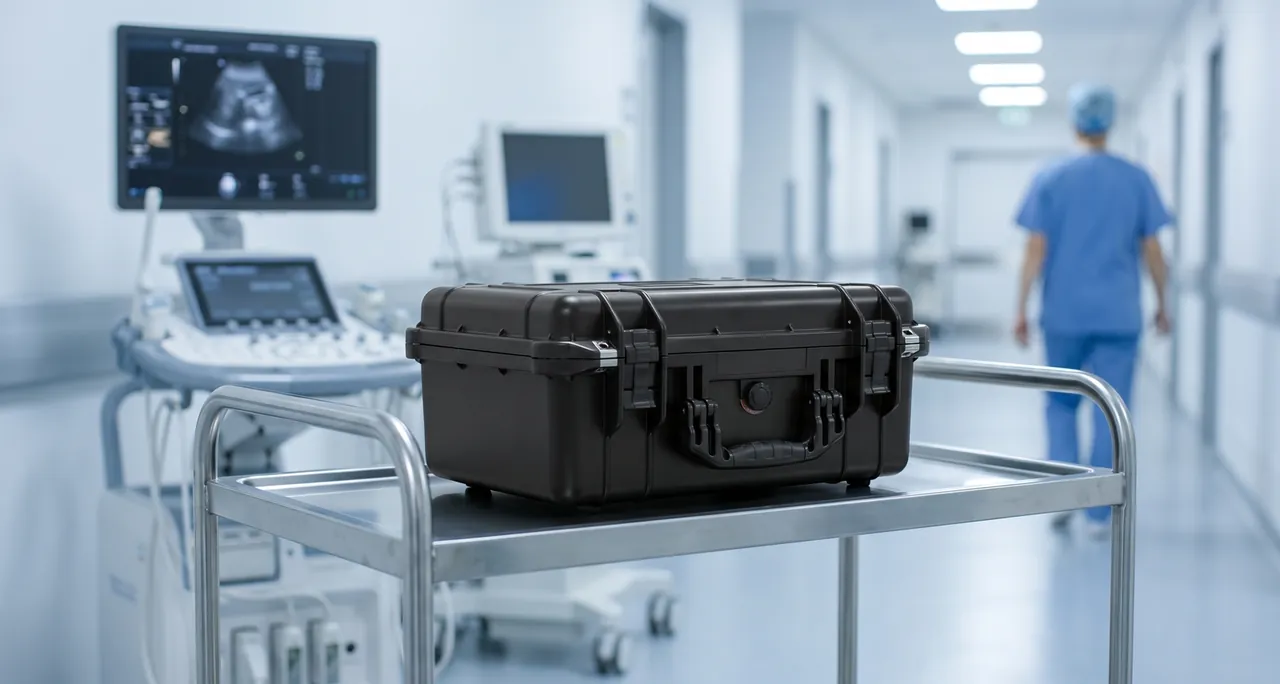
Vehicle and Field Conditions: Securing, Temperature, Sealing and Power
Securing in the Vehicle
Cases in an ambulance must be secured reliably; this protects both the equipment and the occupants:
- Place cases in a dedicated rack or strap them to vehicle anchor points so they do not move under hard braking.
- When stacking several cases, use formats with stacking locators so mating bosses and recesses prevent sliding.
- Put heavy cases low and light ones high to lower the combined center of gravity.
- Keep the access path clear: frequently used cases go outermost so reaching them never requires moving others.
Sealing and the Field Environment
Pre-hospital scenes involve rain, wading, dust and mud. Case requirements:
- Protection rating: A case with IP67 capability handles temporary immersion and powerful spray, suiting rainy and flooded scenes.
- Anti-slip feet: On wet or uneven ground, feet reduce sliding and abrasion.
- Rinseable: After a call the exterior can be rinsed with water and cleaning agent, then dried and checked for ingress.
- Color and visibility: Emergency cases often use high-visibility colors and reserve a label area, aiding rapid identification and team role assignment on scene.
Power and Cable Management
- Keep vehicle chargers, spare batteries and cables together so they do not interfere with access.
- Coil and secure cables individually so connectors are not strained or broken.
- Battery tabs must not contact metal instruments; provide a separate bay.
- Inspect batteries regularly for appearance and charge; retire any that are swollen or leaking and handle them under the applicable rules.
Behavior in High and Low Temperatures
In the cold, some plastics lose toughness and become brittle, raising the risk of cracking on impact. In the heat, stiffness drops, so stacked cases creep and deform more easily and the gasket's compression recovery degrades faster. For an emergency case the most realistic heat risk is a sun-exposed vehicle cabin, where the temperature can run well above ambient and accelerate aging of device batteries, gaskets and liners at the same time. Avoid long-term storage in direct sun, limit stack height and load duration in the heat, and confirm the service temperature range of the gasket and liner with the manufacturer at selection time. In winter, watch for condensation when moving from cold outdoors into a warm vehicle, and let the case acclimatize before opening.
Matching Case Size to Vehicle Space
Sizing an emergency case is not only about what fits inside, but whether it fits the space, can be removed and can be carried. Measure the actual rack, cabinet or floor area in the vehicle, and allow clearance for the lid to open plus working room for the operator. If the case must be carried to the patient, assess the carry route, door width and stair turns. The practical method is to fix the maximum external envelope the vehicle allows first, then derive the internal volume and zoning within that constraint, rather than choosing contents and then hunting for a location.
On carrying style, cases that are light enough to be hand-carried to the patient should prioritize handle ergonomics and a shoulder option. Heavier cases that mostly stay racked and move short distances benefit from wheels and a handle, reducing strain and speeding turnaround at station. For multi-case setups, standardize the external envelope so racks, straps and stacking are all standardized and cases can be swapped between vehicles.
Hard Case and Soft Bag in Combination
In practice the most effective setup is a hard case plus a soft bag. The hard-shell protective case is the vehicle-mounted unit carrying the defibrillator, monitor and ventilator, giving shock, crush, water and cleanable-surface protection. The soft bag is the carry unit holding consumables, drugs and single-use instruments: light, wearable and flexible in capacity, suited to walking up stairs, narrow corridors and crowded scenes. The two should share the same classification and color coding for consumables so that retrieval habits transfer seamlessly between them.
Shift Handover and Inspection Routines
Reliability is ultimately guaranteed by routine. Give each case a card recording its number, assigned vehicle, responsible person, last inspection date and next due date. At every handover, check that the seal or inspection tag is intact, that the checklist matches the actual contents, and that battery charge and consumable expiry dates are acceptable. Any shortage or expired item is replenished and logged immediately rather than deferred. The value of this routine is turning "is the case usable" from individual memory into a checkable process, and it is the link most likely to fail across shifts and vehicles, yet the one least worth skipping.
Weight, Handling and Human Factors
Weight deserves its own place in the specification because an emergency case is lifted by one person, often on a stairwell, in gloves and in a hurry. Start by separating the fixed weight of shell and liner from the variable weight of drugs, consumables and batteries, then check the total against what a single responder can carry safely down a flight of stairs. If the answer is no, split the load into two cases rather than building one heavy case, because a case that cannot be carried to the patient fails its purpose no matter how well it protects the contents. Handle ergonomics matter as much as the number: a wide, soft-overmolded grip distributes load across the hand, and a case that balances close to the body is easier on the back than one that hangs outward. Wheeled formats help for station turnaround and long corridors but add bulk in tight vehicles, so the sensible split is wheels on the heavier equipment case and a hand-carried soft bag for the items that actually travel to the patient.
Battery and Power Readiness
Power is the failure mode that most often surprises a crew, because a case can look perfectly packed and still be unusable when the defibrillator will not start. Treat batteries as managed consumables with the same discipline as drugs: give each pack an identity, log its charge cycles, and rotate it on a schedule rather than charging only when something looks flat. Store spare packs in their own non-conductive bays with terminals protected, keep vehicle chargers and cables in one labeled pouch, and verify state of charge at every shift handover rather than monthly. Watch for the early warning signs of retirement, including swelling, heat during charging and a marked drop in runtime, and remove any suspect pack from service immediately. Finally, remember that cold reduces available capacity, so winter operations should carry a larger margin of charged spares than summer ones.
Identification, Color and Team Coordination
An emergency scene is a multi-person operation, and the case itself is a communication tool. Reserve a label area on the exterior showing a zone overview plus the assigned vehicle or crew. Use high-visibility colors and reflective strips on the sides and top so the case can be located quickly at night or in low light. Where several identical cases are in service, distinguish contents by number and color so nobody opens the wrong case at the critical moment. At team level, standardize the internal layout and label format across every vehicle, so retrieval positions are identical regardless of who is on shift or which case is used. That consistency matters most during shift rotation and cross-vehicle support.
Common Mistakes
- Mistake one: the fuller the case, the better prepared. Excess contents slow retrieval, complicate restocking, add vehicle load and increase handling risk. Carry only essentials and keep the rest in a resupply bag.
- Mistake two: using open-cell sponge as a liner. Open-cell sponge absorbs fluid, becomes a contamination source and cannot be reliably disinfected. Emergency case liners must be closed-cell and wipeable.
- Mistake three: chasing sealing while ignoring dryness. Every opening exchanges air, and moisture accumulates in humid climates. Fit desiccant and a hygrometer and replace them on schedule.
- Mistake four: changing positions frequently. Once the layout is fixed, stop moving things; frequent changes destroy the team's muscle memory and increase retrieval errors.
- Mistake five: checking equipment but not consumable expiry. Expired drugs and consumables are among the most common failures in emergency cases; run an expiry ledger and first-in first-out rotation.
- Mistake six: leaving cases unsecured in the vehicle. An unsecured case becomes a projectile under hard braking, damaging equipment and endangering people. It must be racked or strapped.
- Mistake seven: closing the case before it is dry. Residual moisture inside a sealed case creates a humid environment that harms both equipment and consumables. Always dry thoroughly after cleaning.
Incoming Inspection and Routine Maintenance Checklist
- Shell inspection: Ribs complete, corners properly radiused, no visible deflection when pressing the long side with both hands, no cracks or sink marks.
- Seal inspection: With the lid closed, confirm the gasket is compressed evenly around the perimeter with no local gaps; no dirt and no aging cracks on the gasket.
- Latches and hinge: Crisp open and close with a clear self-lock, operable in gloves; metal parts free of rust and screws tight.
- Liner inspection: Closed-cell, wipeable, cavities secure equipment without pressing keys or screens; run drop and vibration simulations where appropriate.
- Identification and checklist: Checklist card, zone labels and color coding complete, with usable expiry fields.
- Accessories: Anti-slip feet complete, stacking locators effective, pressure equalization valve intact where specified.
- Routine care: After every call, clean, disinfect, dry, restock against the checklist and log it; monthly, check battery charge and appearance, drug expiry and gasket condition; quarterly, run a full inventory and function test.
Frequently Asked Questions (FAQ)
Q: Should an emergency case be a hard case or a soft bag? A: They serve different roles and complement each other. A hard-shell protective case is clearly stronger on shock resistance, crush resistance, water and dust protection and rinse-down disinfection, so it suits defibrillators, monitors and ventilators, and works well as a vehicle-mounted case. A soft bag is lighter, wearable and flexible in capacity, suiting walking rescue, tight spaces and supplementary consumable loads. The sensible configuration for most pre-hospital setups is core equipment in a hard case secured in the vehicle, with consumables and resupply items in a soft bag carried to the patient.
Q: Should the liner be foam or dividers? A: It depends whether the contents are equipment or consumables. High-value equipment such as defibrillators and monitors needs a foam cavity cut to shape for fixation and cushioning, since foam provides conforming location and shock absorption. Consumables and drugs suit dividers and compartment boxes better, because they are restocked often, rotated by expiry and vary by mission type, so the flexibility of dividers wins. A common combination is custom foam in the equipment zone and adjustable dividers plus clear pouches in the consumable zone.
Q: How do you achieve fast access in an emergency case? A: Through layout and consistency. Zone by function (airway, breathing, circulation, drugs, trauma, consumables), dual-code each zone with a distinct liner color and a uniformly formatted label, and layer by frequency so the highest-frequency items sit in the lid mesh and top layer. Once positions are set, do not move them, so the team builds muscle memory and can drill blind retrieval. Add an in-case checklist card with quantities and expiry dates, and restock against it after every call.
Q: How should the case be cleaned after blood or body fluid contamination? A: First follow your organization's infection-control protocol, including personal protective equipment. Remove visible contamination from the exterior with single-use absorbent material, then wipe with cleaning agent and disinfectant wipes, and finally wipe with clean water and dry. Closed-cell liners can be treated the same way, and removable liners are taken out for separate handling. Open-cell sponge liners absorb fluid and cannot be reliably disinfected, so they are not recommended for emergency cases. After cleaning, verify the seal is intact and the equipment works, and log the cleaning time and restocked items.
Q: Does an emergency case need a pressure equalization valve? A: If the case will be used for air transfer, in high-altitude regions or on routes with significant elevation change, a pressure equalization valve is necessary; it balances the pressure differential so the lid opens normally and the gasket is not overloaded. For use within a flat urban area it is not essential, though you should still check that the case opens easily across temperature swings. When specifying one, confirm with the manufacturer that the valve still maintains the overall sealing performance of the case.
Q: How do you judge whether an emergency case is genuinely protective? A: Look at four levels. First the shell: does it have reinforcement ribs, radiused corners and adequate wall thickness, and does it visibly deform when you press the long side with both hands? Second the seal: is there a full-perimeter elastic gasket that compresses evenly when closed, and are there enough latches to compress it uniformly? Third the latches and hinge: does it open crisply with a clear self-lock, and are metal parts corrosion resistant? Fourth the liner: is it closed-cell, does it secure equipment without pressure, and can it be wiped and disinfected? Also ask the manufacturer for the specification sheet and the test basis.
Q: What protection rating should an emergency case have? A: For fixed storage inside an urban ambulance, general water and dust resistance is usually adequate for daily needs. As soon as rainy scenes, wading, wilderness rescue, rinse-down disinfection or possible air transfer are involved, choose a case with IP67 capability. Note that an IP rating is a test result on a new product under standard conditions; day-to-day protection depends on gasket maintenance, latch compression and whether the shell is damaged, so gasket inspection belongs in the periodic maintenance routine.
Conclusion
The distinctive character of a medical emergency equipment case is that it carries four responsibilities at once: protecting precision equipment, supporting second-level access, allowing thorough cleaning and disinfection, and presenting a checkable status. Tensions exist between them, since more contents mean slower access, better sealing demands more attention to cleaning and drying, and tighter fixation must still avoid pressing on keys and screens. The way to resolve the tension is layered design: use a hard-shell case with IP67 capability as the vehicle-mounted unit for defibrillators, monitors and ventilators, with closed-cell foam cavities cut to shape that secure without pressure and float the device in cushioning; manage consumables and drugs with adjustable dividers and clear pouches, rotated first-in first-out against a checklist card; keep high-frequency items in the lid mesh and top layer with fixed positions that build muscle memory; and on the cleaning side insist on closed-cell liners, flat outer surfaces, removable structures and corrosion-resistant hardware, cleaning, drying, restocking and logging after every call. Beyond that, vehicle securing, anti-slip feet, stacking locators, isolated battery bays and humidity and temperature management are all necessary steps that turn a good case into a reliable one on scene. KeXin New Materials (Guangdong) Co., Ltd. was founded in 2014 and its factory is in Zhongshan City, Guangdong Province, covering about 18,000 square meters with more than 80 machines and over 100 staff. The protective-case line is marketed globally under the brand kexinMaterials and domestically under the JUNZHJIA product-line brand, with more than 150 specifications available, IP67 capability, and environmental suitability validation against MIL-STD-810H. The company operates under ISO9001 and meets REACH, California Prop 65 and RoHS requirements, holds more than 20 utility model and design patents, and offers one-stop OEM and ODM customization covering product design, mold manufacturing, injection molding, LOGO printing and tray and liner fabrication, including insert and labeling schemes developed against specific equipment lists and vehicle mounting dimensions. For bulk quotation, specification sheets or customization cooperation, please book through the contact page or inquiry form on this site.
Further Reading
- What Does IP67 Mean for a Protective Case and Where Does It Apply?
- Which Suits a Protective Case Better: Dividers or Foam?
- What Factors Matter When Customizing Protective-Case Foam?
- How Does an Outdoor Protective Case Protect Internal Electronics?
- Why Does a Protective Case Need Anti-Slip Feet?
- Why Does a Protective Case Need a Stacking Structure?
- Which Structural Details Reveal a High-Quality Protective Case?