

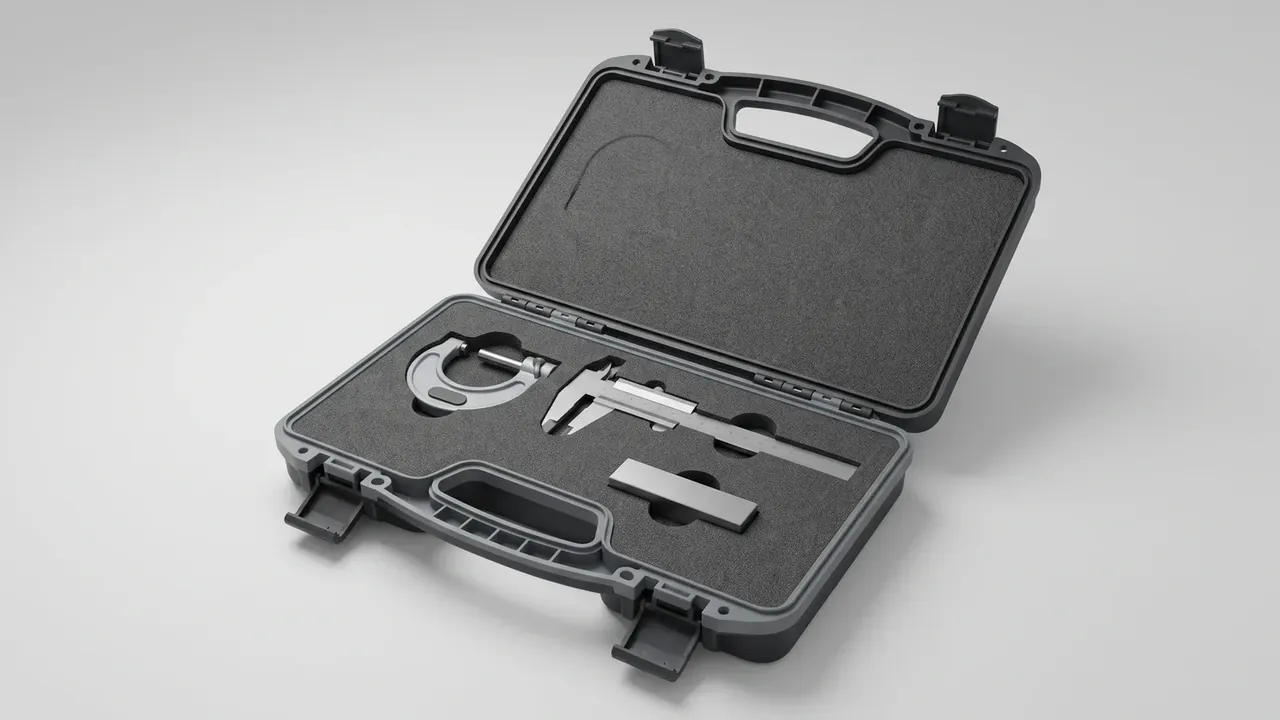
Quick answer: An emergency response tool transport case stacked four high puts 1200 kg on each bottom corner, held by four 800 daN anchors and 40 × 8 mm slots.
Table of contents
- Stacking Duty Inside the Van Body
- Corner Load and the Four-High Static Press
- Strap Slots and Floor Anchor Points
- Relative Movement Under Random Vibration
- Stacking Values for the Transport Crew
- FAQ
1. Stacking Duty Inside the Van Body
Once the wheels turn the shell meets other forces: the weight above and the straps below are written into the corners. An emergency response tool transport case rides in one of three patterns, each sending load through the shell by its own path.
Squared stacks look tidiest and load the corners hardest: half a corner off and the weight lands on the middle of the lid, which bows and slackens the seal. Crossed courses feed bending into the joint between two cases.
| Stack tier | How it sits in the van | What the corner carries |
|---|---|---|
| Single row | Side by side, lids up | Own weight only |
| Two crossed | Straddles the joint below | Bending into the lid, corner off centre |
| Four squared | Corners aligned to the roof rail | Three cases of weight plus road peaks |
Van interiors run 1.8 to 2.1 m clear and four courses of a 14.5 kg, 340 mm shell reach 1,360 mm, so one more course puts the top case against the roof and the strap loses its angle.
2. Corner Load and the Four-High Static Press
The 1200 kg figure belongs to the bench, not the road. Load is concentrated on one corner until the gauge reads 1200 kg; the corner may not crack, and permanent set may not pass 2.0 mm. In service a bottom corner carries a little over a hundred kilos; the rest is reserve for braking.
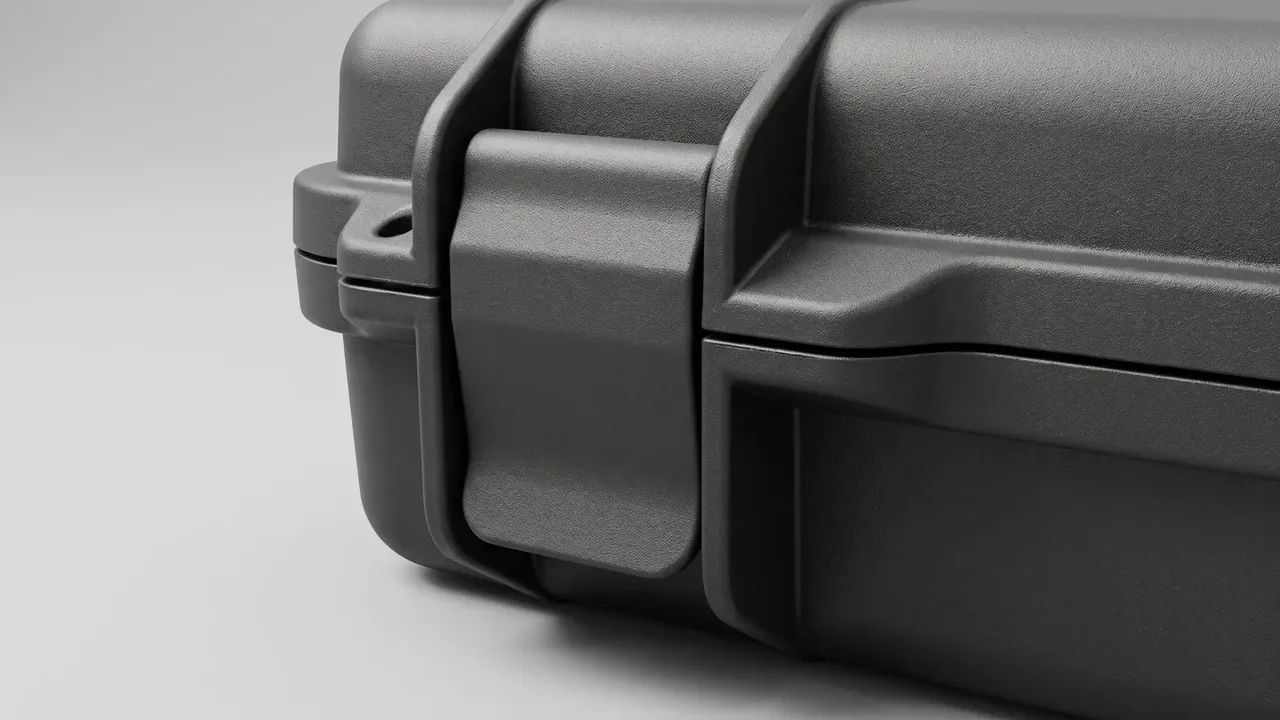
The static press on an emergency response tool transport case runs 72 h, the constant-load duration ISO 8611-3 sets for plastic stacking containers. Polypropylene creep modulus falls to 45 to 60 per cent of its short-term value, so an hour proves nothing.
Between the 800 × 520 × 340 mm outside and the 745 × 465 × 295 mm cavity the wall line is 27.5 mm, of which only 5.0 mm is main wall. Two walls meet there and the melt front merges, leaving the corner one to two tenths thicker than the panel, which is why cracks start at the rib root.
3. Strap Slots and Floor Anchor Points
Four strap slots sit low on the long sides of an emergency response tool transport case, 40 × 8 mm, two forward and two aft. A 25 mm polyester webbing passes flat through the 40 mm opening with 7.5 mm left at each side, so the tape never rides the edge.
Each of the four anchor points is rated 800 daN, which matches a choker hitch: a 25 mm polyester webbing is good for 400 daN straight under EN 12195-2, and doubling it round the base brings 800 daN. Four straps give 3,200 daN, yet what pins the stack down is friction.
Hand tension has a standard value — SHF 500 N, about fifty kilos of pull. What stays in the tape, the STF, lands between 0.1 and 0.5 of lashing capacity, so higher STF clamps harder with fewer straps. Webbing stretches under 7 per cent, so a motorway run needs one retension.
Two drag handles, 500 N each, are separate from the anchors and take a short pull along the floor only; 4,200 latch movements are the other wear source, and the slot carries R2.
4. Relative Movement Under Random Vibration
The shaker runs 5–500 Hz for 2 h per axis, taken from the wheeled-vehicle spectrum of MIL-STD-810H Method 514.8, vertical level about 2.24 g RMS.
The weak point of an emergency response tool transport case in that spectrum is the joint where lid meets base. Resonance falls near 42 Hz, where the halves move 1.5 mm against each other. Less is not better: a still joint has a crushed gasket and stiff latches; past 1.5 mm a jet finds the seam.
IP65 is re-tested after. IPX5 means a 6.3 mm nozzle at 12.5 L/min and 30 kPa, 2.5 to 3 m away for three minutes; vibration walks the tongue back slightly and water enters there.
| Vibration window | Shaker state | What to watch |
|---|---|---|
| 0–30 min | Low band sweep, table starting | Strap jumping with the shell |
| 30–90 min | Dwell near 42 Hz | Lid movement against base |
| 90–120 min | High band closing | Tongue backing off |
5. Stacking Values for the Transport Crew
The stack tier for an emergency response tool transport case is the one that holds permanent corner set under 2.0 mm after seventy-two hours of four-high load; above it a timber pad spreads the upper base across the lower lid.
Four checks before departure: pull each strap, look at the slot edges, press each latch, measure the corner height; two minutes, whoever loads does it.
| Displacement reading | What it means | Action |
|---|---|---|
| Under 0.8 mm | Compression and preload normal | Release the vehicle |
| 0.8 to 1.5 mm | Joint loosening, still inside the limit | Retension, measure again |
| Over 1.5 mm | Tongue backed off or gasket crushed | Swap the case, no repair |
On an emergency response tool transport case, if most readings in a batch sit at 1.5 mm the strap route is at fault, not the shell: four straps over the top press the lid instead of the body. Course count follows clear height and strap angle, and the 1200 kg figure is reserve for the road, not a licence for another course.
Conclusion
An emergency response tool transport case is judged by the stacking pattern, then by the balance between corner rating and strap slots, then by movement under vibration. Four squared courses, a 1200 kg corner limit, four slots feeding four 800 daN anchors and 1.5 mm after two hours across 5–500 Hz — those numbers decide whether the shell travels well.
Related Reading
Related Products
- 8 Series — Gun Cases; Military Equipment Cases; Camera Equipment Cases; Drone Cases; Watch Cases; Knife Cases; First Aid Cases; Electronics Equipment Cases
- WL8-2812 PP Gun Case — model WL8-2812
- All protective cases and toolboxes: 7 series, 158 models