

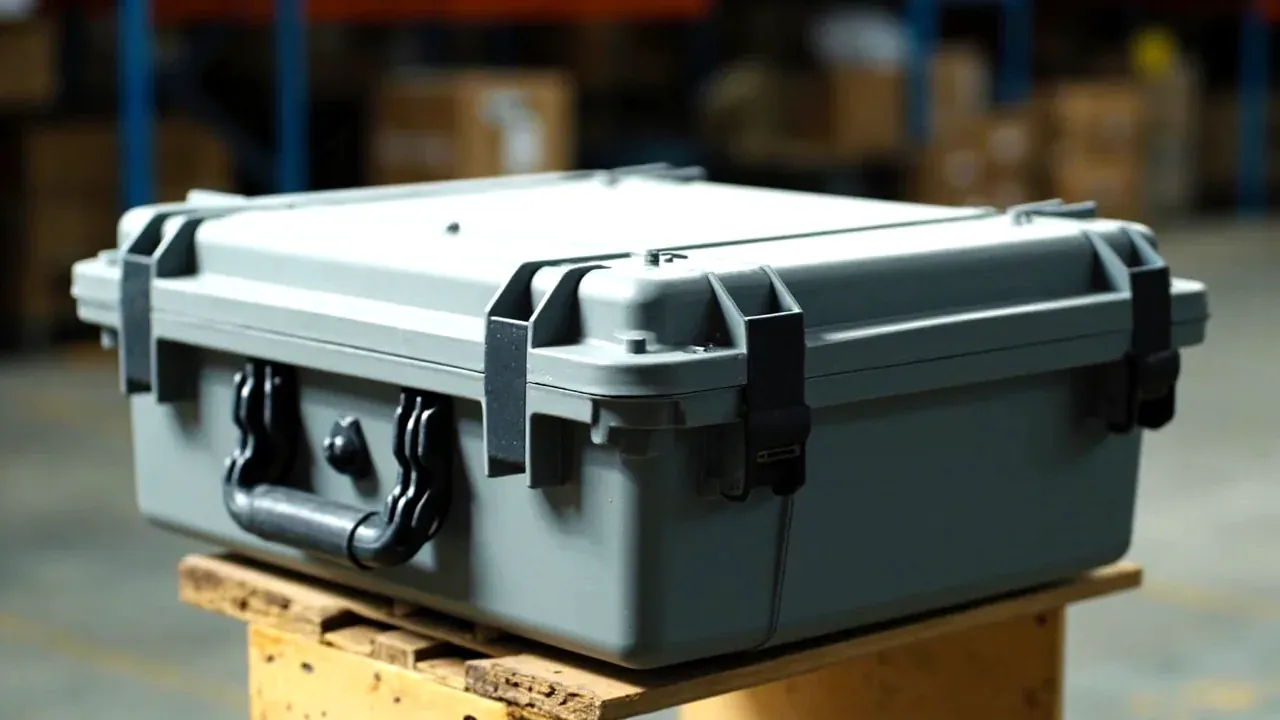
Quick answer: An EMI shielding case is a rotomolded box whose surfaces conduct, whose seams close and whose shell is bonded to ground. Performance comes from a continuous conductive surface, not from wall thickness, since extra polyethylene adds almost no absorption while one unbonded seam erases tens of decibels. Seams, apertures and cable entries are the three paths that leak, and grounding turns the shell into a low-impedance return. Miss any of the three and an EMI shielding case is only a plastic box with a metallic finish.
Table of contents
- Definition: a continuous conductive surface
- Shell: applying the layer and keeping it continuous
- Three breaks: seams, apertures, cable entries
- Grounding: a low-impedance return
- Deciding when the premium pays
- FAQ
1. Definition: a continuous conductive surface
An EMI shielding case separates inner fields from outer ones with a conductive shell. Its figure of merit is shielding effectiveness, the ratio of field strength without the EMI shielding case to that with it, in decibels. Surface conductivity, seam bonding and aperture size set that figure, not wall thickness.
Polyethylene is an insulator, so untreated it blocks almost nothing. An EMI shielding case therefore means a coated, metallised or fabric-lined shell, not a plastic box with a new name. From one mould, coated and uncoated leave the shop as two products.
2. Shell: applying the layer and keeping it continuous
Three routes are common on an EMI shielding case: conductive paint inside, thermal metal spray and conductive fabric liners. Filled paint reaches 50 to 100 microns and under 0.1 ohm per square. Sprayed metal wears better but runs hot.
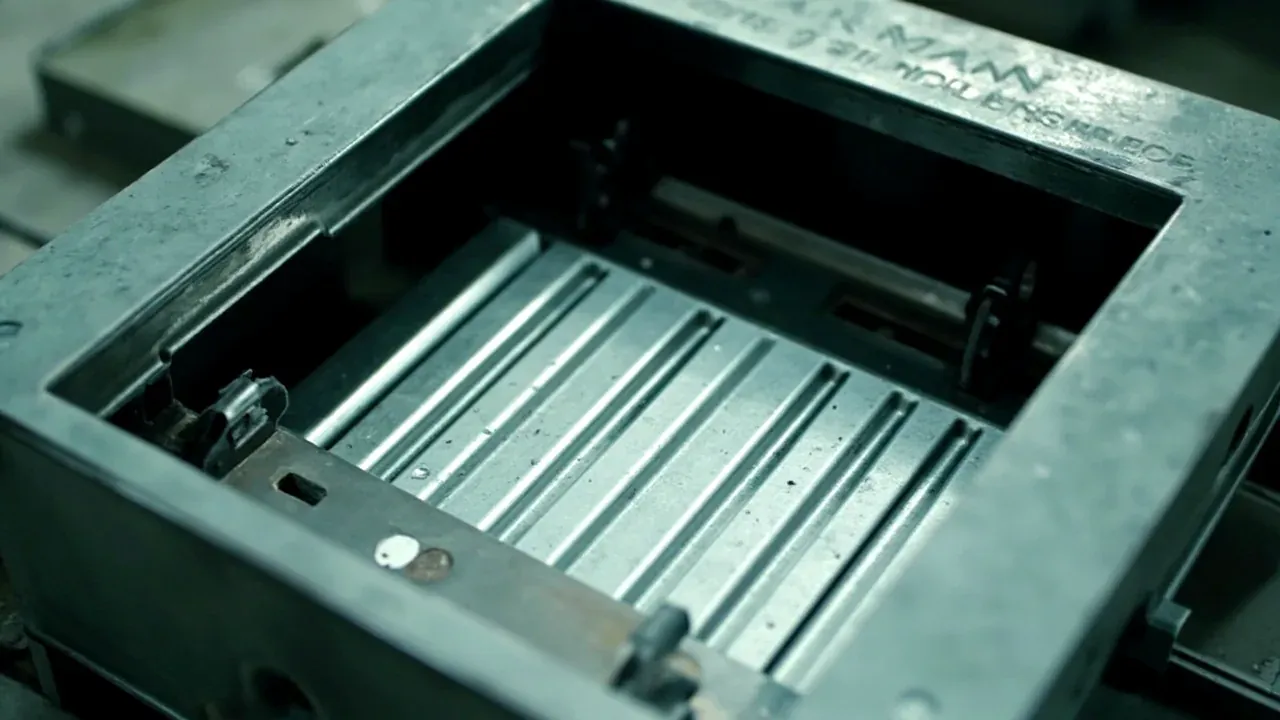
Continuity matters more than thickness. A rotomolded part has shallow draft and deep cavities, so the gun thins out in recesses, latch seats and handle roots, where current turns a corner. Mask threads before coating, or the shell leaks.
3. Three breaks: seams, apertures, cable entries
The seam has the longest perimeter, and leakage follows length rather than width: a 300 mm slit 0.2 mm wide can pass more at gigahertz than a 10 mm hole, acting as a slot antenna. A stepped rebate folds the joint once and adds about ten decibels.

Apertures cover vents, windows and ports. A hole stops passing energy near a twentieth of a wavelength, so ventilation needs honeycomb mesh. Cable entries are forgotten most: one untreated power lead can pull an EMI shielding case down to 20 dB.
| Break | Why it leaks | First loss at | Case-side fix |
|---|---|---|---|
| Lid seam | longest perimeter, acts as a slot | above 300 MHz | stepped rebate plus gasket |
| Vents and windows | hole near wavelength, no cutoff | above 1 GHz | honeycomb or finer mesh |
| Cable entry | conductor uses the shell as an antenna | one lead drags the case | shielded gland and filtering |
| Ground bond | paint and oxide block the path | low-frequency drain | toothed washer onto coating |
4. Grounding: a low-impedance return
In an EMI shielding case, grounding is not a lightning accessory but one leg of the shielding circuit. Current picked up by the shell needs a low-impedance path away, or a potential difference builds and radiates inward. Bonding resistance stays under 10 milliohms.
Bond onto the conductive layer, never onto decorative paint. A stainless stud with a toothed washer bites through oxide. Copper against aluminium corrodes when damp, so a plated transition goes between, and above a few megahertz every bond runs in parallel.
5. Deciding when the premium pays
Three situations justify an EMI shielding case: sensitive electronics inside, an emission or immunity limit, or a stated leakage requirement. Each must resolve into a band and a decibel figure, or a standard protective case will do.
Metal cases shield well but are heavy and dent. Moulded conductive plastics hold tolerance and stop at the mould size. Rotomolding with a coating wins on size, impact and corrosion, and loses on labour.
Conclusion
Judge an EMI shielding case in order: band and decibels first, the three leak paths second, the ground reference last. The first decides whether the work is needed, the second how well it is done, the third whether it survives on site. Grounding is usually left to the end and wastes everything before it, because a shell with no path under 10 milliohms keeps its charge.
This article covers container-side specifications and design implications only, not the handling, loading or use of the contents.
Related Reading
- Attenuation and interface figures for a shielding case
- Electronic Equipment Case: Vibration and ESD Protection
- Venting and containment in an explosion-proof case
- Rotomolded Cases: Rotational-Moulded Shell Structure & Pro…
Related Products
- 8 Series — Gun Cases; Military Equipment Cases; Camera Equipment Cases; Drone Cases; Watch Cases; Knife Cases; First Aid Cases; Electronics Equipment Cases
- WL8-2812 PP Gun Case — model WL8-2812
- All protective cases and toolboxes: 7 series, 158 models