

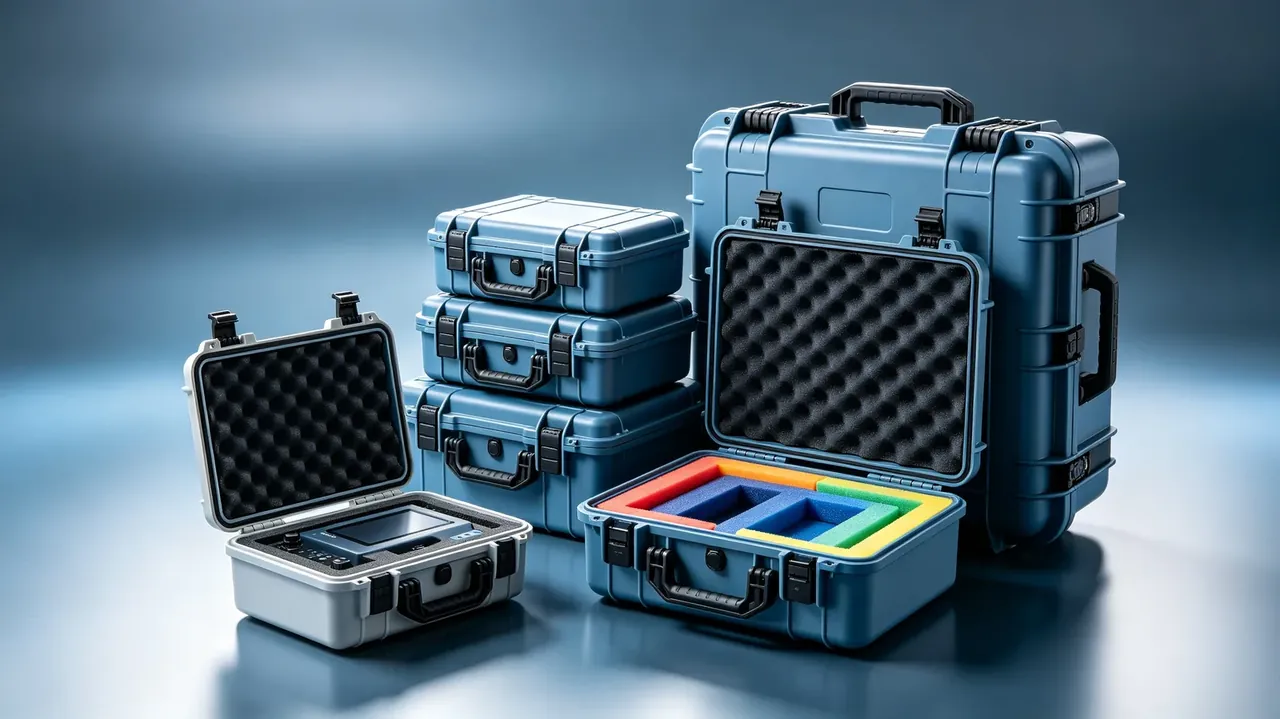
Quick answer: Environmental monitoring meter shockproof plastic case keeps acceleration <=3 g at 5-200 Hz via 40 kg/m3 foam, 4 mounts; rebound >=95% after 4 h at -10 C.
Table of contents
- Two field loads on the Environmental monitoring meter shockproof plastic case
- Reserving outer-size allowance for foam travel
- Suspension layout across the sweep band
- Verifying rebound after a cold soak
- Salt fog and drop checks on the shell
- FAQ
1. Two field loads on the Environmental monitoring meter shockproof plastic case
Field crews set the shell on a vehicle floor or open ground, so low-frequency vibration reaches the instrument seat while sun and night cooling cycle the foam across tens of degrees. An Environmental monitoring meter shockproof plastic case must absorb both loads, so isolation cannot be judged by static load alone. A 5-200 Hz sweep covers road travel and generator excitation: the low end sets bulk foam travel, the high end drives seat resonance. A 40 kg/m3 density supports a 9.5 kg payload yet leaves room for a 25 mm base pad, and 4 suspension points keep the seat clear of the floor.
Split the duty cycle and the two loads part company. Vibration must hold transmitted acceleration to <=3 g across the sweep, while the Environmental monitoring meter shockproof plastic case treats cold as an intermittent shock that still leaves >=95% rebound.
2. Reserving outer-size allowance for foam travel
The gap between 520 x 400 x 260 mm outer and 465 x 345 x 210 mm cavity is not given to the 3.8 mm wall alone. On the long edge, 520 mm minus 465 mm leaves 55 mm, about 27.5 mm per side; the wall takes 3.8 mm and the rest stacks base pad and side lining. Height gives 50 mm, and after the lid liner a 25 mm pad just fits. An empty 5.2 kg plus a 9.5 kg payload puts the loaded case near 14.7 kg, which rules out soft suspension points. The Environmental monitoring meter shockproof plastic case is sized link by link, since lost allowance shows up first as lost travel. Corners and the rim are thickened while long edges stay at a uniform 3.8 mm.
3. Suspension layout across the sweep band
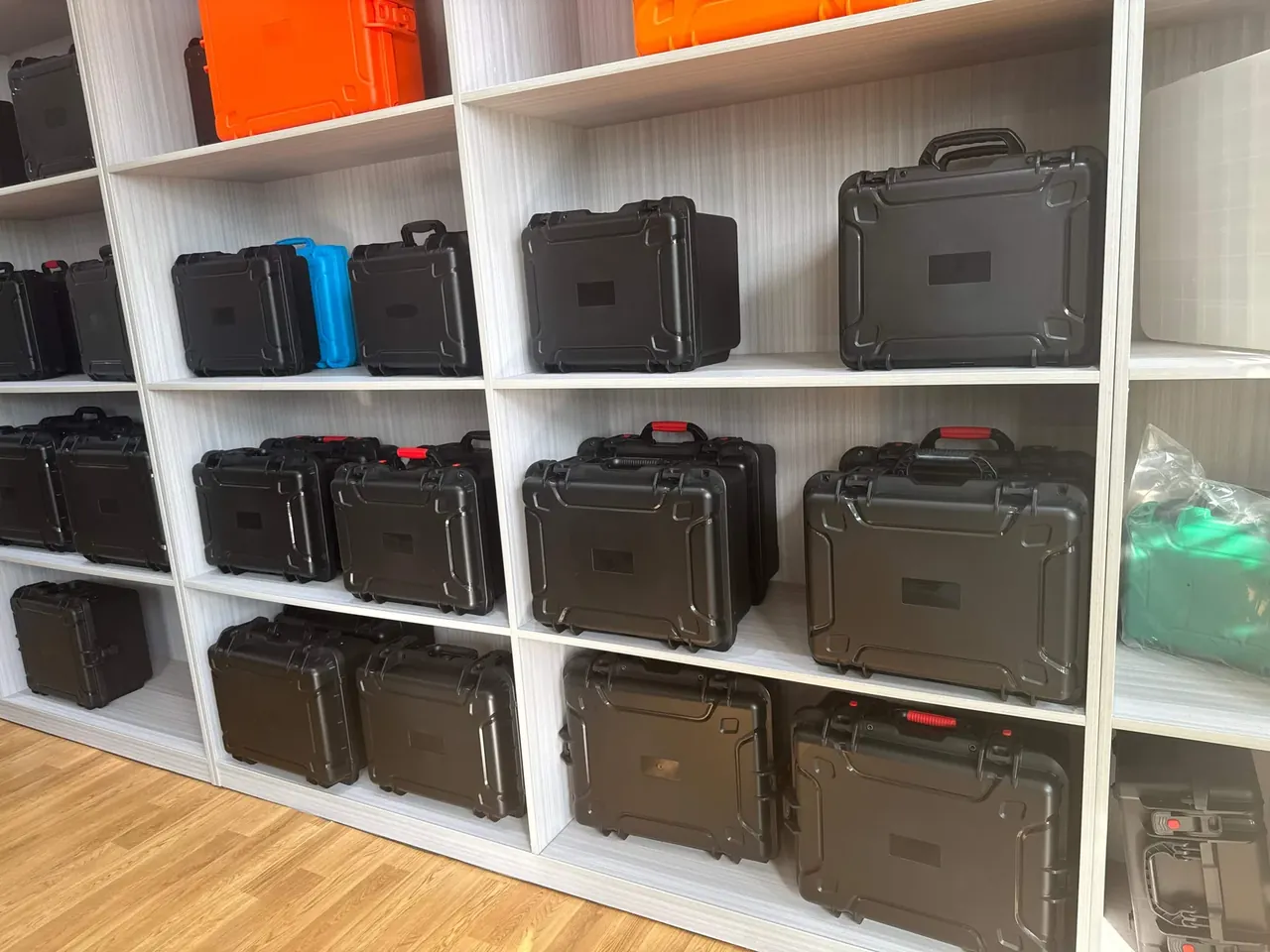
The 5-200 Hz sweep must keep seat acceleration at or below 3 g. Four points sit in a rectangle, each on a 40 kg/m3 foam column tuned with the 25 mm pad: low bands compress in bulk, mid bands shear. From 120 Hz to 200 Hz the 3.8 mm shell mode dominates, so points shift from mid-span to near quarter-span. On the bench the Environmental monitoring meter shockproof plastic case carries a 9.5 kg mass and the largest of three seat axes is compared with the <=3 g limit. Peaks are fixed by moving points, not thickening foam, which would eat the 25 mm travel.
| Band | Sweep range | Dominant effect |
|---|---|---|
| Low | 5-30 Hz | Bulk foam compression |
| Mid | 30-120 Hz | Suspension shear |
| High | 120-200 Hz | Seat local resonance |
Read by isolation stage, each part's share is clear, and the Environmental monitoring meter shockproof plastic case files sweep data against this grouping. The table pairs each structural choice with its value so the checklist can be ticked item by item.
| Isolation stage | Structural choice | Linked value |
|---|---|---|
| Base layer | 25 mm full foam pad | Compression travel |
| Suspension | 4 points in a rectangle | Load per point |
| Shell body | 3.8 mm moulded wall | Local mode |
4. Verifying rebound after a cold soak
Cold soak leaves residual set. A 40 kg/m3 sample rests in the case at -10 C for 4 h, then under a 9.5 kg mass; recovered over initial thickness is the rebound, accepted at >=95%. An upper limit of 55 C matches a sun-heated vehicle and a lower -10 C a cold overnight stop, and both ends must keep the lid gasket preloaded. A 48 h salt fog run and an IP67 benchmark cover coastal siting and rain at the rim; immersion is a cross-check on the sealing pair rather than a replacement for the cold item. The Environmental monitoring meter shockproof plastic case keeps all of these on one inspection card.
5. Salt fog and drop checks on the shell
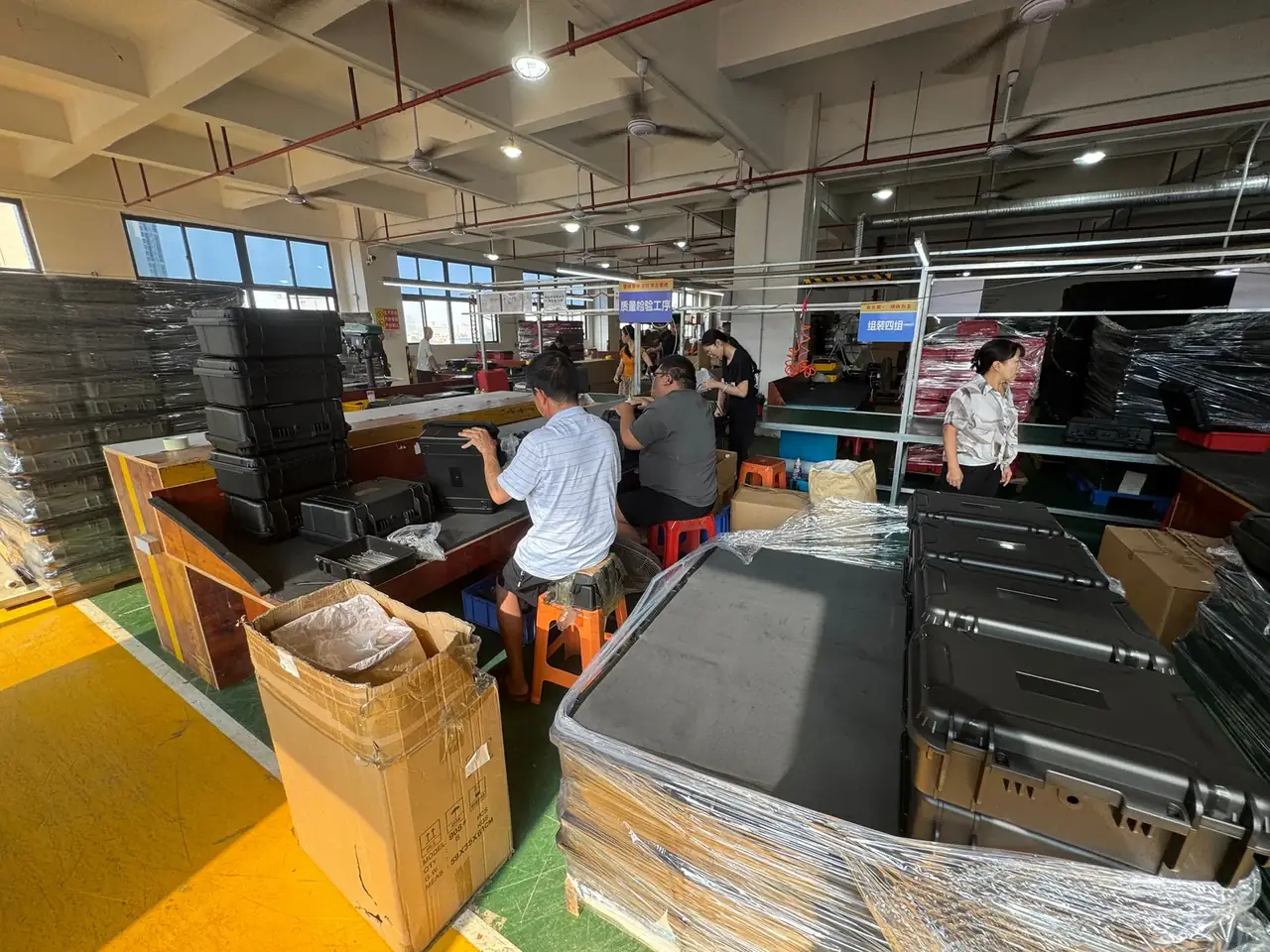
The 1.2 m drop is repeated on base, lid, both edges and each corner, checking rim-gasket alignment and latch release. After 48 h of salt fog, hinge and latch metalwork is examined and the shell may not deform enough to spoil closing. The empty 5.2 kg run exposes moulding weak spots before the same sequence is repeated with the 9.5 kg payload. After the drop, foam-to-floor heat bonds and the 4 suspension bonds are checked one by one; debonding or collapse is a reject. A second sweep must still land within <=3 g. JUNZHIJIA has this series reviewed by Kexin New Materials (Guangdong) Co., Ltd. against the same card, with records filed per case.
| Transmitted value | Figure | Acceptance condition |
|---|---|---|
| Transmitted acceleration | <=3 g | 5-200 Hz continuous sweep |
| Foam rebound | >=95% | after 4 h at -10 C |
| Empty mass | 5.2 kg | complete case with liner |
The Environmental monitoring meter shockproof plastic case keeps salt fog and drop records side by side, tying both rounds to the same acceptance figures rather than judging the shell by looks.
Conclusion
Specifying an Environmental monitoring meter shockproof plastic case comes down to how 40 kg/m3 foam, a 25 mm base pad and 4 suspension points work together. Acceleration of <=3 g across 5-200 Hz and rebound of >=95% after 4 h at -10 C belong on the acceptance sheet. The 520 x 400 x 260 mm to 465 x 345 x 210 mm allowance, plus 48 h salt fog and 1.2 m drop checks, keeps those figures valid outdoors. Aligning each number beats comparing wall thickness in the abstract.
Related Reading
- Hydrology monitoring case shell sealing
- Hydrological monitoring case specification guide
- Electrician meter case isolation structure
- Environmental chamber case gasket design
Related Products
- 8 Series — Gun Cases; Military Equipment Cases; Camera Equipment Cases; Drone Cases; Watch Cases; Knife Cases; First Aid Cases; Electronics Equipment Cases
- WL8-2812 PP Gun Case — model WL8-2812
- All protective cases and toolboxes: 7 series, 158 models