

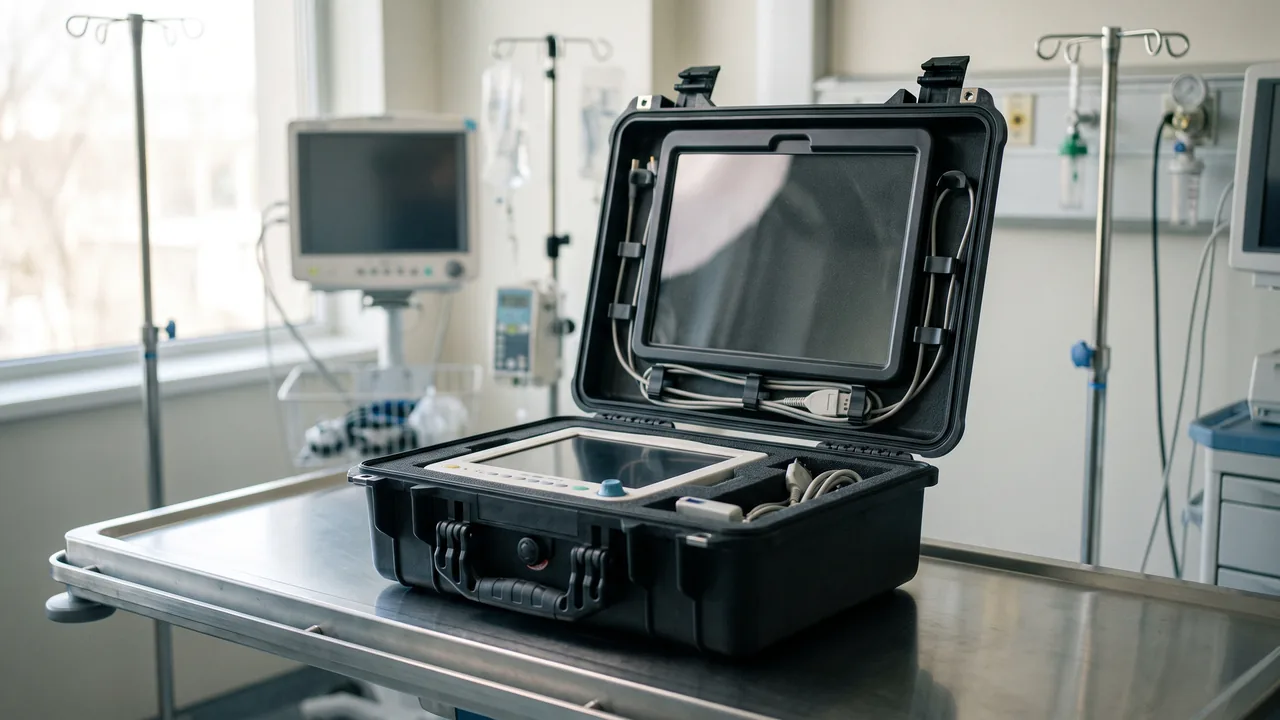
Hydrological monitoring is the data foundation for basin management, reservoir operation and flood early warning. Crews carry data loggers, water-level meters, current meters, water-quality probes and portable samplers between rivers, sluice stations and wetlands, and the single biggest threat to that gear is water ingress and impact during transit. The core value of a hydrological monitoring equipment case is its IP67-class waterproofing combined with an optional positive-buoyancy design, which keeps precision instruments dry and recoverable even if the case falls into water, minimizing both data loss and repeat procurement. Unlike a generic plastic bin, this purpose-built container must integrate waterproof sealing, impact resistance, corrosion resistance and floatability into one shell. This article covers material, sealing, flotation, anti-corrosion, cushioning, hardware, certification and customization so that hydrological stations, basin authorities and water-monitoring units can build a standardized storage-and-transport specification. Related guidance on water-sector enclosures is available in the water-conservancy case guide. For procurement teams, the first step is to separate the container requirement from the instrument requirement: the case is a protective system rather than merely a box, and its specification should follow instrument value, transit profile and site exposure. A useful framing is to list the failure modes first - ingress, shock, corrosion and loss - and then map each to a design feature, so the tender reads as a chain of causes and controls instead of a wish list of adjectives.
1. Background and Wet-Site Transit Pain Points
Hydrological monitoring is the front-end sensing layer of water-resource work, and its data quality directly determines flood forecasting, water allocation and ecological-flow control. Monitoring teams routinely move data loggers, stage meters, velocity meters, temperature and salinity probes, and portable samplers across mountain streams, plain-channel rivers, reservoir dams, estuarine sluices and urban drainage networks. These instruments contain electronic modules, optical windows and precision sensors that fail or drift the moment water enters or a hard shock occurs. The real risks on wet sites are far messier than an office imagines: rain back-flushing through lid seams during storm patrols, shallow-water wading that submerges the case base, spray flying over the gunwale during boat transfers, current sweeping a temporarily placed case away, and salt-spray corrosion plus abrasive sand at coastal stations. Many grassroots units still load instruments into ordinary plastic boxes, wooden crates or even woven bags, and one rainy-season patrol can wreck thousands of dollars of equipment while also breaking the data chain. This article focuses strictly on the container itself - the specialized case for hydrological instruments - and explains the full chain from material to certification and from customization to maintenance, so teams can standardize how sensitive gear is stored and moved.
2. Shell Material Selection: Engineering Plastics vs Metal
The shell of a hydrological monitoring equipment case falls into three families: modified PP (polypropylene) engineering plastic, ABS/PC alloy, and aluminum alloy. Modified PP is low-density, acid- and alkali-resistant, and tough at low temperature, and it suits rotational or injection molding into a single seamless shell, making it the first choice for wet and float-transport scenarios. ABS/PC alloy offers higher rigidity and scratch resistance but becomes slightly more brittle below freezing. Aluminum alloy is strong and weather-stable yet costly, and it has no natural buoyancy, so it sinks quickly once dropped in water. When the operation demands "it must float after falling in," a modified PP shell with closed-cell foam cavities delivers positive buoyancy, whereas an aluminum solution needs an external float bag. Material choice should also weigh flame retardancy and compliance: confirm a UL94 rating and check RoHS and REACH conformity to avoid hazardous off-gassing inside a closed vehicle or cabin. For sites under long-term sun exposure, the shell color masterbatch should be UV-resistant to slow chalking. JUNZHIJIA favors a one-piece modified PP shell with reinforced ribs for its wet-site cases, balancing light weight, impact resistance and buoyancy; the sealing philosophy aligns with the discussion in the case seal materials guide. When budget is constrained, a tiered approach works well: place the most sensitive and costly instruments in a high-protection modified-PP case, and keep cables and consumables in a simpler engineering case, controlling cost while protecting the priorities. Transport mode also drives material choice; boat transfer emphasizes buoyancy and salt spray, while vehicle transfer emphasizes stacking and vibration, and the shell and hardware should be matched accordingly rather than chosen in isolation.
3. Waterproof Sealing System Design (IP67/IP68)
Waterproof grades follow IEC 60529 and GB/T 4208. IP67 means dust-tight and immersion in 1 meter of water for 30 minutes without ingress; IP68 is defined by the maker for deeper and longer submersion. A hydrological monitoring equipment case normally requires at least IP67, and coastal or deep-water deployment may call for IP68. The implementation path includes a continuous gasket along the mold parting line, a pressure-engaged lip seal, the even clamping force that latches apply to the lid, and waterproof caps over cable glands and valves. Gasket materials are typically EPDM or silicone, both ozone-resistant, aging-resistant and highly resilient. The crucial point is that an ingress-protection grade is a system grade, not a single-part grade: the shell, gasket, latches and every opening must reach the target together, and any weak link fails the whole box. Procurement should request a third-party immersion test report and verify the test depth, duration and acceptance criteria rather than trusting a label. For a systematic view of ratings, consult the IP67 vs IP68 case guide and the broader waterproof case applications discussion. On-site acceptance should use a two-step method of spray plus immersion: first simulate rain with a shower head to check seams, then verify the grade with a short immersion at the declared depth, which is closer to real duty than a single test. Compression set of the gasket should also enter incoming inspection, preventing leakage from insufficient rebound after short use, and securing the waterproof baseline at the source rather than discovering it in the field.
4. Float Transport and Positive-Buoyancy Design
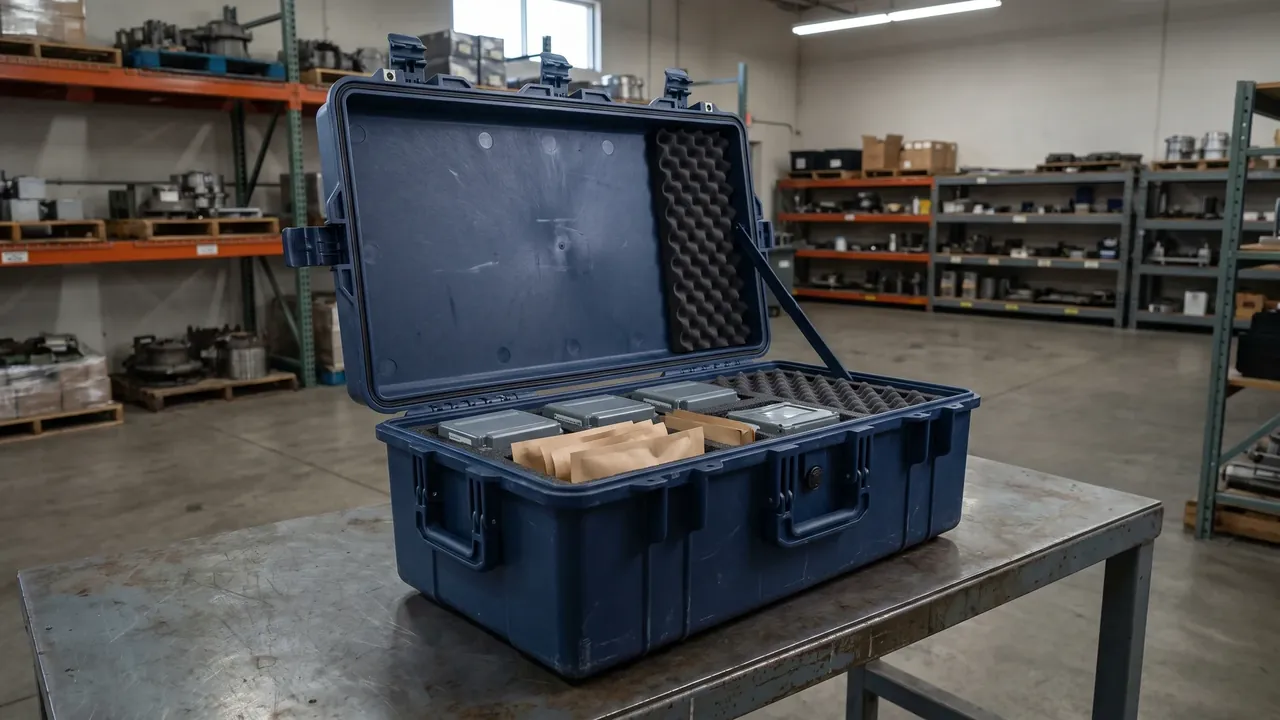
On rivers, reservoirs and wetlands, an accidental drop into water is not unusual, which makes positive buoyancy a key insurance. The goal of flotation design is for the case, fully loaded with instruments, to have an overall density lower than water so it floats on the surface and can be retrieved. Methods include low-density shell material, closed-cell PE or EVA foam filling the double-wall cavity, strict control of internal metal ballast, and a high-visibility floating color band on the lid edge. Buoyancy must be checked against the worst case of "fully loaded and 10 percent of the cavity flooded," not the idealized empty state. It must be stated clearly: flotation is not the same as waterproofing, and both are required - a floating but leaking case still destroys the instruments, while a waterproof but sinking case creates a costly recovery problem. For crews that wade shallow water while towing gear, JUNZHIJIA can adjust liner density and wall thickness against the total instrument weight and case volume so the fully loaded box still holds positive buoyancy, and can optionally fit an external float-ring interface. Buoyancy design also involves center-of-gravity control: instruments should be arranged low to make the case float nearly upright rather than capsize when dropped, easing visual detection and recovery. For buoy-type monitoring points moored at the surface for long periods, a high-visibility band and reflective strip on the case exterior further improve recoverability and reduce the operational loss of an entire data set after an accidental drop.
5. Corrosion Resistance in Salt-Spray Environments
At coastal sluices, estuaries and salt-marsh sites the air carries high chloride concentration, and metal hinges, latch tongues and fasteners quickly form red rust that jams or breaks. The response is systemic: prefer 304 or 316 stainless steel for hardware; anodize or powder-coat aluminum parts; place VCI vapor-phase rust-inhibiting paper inside the sealed cavity; and avoid direct contact between dissimilar metals to reduce galvanic corrosion. The shell color masterbatch should be UV-resistant to slow chalking under prolonged sun. Selection can reference neutral salt-spray (NSS) test experience: in a typical coastal environment, hardware showing no obvious corrosion after 480 hours of NSS generally offers better durability expectations. Note that actual service life depends heavily on the local environment, and the figures here are experience references rather than guarantees. For a broader anti-corrosion perspective, see the corrosion-resistant enclosure and salt-spray corrosion test articles, both directly relevant to wet-site hardware selection. Beyond hardware anti-corrosion, structural design can also lower corrosion: for example, orient drain and vent ports downward with dust caps to reduce salt-spray pooling, and finish the inner wall smoothly for easy rinsing after each use. For older cases already in corrosive environments, periodically applying food-grade rust inhibitor to hardware pivots slows deterioration and keeps operation smooth, extending anti-corrosion from a single material choice into a synergy of structure, material and maintenance practice.
6. Shock-Absorbing Liners and Instrument Fixation
Instruments inside the case must stay at zero displacement through transit vibration and drop impact, or they will collide and suffer unrecoverable damage. Common liner materials are EVA CNC-cut foam, PE self-adhesive foam, PU foam and pre-cut sponge, with clear performance and cost differences. Hydrological instruments vary enormously in shape - columnar stage meters, slab-style loggers, boxed probes, spool-wound cables - so a CNC-cut or thermoformed custom liner matched to each instrument is strongly recommended, giving every item its own locating cavity. Fixation uses elastic straps, hook-and-loop, clamps and recess limiters, and the principle is "every part has a nest, every nest has pressure." Cushioning targets can follow MIL-STD-810H Method 514 random vibration and Method 516 drop procedures, setting semi-sine shock peaks from experience. The liner should also reserve a desiccant bay to control internal relative humidity and prevent fogging on optical windows. More liner detail appears in the custom foam lining guide. Liner life management is often neglected: foam creeps under long-term compression, so cavity fit should be checked every six months and replaced when sagging appears. For standard cases shared by multiple teams, a combination of universal base foam and replaceable locator lid foam keeps single-item positioning while lowering change-out cost. Pick-and-place actions should be written on the operation card to avoid hand-tearing foam for convenience, extending liner service from usage habits and keeping cushioning stable across the equipment life cycle without surprise degradation.
7. Latches, Hinges and Stacking Structure
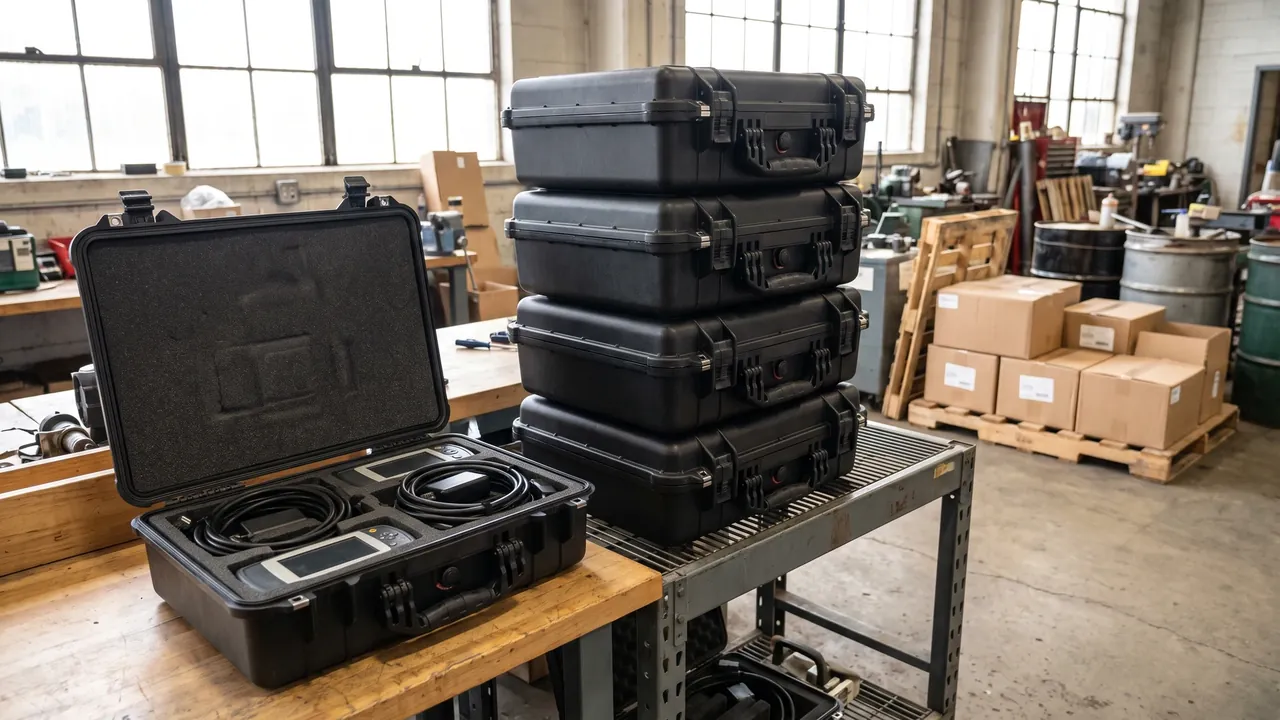
Latches determine theft resistance and the risk of accidental opening. Hydrological cases commonly use three latch types: press-down clasps, butterfly latches and TSA customs locks. Clasps should carry a safety pin to prevent mis-release, and metal parts should be 316 stainless for salt-spray resistance; hinges must survive repeated opening, with 5000 open-close cycles without fracture being a reasonable experience target. The stacking structure places locating ribs and anti-slip feet on lid and base so multiple cases stack without shifting or crushing the lower instruments. For teams that stack cases in vehicles or cabins, choose a model with reinforced corner guards and verify stack stability against ISTA 3-series transit simulation. Latch and hinge pivots should have dust- and water-proof caps to keep sand out of the mechanism. Importantly, on wet sites a rusted latch not only hinders opening but can also distort the sealing-face flatness, so hardware anti-corrosion and box waterproofing must be designed together rather than separately. Stacking safety also depends on ground flatness and lashing: in vehicles, lash the whole stack to the compartment to avoid sliding on hard braking. For stacking above three layers, reduce load on middle cases or use a pallet to spread pressure and prevent fatigue deformation of the bottom case wall ribs. For squads needing rapid field deployment, consider models with wheels and a trolley handle, weighing stack stability and carry convenience together in the selection trade-off rather than optimizing either alone.
8. Pressure-Equalization Valve for Plateau and Deep-Water Use
Wet sites and high-altitude or deep-valley monitoring often involve significant pressure changes. A fully sealed case, when moved from plain to plateau or down from a high mountain, builds an internal-external pressure differential that makes the lid hard to open and can even pull dust inward. A pressure-equalization valve (automatic breather valve) balances the differential through a waterproof breathable membrane while keeping the IP grade unchanged. In deep-water deployment the static water pressure inside and outside the case must be calculated to avoid lid collapse; increase latch count and wall-rib thickness when needed. The valve body should resist hydrolysis, and the membrane is typically ePTFE, balancing breathability and water blocking. Confirm the valve breathing flow and pressure rating at selection, and clean sand or algae off the membrane after every wet deployment. For tasks that span above-water and underwater placement, validate at shallow depth first, then increase step by step; the principle is further explained in the pressure-equalization valve guide. The valve is not maintenance-free: the membrane ages under long-term UV and algae attachment, so a replacement-interval card with the case is advised, bringing breathability into the quarterly check. For tasks with frequent shallow-deep alternation, a mechanical depressurization hint sticker inside the case reminds operators to equalize pressure before opening, protecting the seal face and avoiding shock to internal instruments from sudden lid release during a pressure differential event.
9. Certification Standards (IEC 60529 / GB/T 4208 / MIL-STD-810H / ISTA)
Procurement contracts should cite standards explicitly so protective capability becomes a verifiable clause. Waterproofing follows IEC 60529 and GB/T 4208; field and military reliability can reference the temperature-humidity, vibration, drop and salt-spray procedures of MIL-STD-810H; transit simulation follows ISTA 1A, 2A or 3A; flame retardancy follows UL94; and electromagnetic compatibility can reference relevant EMC requirements. It is essential to distinguish "third-party certified" from "self-tested by the standard method," because their evidential weight differs and tenders should require the former. Request a test report from a laboratory accredited to CNAS or CMA, noting sample model, test conditions and acceptance result for archiving and acceptance. JUNZHIJIA can match the corresponding gasket specification to the customer model and supply a full set of test documents and compliance statements, reducing disputes during basin-authority tenders and acceptance; the reliability procedures are detailed in MIL-STD-810H explained and the ISTA test guide. Standard references should avoid a checklist pile-up: pick against real risks, for example inland channels focus on waterproofing and drop, coastal sites add salt spray, plateau tasks add temperature shock and pressure. Writing the standard number and acceptable criteria into the acceptance table is more executable than vaguely stating "compliant with relevant standards," and eases later audit and cross-batch comparison, truly turning certification into verifiable clauses rather than decorative citations.
10. Custom Liners and OEM/ODM Service
Different basin authorities combine instruments very differently, and standard cases often "fit but do not hold" - instruments knock together in long transit. JUNZHIJIA offers OEM/ODM customization: from the customer instrument list and dimensions, it models the cavity layout through 3D scanning or engineering drawings and outputs a matched liner; it can embed an equipment checklist card in the lid and add a QR asset code on the side wall for inventory; latches, handles and wheels are selected by carry method. The customization flow has four steps: instrument survey, liner prototyping, drop and immersion validation, and small-batch trial production. For cross-basin joint projects, unifying case appearance and markings eases multi-team coordination and asset counting. Note that customization is not "more expensive is better" - invest by instrument value and consequence of loss: an expensive multi-beam probe deserves deep customization, while ordinary cables can use generic foam. Budget allocation can also draw on the instrument case selection guide. Customization must also consider manufacturability and delivery rhythm: complex multi-cavity liners may add molding and prototyping rounds, so validate ergonomic pick-and-place with 3D printing or a sample early. JUNZHIJIA can provide cavity-layout advice at the proposal stage, helping customers converge early among protection, weight and cost, avoiding post-production discovery of awkward handling or center-shift. Treat customization as a closed loop from requirement to mold, not a one-off tooling, to accumulate reusable case assets that pay back across future monitoring programs and reduce repeated design effort.
11. Selection Parameter Table and Procurement Checklist
Before purchase, build a structured parameter table with at least these fields: external and internal dimensions, empty and loaded weight, IP grade, whether positive buoyancy exists, liner material, hardware material, allowable stack layers, operating temperature range, certification list and spare-parts lead time. The following are experience reference ranges, not guarantees: a small single-instrument case about 300x220x160 mm with empty weight from 1.8 kg; a medium multi-instrument case about 520x350x280 mm from 3.5 kg; a large joint-deployment case about 720x480x380 mm from 6.0 kg; operating temperature experience covers minus 20 to plus 60 degrees Celsius. The procurement package should include the case body, matched liner, spare gasket, desiccant, asset label, third-party test report and operation card. Standardizing parameters aids both price comparison and later spare-part interchange. For sensor-class transport, also see the sensor transport case and the marine buoy instrument case. After building the parameter table, adopt a one-case-one-file approach: bind model, serial number, test report and maintenance record for traceability and spare forecasting. For same-series cases purchased across years, lock the mold and hardware supplier to avoid batch differences making liners incompatible. When multiple teams share one parameter template, they can also compare actual vendor performance horizontally, upgrading procurement from one-time price comparison to continuous improvement based on in-service data rather than catalog claims alone.
12. Maintenance and Service-Life Management
A equipment case is not "buy once and forget." Only disciplined maintenance converts the investment into long-term reliability. Establish a quarterly inspection: check whether the gasket is deformed or cracked, whether latches open smoothly, whether the valve membrane is blocked, and whether the liner has absorbed moisture and gained weight. Experience replacement interval for seals is 2 to 3 years, shortened to 1 to 2 years in salt-spray environments. Before long storage, empty the liner, remove the desiccant and leave the lid slightly open to vent. After every wet transit, rinse off sand and salt with fresh water and dry in shade before storage - never sun-bake, which accelerates aging. Keep an asset ledger recording every drop, flooding and repair event to drive replacement by data. With standardized care, case service life can reach an experience value of 8 to 10 years. JUNZHIJIA can supply a spare-parts list and replacement guide with the case, lowering the barrier for grassroots maintenance and keeping protection effective through the full equipment life cycle. Life management should include a retirement criterion: when the shell shows through-cracks, the gasket leaks repeatedly, or hardware is broadly corroded, evaluate whole-case replacement rather than piece repair, to avoid failure during critical tasks. A data-driven retirement mechanism is more economical and reliable than "use until broken," and prevents sudden damage from interrupting the monitoring chain. Closing maintenance, replacement and retirement into a loop turns the protective case from a one-time purchase into a managed equipment asset with predictable cost.
FAQ
Q: Does a hydrological monitoring equipment case have to reach IP68 instead of IP67? A: Not every scenario needs IP68. IP67 already covers the vast majority of wet-site patrols, shallow-water wading and short-term drops, defined as no ingress after 30 minutes in 1 meter of water, which is usually enough for daily river and reservoir monitoring. Whether to upgrade to IP68 depends on deployment depth and immersion duration: if instruments must stay submerged deeper for days on a buoy mooring, or are frequently overwhelmed by wave wash, then design to IP68 and verify the maker-declared test depth and duration. It must be stressed that higher grades demand stricter gaskets, latches and shell rigidity, raising cost and weight, so invest by instrument value and consequence of loss. Always obtain a third-party immersion test report and check the sample model and test conditions rather than trusting a label. The final choice should rest on real operating depth and exposure time, not on chasing a higher number for its own sake.
Q: Does positive-buoyancy design sacrifice the protective strength of the case? A: Buoyancy and protective strength are not naturally in conflict; the key is structural design rather than simply adding material. Positive buoyancy comes mainly from low-density shell material and closed-cell foam cavities, and those materials also provide good impact absorption and thermal insulation; what truly determines protection is wall thickness, rib layout, latch count and gasket-face flatness. A sensible wet-site case fills the double-wall cavity with closed-cell PE or EVA foam that both floats and absorbs shock energy without weakening the main load path. By contrast, blindly thickening a metal shell raises strength but loses buoyancy and needs an extra float bag. At selection, require the supplier to provide fully loaded positive-buoyancy verification and drop-validation data, balancing buoyancy, strength and weight. For crews wading shallow water while towing gear, checking buoyancy against the "fully loaded and 10 percent cavity flooded" case is the safest, ensuring the whole box floats for easy recovery if dropped.
Q: How should hardware be specified for durability in salt-spray environments? A: At coastal sluices and estuaries, chloride accelerates metal corrosion, so hardware selection should follow three principles: material first, surface treatment as backup, and structural isolation. For material, prefer 316 stainless steel, whose molybdenum content improves pitting resistance beyond 304; aluminum parts must be anodized or powder-coated to block substrate contact with salt spray. Structurally, avoid direct contact between stainless and aluminum to prevent galvanic corrosion, using insulating washers when needed. Inside the sealed cavity, place VCI vapor-phase rust-inhibiting paper that slowly releases inhibitor molecules to protect exposed metal. For selection, reference neutral salt-spray test experience - for example, hardware with no obvious corrosion after 480 hours of NSS is more trustworthy. Daily care matters equally: rinse with fresh water after each wet deployment, dry in shade, and make latches a quarterly inspection focus. A practical tip is to keep a small spare-kit of latches and hinge pins on hand at coastal stations, because replacing a single corroded part is far cheaper than rebuilding the whole case, and it keeps the sealing face aligned. Combining material, treatment and maintenance significantly extends hardware life in salt spray.
Q: How should instruments be fixed inside the case to avoid collision in transit? A: The core of fixation is "every part has a nest, every nest has pressure," achieved with custom liners and limit structures. The first choice is CNC-cut or thermoformed EVA liner matched to instrument shape, with separate cavities for columnar stage meters, slab loggers and boxed probes; wrap spools and cables in PE self-adhesive foam by layer. Cavity edges should sit slightly above the instrument so the lid foam lightly presses it when closed, forming elastic preload. For probes prone to loosening, add elastic straps or hook-and-loop as secondary fixation. Cushioning targets can follow MIL-STD-810H Method 514 and 516 vibration and drop procedures for experience peaks. The liner also needs a desiccant bay to control humidity and prevent optical-window fog. Note that generic foam only cushions, it cannot locate; real anti-collision requires form-fitting molding, which is why custom liners outperform standard sponge in reliability. For teams sharing one case among rotating instruments, consider a base tray with a Velcro-compatible surface plus shaped inserts, so the layout can be reconfigured without losing location control, balancing flexibility with protection.
Q: Will a pressure-equalization valve break the waterproof grade of the whole case? A: A qualified pressure-equalization valve does not break waterproofing; on the contrary, it is key to keeping the seal reliable long term. Its principle uses an ePTFE waterproof breathable membrane to separate water from air: air molecules pass freely to balance differential pressure, while liquid water cannot penetrate the membrane pores because of surface tension, so the IP grade is maintained. Without a valve, the internal-external pressure difference across plateau or deep-valley transfers can suck the lid tight or even draw in dust, and forcing it open may damage the gasket face. At selection, confirm the valve breathing flow, pressure rating and protection grade, and ask the supplier about membrane material and replacement interval. In maintenance, clean sand or algae off the membrane after every wet deployment to prevent blockage. Note the valve only balances pressure; overall waterproofing still depends on the parting-line seal and latch clamping, and the two must be designed together rather than assumed safe once a valve is fitted.
Q: What is the typical process and lead time for custom liners and OEM service? A: A sound customization moves through four steps, with lead time varying by complexity. Step one is instrument survey, where the customer provides the list, dimensions and weights, modeled if needed by 3D scanning or engineering drawings. Step two is liner prototyping, outputting EVA-cut or PU-foam samples from the cavity layout. Step three is validation, dropping and immersing samples to confirm zero displacement and zero ingress. Step four is small-batch trial before volume production. Simple generic liners prototype quickly, while deeply customized multi-instrument shapes need longer modeling and validation, with exact milestones agreed between both sides. JUNZHIJIA supports OEM/ODM on wet-site cases, optionally matching latches, handles and wheels, and embedding a checklist card in the lid plus a QR asset code on the side wall. For cross-basin joint projects, unifying case appearance and markings eases coordination and counting, turning customization spend into management efficiency. Lead time is best agreed as milestone-based rather than a single date, with the prototyping sign-off as a gate before tooling, so both sides share risk and avoid rework after the mold is cut.
Q: How can a buyer verify a supplier's claimed protection grade is real? A: Verification shifts from "label claim" to "verifiable document." First, require a test report from a CNAS- or CMA-accredited third-party laboratory that states the sample model, test standard such as IEC 60529 or GB/T 4208, test depth, duration and acceptance result - not a vague "compliant with IP67." Second, distinguish "third-party certified" from "self-tested by the standard method," and tenders should accept only third-party reports. Third, ask for a copy of the test report and an operation card with the case for acceptance archiving. Fourth, sample-inspect critical batches against experience immersion and drop methods. Finally, write the certification list into the contract technical clause with remedies for non-conformance. For flotation, also request fully loaded positive-buoyancy verification data. The reliability procedures in MIL-STD-810H and ISTA transport testing help bind supplier claims to standard methods and reduce later disputes and data risk. Where the monitoring program is funded by a public tender, keep the acceptance report in the project file alongside the purchase order, because auditors increasingly ask for traceable evidence that the delivered case matches the specified grade.
Q: What daily maintenance habits must be developed for the equipment case? A: Disciplined care can extend case life to an experience value of 8 to 10 years, built on six habits. One, quarterly inspection: check gasket deformation or cracks, smooth latch action, valve-membrane blockage and liner moisture weight gain. Two, shorten seal replacement to 1 to 2 years in salt spray, 2 to 3 years in normal environments. Three, after every wet deployment rinse off sand and salt with fresh water, dry in shade, never sun-bake which accelerates aging. Four, before long storage empty the liner, remove desiccant and leave the lid slightly open to vent. Five, keep an asset ledger recording every drop, flood and repair to drive replacement by data. Six, stock consumables such as gaskets, desiccant and asset labels with the case. JUNZHIJIA can supply a spare-parts list and replacement guide with the case, lowering grassroots maintenance barriers. Institutionalizing these actions keeps protection stable across the full equipment life cycle and avoids small neglect causing large instrument loss.
Q: Can a hydrological case share one management specification with other instrument cases? A: The framework can be borrowed, but the cases should not be fully merged, because wet sites have unique requirements. General instrument-case management stresses dust control, shock absorption and asset counting, and those principles apply to hydrological cases too; but a hydrological case additionally requires IP67 or higher waterproofing, optional positive buoyancy, salt-spray corrosion resistance and pressure equalization that ordinary land cases may lack. Under a unified asset ledger and quarterly inspection framework, set three extra checks for wet-site cases: waterproof seal, buoyancy verification and hardware anti-corrosion. On supplier management, the common experience in the water-conservancy case guide and the water-treatment instrument case can be referenced, but technical clauses must be written separately for wet-site duty. This borrows general management efficiency while holding the specialized red line of wet-site protection, avoiding misjudging a hydrological case by land-case standards. In practice, a single unified asset system with a wet-site subclass flag achieves both goals: one database, two inspection routines, and clearer accountability when a case fails in the field.