

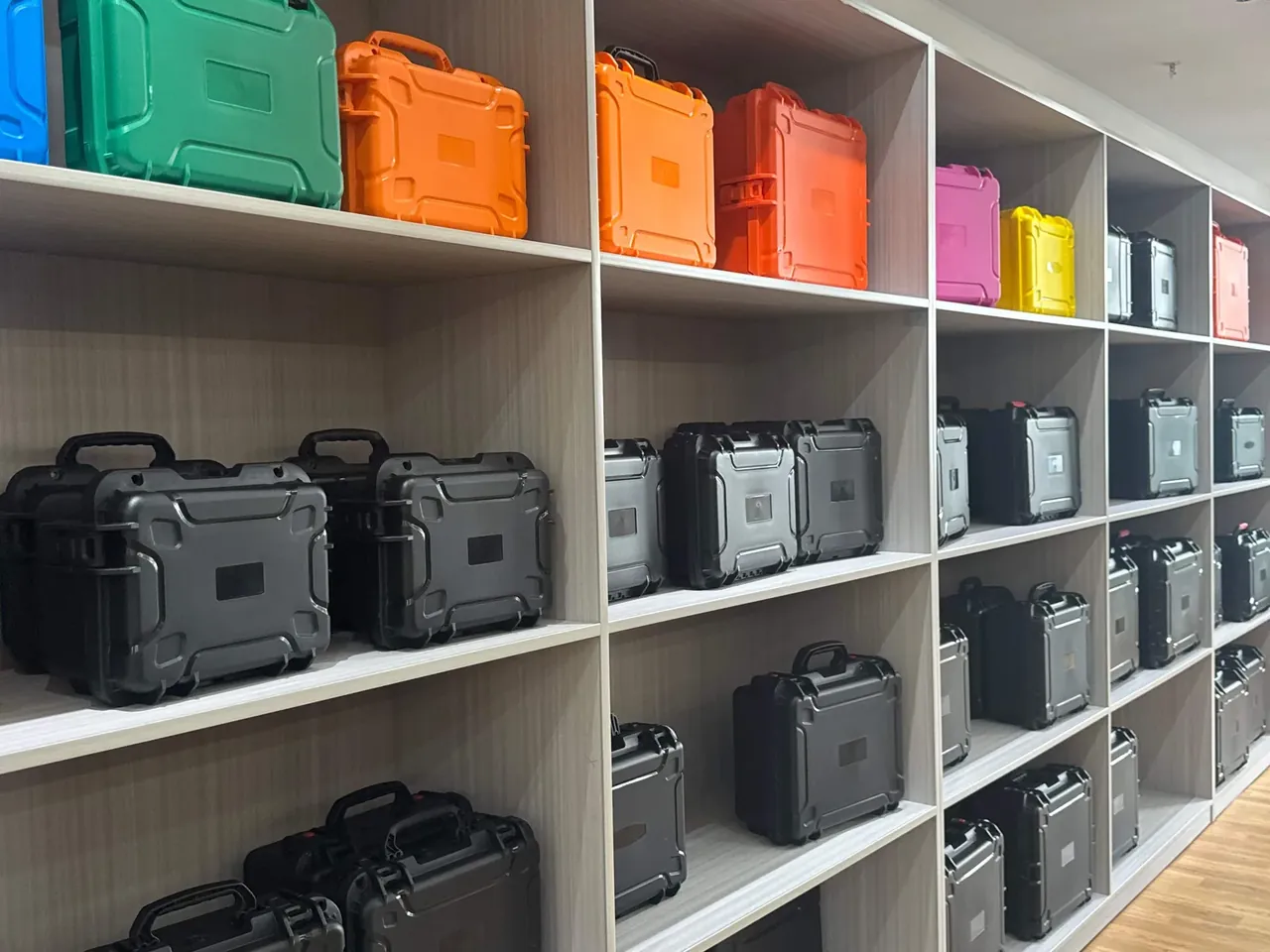
Quick answer: A hydrology case left on a river bank for 18 months reached ΔE 6.8 on its orange lid, against only 5.9 after 1000 h of xenon light.
Table of contents
- The first evidence after 18 months
- UV ageing in xenon hours
- Long immersion and wet-dry cycling
- Galvanic corrosion at the bracket
- Algae, silt and annual service
- FAQ
1. The first evidence after 18 months
Twelve hydrology case units were split in two: six bolted to concrete piers 1.6 m above normal water with lids tilted 15° south, six kept indoors as controls. After 18 months the exposed orange lids read ΔE 6.8, the grey shells 3.1 and the controls 1.2, taken at D65 and 8° with five points per shell.
| Months | Orange lid ΔE | Grey shell ΔE | 60° gloss | Shore A |
|---|---|---|---|---|
| 0 | 0 | 0 | 100% | 72 |
| 18 | 6.8 | 3.1 | 68% | 76 |
| 24 | 9.3 | 4.6 | 54% | 78 |
ΔE 3 is the first line for visible parts, where the eye begins to separate two same-colour faces, so 6.8 means lid and shell read as two colours. The grey shell ran at half the rate, because orange pigment absorbs weakly at 340 nm and UV reaches deeper.
2. UV ageing in xenon hours
The xenon test runs the ISO 4892-2 cycle, 102 min dry plus 18 min spray, 0.51 W/m² at 340 nm and 65 ℃ black panel. At 1000 h the orange lid read ΔE 5.9 against 6.8 outdoors, inside the usual ±15% band, so 1000 h converts to 2 years and a humid bank takes a 0.9 factor.
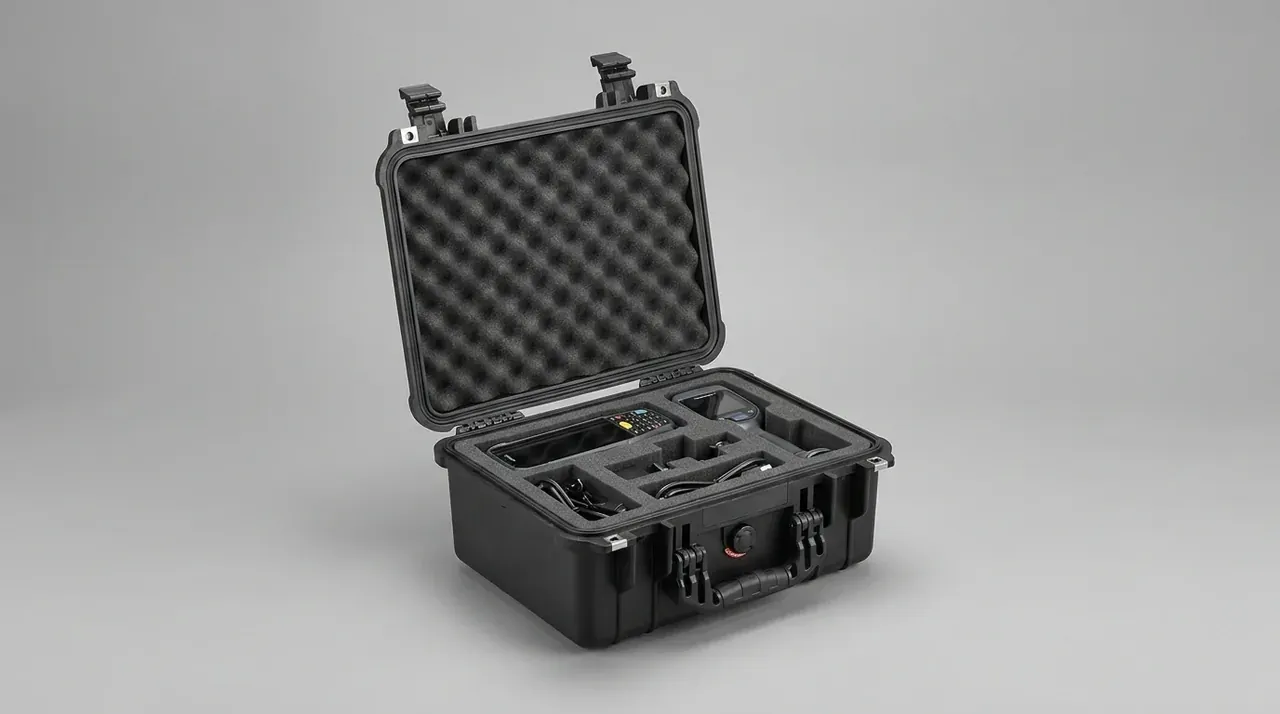
The stabiliser package decides whether that conversion holds. Dropping HALS from 0.3% to 0.15% pushed ΔE from 6.2 to 11.4, while raising the UV absorber from 0.25% to 0.35% recovered only 1.1.
Wall thickness consumes stabiliser too. Thinning the lid from 3.2 mm to 2.8 mm removes 12% per unit area and lifts ΔE at 1000 h from 5.9 to 7.1.
Three thresholds apply: ΔE 3 to report a visible part, ΔE 6 to replace a structural part, and ISO 4628-6 grade 2 chalking to replace at once.
3. Long immersion and wet-dry cycling
River level swings 2.4 m a year, the lower edge of each shell sits 0.5 m above the highest flood mark, and 90 to 120 days fall in the splash zone with 1 to 3 wet-dry cycles a day. The first part to fail is the gasket groove, where water cannot drain and the EPDM strip sits at 25 ℃ to 33 ℃ all year.
| Part | Material | 24 h uptake | State at 18 months | Limit |
|---|---|---|---|---|
| Shell | Modified PP | 0.03% | No swelling | None |
| Lid rib | PA66-GF30 | 1.8% | Bulge 0.2 mm | Above 0.5 mm |
| Gasket | EPDM 70 A | 0.6% | Set 34% | Above 40% |
| Insert | Brass | — | White corrosion | When seized |
| Bracket | Q235, 65 μm zinc | — | Down to 48 μm | Below 40 μm |
Compression set is the comparable figure: a new strip reads 28% after 72 h at 70 ℃, the exposed units 34% at 18 months against a 40% limit, and squeeze falls from 25% to 18% in two years.
Water enters by three routes: a gasket lip lifted 0.1 mm by silt, a blocked drain backing water 2 mm over the lip, and an insert that separates 20 μm from the shell after 60 thermal cycles.
4. Galvanic corrosion at the bracket
The bracket joint is the detail reports skip: hot-dip galvanised Q235 at 65 μm, a 304 stainless M8 bolt, and a PA66-GF30 shell loaded through a brass insert. Once a wet film links all three, the 0.15 V between stainless and brass drives a cell that consumes the insert.
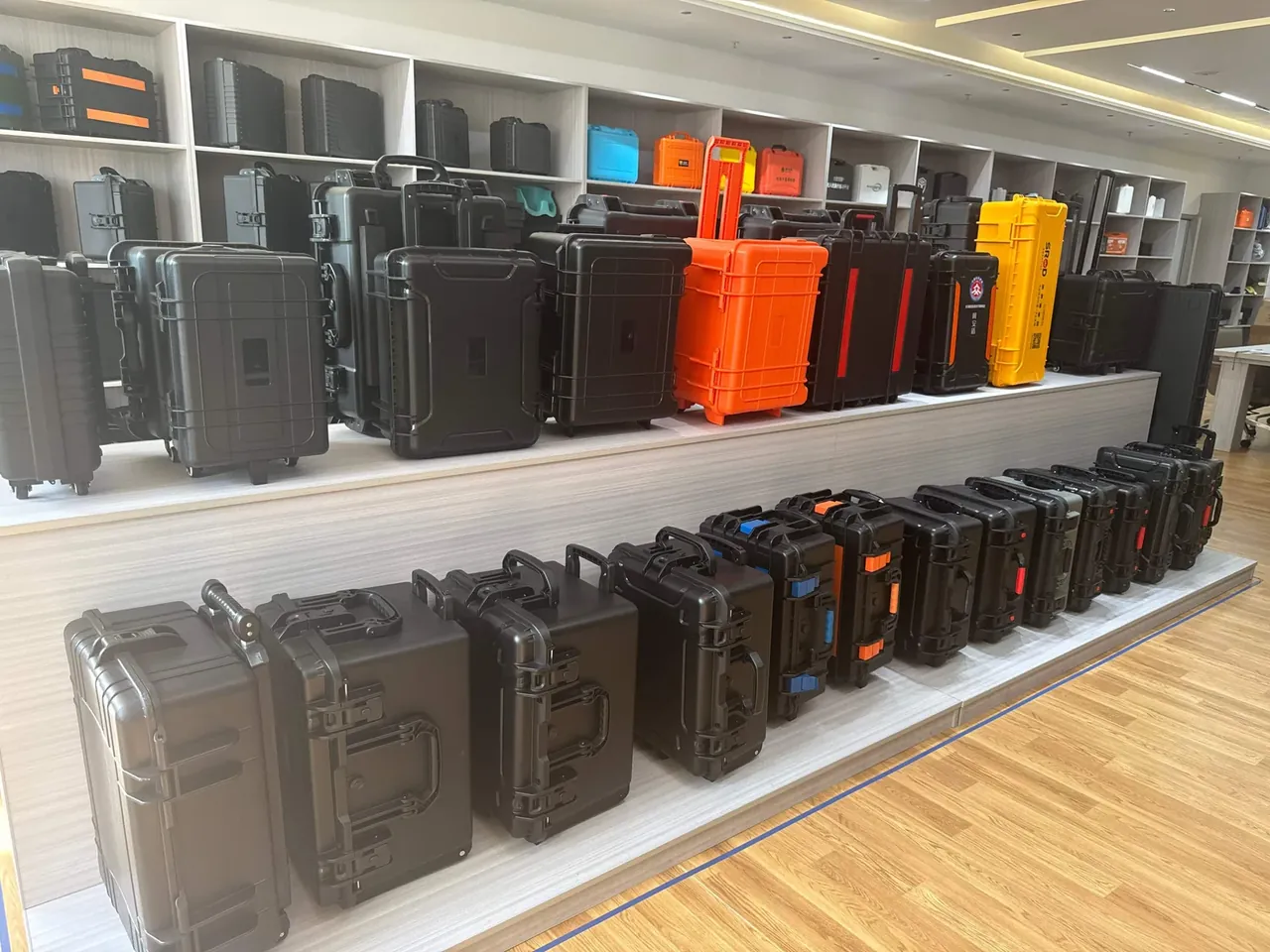
At 18 months the bores held white zinc salt mixed with copper green, threads had seized, and breakaway torque had risen from 8 N·m to 21 N·m. Two inserts spun with the bolt and tore 0.4 mm cracks, so those units were scrapped.
Three fixes: 316 inserts, molybdenum disulphide grease on the bolt, and a 1 mm nylon washer to break the couple. Torque is then capped at 6 N·m and checked every 12 months, still holding 5.5 N·m at the fourth teardown.
5. Algae, silt and annual service
The lid channel is 3 mm deep with one 4 mm drain hole at each corner, and river silt runs 0.05 to 0.3 mm, so one flood can block two holes. Water standing 3 days is enough for algae to sheet across the channel and the gasket lip.
Never clean it with a wire brush. A scratch deeper than 0.1 mm across the 0.8 mm lip becomes a leak path worse than the algae; use a soft brush, then a flush to confirm the drain empties within 10 s.
| Service task | Interval | Tool | Pass mark |
|---|---|---|---|
| Clear drains | 90 days | 4 mm pin | Empties in 10 s |
| Clean groove | 90 days | Soft brush | No grit |
| Check squeeze | 180 days | Caliper | ≥18% |
| Teardown threads | 12 months | Torque wrench | ≤6 N·m |
| Re-measure ΔE | 12 months | Colour meter | ≤6 |
| Measure coating | 24 months | Coating gauge | ≥40 μm |
Three lid openings across 12 screws make 36 teardowns; grease after each and the fourth should rise by no more than 1 N·m, flagging seizure earlier than any visual check.
Conclusion
Match each service action to a design number and the life of a hydrology case becomes predictable. Drains every 90 days answer a 3 mm channel and 0.3 mm silt; squeeze checks every 180 days answer 34% set against a 40% limit; thread teardowns every 12 months answer a 0.15 V couple and 21 N·m of seizure. Three things belong on the drawing: HALS at 0.3% or above, 316 inserts, and 25 μm of coating margin. Do those and the sheet drops from six tasks to four, cutting a visit from 2.5 h to 1.5 h.
This article discusses container-side specifications and design implications only, and does not cover any handling, loading or use of the contents.
Related Reading
- UV stabilisers and weathering colours for cases
- Choosing a waterproof case for permanent immersion
- IP67 cases in immersion and dust service
- Galvanic corrosion between shells and metal parts
Related Products
- 8 Series — Gun Cases; Military Equipment Cases; Camera Equipment Cases; Drone Cases; Watch Cases; Knife Cases; First Aid Cases; Electronics Equipment Cases
- WL8-2812 PP Gun Case — model WL8-2812
- All protective cases and toolboxes: 7 series, 158 models