

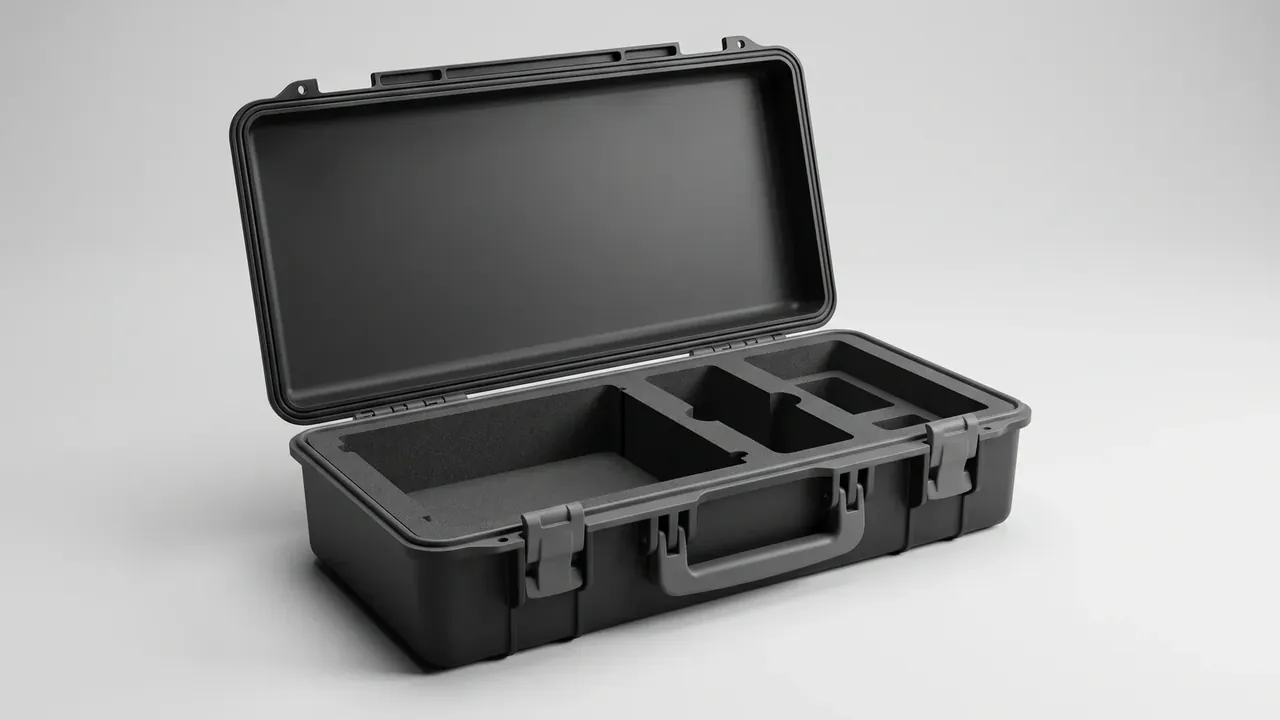
Quick answer: An Equipment Case does not win every count. It trades five traits against four alternatives: seal, weight per litre, cut-out effort, closure life and spare parts.
Table of contents
- How an Equipment Case Compares with Four Alternatives
- Protection Ratings and Where the Seal Sits
- Weight per Litre and Cut-out Effort
- Open-close Life and Spare Part Cost
- Choosing by Use Frequency
- FAQ
1. How an Equipment Case Compares with Four Alternatives
The baseline Equipment Case is a single-shot moulding with a solid gasket on the rim, two latches and a 3.0 mm wall. A 50 litre cavity in an 8.6 kg shell gives 0.17 kg per litre, twice a tote and under half a flight case.
Each rival has one strength: plywood re-cuts on site, 1.2 mm aluminium resists puncture, a 1.8 mm tote costs least, 1680D over 30 mm EVA absorbs best.
| Type | Protection | Weight per litre | Cut-outs | Closures | Spares |
|---|---|---|---|---|---|
| Equipment Case | IP67 | 0.17 kg/L | gasket | 20,000 | factory |
| Flight case | splash proof | 0.38 kg/L | easiest | 12,000 | trade |
| Aluminium case | IP55 class | 0.31 kg/L | reinforcement | 8,000 | extrusion |
| Thin-wall tote | no seal | 0.09 kg/L | not advised | 5,000 | replace |
| Soft bag and insert | dust only | 0.06 kg/L | sewing | zip 30,000 | insert |
Protection and closure life cannot be retrofitted; weight and cut-out time can be bought back.
2. Protection Ratings and Where the Seal Sits
An IP rating describes the seal path, not the wall. Here it is a 60 Shore A gasket compressed 25 to 30 per cent by the rim groove. Under-compress and water passes; over-compress and the rubber takes a set, so the second closure leaks.
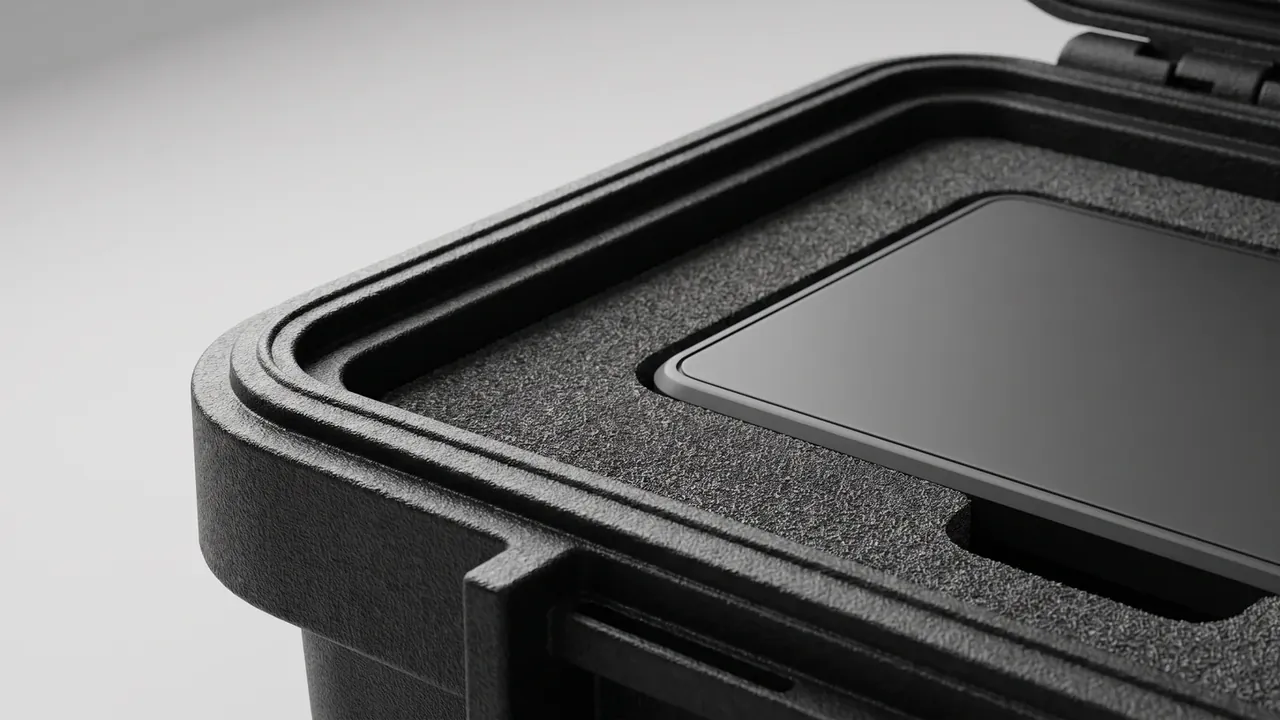
A flight case runs a labyrinth of two serrated extrusions: splash yes, immersion no. Aluminium seals on a foam strip and riveted seams, and a 400 mm case carries over 60 rivet holes, each a leak path.
At one metre for thirty minutes the solid gasket shows no ingress, the foam strip weeps, the labyrinth seeps, the zip fails inside a minute.
3. Weight per Litre and Cut-out Effort
At 50 litres the rivals run 19 kg, 15.5 kg, 4.5 kg and 2.9 kg against 8.6 kg. Load 20 kg of gear into the two lightest and every staircase needs a hand-over.
Cut-outs split the field wider. The Equipment Case leaves a 2.5 mm pad where panels sit, so a 60 mm hole takes 40 minutes with the gasket seated. Plywood takes 20 minutes plus 24 hours of cure; aluminium 55 minutes plus riveted reinforcement.
One or two changes favour plywood; past five revisions, moulded inserts win and the case returns to service that afternoon.
4. Open-close Life and Spare Part Cost
The limit sits in the latch and hinge pin, not the shell. POM catches on stainless pins held 420 N new and 350 N after 20,000 closures, above the 300 N service line.
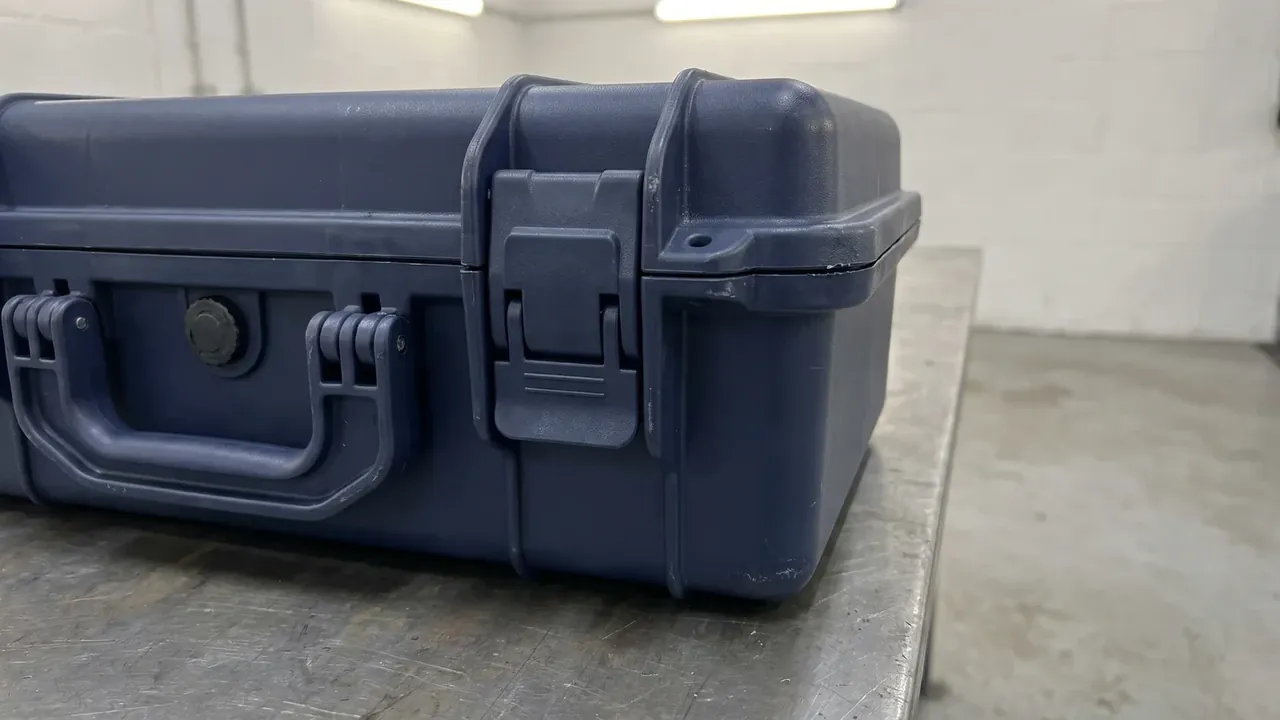
Butterfly catches on a flight case wore a 0.6 mm groove by 12,000 closures; aluminium hinges reached 0.5 mm of play at 8,000, and a rocking lid shears its gasket.
Spares are a five year number: a gasket at 45 and a latch at 18 keep annual upkeep near 30, while corners at 12 look cheap until damp plywood writes the shell off.
| 20 cases, 5 years | Equipment Case | Flight case | Aluminium case |
|---|---|---|---|
| Purchase | 1.00 | 1.35 | 1.60 |
| Spares | 0.08 | 0.22 | 0.31 |
| Labour | 0.05 | 0.12 | 0.10 |
| Write-off | 2% | 15% | 8% |
5. Choosing by Use Frequency
Three questions in order: closures a year, water in transit, panel revisions in five years. When two answers agree, stop comparing.
Under 200 closures a year between store and truck, a tote with a custom insert is cheapest, with desiccant covering the gap. Above 500 outdoors, the sealed combination pays.
The common error is treating a flight case as the upgrade: it wins on cut-out freedom, loses on sealing.
Conclusion
There is no absolute winner, only an order of traits: the seal decides whether water enters, mass decides who carries it, cut-out time sets the revision rhythm, and spares decide whether the shell is worth repairing in year five. Pick the option whose weakest trait never appears on your route, and the Equipment Case holds up.
This article discusses only the container (case body) side of specifications and design intent, and does not cover any handling, loading or use of the contents.
Related Reading
- Equipment cases in industrial inspection and field work
- How to choose an equipment case from the gear backwards
- Instrument cases: damping, level and access height
- Designing internal dividers: thickness, slots and location
Related Products
- 8 Series — Gun Cases; Military Equipment Cases; Camera Equipment Cases; Drone Cases; Watch Cases; Knife Cases; First Aid Cases; Electronics Equipment Cases
- WL8-2812 PP Gun Case — model WL8-2812
- All protective cases and toolboxes: 7 series, 158 models