

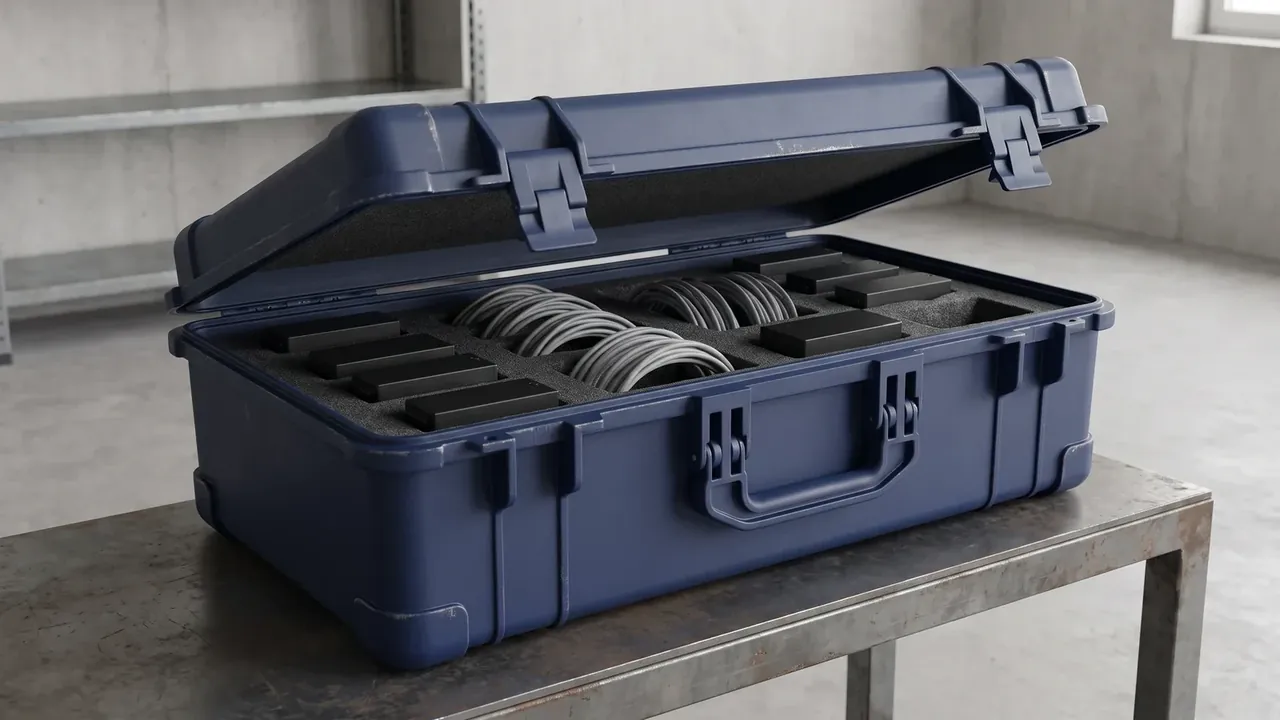
Quick answer: An Equipment Case works or fails on five details: how the body is moulded, how foam locates gear, how cut-outs are reinforced, how latches and hinges take load, and how sealing is balanced against pressure.
Table of contents
- How an Equipment Case Body Is Moulded
- Foam Inserts That Actually Locate Gear
- Cut-outs, Reinforcement and the Load Path
- Latches and Hinges Under Repeated Load
- Sealing and Pressure Equalisation
- FAQ
1. How an Equipment Case Body Is Moulded
Three routes dominate. Injection moulding runs a 3.2 mm PP or ABS wall on a 650 tonne machine at a 90 second cycle and wins on price above 3,000 units. Rotomoulding builds a 6 mm PE wall in 25 minutes from a sheet steel mould costing a third as much, suiting large low-volume bodies. Thermoforming pulls a 2 mm ABS tray in four minutes.
The process shows up in the structure. An injection-moulded Equipment Case holds a 0.2 mm rim tolerance and carries moulded posts; a rotomoulded body varies about 1 mm across the same wall, so the rim is cut wide and the gasket absorbs it; a thermoformed tray has almost no stiffness.
| Process | Wall | Cycle | Mould cost | Batch |
|---|---|---|---|---|
| Injection | 3.2 mm | 90 s | high | 3,000+ |
| Rotomoulding | 6 mm | 25 min | low | 100–800 |
| Thermoforming | 2 mm | 4 min | very low | 50–300 |
2. Foam Inserts That Actually Locate Gear
Foam in an Equipment Case is a location system, not padding. It holds gear at the drawn position, spreads impact, and keeps pick-and-place under two seconds.
Density decides the rest. EVA at 45 kg/m³ holds 92 percent rebound at 15 percent compression and dies cleanly; PE at 30 kg/m³ costs half but loosens after five cycles; PU at 25 kg/m³ feels best and hardens in humid air. Clearance is 1.5 mm per side: under 1 mm gear must be prised out, over 3 mm it slides and impact lands on one thin edge.
| Liner | Density | Rebound | Life |
|---|---|---|---|
| EVA | 45 kg/m³ | 92% | 5 years+ |
| PE | 30 kg/m³ | 78% | 2 years |
| PU | 25 kg/m³ | 88% | 3 years |
3. Cut-outs, Reinforcement and the Load Path
Every cut-out weakens strength and sealing at once. Keep the hole 25 mm or more from the inner wall, or the edge sits in the stress band and a drop starts a crack at the corner.
Small holes take a local pad thickened to 5 mm in the tool. Panels and large ports take a plate: 1.5 mm stainless or 3 mm aluminium clamped from inside, M4 screws at 40 mm pitch, a 1 mm gasket beneath. Square openings need R3 corners, since a sharp one cracks a third earlier, and round holes get a 0.5 mm chamfer against the seal.
4. Latches and Hinges Under Repeated Load
A latch decides whether lid meets rim; a hinge decides whether it still does after thousands of cycles. Both are bought as accessories, yet they set the life of the whole Equipment Case.
A 700 N draw latch, two opposed, pulls a 5 mm cord to its designed compression; below 500 N the cord never seats and the first pressure test fails. Allow 2 mm of over-travel so the seal stays loaded after cold shrinkage. Pin diameter is everything on hinges: a 6 mm stainless pin in a nylon bush grows 0.3 mm over 5,000 cycles, while a 4 mm pin feels loose by 1,500 and the lid crushes the gasket. Stop the lid at 105 degrees, beyond which weight pulls the hinge backwards.
5. Sealing and Pressure Equalisation
On an Equipment Case, cut the groove to about 70 percent of cord diameter. A 5 mm cord in a 3.5 mm deep, 6.5 mm wide groove compresses 22 percent, inside the 20 to 25 percent window; too shallow and it loses rebound, too wide and it rolls and lifts at the corners.
Pressure is the other half: lowland to plateau leaves 40 kPa across the wall, and a case out of a cold store vacuums the lid shut. A membrane vent cracking at 3.5 kPa solves both and still holds IP67. Immerse 1 m for 30 minutes, then pull minus 20 kPa for 3 minutes with no more than 1.0 kPa of loss.
Conclusion
The five points form one chain: the process sets wall and tolerance, foam locates gear inside it, cut-outs break the load path and plates rebuild it, latches and hinges return the lid to the same seat, and the vent closes the loop. Drop a link and the Equipment Case fails at a specific action.
This article discusses only the container (case body) side of specifications and design intent, and does not cover any handling, loading or use of the contents.
Related Reading
- Where an equipment case is used and how it is fitted out
- How to choose an equipment case in five calls
- How custom foam inserts are cut
- How a rotomoulded case body is formed
Related Products
- 8 Series — Gun Cases; Military Equipment Cases; Camera Equipment Cases; Drone Cases; Watch Cases; Knife Cases; First Aid Cases; Electronics Equipment Cases
- WL8-2812 PP Gun Case — model WL8-2812
- All protective cases and toolboxes: 7 series, 158 models