

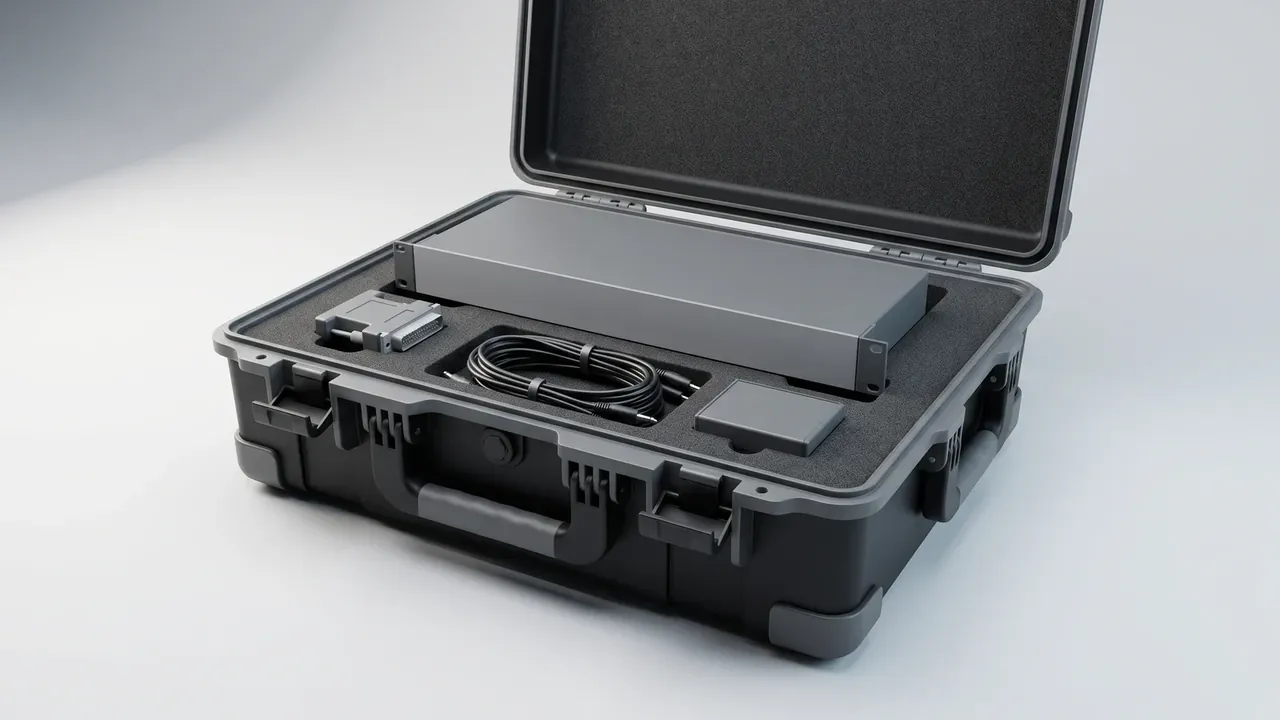
Quick answer: Maintenance means reading six numbers: gasket compression set, pressure drop, hinge pin wear, latch gap, rebound and insert torque.
Table of contents
- Where Equipment Case Inspections Start
- Gaskets and Air Tightness Testing
- Hinge, Latch and Panel Seal Ageing
- Foam Set and Insert Torque Intervals
- Spares List and Write-off Rules
- FAQ
1. Where Equipment Case Inspections Start
Three clocks drive inspection: a visual check at every dispatch, an air test each quarter, a strip-down yearly. Wear shows first, seals age next, foam sets last.
Six readings replace judgement. Each item has a limit, and anything past it is replaced rather than watched.
| Item | Method | Interval | Limit |
|---|---|---|---|
| Gasket | feeler gauge | monthly | 25 to 30 per cent compression |
| Pressure drop | 30 kPa, 5 min | quarterly | 2.0 kPa or less |
| Hinge pin | caliper, two axes | six months | 0.3 mm on a 4 mm pin |
| Latch gap | feeler gauge | monthly | 0.8 mm or less |
| Panel ring | compress, release | annual | 70 per cent rebound |
| Insert torque | torque wrench, M6 | six months | 4.5 N·m |
Three tests that creep upward put the gasket on the plan while it still passes.
2. Gaskets and Air Tightness Testing
Air is the only reading that gives a number on the spot. Close the latches, charge to 30 kPa, read after 5 minutes. Under 2.0 kPa passes, 2.0 to 3.5 puts the gasket on the plan, above 3.5 it is replaced without a retest.
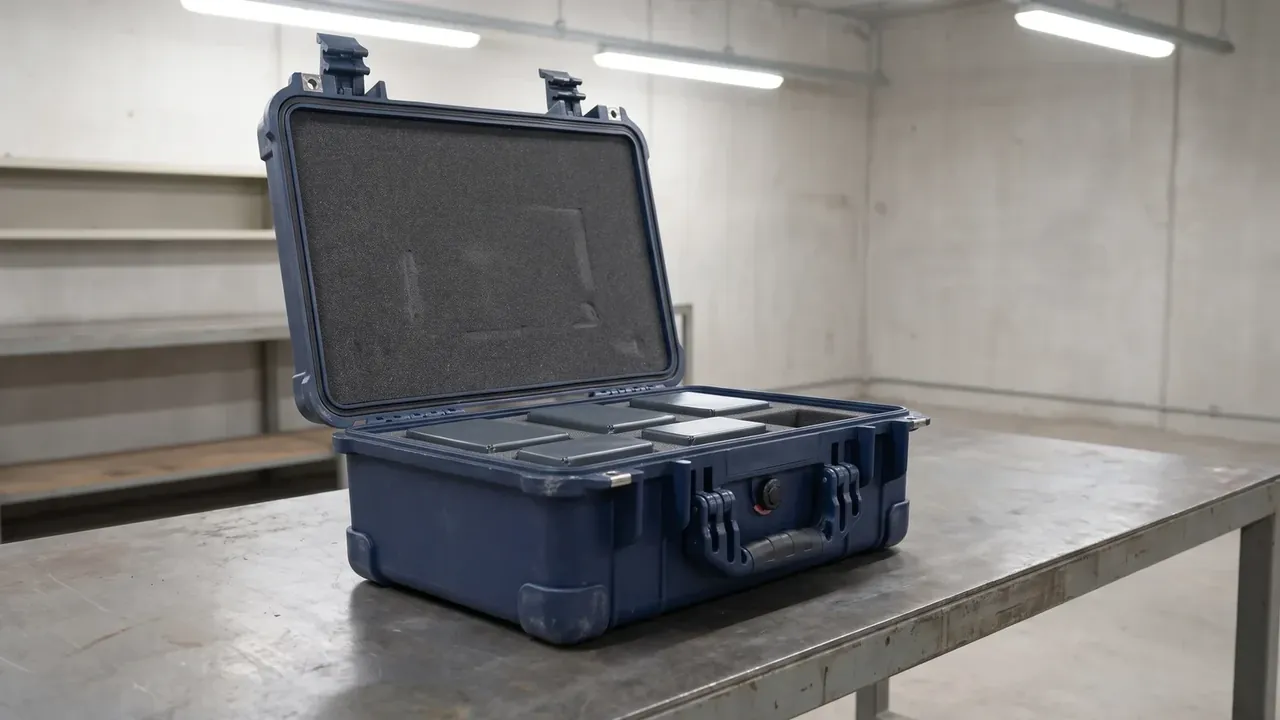
Trace the leak first: a latch side drop is compression, a corner drop is a lifting joint, a valve drop is its O ring.
Gasket life in an Equipment Case is measured as compression set: 24 hours at 70 °C, 30 minutes of recovery, then gauge. 30 per cent passes, 35 is the change line; rubber that feels hard reads past 40.
3. Hinge, Latch and Panel Seal Ageing
The hinge pin is 4 mm stainless, retired once oval: a 0.15 mm difference between axes, or 3.7 mm diameter, and a worn hole takes the hinge block with it.
Latches are judged on engagement, not pull: a new one preloads 0.2 mm, and a 0.8 mm feeler must not enter.
| Part | Reading | Change | Write-off |
|---|---|---|---|
| Gasket | compression set | 35% | 45% |
| Gasket | hardness rise | 8 points | 12 points |
| Hinge pin | diameter wear | 0.3 mm | 0.6 mm oval hole |
| Latch | gap | 0.8 mm | 1.5 mm |
| Panel ring | rebound | 70% | 55% |
| Insert | torque decay | 20% | two failed repairs |
Panel seals need 30 per cent compression from a 50 Shore A ring and an M6 screw at 4.5 N·m; rebound under 70 per cent lets torque fall on its own.
4. Foam Set and Insert Torque Intervals
Foam set in an Equipment Case is read with a depth gauge: 30 mm EVA loaded for 60 days that reads 25 mm has lost a sixth of its cushion, and 22 mm retires the insert.
Insert torque is rechecked every six months at 4.5 N·m. Below 3.6 N·m it gets fresh compound and 24 hours; two failures on one insert means a new insert.
The intervals follow material speed: rubber quarterly, pins half-yearly, foam annually.
5. Spares List and Write-off Rules
Equipment Case spares follow the fleet, not the failure rate. Per 100 cases: 60 gaskets, 20 latches, 40 pins, 80 rings and 100 inserts, with gaskets stored flat since a fold doubles the set.
| Spare | Specification | Per 100 | Swap |
|---|---|---|---|
| Gasket | silicone, 60 Shore A | 60 | 25 min |
| Latch | POM, stainless pin | 20 | 15 min |
| Hinge pin | 4 mm stainless | 40 | 20 min |
| Panel ring | closed cell, 50 A | 80 | 10 min |
| Thread insert | M6 brass | 100 | 35 min |
Three write-off lines: a rim crack over 30 mm, base wear past 1.5 mm, or one repair above 60 per cent of a new case. Any one ends the life of the Equipment Case.
Conclusion
Maintenance is measurement: pressure drop, compression set, pin diameter, latch gap, rebound and torque, each with a line drawn in front of it. Posted at the bench, those lines change parts before a failure rather than after. File the readings by quarter and the Equipment Case holds its seal and rating.
This article discusses only the container (case body) side of specifications and design intent, and does not cover any handling, loading or use of the contents.
Related Reading
- Equipment cases in industrial inspection and field work
- Weather resistance and long-term care for rotomolded cases
- Preventing storage damage: dents, warping and UV ageing
- Military supply case acceptance: appearance, seal and drop
Related Products
- 8 Series — Gun Cases; Military Equipment Cases; Camera Equipment Cases; Drone Cases; Watch Cases; Knife Cases; First Aid Cases; Electronics Equipment Cases
- WL8-2812 PP Gun Case — model WL8-2812
- All protective cases and toolboxes: 7 series, 158 models