

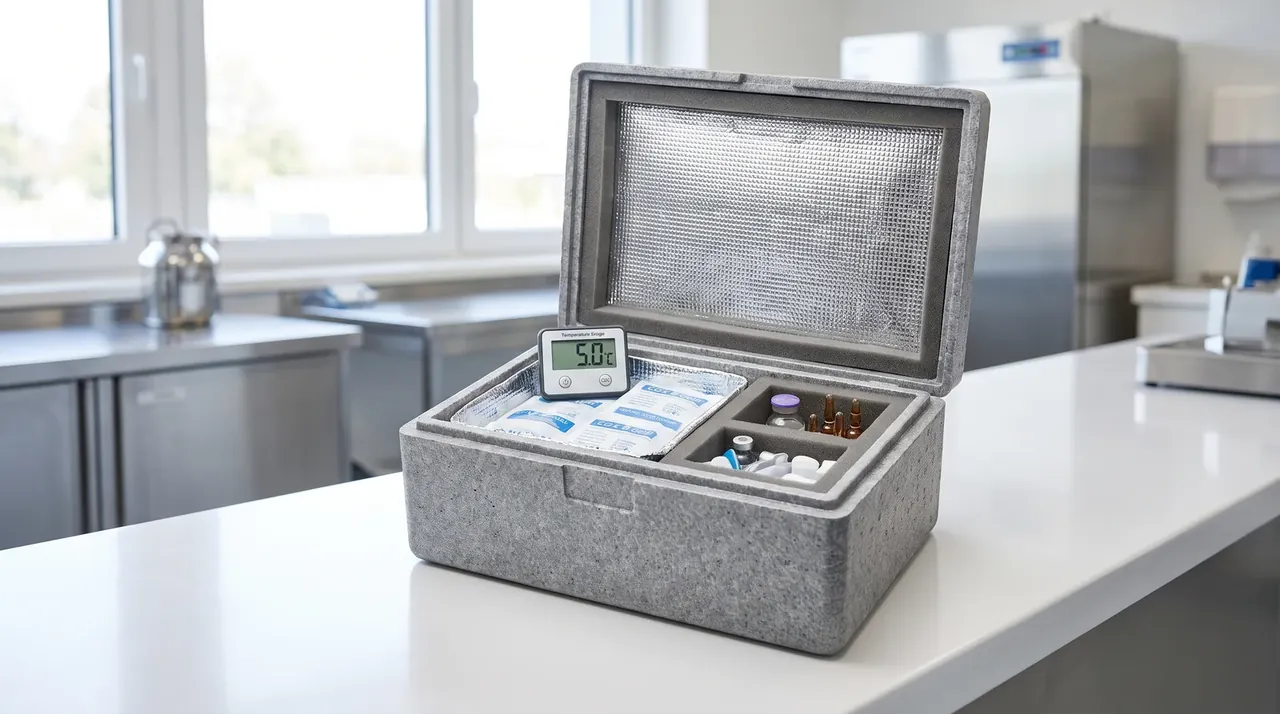
Quick answer: The Expedition team biological sampling case runs 24 tube positions, two 45 mm holes and a 3.4 mm wall at 11.0 kg loaded, with a 12 h cold hold.
Table of contents
- One day of opening cycles in the Expedition team biological sampling case
- Twenty four tube positions and two 45 mm round holes
- A 3.4 mm wall under the drop hammer at minus 15 C
- Vehicle vibration against shoulder carry
- How the gasket recovers after dust
- FAQ
1. One day of opening cycles in the Expedition team biological sampling case
The truck is loaded at four and reaches the first site at twenty past six, when the lid comes up. The Expedition team biological sampling case opens about 40 times that day: once before sampling, once after sealing, twice more where material is split on the spot. A 410 by 300 by 170 mm cavity holds 20.9 L; one 10 s opening swaps most of that air, so 40 openings move 836 L of outside air.
What wears first is not the hinge. Each closure presses the gasket to 28 percent compression and the strip must spring back unaided. Forty closures across 300 sampling days a year is 12,000 cycles.
| Part of the day | Closures | Load on the gasket |
|---|---|---|
| Loading before departure | 2 to 3 | Room temperature press at 28 percent |
| Work at the sites | about 30 | Dust on the seal edge, fines pressed in |
| Check at camp | 5 to 6 | Lid opened cold, rubber stiffer |
The count is not the problem; dust and cold are. Hence the shallow gasket channel on the Expedition team biological sampling case, which lifts out whole so fines are not walked into the groove.
2. Twenty four tube positions and two 45 mm round holes
The holes are not drilled at random. Twenty four positions sit in six columns and four rows at 50 mm pitch, a block of 250 by 150 mm; the remaining 160 by 150 mm takes the two 45 mm holes and one ice pack channel. Racks hold standard tubes, round holes take wide centrifuge tubes, and the two never mix, so a hand does not search the box at each site.
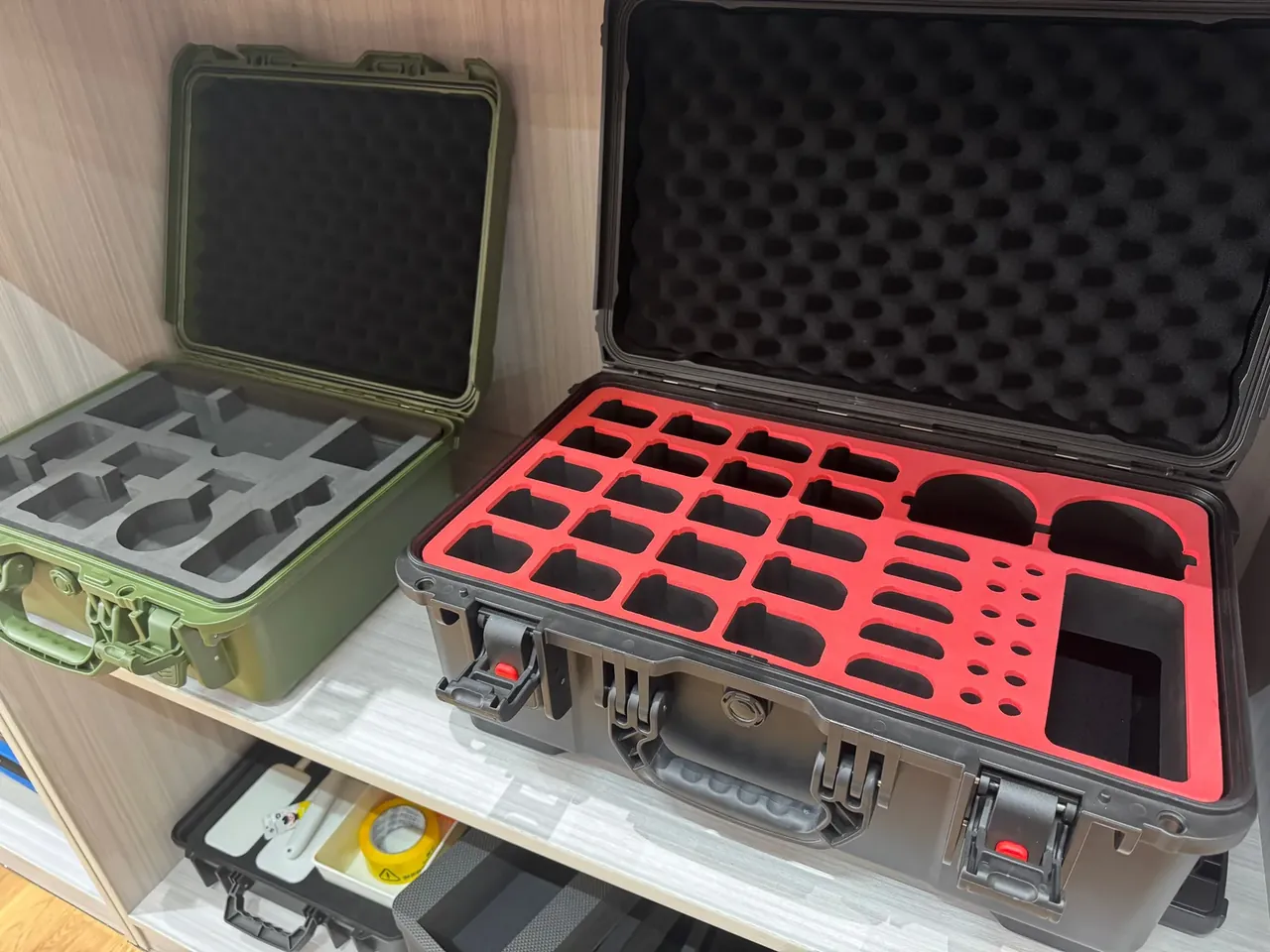
| Position type | Count | What it holds |
|---|---|---|
| Rack holes | 24 at 50 mm pitch | Standard sampling tubes |
| Round holes | 2 at 45 mm | Wide tubes and split bottles |
| Edge channel | 1 at 60 mm wide | Ice packs and a data logger |
At 1.5 tubes per opening, 40 openings mean about 60 tube movements, so one rack covers a round. Fully loaded the Expedition team biological sampling case carries 7.4 kg, mostly tubes and ice, for 11.0 kg total.
3. A 3.4 mm wall under the drop hammer at minus 15 C
Wall thickness is stiffness at room temperature and brittleness at minus 15 C. Homopolymer PP turns brittle below minus 10 C, and a hammer on a corner starts a crack at the radius; a copolymer or impact modified grade pushes that line lower, so the shell is moulded from a toughened compound rated minus 15 C to 50 C.
The 3.4 mm figure sits between two failures. At 2.8 mm a corner dents then splits under a 1.0 m drop; at 4.5 mm empty mass climbs past 4 kg from 3.6 kg. Drop work follows the impact logic of MIL-STD-810H method 516.8, three strikes per corner and bottom edge, checking for through-wall cracks and any shift of the latch seat; the hot side follows 501.7 at 50 C, the cold side 502.7 at 4 h and minus 15 C.
4. Vehicle vibration against shoulder carry
A box in a field vehicle and a box on one shoulder see two load cases. In the vehicle the load enters through the bottom, and the inertia of 11.0 kg spreads through the corners. On a shoulder it collects at the handle seat and two strap ears, where 11.0 kg at a dynamic factor of 2.5 gives about 270 N, and the 3.4 mm wall there must be ribbed.
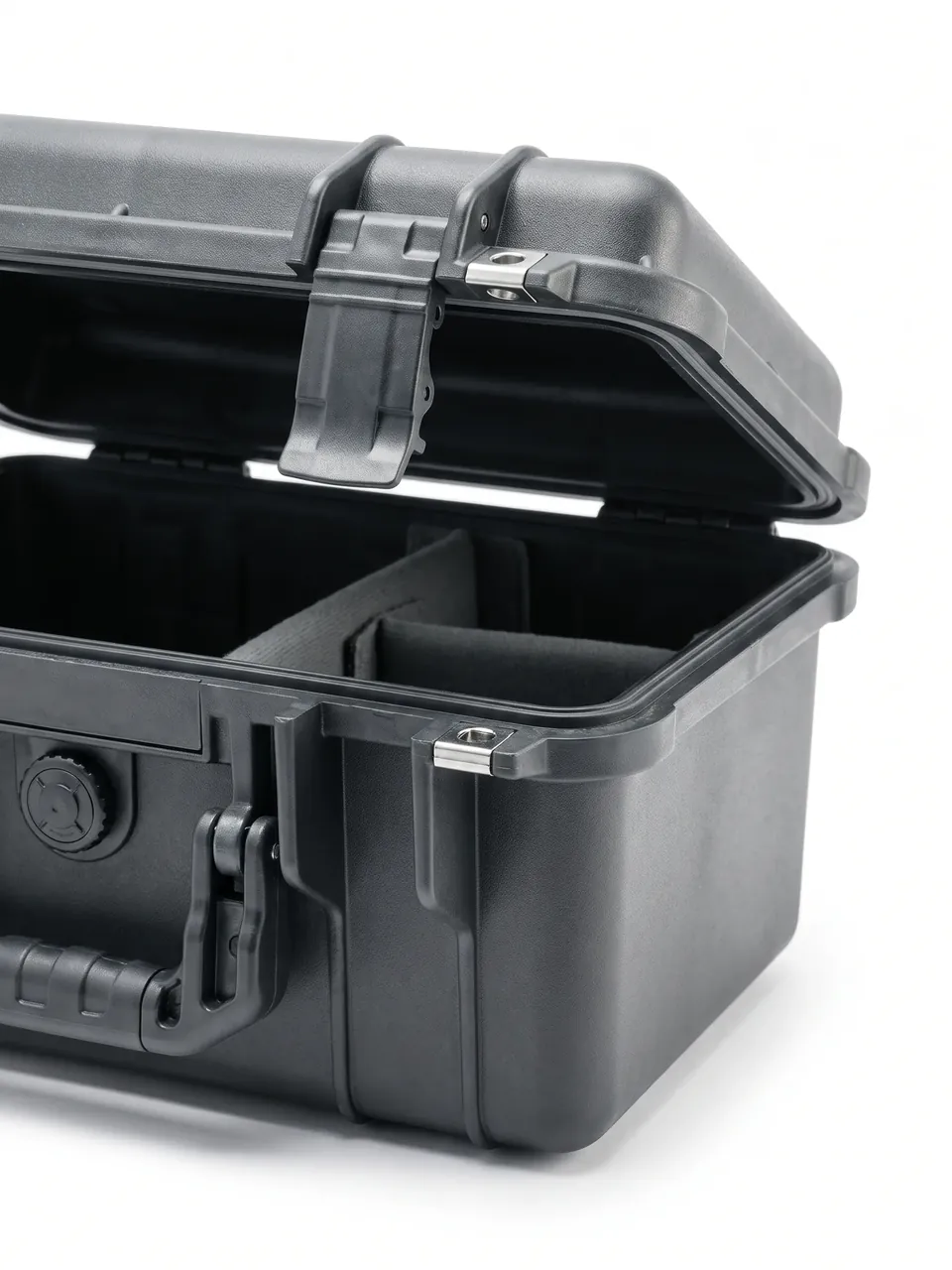
| Carry mode | Main load point | Acceptance check |
|---|---|---|
| Vehicle rear bay | Bottom corners and guards | No whitening, latches stay tight |
| Single shoulder | Handle seat and strap ears | No tear at the anchor, strap stays flat |
| Short hand carry | Handle bridge | No rattle on release |
The two pull the design in opposite directions. Vehicle use wants a stiff bottom and thick guards and accepts 11.0 kg; shoulder carry wants an empty box as light as possible. Between 3.6 kg empty and 7.4 kg of load, the Expedition team biological sampling case puts margin in the side walls and makes the guards replaceable.
5. How the gasket recovers after dust
Dust does not defeat a seal in one pass; it is pressed in closure after closure. The gasket on the Expedition team biological sampling case is set at 28 percent compression, which still leaves room to spring back, so it returns to full height within seconds of the lid lifting. Press further and recovery slows year on year as fines travel deeper.
Cold is the second obstacle. Silicone keeps elasticity at minus 15 C while EPDM shows a larger compression set, so the strip is silicone and the channel floor carries vent holes for trapped air. IP67 is a benchmark at 1 m immersion for 30 min, measuring contact between strip and lip rather than shell strength.
Dust on the strip cannot be avoided: wipe strip and lip with a damp cloth at camp and never let fines sit overnight. Two dusty closures out of forty can start micro cracks that grow in the cold.
Conclusion
The Expedition team biological sampling case is built around 40 closures a day that each have to shut clean. A 460 by 350 by 220 mm shell, a 410 by 300 by 170 mm cavity and a 3.4 mm wall hold empty mass at 3.6 kg and 11.0 kg loaded. Twenty four rack holes and two 45 mm round holes split the tube load, while 28 percent compression and silicone carry the seal through dust and minus 15 C.
Related Reading
- Shell sizing for sealed specimen transit boxes
- Load capacity and dividers in core sample boxes
- Volume and mass terms for insulated cold chain boxes
- Dividers and cushioning in glassware transit cases
Related Products
- 8 Series — Gun Cases; Military Equipment Cases; Camera Equipment Cases; Drone Cases; Watch Cases; Knife Cases; First Aid Cases; Electronics Equipment Cases
- WL8-2812 PP Gun Case — model WL8-2812
- All protective cases and toolboxes: 7 series, 158 models