

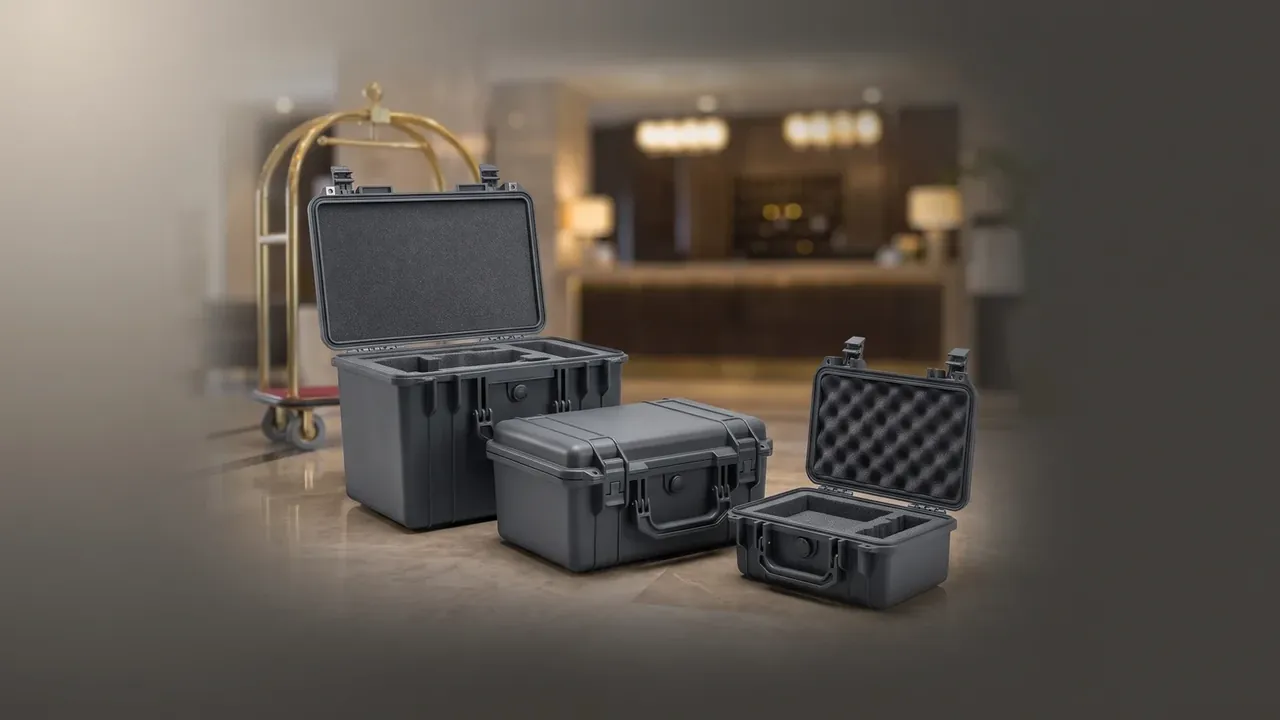
Quick answer: An explosion-proof case is dimensioned from its duty, not traced from a catalogue outline. Fix the cavity from the loading and drop conditions of a minus 18 C platform, derive wall and rib from the drop height, then check joint and latch spacing. Each step leaves a number you can measure at goods-in.
Table of contents
- A Minus 18 Platform and Three Spec Questions
- From Cavity to Outline the Dimension Chain
- Wall Thickness Derived From Drop Height
- Base Structure and Latch Spacing
- FAQ
1. A Minus 18 Platform and Three Spec Questions
A cold-store dock sits at minus 18 C all year. The case is frozen through before two people lift it, release it from 1.1 m, and open it only in a warm room. Each fact asks something different: cold makes polyethylene brittle, handling puts the corners in first, the step condenses water inside.
Cold is the part most often skipped. A shell that survives a drop at room temperature shows pale stress marks at the corners after four hours at minus 18 C, and those marks are the material crossing from ductile to brittle. Handling is read at the feet, the step at the joint.
| Duty condition | Field value | Which specification it sets |
|---|---|---|
| Dock temperature | minus 18 C, 4 hours parked | low-temperature impact margin of the resin |
| Load per case | 32 kg | base strength and stacking layers |
| Handling drop | 1.1 m, corner first | corner wall and rib root radius |
| Warm-cold step | about 25 C per move | joint form and seal compression |
The four rows are sequential. Temperature picks the resin, the drop picks the corner, the step picks the joint.
2. From Cavity to Outline the Dimension Chain
The cavity is the only dimension the load gives you. Add 8 mm to 12 mm around the largest packed outline and it lands at 520 mm by 380 mm by 220 mm; take 6.5 mm of wall per side, add rib and hinge relief, and the outline comes out at 548 mm by 408 mm by 248 mm.
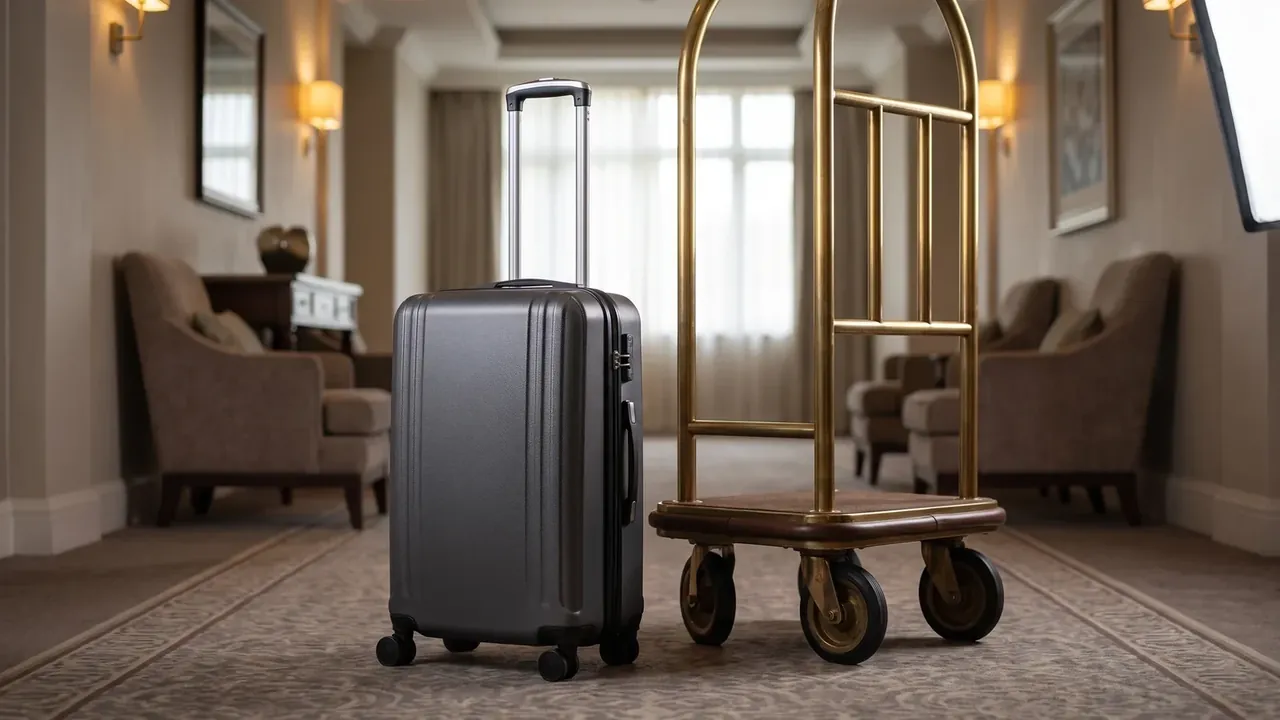
Measure the cavity away from rib roots, tape at three points and keep the smallest reading. Measure wall at the rim and at the base. Measure relief from the flat face to the rib crest. Three tolerances each taken at their limit will walk the outline out of its pallet slot. A sampling run is three cases and not one. Only together do the readings show which way the mould is offset.
| Chain element | Value | Tolerance | How it is checked |
|---|---|---|---|
| Cavity | 520 mm by 380 mm by 220 mm | plus or minus 1.5 mm | tape at three points, lowest kept |
| Wall per side | 6.5 mm | plus or minus 0.4 mm | caliper at rim and base |
| Relief per side | 15 mm | plus or minus 1.0 mm | height gauge from the flat face |
| Outline | 548 mm by 408 mm by 248 mm | plus or minus 2.0 mm | tape, feet included |
A 1200 mm by 1000 mm pallet takes four cases in two rows of two, at 128 kg gross plus 18 kg of pallet.
3. Wall Thickness Derived From Drop Height
Wall thickness is not chosen first; it falls out of the drop height. At 1.1 m with the corner leading, the impact sits on the line where three faces meet.
- Corner drop of 1.1 m: 6.0 mm minimum at the corner, plus 1.5 mm of local build.
- Vertical ribs 22 mm high at 160 mm centres, root radius 8 mm or more.
- Rim ring thickened by 1.5 mm so the rim carries the load, not the seal.
- Impact margin at minus 18 C set at 1.4 times the room-temperature figure.
- Wall above 9 mm with unchanged rib height pulls the flat face into a dish.
Extra wall buys stiffness, not toughness. In a rotomoulded part the skins cool at different rates, and the thicker the wall the more the flat face sags. Wall and rib on an explosion-proof case move as a pair; change one and the margin at the other is wasted.
4. Base Structure and Latch Spacing
The base carries the most concentrated load in the case. Four feet 30 mm high take 128 kg static, and at four layers the bottom case holds three more above it.
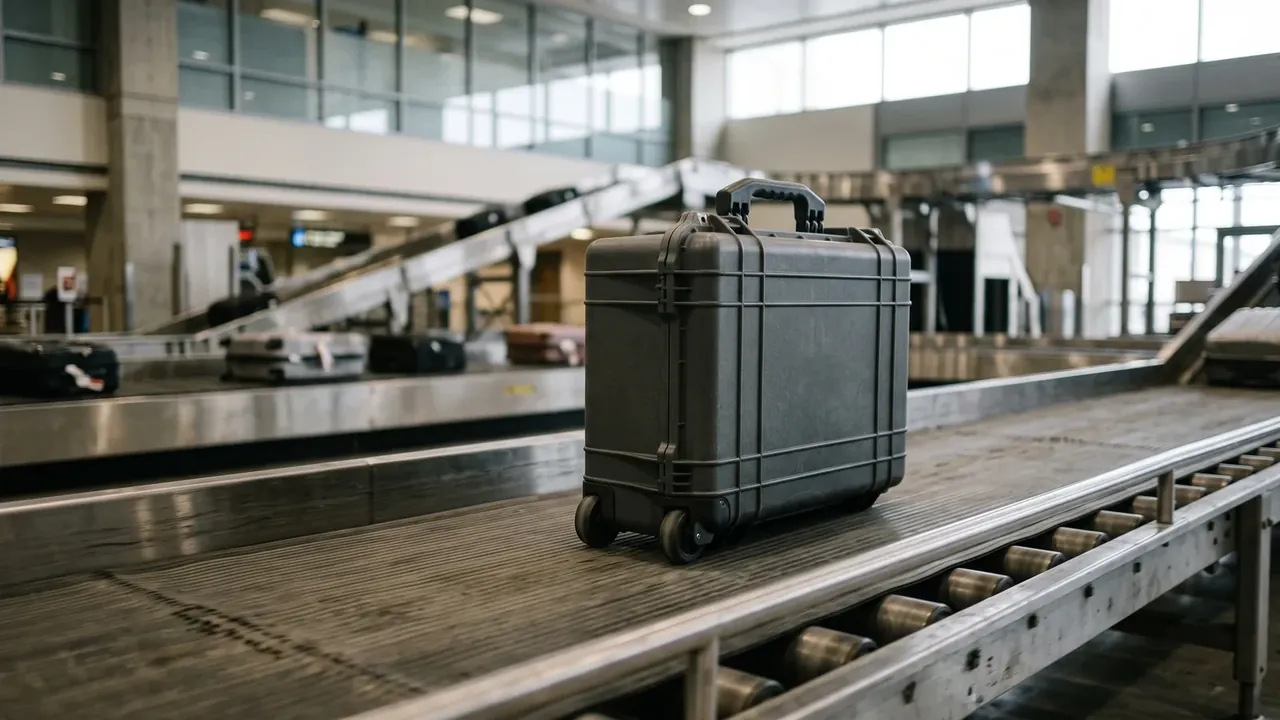
Four layers also stay under 1.1 m of total height, or the third tier will not enter the trailer.
Latches follow the perimeter: two draw latches at 240 mm centres, each holding 260 N. The handle is checked separately at 40 kg, and the hinge runs 180 mm on a through-pin.
Read the joint before the latches. A joint that will not close leaves the latches squeezing a gap that will never shut.
Conclusion
The four sections form one directed chain: the minus 18 C dock sets resin and joint, the 32 kg load sets the base, the 1.1 m drop sets the corner wall, and four stacking layers set latch and handle. Every link is measurable with a tape, a caliper and a depth gauge. When drawing and part disagree, find the broken link first, because an explosion-proof case that survives re-measurement is the only kind worth certifying.
This article discusses only the container (case body) side of specifications and design intent, and does not cover any handling, loading or use of the contents.
Related Reading
- What an explosion-proof case is: relief, containment, strength
- Shockproof case dimensions and wall thickness
- How an explosion-proof case differs from alternatives
Related Products
- 8 Series — Gun Cases; Military Equipment Cases; Camera Equipment Cases; Drone Cases; Watch Cases; Knife Cases; First Aid Cases; Electronics Equipment Cases
- WL8-2812 PP Gun Case — model WL8-2812
- All protective cases and toolboxes: 7 series, 158 models