

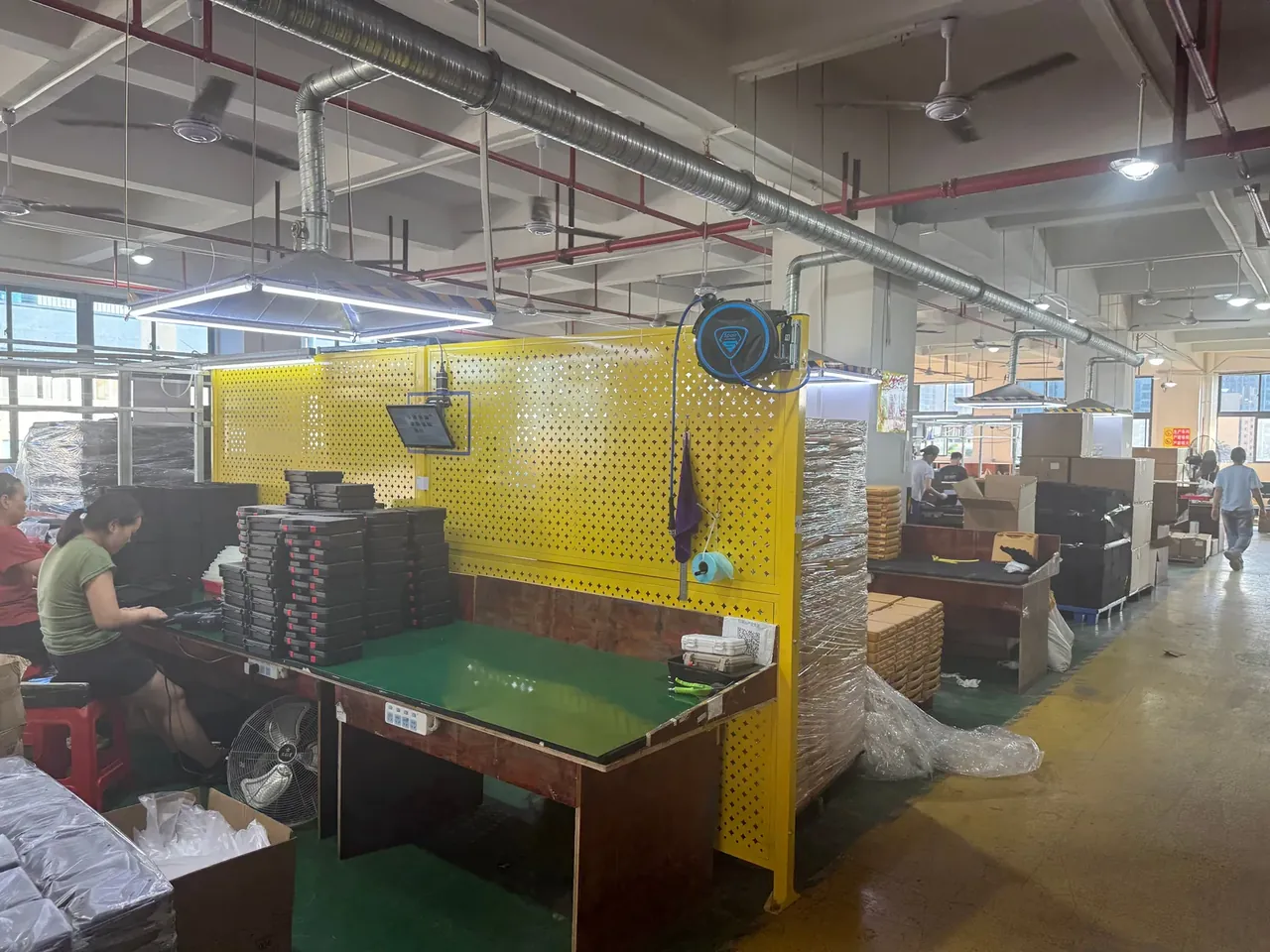
Quick answer: An explosion proof tactical equipment safety box factory runs a 210 s cycle and three quality gates; 640 shells a day, 624 shippable.
Table of contents
- Why an Explosion proof tactical equipment safety box factory Locks the Cycle at 210 s
- Nine Processes, Three Quality Gates
- Holding ±0.15 mm with 230 °C Melt and 60 °C Mould
- From 640 to 624: Yield 97.5 Percent and OEE 82 Percent
- Where the 25 Delivery Days Go
- FAQ
1. Why an Explosion proof tactical equipment safety box factory Locks the Cycle at 210 s
Output is set by the slowest station, and here that station is moulding. Clamp 8 s, inject 12 s, hold 35 s, cool 145 s, demould 10 s: 210 s per shell, one cavity, no slack.
An 800 t press at 7.5 effective hours a shift gives 128 shells, 385 a day over three shifts; two presses, 770. Changeover, tuning and waiting for material take 17 percent, so an explosion proof tactical equipment safety box factory schedules 640.
| Process | Equipment | Cycle s |
|---|---|---|
| Dosing and drying | desiccant dryer, 120 kg | 90 |
| Injection moulding | 800 t press | 210 |
| Degating and trimming | pneumatic cutter, fixture bench | 45 |
| Hinge and latch fitting | riveting press | 120 |
| Gasket insertion | press-in jig | 75 |
| Air leak test | differential pressure bench | 60 |
| Foam cutting | die and punch press | 95 |
| Visual inspection | light booth | 50 |
| Packing | carton sealer | 40 |
Only moulding runs at 210 s; every other process finishes inside 120 s, so no explosion proof tactical equipment safety box factory levels it any other way.
Three numbers must reconcile: 770 theoretical, 640 scheduled, 624 shippable; a plant quoting only two has left yield out.
2. Nine Processes, Three Quality Gates
Inspecting all nine processes is not realistic. Quality sits at three gates, first article, patrol and final; the other six rely on fixtures and self-checks.
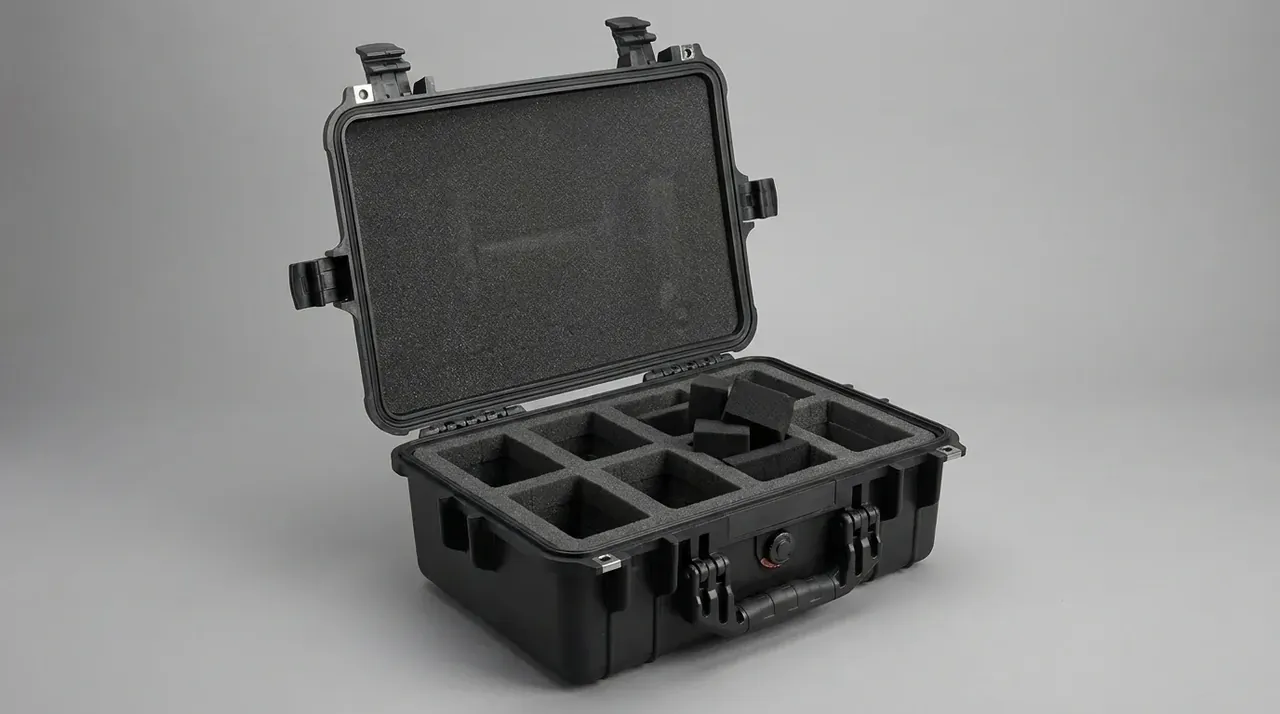
First article runs by mould number, three shells at start-up, checking the cavity, wall thickness on four sides and weld lines. One failure and the mould stays out.
Patrol takes 20 shells every 2 h, measuring wall thickness and latch holding force, sampled per press, not per batch: 20 each, 40 across two.
Final is air only, 100 percent: charged to 1.0 kPa, held 60 s, rejected above 0.3 kPa. Two benches at 60 s keep it inside a third of the cycle.
| Equipment | Quantity | Gate it serves |
|---|---|---|
| Differential pressure bench | 2 | final, 1.0 kPa held 60 s |
| Ultrasonic thickness gauge | 2 | first article and patrol |
| Digital caliper | 4 | cavity and hardware points |
| Latch pull gauge | 2 | patrol, holding force |
| Light booth | 1 | first article, patrol review |
Each gate owns one segment, so a faulty case traces back to the gate that missed it, as an explosion proof tactical equipment safety box factory must show.
3. Holding ±0.15 mm with 230 °C Melt and 60 °C Mould
Wall thickness is nominally 4.0 mm and ±0.15 mm is the hard line. A 5 °C swing in melt or 2 °C in mould moves thickness 0.1 mm; drifting off 23±3 °C or 55%±10% humidity moves it further.
Four readings per shell, at the long-side midpoint, short-side midpoint, a corner radius and the base centre; a spread above 0.30 mm rejects it, since the thin patch splits first. Mould temperature runs on zoned circuits written into the set-up sheet; crossing one makes that face run thin. Melt follows dew point and hopper temperature, and a dew point above −20 °C stops the line. Patrol readings plot as a trend, and five consecutive drifts trigger a mould temperature change before the tolerance is breached.
Melt at 230 °C and mould at 60 °C are a linked pair. Drop the melt 10 °C alone and weld lines deepen at the latch pocket, so an explosion proof tactical equipment safety box factory downgrades the shell rather than reworking it.
4. From 640 to 624: Yield 97.5 Percent and OEE 82 Percent
640 times 0.975 is 624, but the figures differ in kind: 640 is scheduling, after changeover and start-up; 624 is shippable, after defects.

OEE 82 percent is the floor; scheduling uses 83 percent so 770 converts to 640. On a floor day an explosion proof tactical equipment safety box factory makes 631 and ships 615; the gap closes with overtime, never a shorter cycle.
| Cycle s | Gap to 210 s | How it is covered |
|---|---|---|
| 210 | 0 | master cycle, no buffer |
| 120 | −90 | two stations in parallel |
| 95 | −115 | one machine covers two shifts |
| 60 | −150 | two leak benches in rotation |
| 40 | −170 | packing doubles as visual |
The table finds slack: packing absorbs visual inspection, moulding cannot be touched, so an explosion proof tactical equipment safety box factory argues capacity on the press.
5. Where the 25 Delivery Days Go
Twelve thousand cases at 624 a day is 19.2 days, scheduled as 19; three days of preparation and three of dispatch make 25.
Twelve moulds are the second variable: 40 min a changeover, 8 h for a full rotation, the equivalent of 137 shells, so orders are grouped by colour and mould and changeovers fall from 12 to 4.
Foam is the third: a die takes 5 days and runs parallel with moulding, but cutting sits in the last three days, and one late day delays the shipment. An explosion proof tactical equipment safety box factory that opens these three blocks gives the buyer something to check.
Conclusion
Capacity at an explosion proof tactical equipment safety box factory is not a monthly figure; it is 210 s of cycle, 640 scheduled, 624 shippable. Nine processes are held by three gates, wall thickness stays inside ±0.15 mm, and 25 days is 19 plus 3 plus 3.
Related Reading
- How production SOP clauses land on the floor
- Military standard cases versus plain moulded cases
- Comparing mould plans: cavities, steel and life
- How to sample a batch on arrival
Related Products
- 8 Series — Gun Cases; Military Equipment Cases; Camera Equipment Cases; Drone Cases; Watch Cases; Knife Cases; First Aid Cases; Electronics Equipment Cases
- WL8-2812 PP Gun Case — model WL8-2812
- All protective cases and toolboxes: 7 series, 158 models