

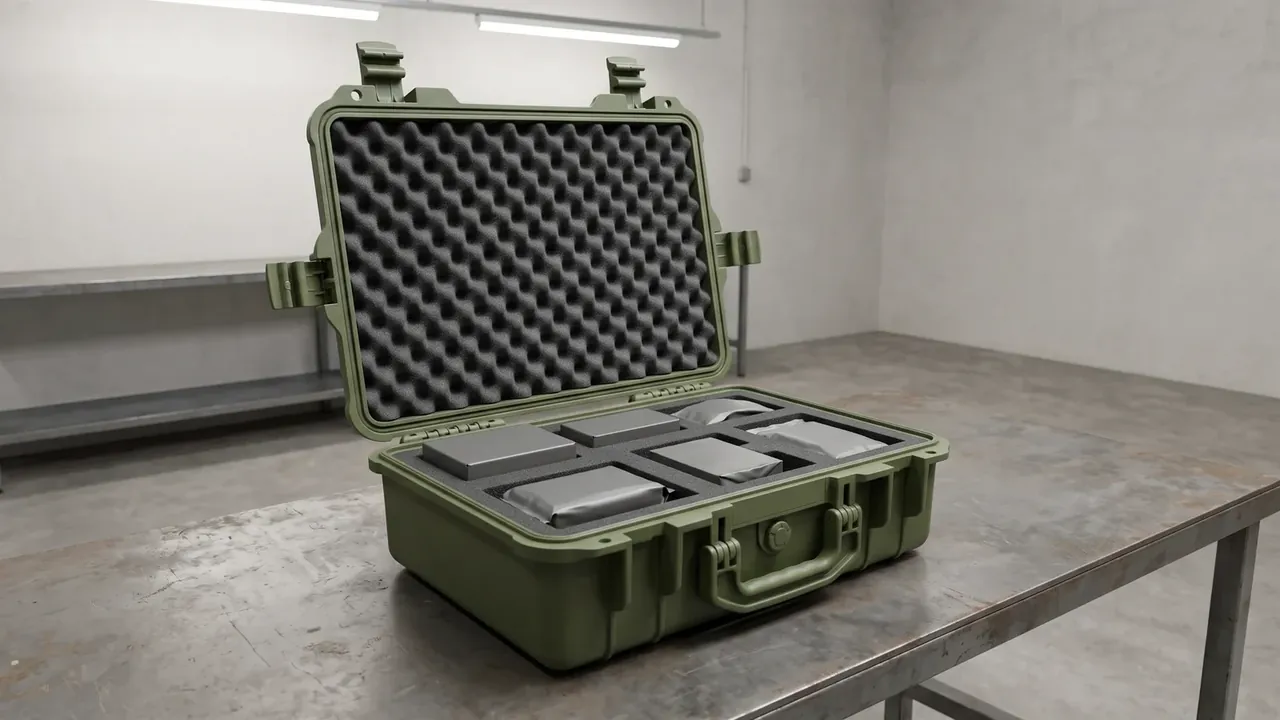
Quick answer: Ten minutes buys four checks on an explosive container: lid seam, wall uniformity, latch preload and cavity squareness. All four can be measured with tools a buyer already carries, and all four leave a record.
Table of contents
- The lid seam comes first
- Three fits you can measure
- Run the case through your own duty cycle
- Four options behind one identical price
- FAQ
1. The lid seam comes first
In front of a sample, a buyer can close the lid, throw the latches and look at the seam. No instrument is needed beyond a 0.3 mm feeler gauge: run it round the perimeter and mark where it enters.
Clustering is the problem: a wide gap between latches with tight gaps beside it means the lid lacks stiffness and the clamp sits on a few points. An even hairline seam is fine, since the gasket takes it up.
Weighing an explosive container is the second move. A nominal 52 kg case that comes in 2 kg light usually has uneven wall, since rotomoulded parts run thinnest at convex corners.
| Check | Tool | Pass line | What failure looks like |
|---|---|---|---|
| Lid seam | 0.3 mm feeler | No more than 3 entry points | Gaps clustered between latches |
| Wall | Ultrasonic gauge | 6.5 mm or more | Corners thinner than base |
| Latch preload | Push-pull gauge | 120 N or above | Opens one-handed |
| Gasket squeeze | Depth gauge | Around 25% | Squeezed past 40% |
| Cavity square | Tape measure | Diagonals within 2 mm | Insert will not sit flat |
Measure five samples and compare: the widest spread is that plant's weak step and the item to watch at acceptance.
2. Three fits you can measure
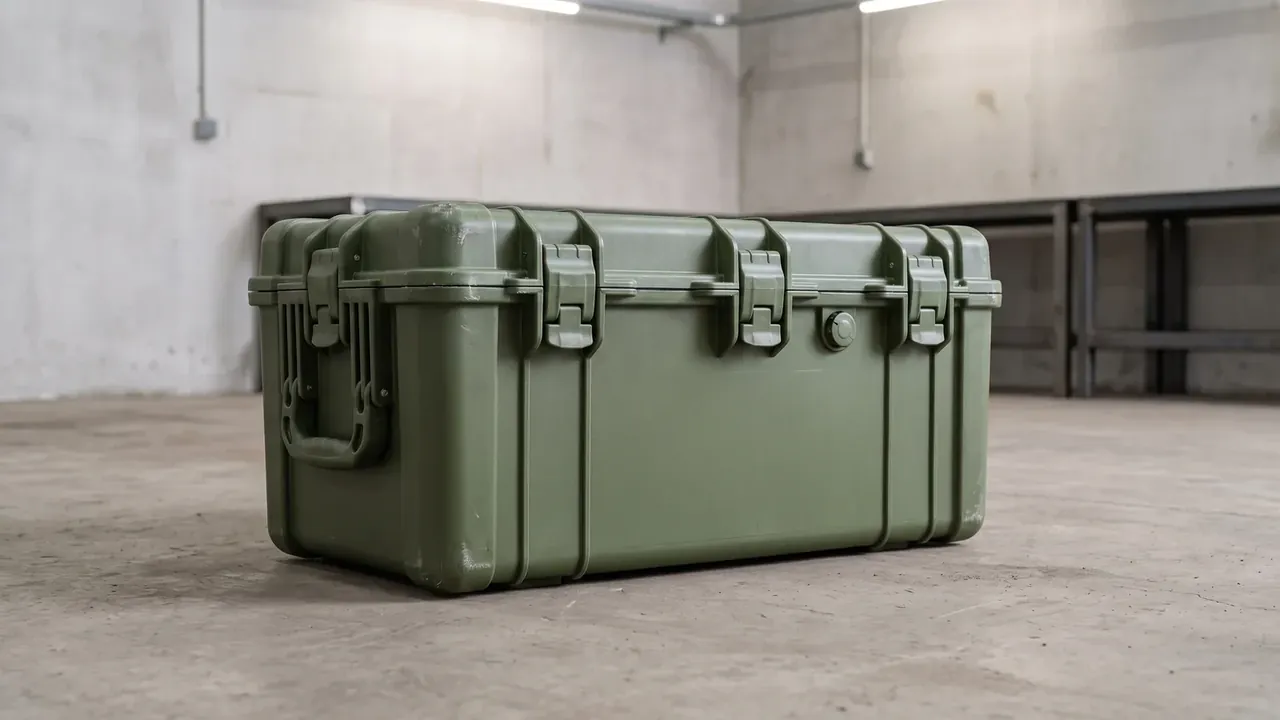
Seam, gasket and latch act as one system on an explosive container; judging any alone misleads. A 12 mm gasket squeezed to 9 mm is 25% compression, enough sealing without crushing the rubber. Past 40% it loses rebound and leaks within about three openings.
Preload of 120 N is the usual floor for an explosive container latch. Below that, a 52 kg loaded case sheds a notch after 2 hours of vibration; read the peak at release with a push-pull gauge.
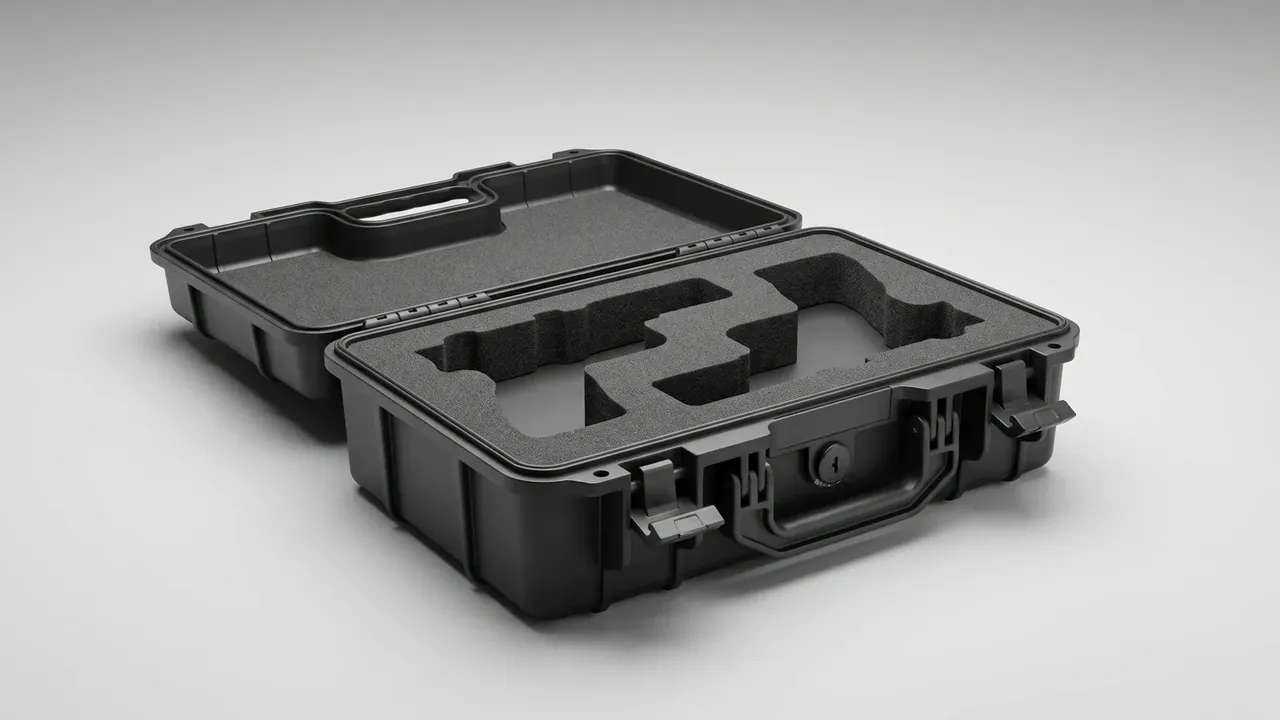
Cavity squareness gets ignored most. Across a 1.2 m by 0.8 m cavity, diagonals 2 mm apart stop a cut insert from seating.
3. Run the case through your own duty cycle
A good-looking explosive container sample is not a working case. Three trials separate them: a 1.5 m corner drop at 52 kg loaded, 300 kg stacked for 24 hours, and 6 cycles between minus 40 and 60 degrees Celsius.
Drops are about attitude, not height. One corner, one edge, one face, and the results rarely agree. A corner drop concentrates energy at a point. A face drop opens the seam first, because the lid springs before the body moves. Note which corner and whether the floor was concrete.
Stacking measures permanent set on an explosive container: 300 kg on the lid, 2 hours of recovery, and a dip over 3 mm at the centre says the ribs sit too far apart.
Thermal cycling exposes dissimilar materials. After 6 cycles a white line around a metal insert means the expansion coefficients were never matched.
4. Four options behind one identical price
Five suppliers can quote one figure for the same explosive container with 38% of cost hidden in four places: latch count, gasket compound, wall thickness and pressure valve.
Two latches and five are different philosophies: two rely on lid stiffness, five spread the clamp load. The two-latch version is 8% cheaper but needs 8.5 mm wall to hold.
Gasket compound is the quietest substitution. EPDM stiffens near minus 25 degrees Celsius, silicone holds to minus 55, and the difference runs about 12% of gasket cost.
| Option | Cheap version | Better version | Which check it moves |
|---|---|---|---|
| Latches | 2, plastic jaw | 5, metal core | Seam evenness, preload retention |
| Gasket | EPDM, 70 shore | Silicone, 60 shore | Sealing below minus 25 |
| Wall | 6.5 mm | 8.5 mm | Permanent set at 3 tiers |
| Valve | None | 0.2 bar bidirectional | Lid force after a swing |
Skipping the valve saves 3%, but move the case from a 30 degree store to a minus 20 site and the lid gets sucked down. A 0.2 bar valve keeps opening force under 80 N. Selection ends as a purchasing line: if an explosive container quote shows only a total, those switches are not in your hands.
Conclusion
Ten minutes on site covers four measurements: feeler along the seam, gauge on the wall, push-pull on the latch, tape across the diagonals. When they line up, talk price; when they do not, a low price is risk bought in advance. Choosing an explosive container is a measurement before it is a negotiation.
This article discusses only the container (case body) side of specifications and design intent, and does not cover any handling, loading or use of the contents.
Related Reading
- Compliance limits for storage rooms
- Latch and liner layout on a handgun case
- Foam layout and tie-downs for long items
- Damping a gimbal payload on the move
Related Products
- 8 Series — Gun Cases; Military Equipment Cases; Camera Equipment Cases; Drone Cases; Watch Cases; Knife Cases; First Aid Cases; Electronics Equipment Cases
- WL8-2812 PP Gun Case — model WL8-2812
- All protective cases and toolboxes: 7 series, 158 models