

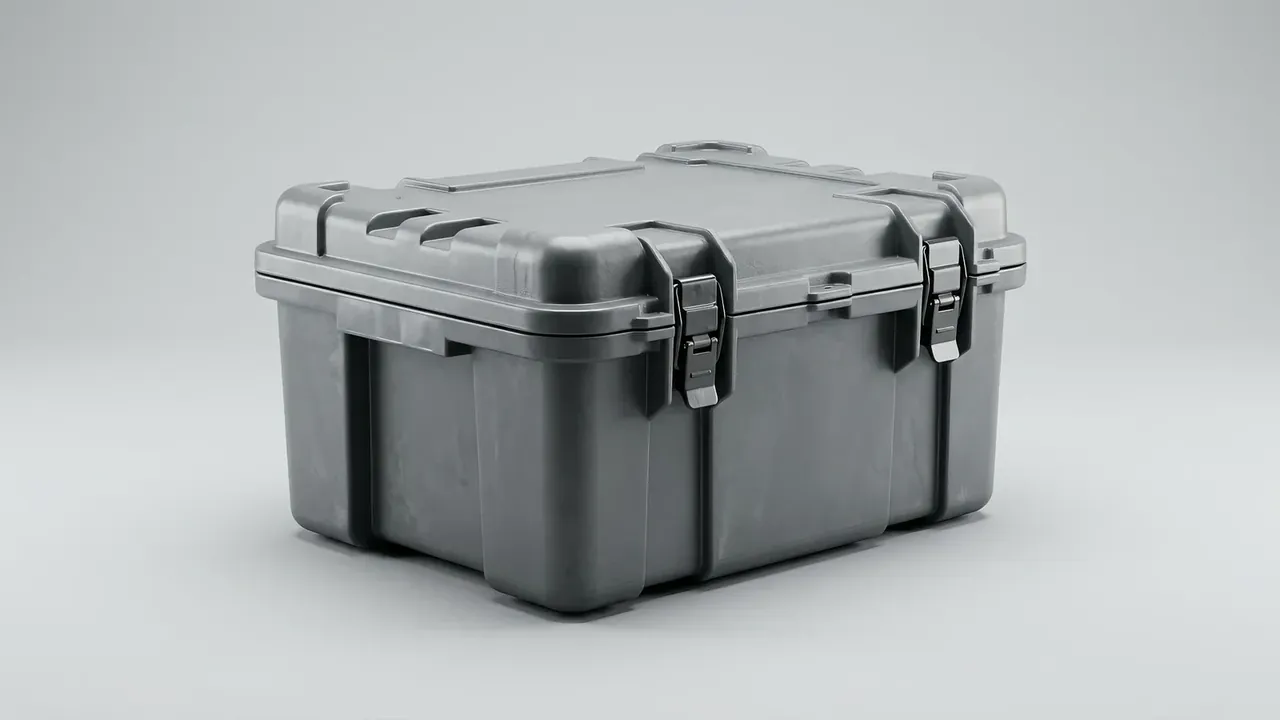
Quick answer: A quote splits into tooling, material, moulding time and finishing. Minimum order quantity follows the moulding route, and lead time stacks sampling, production and testing. Below are the four quote lines, three MOQ thresholds and a five-part schedule.
Table of contents
- What a Quote for an Explosive Storage Box Should Break Down
- Three Minimum Order Thresholds
- Tooling and Sample Charges: Cost and Credit
- The Five-Part Lead Time
- Certificates Tied to Payment Milestones
- FAQ
1. What a Quote for an Explosive Storage Box Should Break Down
A single total price cannot be compared. One plant quotes 380 CNY with tooling amortised, another 340 without, then bills a mould charge later.
A rotomoulded body of 700 × 480 × 360 mm at 6 mm wall weighs 11 to 14 kg; material at 10.5 CNY per kilogram runs 120 to 150; an 18-minute cycle on a 2.5 m carousel; latches and labelling add 35 to 50.
| Quote line | Basis | Typical band | Commonly missed |
|---|---|---|---|
| Tooling | Mould cost over volume | 12 to 120 per unit | Years in the divisor |
| Material | Net weight times price | 120 to 150 | Regrind share, grade |
| Moulding | Cycle time times rate | 45 to 70 | Colour change, purge |
| Finishing | Latches, gasket, label, packing | 35 to 75 | Pallet, fumigation |
2. Three Minimum Order Thresholds
Minimum order quantity is arithmetic, not negotiation: three routes, entry costs an order of magnitude apart.
| Route | Entry cost | Usual MOQ | Price curve |
|---|---|---|---|
| Welded steel | Jigs 2,000 to 6,000 | 30 units | Slow to fall |
| Rotomoulding | Mould 35,000 to 60,000 | 500 units | Step down above 500 |
| Injection | Mould 120,000 to 250,000 | 2,000 units | Lowest above 2,000 |
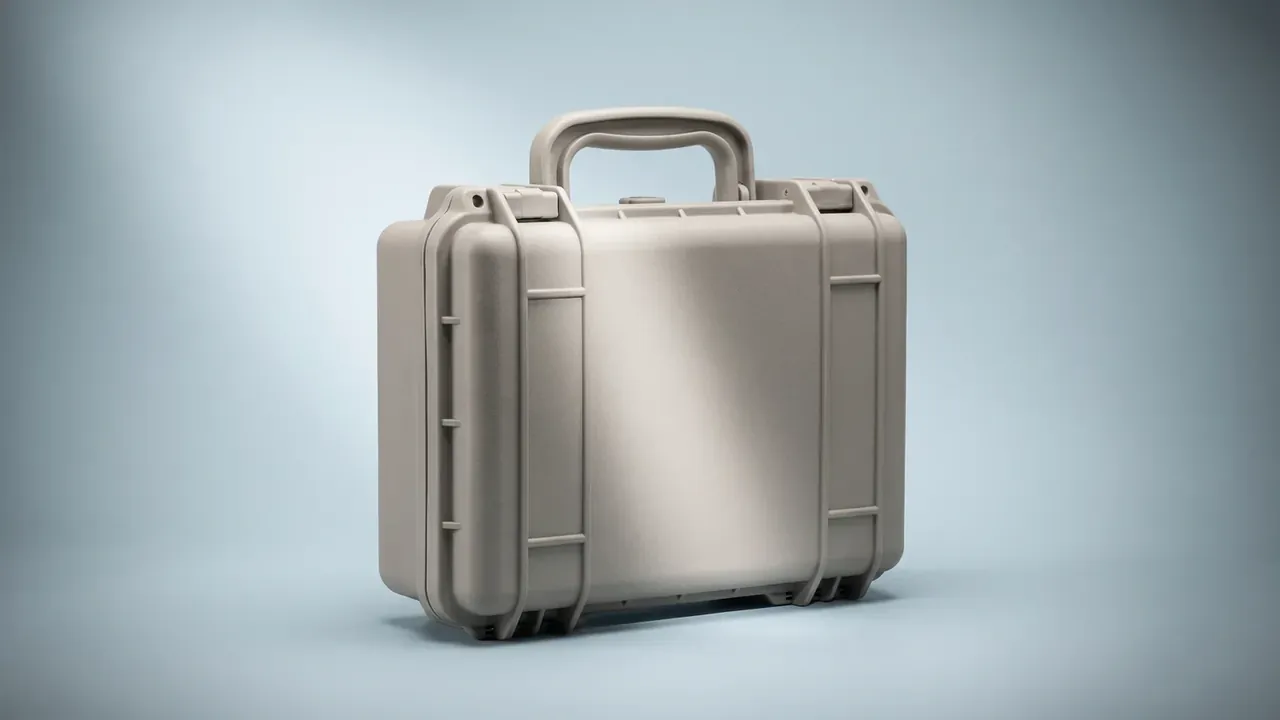
Below 30 units, welded steel wins: no mould charge, priced per piece, but every weld needs dressing. Above 500, rotomoulding gives a seamless body and an amortised mould. Injection pays only above 2,000.
Negotiate the split, not the unit price: three batches of 1,000 still amortise over an annual 3,000, while squeezing batch one to 200 means recovering the gap in wall thickness.
3. Tooling and Sample Charges: Cost and Credit
An aluminium rotomould costs 35,000 to 60,000, a two-cavity version 30 percent more, an injection mould 120,000 to 250,000 with 20,000 to 40,000 per extra slider.
Sample charges run 2,000 to 5,000 for two or three trial units and first-mould debugging, usually credited in full once the first order reaches 300 units, sometimes across three invoices.
Ownership has to be stated: once paid, the mould belongs to the buyer, and after 12 months without an order the buyer may ask for transfer.
4. The Five-Part Lead Time
Lead time for an explosive storage box is five stages added together. When a supplier says 35 days, ask which day the count starts.
| Stage | Days | Output | Usual delay |
|---|---|---|---|
| Enquiry to quote | 2 to 3 | Quote, tooling plan | Thin drawings |
| Trial, first mould | 16 to 23 | Two or three samples | Sample queue |
| Production | 20 to 28 | First batch | Purge, resin delivery |
| Testing | 7 to 12 | Drop, stack, seal reports | Lab booking |
| Shipping | 3 to 5 | Packing list, papers | Fumigation, space |
Testing is the stage that gets squeezed: a laboratory round trip takes 7 to 12 days, so it runs beside production. Trial and first mould are two rounds, one proving dimensions, the other shrinkage.
Stage the schedule: first batch 25 days after sample approval is enforceable, a 35-day delivery is not.
5. Certificates Tied to Payment Milestones
Certificates carry weight only when tied to payment and lot release. The pack holds five items: business licence, quality certificate, resin batch reports, product test reports and export classification. The report must name the producer or buyer, and the model must match the contract.
Payment runs 30/60/10: thirty on sample approval, sixty on passing pre-shipment inspection with a complete file, ten as retention released 90 days after delivery. A failed lot waits for retest, and two failures let the buyer reclaim unamortised tooling.
Conclusion
Procurement comes down to three figures: units absorbing the tooling, the MOQ threshold, and days allowed for testing. Split the quote into four lines, put the amortisation basis in the contract, and tie payment to a complete file. Handled that way, explosive storage box sourcing stays under control from enquiry to delivery.
This article discusses only the container (case body) side of specifications and design intent, and does not cover any handling, loading or use of the contents.
Related Reading
- Acceptance criteria and verdict rules for an explosive storage box
- Explosive storage box dimensions, wall thickness and load ratings
- How an explosive storage box compares with alternatives
- Enquiry steps in the explosive storage case procurement flow
Related Products
- 8 Series — Gun Cases; Military Equipment Cases; Camera Equipment Cases; Drone Cases; Watch Cases; Knife Cases; First Aid Cases; Electronics Equipment Cases
- WL8-2812 PP Gun Case — model WL8-2812
- All protective cases and toolboxes: 7 series, 158 models