

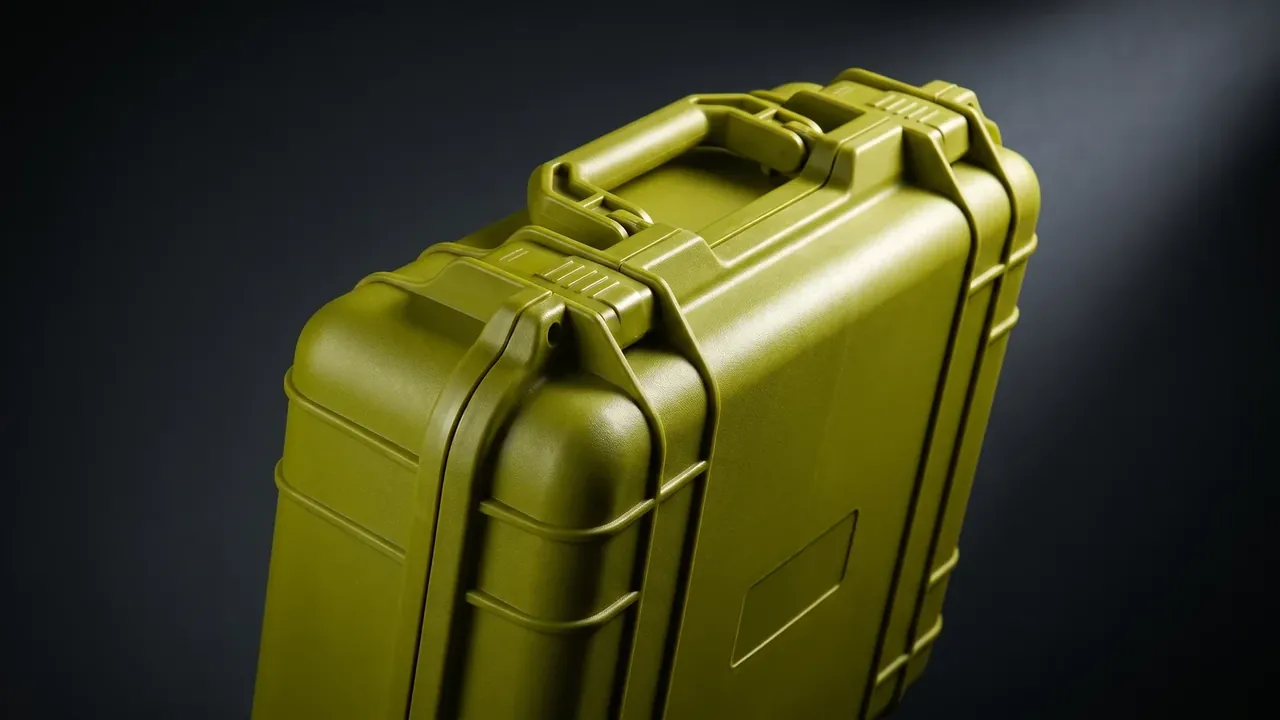
Quick answer: Acceptance rests on three decisions: which document governs the verdict, how test items are graded, and how many units to sample. Critical items fail a lot on one defect, major items run at AQL 1.0, minor items can pass with a price cut.
Table of contents
- Where an Explosive Storage Box Acceptance Starts
- Visual Checks and Sampling Ratios
- Dimensional Verdicts and Fit Tolerance
- Reading and Retaining Test Reports
- Verdicts and Disposition
- FAQ
1. Where an Explosive Storage Box Acceptance Starts
Most disputes begin with the wrong document: buyers reach for a general standard, then hunt for a clause that fits. The order that works is contract annex, drawing and signed sample, general standard only where those are silent.
Three conditions apply before the first measurement: a signed sample of three units from one batch and mould, tools inside a 12-month calibration window, and a case rested four hours at 23 ± 5 °C.
| Grade | Test items | Sampling | Failure rule |
|---|---|---|---|
| Critical | Latch force, thinnest wall, seal contact, handle load | 3 units per lot | One defect rejects the lot |
| Major | Internal length, lid gap, flatness, colour | AQL 1.0 | Above the limit rejects the lot |
| Minor | Scratches, flash, print, label | AQL 2.5 | Price adjustment allowed |
2. Visual Checks and Sampling Ratios
Visual inspection needs reproducible conditions: D65 light, 500 lx minimum, 500 mm viewing distance, sight line at 45 degrees. Without them, slight scratch means whatever the inspector decides. Fix the scale: scratches under 10 mm long and 0.2 mm wide, two per face at most; anything over 30 mm fails; flash above 0.3 mm counts as major.
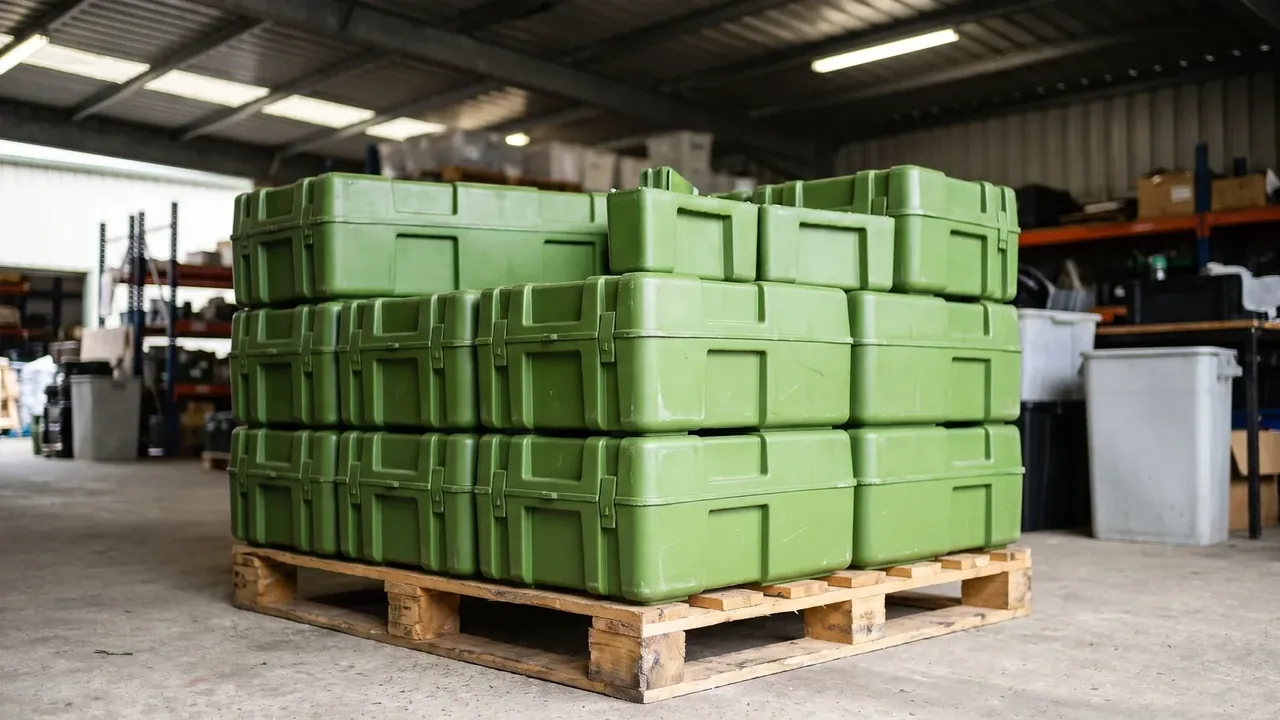
Sample an explosive storage box lot this way: up to 500 units take 8, up to 1,200 take 13, above that 20, doubled after a rejection. Draw from top, middle and bottom of the pallet, or every stacking bruise slips through. Log resin batch, density and melt index alongside; a regrind share above 20 percent drags wall uniformity and low-temperature impact down.
3. Dimensional Verdicts and Fit Tolerance
Dimension checks are not a pass-or-fail switch. The middle verdict, accept with concession, stops a half-millimetre deviation from returning a lot while still blocking anything that disturbs assembly or sealing.
| Item | Nominal | Pass band | Concession band |
|---|---|---|---|
| Internal length | 820 ± 2.0 mm | 818.0 to 822.0 mm | 817.0 to 818.0 mm |
| Lid gap | 1.5 mm max | 0.3 to 1.5 mm | 1.5 to 2.0 mm |
| Thinnest wall | 6.0 mm nominal | 5.4 mm minimum | 5.2 to 5.4 mm |
Measure lid gap with a feeler gauge every 200 mm around the rim, worst point recorded. Above 1.5 mm it usually means under-torqued latches or a misaligned parting line, so adjust and re-measure before writing a verdict. Wall thickness uses six points, four corners plus each long-side midpoint, sliced and ultrasonic readings within 0.1 mm.
4. Reading and Retaining Test Reports
A report that can carry a verdict survives four questions: is the addressee the producer of this lot, do sample number and model match the contract word for word, are temperature, drop height, stacking load and hold time stated, and is there a signed verdict?
Validity runs 24 months, only while resin grade, wall thickness and latch model stay unchanged; change one and the old report lapses. Keep paper and scan five years, one physical unit per lot for 12 months with lot, mould and date on the tag.
5. Verdicts and Disposition
Three verdicts exist: accept, accept with concession, reject; a fourth path, rework then reinspect, covers replaceable parts.
| Verdict | Trigger | Action | Record |
|---|---|---|---|
| Accept | No critical defect, majors within limit | Label and store by lot | Kept five years |
| Concession | Minors only, seal and load unaffected | 3 to 8 percent price cut | Retest in 30 days |
| Reject | Two critical defects or no report | Return the lot | Notice in 7 working days |
Tightened inspection belongs in the contract: after a first rejection the next explosive storage box lot is sampled at double the count and one AQL step tighter, back to normal after three clean lots.
Conclusion
An acceptance standard earns its keep when the same case yields the same verdict in two hands. Fix the document order, grade the test items, sample by lot, keep a concession band, and hold reports and samples for their stated terms. Done that way, every explosive storage box acceptance becomes defensible.
This article discusses only the container (case body) side of specifications and design intent, and does not cover any handling, loading or use of the contents.
Related Reading
- Explosive storage box dimensions, wall thickness and load ratings
- How the explosive storage box body is built and moulded
- Routine checks and retest intervals for an explosive storage box
- How standards for explosive containment products are layered
Related Products
- 8 Series — Gun Cases; Military Equipment Cases; Camera Equipment Cases; Drone Cases; Watch Cases; Knife Cases; First Aid Cases; Electronics Equipment Cases
- WL8-2812 PP Gun Case — model WL8-2812
- All protective cases and toolboxes: 7 series, 158 models