

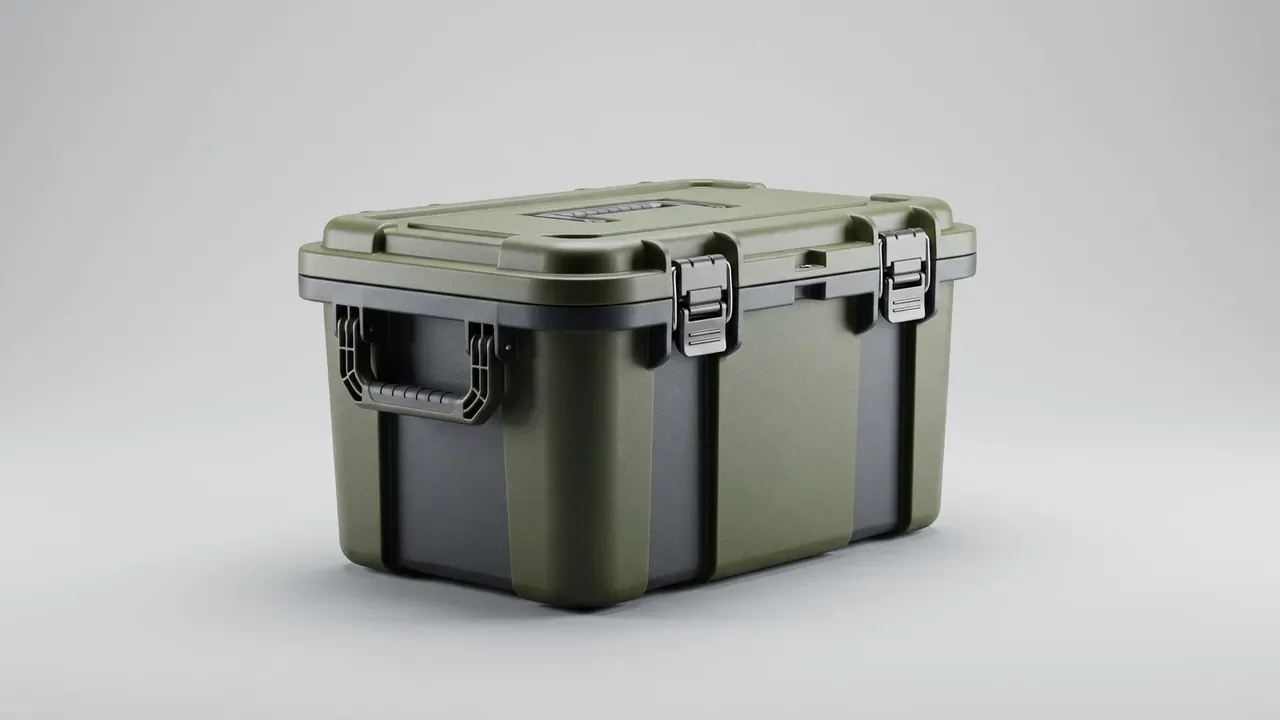
Quick answer: An explosive storage box is decided by five parts: a three-layer body, an earth stud, four flame figures, a vent sized by volume, and two independent lock points.
Table of contents
- Three layers in the case body
- Static control and earthing
- Four flame retardance figures
- Vent area and vent position
- Locks and liner working together
- FAQ
1. Three layers in the case body
An explosive storage box is three layers, not one shell: the wall takes impact, the ribs take stacking load, the liner holds position.
| Layer | Form | Figure |
|---|---|---|
| Wall | One-piece rotomoulding | 6 to 8 mm, tolerance 0.8 |
| Ribs | Moulded in, 180 mm pitch | Cross pattern at base |
| Liner | Foam or conductive bubble | 30 kg per cubic metre |
There is no weld in a one-piece body. A welded case has a heat affected zone either side of the seam, where cracks start on impact; an R25 corner spreads stress into the side wall. Past 10 millimetres, extra wall only adds weight to the case underneath.
The lid face is the sealing datum: flat within 0.5 millimetres and gasket compression of 25 to 30 percent.
2. Static control and earthing
Polyethylene insulates at 10 to the 14 up to 10 to the 16 ohm, so friction charge leaves through the hand that opens the lid. An explosive storage box has to give it a path.
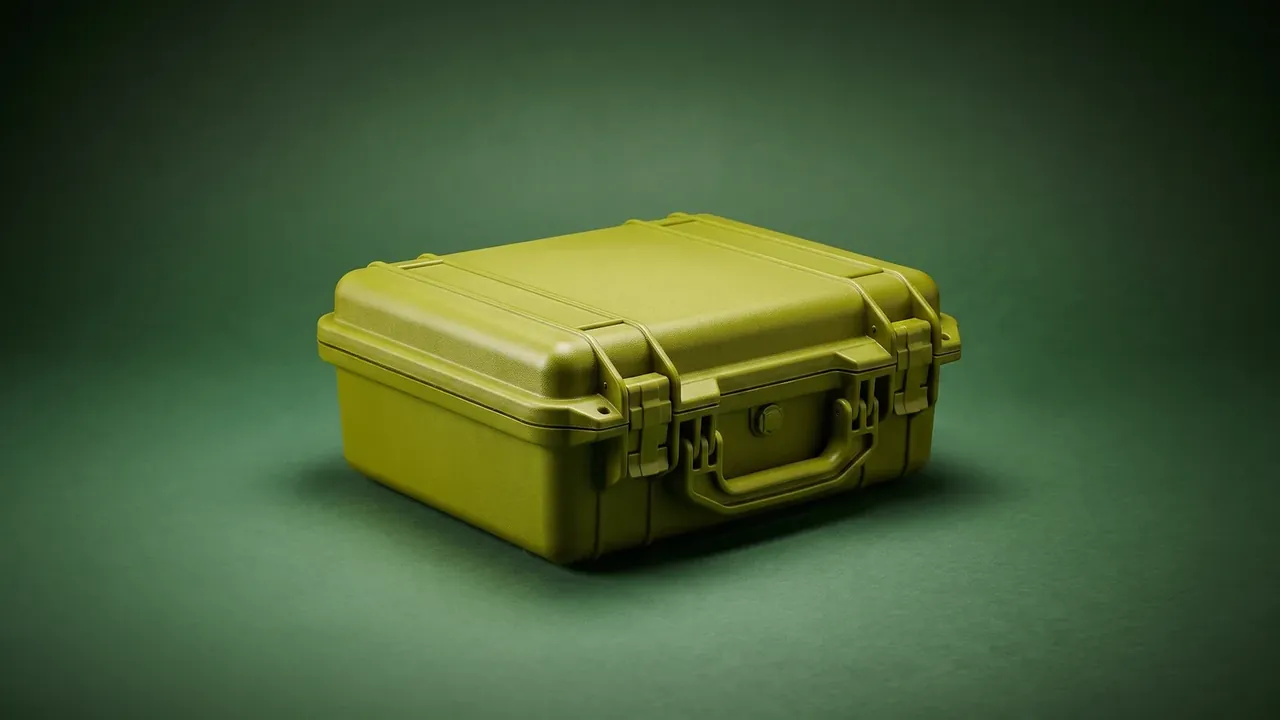
Carbon black gives a conductive grade at 10 to the 3 up to 10 to the 6 ohm for ten percent more cost; antistatic masterbatch gives a dissipative grade at 10 to the 6 up to 10 to the 9 ohm for five to eight percent. The first lasts, the second decays in a dry store.
The earth stud is an M8 stainless bolt through a reinforced area, copper braid inside, a 20 millimetre pad outside. Acceptance is 4 ohm with the paint ground off. Earth the case before opening, and put that step in the procedure.
3. Four flame retardance figures
Retardance is four measurable figures, and they only mean something read together.
| Figure | Typical requirement | Method |
|---|---|---|
| Oxygen index | At least 28 percent | 120 by 10 by 4 mm bar |
| Vertical burn | UL94 V-0 | Two 10 second ignitions |
| Self-extinguish | Within 5 seconds | Clock after flame removal |
| Smoke density | Low | Chamber, light transmission |
Masterbatch needs 6 to 8 percent and takes ten to fifteen percent of impact strength with it. Compensate with half a millimetre more wall, not more masterbatch: past 12 percent the case cracks first.
Retardance covers the case body. What sits inside burns on its own terms, and the two are reported separately.
4. Vent area and vent position
A 200 litre explosive storage box sees 5 to 8 kilopascals of internal change across a 40 degree day-night swing, and the release at opening carries dust out while static may still be there.
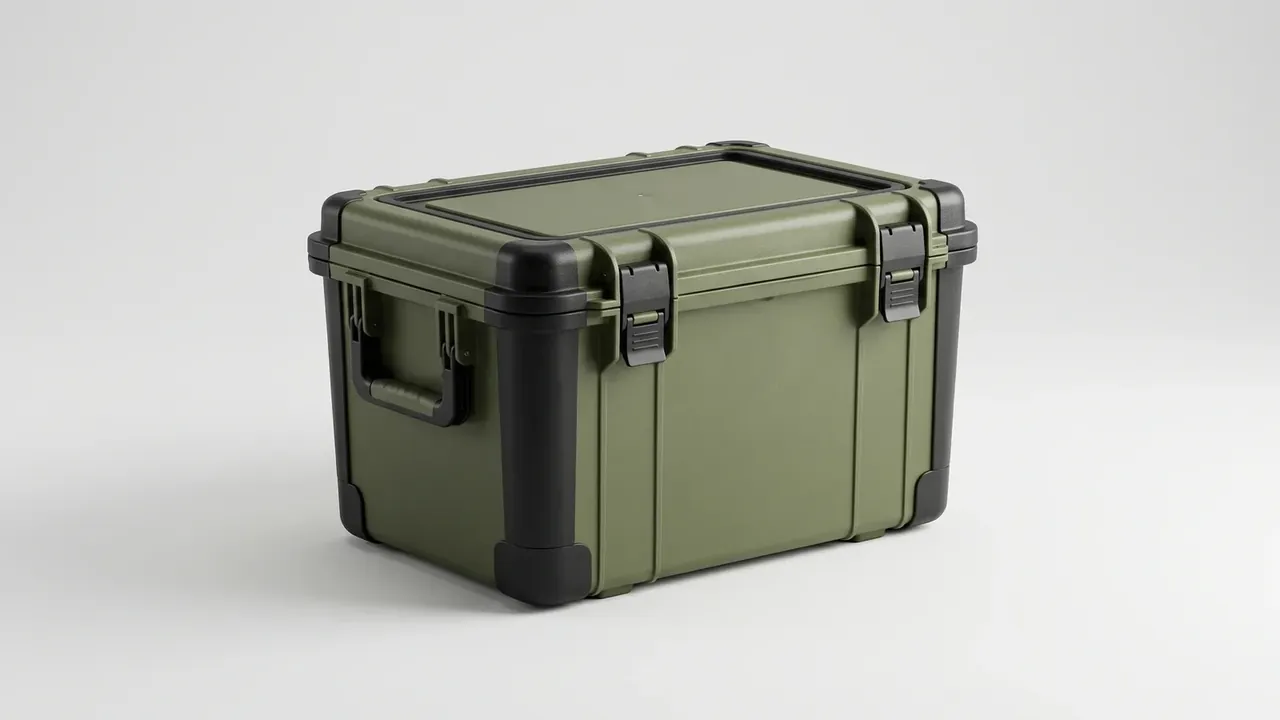
Vent area is 0.02 square metres per cubic metre, so 200 litres gets about 40 square centimetres, a 70 millimetre circle. Cracking pressure sits at 10 to 15 kilopascals: lower and vibration opens it, higher than 20 and it protects nothing.
Place it on the lid near the middle of a long side, clear of latches and handles. The membrane passes gas, not vapour, and is replaced yearly.
5. Locks and liner working together
Two-person locking means two independent hasps: open either and the lid still will not lift. Each sits in a reinforced area with 4 millimetres of wall behind it.
| Item | Practice | Check |
|---|---|---|
| Hasps | Two, independent | Visual |
| Spacing | At least 60 mm | Caliper |
| Shackle | 8 mm | Caliper |
| Keys | Two holders, numbered | Log |
Compartments follow the load outline with no more than 2 millimetres of play; more and the load shifts, sending impact into the wall. The earth stud and vent stay reachable.
An over-thick liner pushes the lid up, the latch needs force, and the hasp fatigues. Read closing effort at sign-off, 80 newtons per latch at most, and thin the liner.
Conclusion
Five sentences cover the explosive storage box: three layers separate impact, stacking and location; the stud takes static out; retardance is four figures, not one claim; the vent is sized by volume; locking rests on two independent points. Each is measurable, and that measurability is the specification of a working explosive storage box.
This article discusses only the container (case body) side of specifications and design intent, and does not cover any handling, loading or use of the contents.
Related Reading
- Choosing and configuring an explosive storage box
- Explosive storage box compared with other options
- Typical applications for explosive storage cases
- Routine maintenance of explosive storage cases
Related Products
- 8 Series — Gun Cases; Military Equipment Cases; Camera Equipment Cases; Drone Cases; Watch Cases; Knife Cases; First Aid Cases; Electronics Equipment Cases
- WL8-2812 PP Gun Case — model WL8-2812
- All protective cases and toolboxes: 7 series, 158 models