

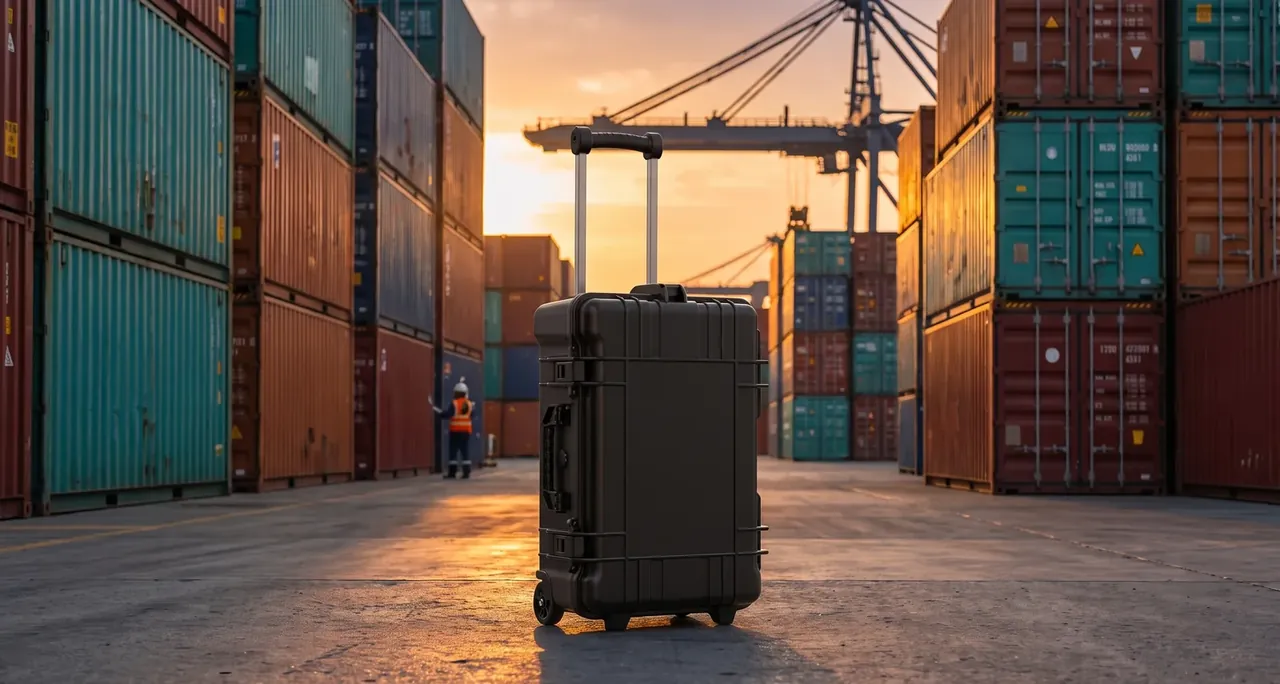
Quick answer: Case export pricing runs USD 52.00 EXW to USD 66.00 CIF on one case, and the USD 14.00 gap is trucking, customs, freight and insurance.
Table of contents
- Where the five cost lines sit
- Trucking and customs
- Ocean freight: 20GP vs 40HQ
- Why insurance is USD 0.22
- FX, BAF and validity
- FAQ
1. Where the five cost lines sit
One 700 x 480 x 380 mm carton holds one wheeled hard case, 9.8 kg net and 11.2 kg gross, and 200 pieces price at USD 52.00 ex-works. Quoting CIF adds four lines on the way to the destination port: trucking USD 1.80, customs and documents USD 1.20, ocean freight USD 10.78, insurance USD 0.22. Together they make USD 14.00, which puts CIF at USD 66.00.
| Cost line | USD per case | Base | Stage |
|---|---|---|---|
| EXW price | 52.00 | 200 cases, one lot | Factory gate |
| Inland trucking | 1.80 | USD 360 per 20GP / 200 | Factory to port |
| Customs and documents | 1.20 | USD 240 per entry / 200 | Export port |
| Ocean freight | 10.78 | USD 2,156 per 20GP / 200 | Port to port |
| Insurance | 0.22 | 66.00 x 110% x 0.3% | Door to door |
| CIF total | 66.00 | — | Destination port |
The bases do not match: trucking per box, customs per entry, freight per box, insurance at 110% of the CIF value times 0.3%. Add them without dividing and the unit price drifts, moving USD 4 between a 100-piece and a 500-piece lot.
Dividing by piece count is the step most quotes skip. USD 600 of fixed cost inside one box is USD 3.00 per case at 200 pieces and USD 1.15 at 520.
At 100 pieces it is USD 6.00.
2. Trucking and customs
Trucking is priced per box, not per case. The 180 km run costs USD 360 one way for a 20GP, pick-up, a 4-hour gate wait and return included, which is USD 1.80 at 200 cases and USD 3.60 at 100.
Customs and documents run USD 240 per entry — broker 150, origin certificate and packing list 60, telex release 30 — so USD 1.20 per case at 200 and USD 0.46 at 520.
The three fixed lines total USD 600. This is the only block in case export pricing that ignores goods value. That is why a 100-piece and a 500-piece quote for the same case diverge here, not at the factory. Ask for box type and piece count before comparing unit prices, or the USD 6.00 against USD 1.15 spread will mislead.
Fixed cost is divided once and then stops moving.
3. Ocean freight: 20GP vs 40HQ
A 200-case lot fills 25.5 m³ of a 20GP's 33 m³, 77% occupancy. At USD 2,156 per box the unit rate is USD 10.78, the one line in case export pricing where volume works against the shipper.
| Box type | Cases loaded | Freight USD | USD per case | vs 20GP |
|---|---|---|---|---|
| 20GP | 200 | 2,156 | 10.78 | Baseline |
| 40HQ, full | 520 | 3,240 | 6.23 | −4.55 |
| 40HQ, part load | 300 | 3,240 | 10.80 | +0.02 |
A 40HQ holds 68 m³ and takes 520 of the same cartons at USD 3,240, or USD 6.23 per case. The USD 4.55 difference comes entirely from 35 m³ of unused space, nothing from the case.
Break-even is 300 cases: 3,240 divided by 10.78 gives 300.6. Below 300 a 40HQ costs more per case, above it the larger box saves money. Book a 20GP at 200 cases, a 40HQ at 380, and treat the 80-case band between them as negotiable.
Volume binds, not weight: the lot weighs 2.24 t against a 28 t limit.
Freight is repriced every two weeks, so the booking week changes the number. USD 2,156 against USD 2,380 is USD 1.12 per case at 200 pieces, and dropping 13 cases pushes the rate from 10.78 to 11.53.
4. Why insurance is USD 0.22
Insurance is the CIF value times 110% times 0.3%: 66.00 x 1.1 x 0.003 = 0.2178, or USD 0.22. The base is CIF because the freight portion needs cover; on 52.00 the same formula gives 0.17.
A USD 100,000 shipment carries USD 330 of premium, while the 200-case lot at USD 13,200 carries USD 43.56. Small, and yet it sets the claim ceiling.
Listing it separately in case export pricing tells the buyer two things: the money is not margin, and the insured amount is 110% of value. Paying USD 0.05 per case buys a claim base of USD 72.60 instead of 52.00.
USD 0.22 is negligible; the ceiling it fixes is not.
The rate has a band too: 0.3% against 0.45% differs by USD 0.11 per case, and trimming it trims the recovery.
5. FX, BAF and validity
Case export pricing is written in dollars while the cost sits in renminbi. CNY 370 becomes USD 51.97 at 7.12 and USD 51.18 at 7.23, so a 1.5% move costs USD 0.79 per case, USD 158 across 200.
BAF adds USD 180 per 40HQ in peak season, USD 0.35 over 520 cases; USD 150 per 20GP spreads to USD 0.75 over 200.
The 30-day validity is calculated, not conventional. Freight is repriced every two weeks, so 30 days spans two rounds; a 1.5% FX move inside a month is likely; trucking and customs reset once a year. Two of the three will move.
The clause stays short: valid 30 days, renegotiate above USD 150 per box of freight or below 7.20. That is easier to accept than a 3% buffer hidden in the unit price.
A 60-day validity lifts the buffer from USD 0.60 to USD 1.20 per case, USD 120 extra on 200 pieces.
Conclusion
The order of work in case export pricing is fixed: list the EXW price and the four route costs separately, then choose the basis. On a 200-case lot freight is 10.78 of the 14.00 gap, and the lever is box type or lot size; the 3.00 of fixed cost only answers to volume, falling to 1.15 between 200 and 520 cases. FX and BAF sit on a third layer, held by a 30-day validity and two trigger lines rather than a buffer buried in the price. The same case is USD 6.40 cheaper at 520 pieces than at 200. The table below drops straight into a quotation sheet.
| Basis | Build-up, USD per case | Unit price | Drifts in 30 days |
|---|---|---|---|
| EXW | Factory price 52.00 | 52.00 | None |
| CIF, 200 cases, 20GP | 52.00 + 1.80 + 1.20 + 10.78 + 0.22 | 66.00 | Freight ±1.00 |
| CIF, 520 cases, 40HQ | 52.00 + 0.69 + 0.46 + 6.23 + 0.20 | 59.60 | Freight ±0.60 |
This article discusses container-side specifications and design implications only, and does not cover any handling, loading or use of the contents.
Related Reading
- Writing an FX clause into a quotation
- Case weight and freight conversion
- What a protective case quotation includes
- Sea freight cost structure for outdoor cases
Related Products
- 8 Series — Gun Cases; Military Equipment Cases; Camera Equipment Cases; Drone Cases; Watch Cases; Knife Cases; First Aid Cases; Electronics Equipment Cases
- WL8-2812 PP Gun Case — model WL8-2812
- All protective cases and toolboxes: 7 series, 158 models