

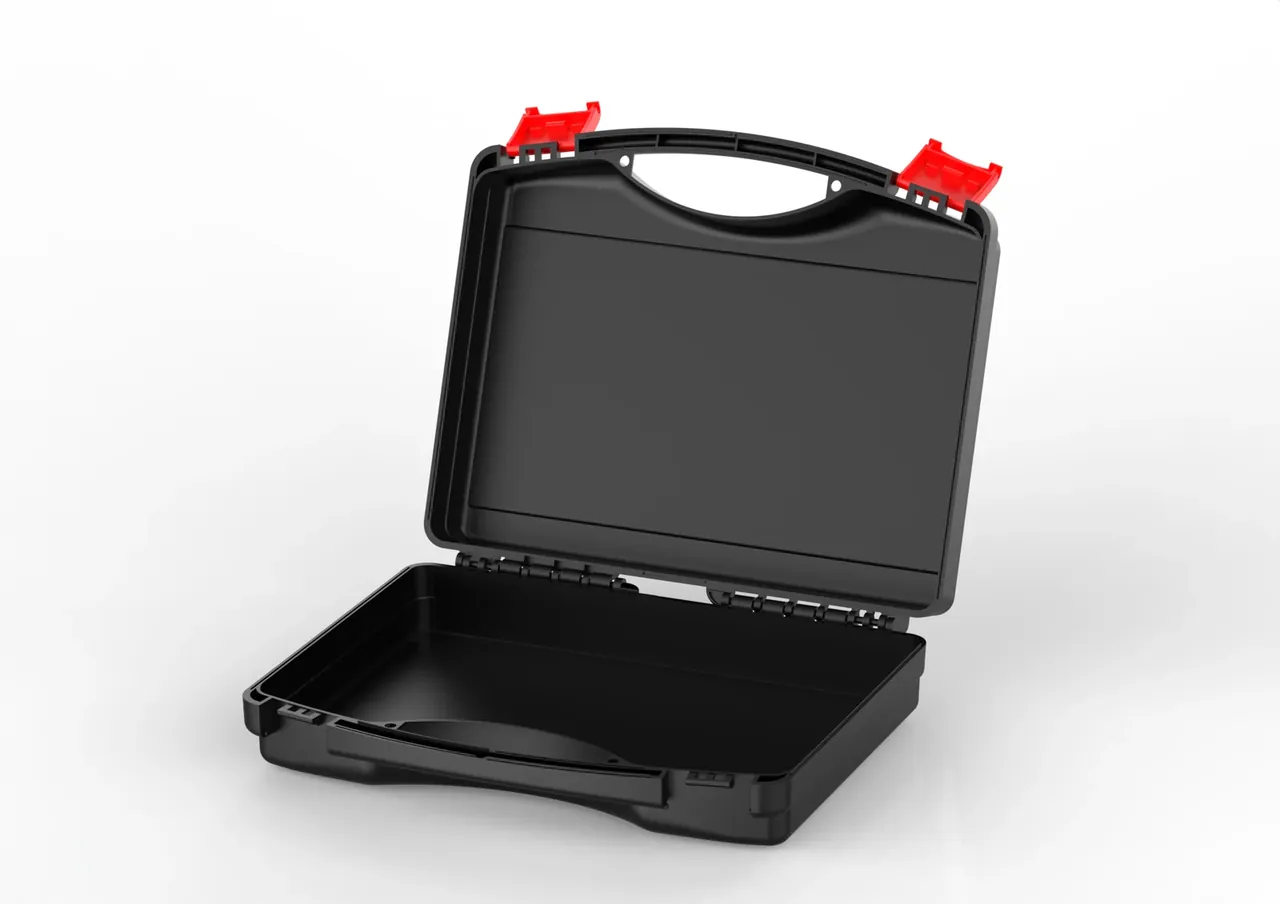
Quick answer: A usable Case Quote splits into four priced layers — material, moulding, hardware and foam — which hold 88% to 94% of the ex-works price, so ask for the split before comparing totals.
Table of contents
- Four layers behind one Case Quote
- Material: grade, shot weight, regrind cap
- Moulding: tonnage, wall thickness, cycle
- Hardware and foam: by set and by density
- Missing lines and Incoterms
- FAQ
1. Four layers behind one Case Quote
A Case Quote arrives as one number built from four units that never convert: material per kilogram, moulding per shot, hardware per set, foam per square metre. The usual shares are 38% to 46%, 22% to 30%, 14% to 20% and 8% to 14%.
Take a 45 litre case at 118 per unit. Material takes 46, moulding 30, hardware 20, foam 13, leaving 9 for packing and sampling. When hardware falls quietly from 20 to 14, nothing looks wrong until latches loosen at 6000 cycles.
| Layer | Priced per | Typical share | Write on the quote |
|---|---|---|---|
| Material | kilogram | 38% to 46% | Grade, melt index, regrind cap |
| Moulding | shot | 22% to 30% | Tonnage, cavities, cycle seconds |
| Hardware | set | 14% to 20% | Latch cycles, valve membrane |
| Foam | square metre | 8% to 14% | Density, die ownership |
Only moulding and foam hold real slack.
2. Material: grade, shot weight, regrind cap
The material line is hardest to audit because it is usually one word. PP against PP copolymer at 9 g/10min melt index differs by 2.8 per unit, and a thin Case Quote will not say which you got.
A 45 litre body weighs 3.6 kg. At 9.4 per kilogram the resin costs 33.8, less 1.2 of sprue, so 32.6. Each 1 per kilogram move shifts the unit by 3.7, hence the resin price date.
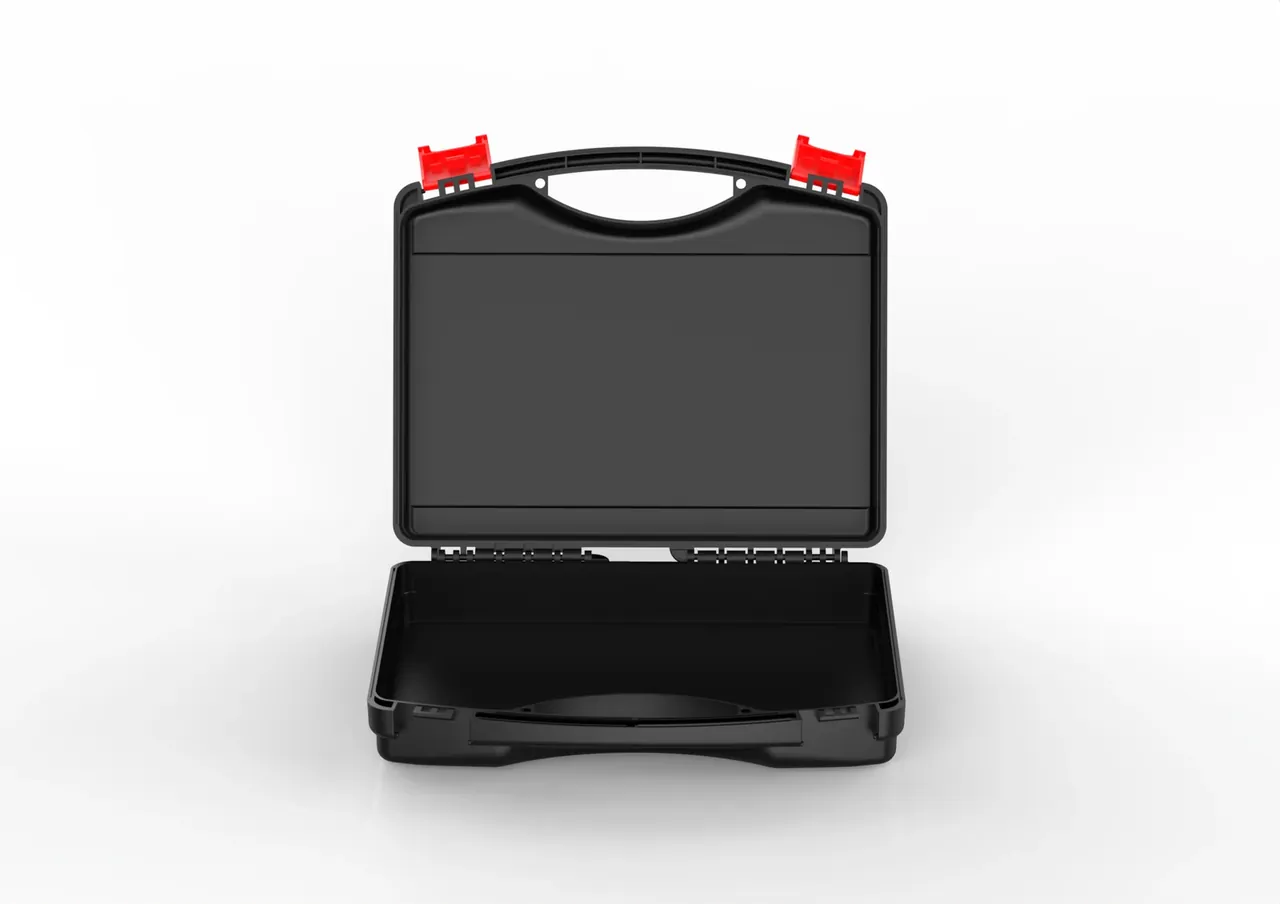
Regrind is the second opening. At 20% the drop height falls from 1.2 m to 0.9 m; at 30% corners split at -20°C. Demand 80% virgin content and in-house sprue only.
ABS takes a gloss without painting at 1.6 per kilogram more, while HDPE holds impact at -40°C but needs ribs above 60 litres.
3. Moulding: tonnage, wall thickness, cycle
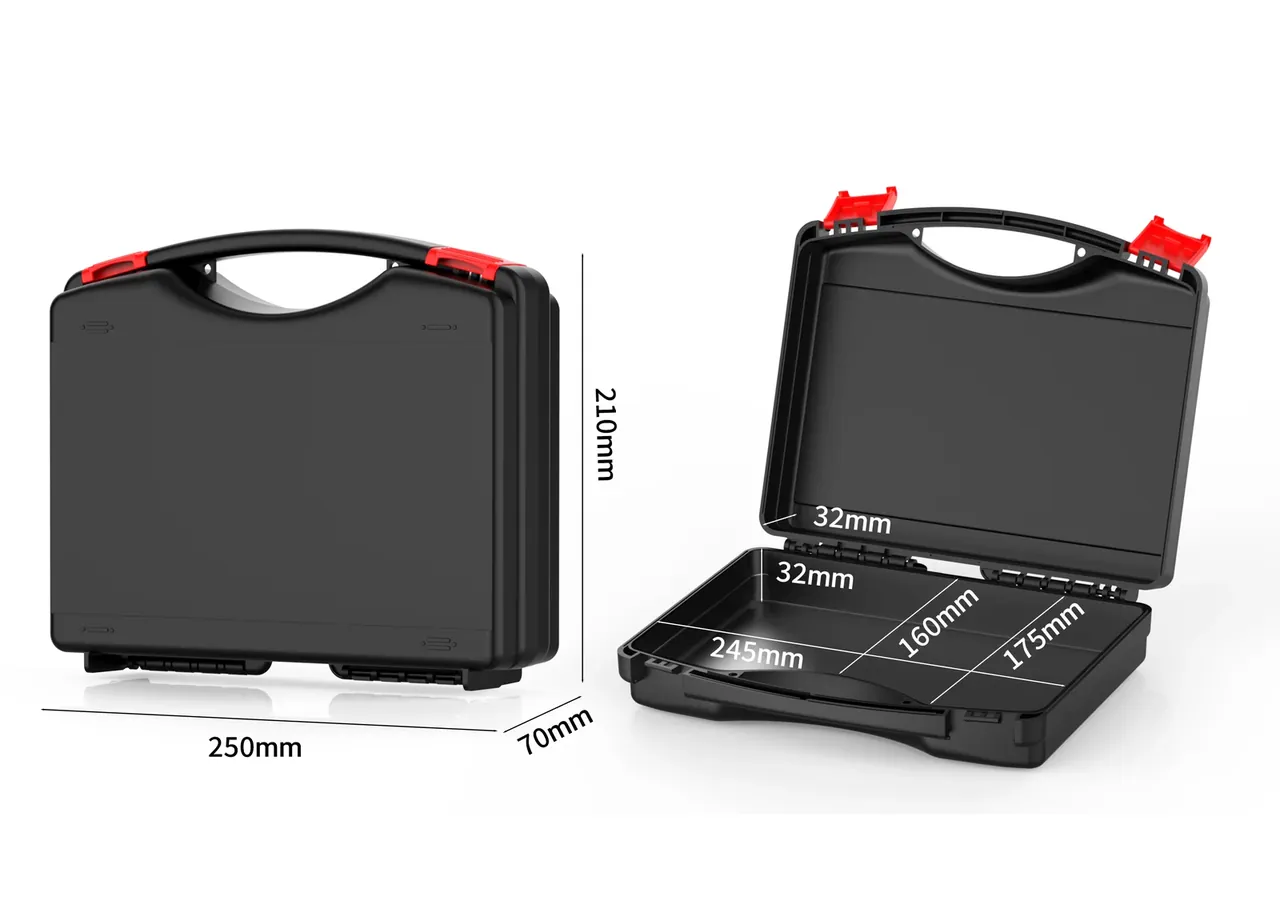
Moulding cost lives in the machine. A 45 litre body projects 0.18 square metres, so 450 kg per square centimetre of clamp leaves a 900 tonne press comfortable; at 1100 tonnes the hourly rate moves from 210 to 280, adding 1.9 per unit.
Cycle time is the second lever. At 3.2 mm wall and 26 seconds of cooling the cycle runs 95 seconds, or 37 cases an hour; at 2.6 mm it falls to 74 seconds and 48 cases, saving 1.3 per unit while wall compression drops from 780 N to 540 N.
Above 80 litres the work goes to rotomoulding: 6 mm wall, 22 minute cycle, about 60 pieces a day. The tool is cheaper but trimming adds 4 per unit.
Ask for four lines inside moulding: machine hours, trimming and assembly, energy, depreciation.
4. Hardware and foam: by set and by density
Hardware is quoted by set: two latches, a hinge pair, a handle, a pressure valve, four feet, screws and inserts. At 1.9 per latch, 2.6 per hinge pair and 4.5 per valve, a set lands near 18.
Cycle rating splits the price: a latch rated at 8000 cycles costs 1.2, one rated at 15000 costs 1.9.
Foam is priced by density and area. EVA at 38 kg/m³ runs 62 per square metre against 88 at 60 kg/m³, so one insert layout can move 42%. The die costs 1400 per set, and a 1.2 by 2.4 m board yields ten inserts.
Density is not a quality score: 38 kg/m³ already carries an 8 kg point load.
5. Missing lines and Incoterms
Six items drop off a Case Quote most often: 13% VAT, mould cost, sample charge, print tooling, packing and inland freight. The first four get waved through as extra, the last two fold into the unit price.
A sample runs 800 to 1500, print tooling 600 per colour, packing 3.2 per unit, none of it inside the unit price.
EXW excludes export clearance, FOB adds inland transport and port charges, CIF adds freight and insurance. The spread between them reaches 4% to 7% on one case.
| Missing line | Usual wording | Separate row | How to check |
|---|---|---|---|
| VAT | included or excluded | Always | 13%, invoice type |
| Mould | inside unit price | Always | Cavities, ownership |
| Sample | free of charge | Recommended | 800 to 1500, credited |
| Print tooling | not mentioned | Recommended | 600 per colour |
| Freight | collect | Always | EXW, FOB or CIF |
A quote worth signing lists at least four of those five as separate rows.
Conclusion
Read a Case Quote in three passes: the four way split, the six missing lines, then the Incoterm. The supplier who answers all three is rarely cheapest per unit, yet the total lands within 3% of plan, while a single number gives back the 4 saved through mould cost and print tooling.
This article discusses only the container (case body) side of specifications and design intent, and does not cover any handling, loading or use of the contents.
Related Reading
- Cost checks when buying from a custom plastic case manufacturer
- Choosing an OEM protective case
- Density and layout of custom foam inserts
- Rotomoulded cases against the alternatives
Related Products
- 8 Series — Gun Cases; Military Equipment Cases; Camera Equipment Cases; Drone Cases; Watch Cases; Knife Cases; First Aid Cases; Electronics Equipment Cases
- WL8-2812 PP Gun Case — model WL8-2812
- All protective cases and toolboxes: 7 series, 158 models