

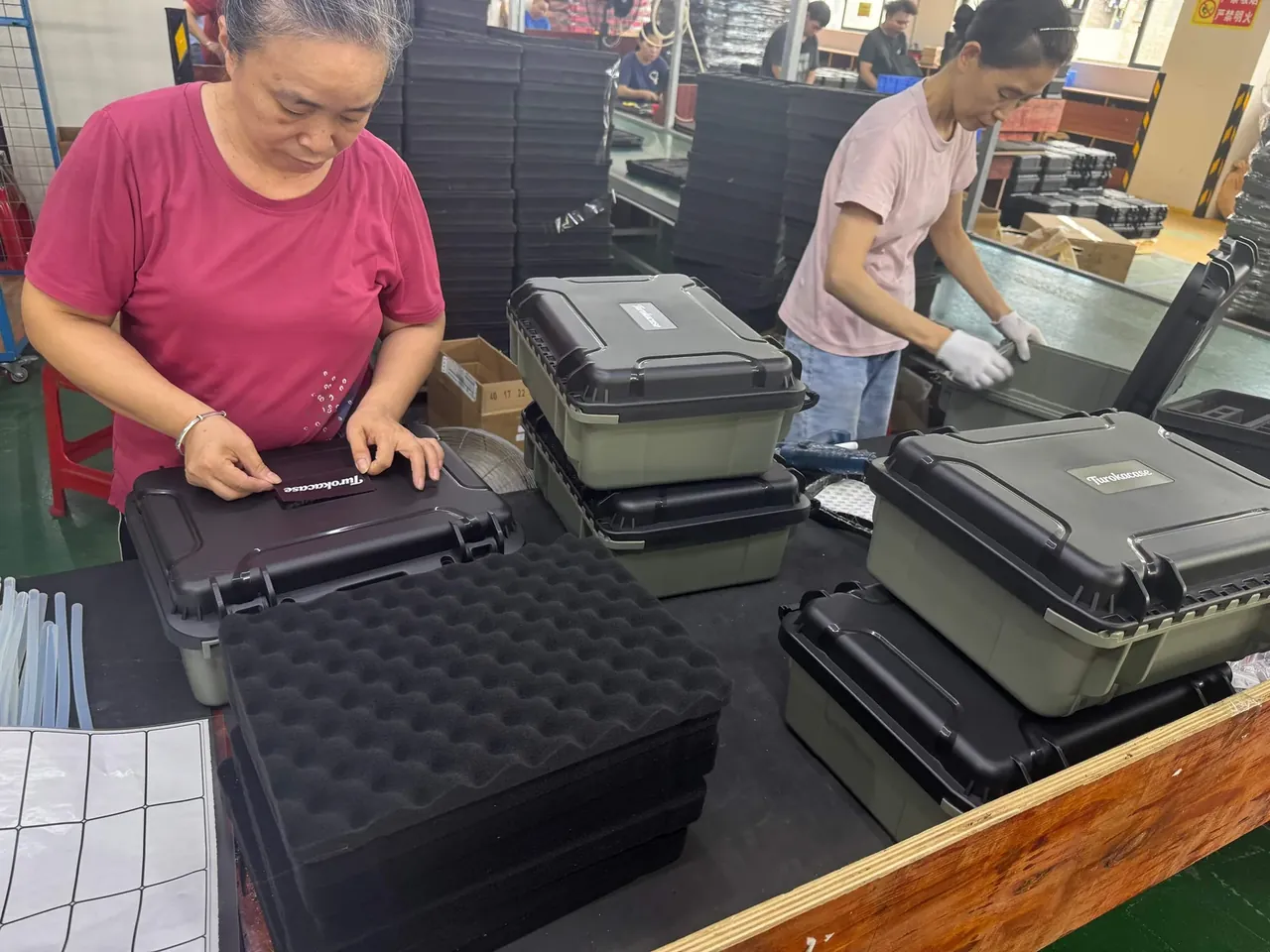
Quick answer: Factory multi-layer compartment tool storage box: 560×400×330 mm outside, 510×350×280 mm inside, three trays at 6 kg each, twelve cells of 55×70×45 mm.
Table of contents
- Two ledgers inside the factory multi-layer compartment tool storage box
- 18 kg through the factory multi-layer compartment tool storage box
- Twelve cells of 55×70×45 mm
- The 2.5 actions behind one pick
- Stacking 5 high, a 1.0 m drop and IP54
- FAQ
1. Two ledgers inside the factory multi-layer compartment tool storage box
More compartments is not automatically better. Trays decide how many slices come out of 280 mm of height, cells decide how finely each slice is cut. Every extra tray costs 40 mm of structure plus 45 mm of clear height, every extra column costs 55 mm of length. Only two figures survive: 45 mm clear height, 55 mm clear width.
The factory multi-layer compartment tool storage box measures 560×400×330 mm outside with a 3.5 mm wall, 510×350×280 mm inside, 5.2 kg empty. The stack came first: 3×(40+45)=255 mm, 25 mm for the lid pad, outside closed at 330 mm.
Table 1: how the trays divide the height
| Tray level | Load per tray | Cell layout |
|---|---|---|
| Upper | 6 kg | 4 columns × 2 rows, 8 cells of 55×70×45 mm |
| Middle | 6 kg | 6 columns × 2 rows, 12 cells of 55×70×45 mm |
| Lower | 6 kg | two full-length slots, 170×210 mm free |
The 6 kg per tray is a ceiling, not an average. Past it the 2 mm fillet at a lug root fails before the tray does.
2. 18 kg through the factory multi-layer compartment tool storage box
Each tray is a 3.5 mm PP pan on four lugs moulded into the wall, 45 mm above the box floor. At 6 kg evenly spread it sags 1.5 mm at most; half a millimetre more opens a gap between cell wall and shell.
Off-centre load is the common case: 6 kg in one cell puts about 15 kPa on a 3850 mm² floor, so the floor goes from 1.0 mm to 1.2 mm with a 1.5 mm upstand. Load 18 kg plus 5.2 kg of shell is 23.2 kg, a 227 N pull on the 400 N handle, a margin of 1.76.
Table 2: four ways one tray meets load
| Load per tray | When it happens | Tray response |
|---|---|---|
| 6 kg even | all cells filled evenly | sag ≤1.5 mm, no gap |
| 6 kg in a corner | heavy parts in one cell | 15 kPa, 1.2 mm floor |
| 18 kg transient | 1.0 m drop on a corner | lug in shear, 30 N point |
| 90 kg long term | stacked 5 high, 3 months | creep ≤0.8 mm |
Sequence decides lug life: the middle tray needs the top lifted out first, and both are carried by their short edges, never the middle of a long edge with one rib over 510 mm. Each lug is rated 30 N and sees 14.7 N.
3. Twelve cells of 55×70×45 mm
The 12 cells run 6 columns by 2 rows over 330×140 mm, and 170×210 mm stays uncut as a full-length zone. The arithmetic is blunt: 510 mm holds nine columns at 55 mm, which squeezes each cell to 40 mm, too narrow for a gloved hand.
Fifty-five millimetres comes from a gloved index and thumb closed at 48 mm plus 7 mm of slack; five less and the hand enters sideways.
Cell depth 45 mm and clear height 45 mm are one number, because foam pillars fence the cells and pillar height is clear height. At 60 mm pillars three trays need 300 mm, beyond the 280 mm inside, so the stack falls to two trays and the load to 12 kg.
4. The 2.5 actions behind one pick
An action is one hand movement with one purpose: lift the lid, lift out a tray, reach and align. With three trays used evenly the expected tray moves are (0+1+2)/3=1.
Add one lid lift and 0.5 for the reach, since 6 of the 12 cells sit on an edge, and the mean is 2.5. Cut the same factory multi-layer compartment tool storage box into 18 cells and clear width falls to 40 mm, the mean rises to 3.0.
Table 3: what each layout costs per pick
| Cell layout | Width × depth | Full-length zone | Mean actions |
|---|---|---|---|
| 12 cells (6 × 2) | 55×70 mm, 45 deep | 170×210 mm | 2.5 |
| 18 cells (9 × 2) | 40×70 mm, 45 deep | 140×210 mm | 3.0 |
| 8 cells (4 × 2) | 80×70 mm, 45 deep | 180×210 mm | 2.2 |
5. Stacking 5 high, a 1.0 m drop and IP54
Stacked 5 high, the bottom lid carries 4×18 kg=72 kg over 560×400 mm, 3.2 kPa. Modest but permanent: in three months PP creeps, the lid sags past 1 mm, latch preload fades and dust enters at the lid line. Four latches at 300 N give 1,200 N and pull spacing on the 560 mm edge to 187 mm; two latches at 280 mm would double that sag.
Drop testing runs at 1.0 m with 23.2 kg aboard: no latch opens, no tray jumps its lugs, no pillar cracks. IP54 splits into grade 5 against chips and sanding powder, grade 4 against angled wash-down, with no claim about standing water. In this factory multi-layer compartment tool storage box the −15 °C to 60 °C range belongs to the PP shell and the EPDM seal; at 60 °C the modulus falls to about 60 percent, so the 400 N handle is re-checked at 320 N.
Conclusion
Factory multi-layer compartment tool storage box dimensions are pinched between two numbers: 45 mm of clear height sets how many trays fit, 55 mm of clear width sets how many cells each tray takes. Twelve cells hold the pick at 2.5 actions and 18 cells push it to 3.0, while three trays of 6 kg reach 23.2 kg on a 400 N handle. Stacking 5 high ends at four latches and 45 mm foam pillars.
Related Reading
- Four ways a multi-layer plastic tool chest is used at a workstation
- Stackable plastic storage box loads and settings
- Professional tool storage cases across six trades
- Plastic storage box material, wall thickness and structure
Related Products
- 8 Series — Gun Cases; Military Equipment Cases; Camera Equipment Cases; Drone Cases; Watch Cases; Knife Cases; First Aid Cases; Electronics Equipment Cases
- WL8-2812 PP Gun Case — model WL8-2812
- All protective cases and toolboxes: 7 series, 158 models