

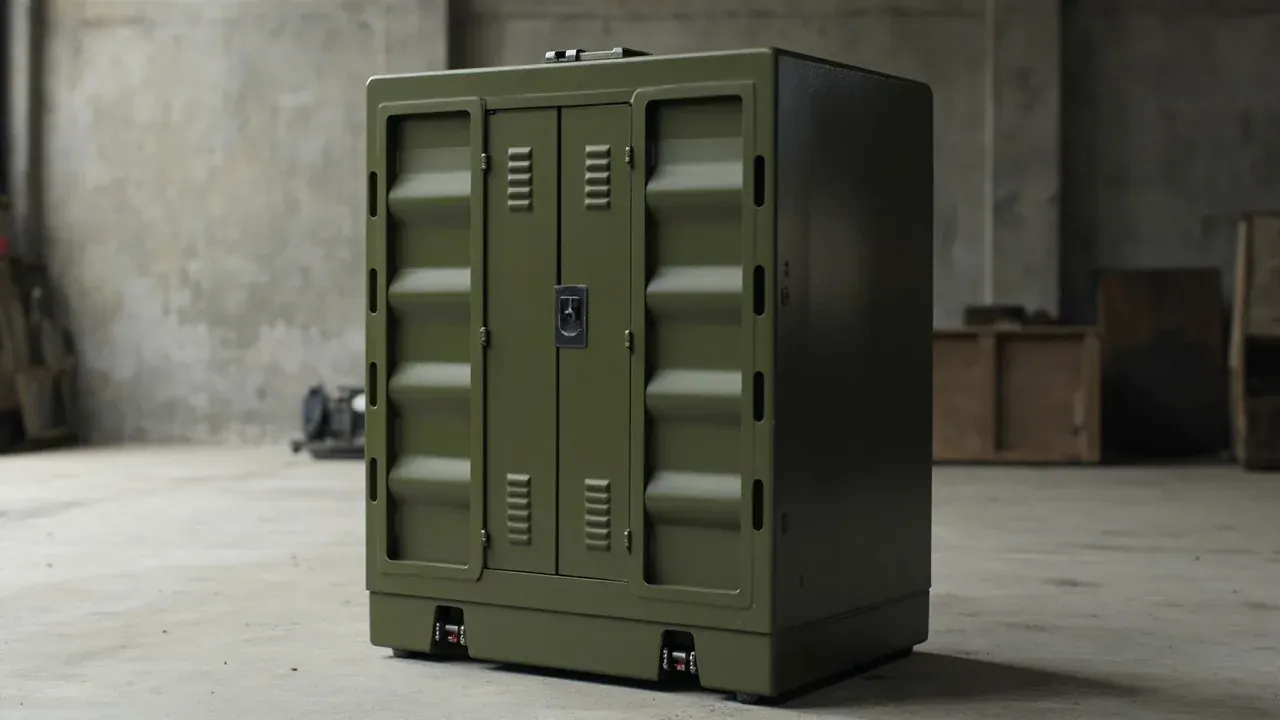
Quick answer: A field armoury is a free-standing, lockable cabinet that moves as one unit and gives a site a fixed enclosed volume. It differs from a case in form and siting, not capacity: the field armoury stands on the floor under its own weight, while a case travels by handle. Four checks identify one: twin doors, vertical tiers, castor or lifting points, lifting without dismantling.
Table of contents
- Definition and boundary
- Form and fixing
- Doors, locks and shelves
- Castors, lifting and moves
- When a cabinet beats a case
- FAQ
1. Definition and boundary
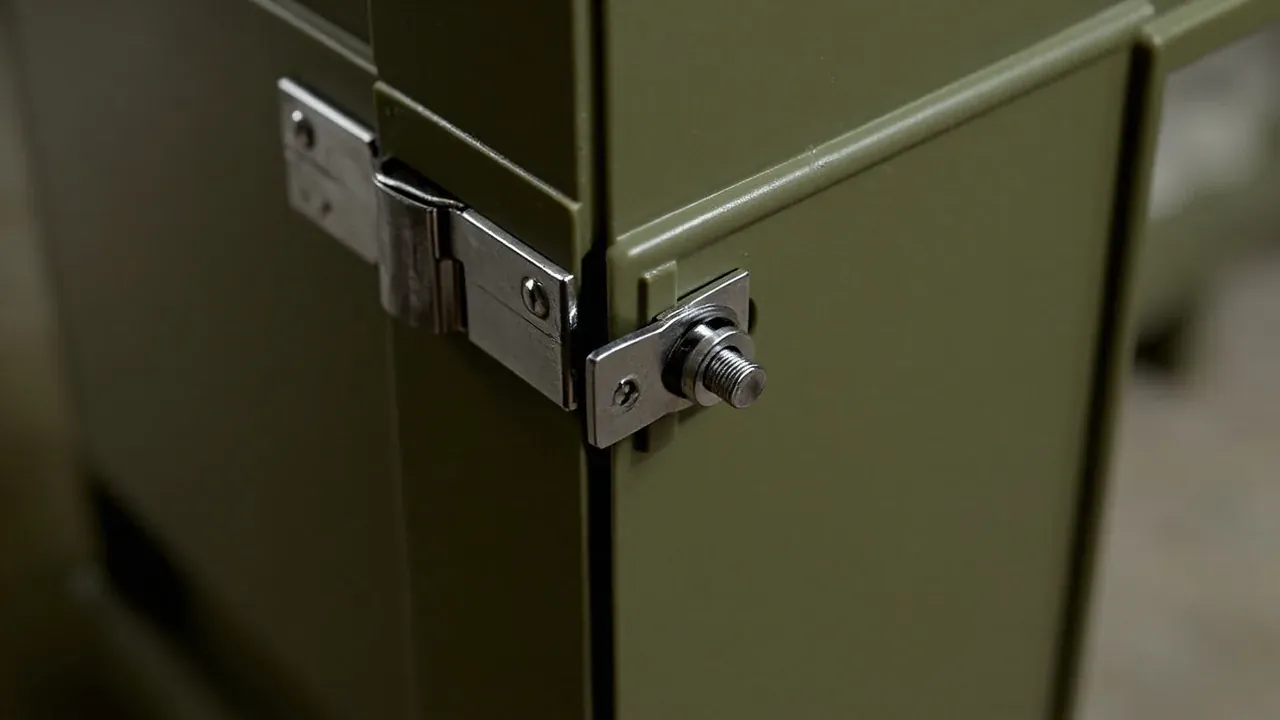
A field armoury is a protective cabinet that stands upright, locks at the door and moves as a whole without being dismantled. Three points can be checked: the door is full width, the body is used standing, and transport keeps the body intact. All three are visible on the unit itself.
Upwards it is not a fixed weapon cabinet, which depends on the building and loses its point once unbolted; a field armoury keeps castors, lifting eyes and pallet pockets so it can follow a site. Downwards it is not shelving, which is open and unlocked. The door seam shows it: a long hinge and a bolted keeper, against the short draw latch of a case.
2. Form and fixing
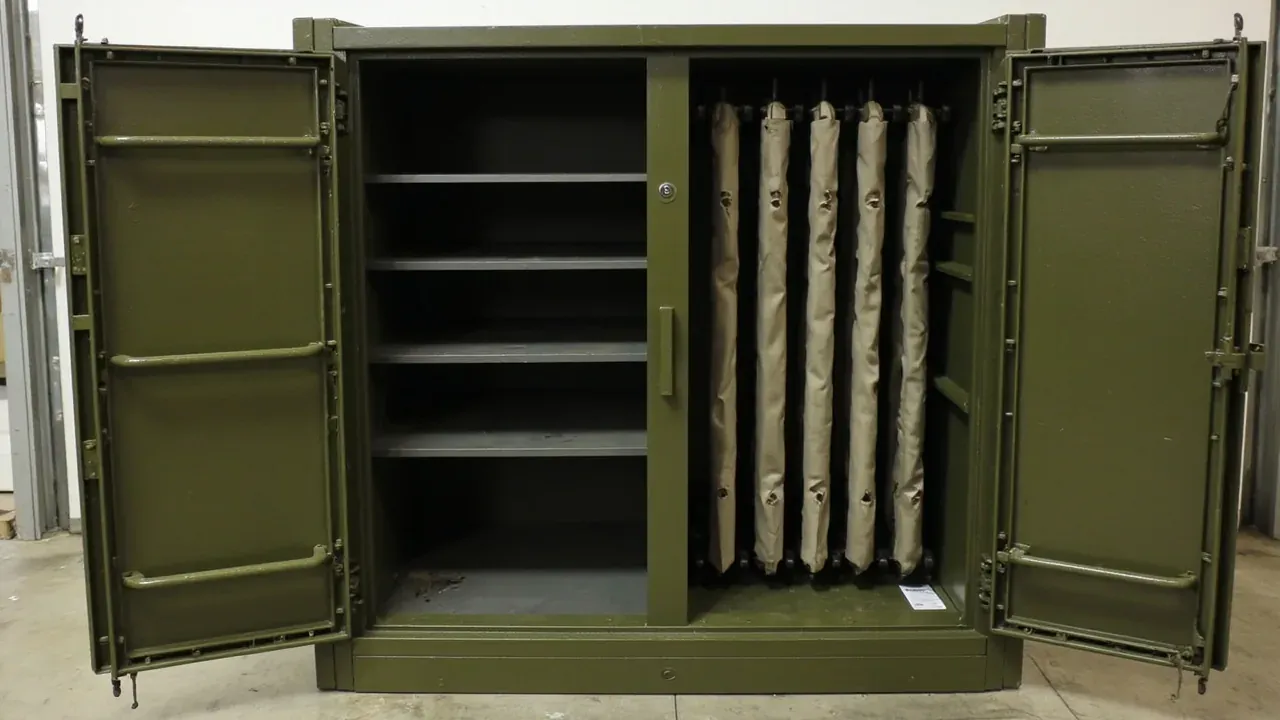
Form decides the load path. A case passes load from cavity floor to handle to person; a field armoury passes it from shelf to upright to base to floor. Overturning and creep replace drop resistance as the design problem.
Open the doors: four tiers rather than one tray, with hanging sleeves using the depth. Shelves hand weight to the uprights, which gather it into the base. The back takes wall brackets, the base takes anchors: tipping and sliding.
3. Doors, locks and shelves
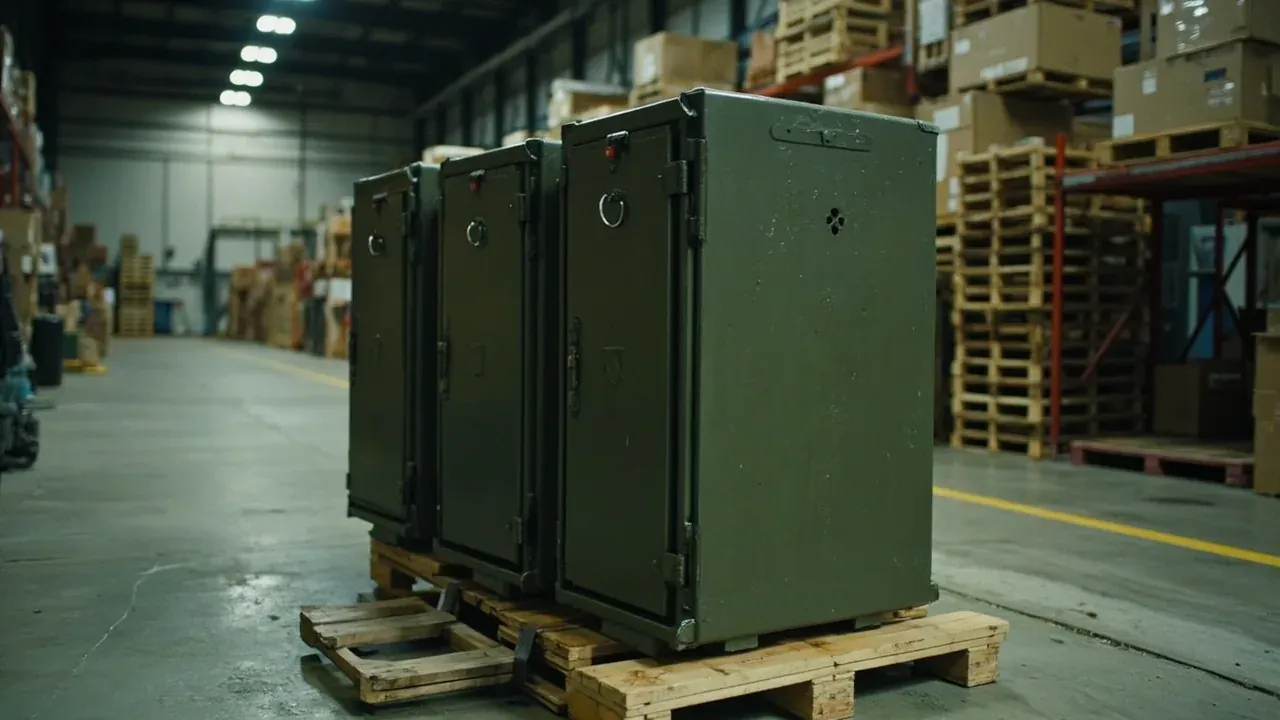
Four sub-systems make the cabinet: doors, locking, shelves and dividers, and the base. They constrain each other, so changing one forces a recheck of the rest. Each fails differently.
| Part | Usual approach | Constraint |
|---|---|---|
| Door | Twin leaves, folded edges | Wider leaf needs a longer hinge |
| Lock | Recessed seam lock, three-point linkage | Lock points set gasket compression |
| Shelf | Cold-formed steel into upright slots | Span sets sheet thickness |
| Base | Pallet pockets, castor plates, eyes | A soft base twists the body |
The base is most often skimped. On a pallet the load crosses four base edges, and a thin sheet base with corner brackets twists into a diamond, so the door gap goes out of square. Inside, fixed shelves give stable tiers; adjustable ones cost stiffness at the punched slots.
4. Castors, lifting and moves
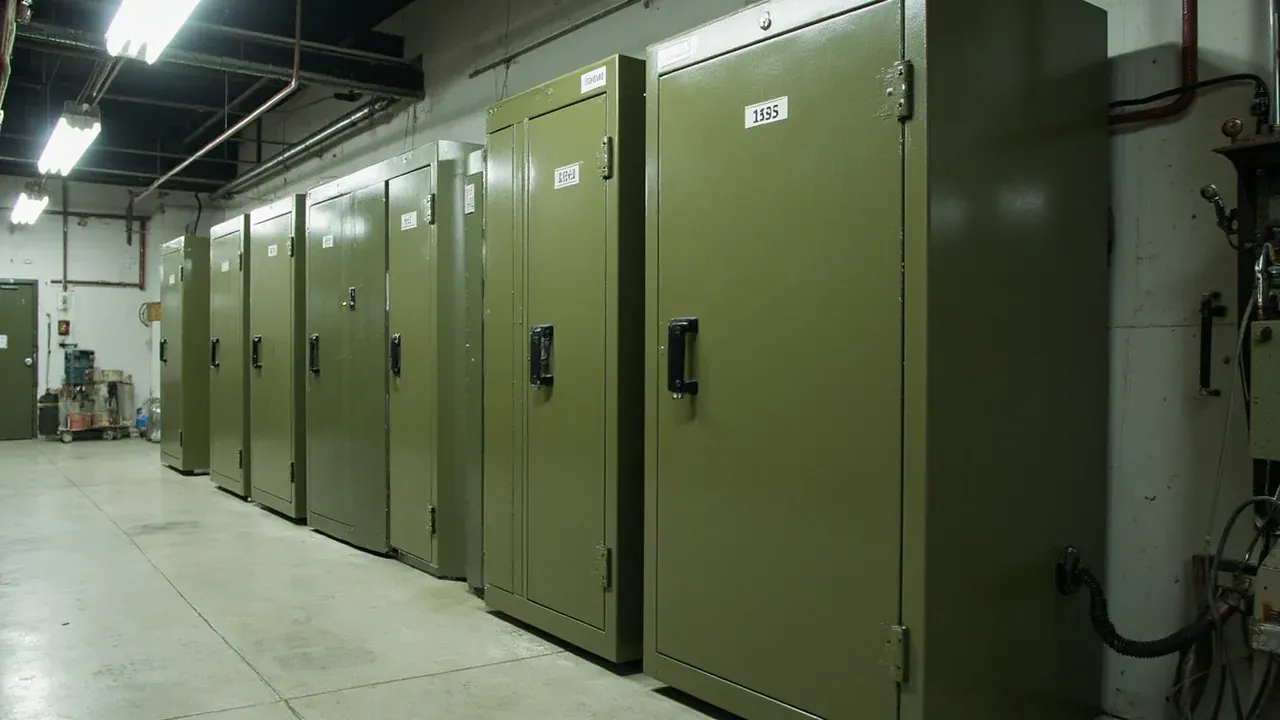
Mobility means moving the field armoury whole, not in pieces. Castors cover short shifts on one slab, lifting covers steps and loading, pallet pockets cover yard transfer, each on a different surface. None covers all three.
Castor choice starts with the floor: hard nylon on concrete, large pneumatic tyres on gravel, or the wheel jams. Two fixed and two swivel stop the drift, and every castor needs a brake. Lifting is sized by the eyes, not the mass. Doors must be shut before the hook loads, or a swinging leaf tears its hinges.
5. When a cabinet beats a case
The test is dwell time and handling frequency, not volume. Height and shelf count do not decide it. A cabinet wins when most of these hold:
- One spot is used for months without withdrawal
- A single item exceeds any case opening
- Tiered or hanging arrangement is needed
- The floor takes anchors, or a wall is close
- A forklift or pallet truck does the moving
Reverse them and a case is better: several moves a week, travel on foot, two-person lifts. A case left for months creeps at its stacking face; a cabinet moved weekly needs lifting gear. One buys position, the other buys travel.
Conclusion
A field armoury is a body that stands on the floor, moves whole and closes its cavity with one lock. The distinction from a case is load path and siting, and it produces long hinges, a recessed seam lock, shelves on uprights and a full-width base.
Check in order: dwell beyond a few months, equipment-dependent handling, clearance in front of the doors, then base interfaces and floor. If any step fails, reconsider a case.
This article covers container-side specifications and design implications only.
Related Reading
- Field armoury selection: door width and handling
- Weapon cabinet versus field armoury
- Stackable case design: load and stability
- War reserve case structure and materials
Related Products
- 8 Series — Gun Cases; Military Equipment Cases; Camera Equipment Cases; Drone Cases; Watch Cases; Knife Cases; First Aid Cases; Electronics Equipment Cases
- WL8-2812 PP Gun Case — model WL8-2812
- All protective cases and toolboxes: 7 series, 158 models