

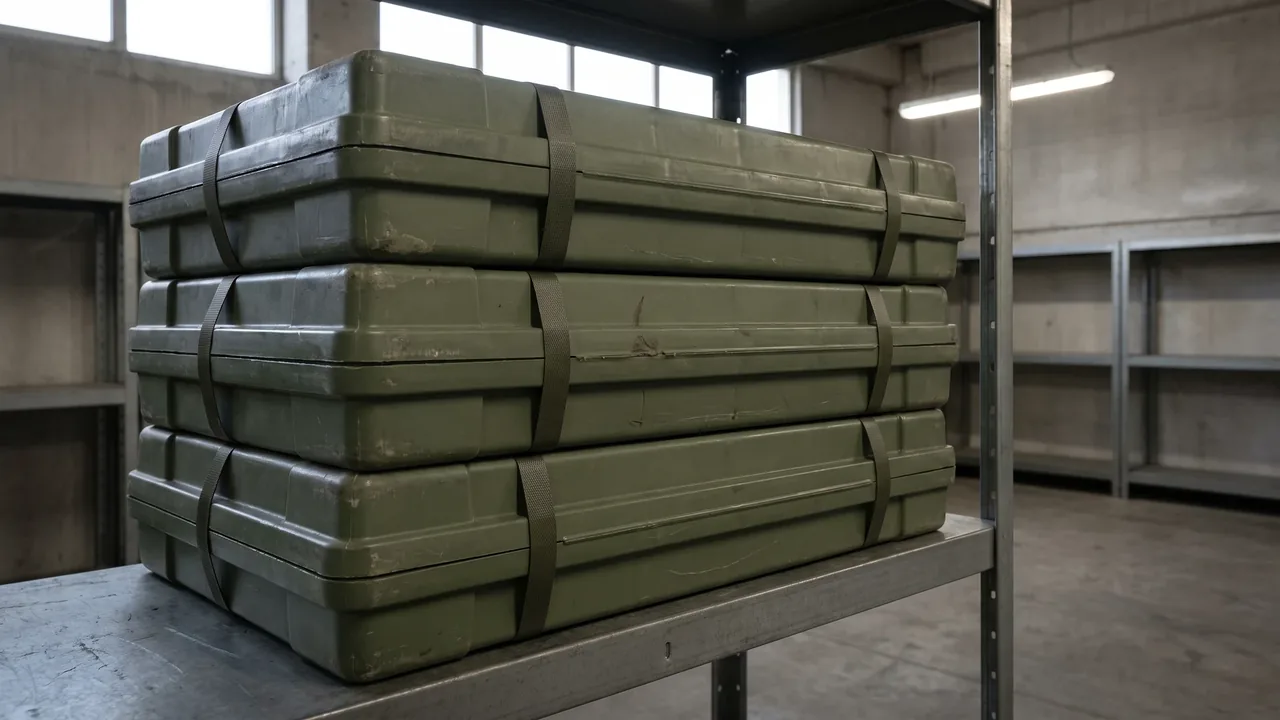
A Weapon Storage Cabinet, a Weapon Storage Cabinet used at a forward post, and a Field Armoury are not three names for one product. They are three tiers of container on a single custody chain. A fixed armoury wants the highest level of static security and centralised control; a garrison readiness cabinet has to balance access speed against access control inside limited space; a field armoury must treat shock resistance, sealing, stackability and mobility as priorities equal to security. Tiering is not a matter of building the cabinet in three sizes, but of reallocating structural stiffness, lock grade, seal grade and traceability methods to match the scenario. This article examines all three tiers from a container-engineering standpoint and sets out the selection logic for materials, locks, liners, sealing, testing and palletised loading for armoury managers, range operators and garrison security teams.
Choosing the wrong tier rarely shows up immediately. It surfaces in the maintenance log six months later: a fixed vault fitted with field cases, where sealing and stacking capacity are badly oversized and daily opening efficiency has been sacrificed; a garrison post substituting an ordinary tool cabinet for a proper cabinet, where hinges and locks fail early under repeated cycling; a field unit copying the steel-girder thinking of a fixed vault, where the resulting weight crushes the very mobility it needed. JUNZHIJIA, manufactured by Kexin New Materials (Guangdong) Co., Ltd., designs protective cases and storage cabinets on a principle of "scenario sets the grade, the grade sets the structure". This article develops that principle and turns it into a parameter framework that can be written directly into a procurement specification.
Why Storage Tiering Must Start from the Scenario
Tiering that ignores the scenario degrades into an argument about capacity and wall thickness. Three things actually decide how a shell should be designed: where the container will sit, who opens it and at what tempo, and what transport and climate it will meet once it leaves the fixed site. An armoury cabinet may be counted in bulk only a few times a year, with only a handful of authorised people opening it day to day. A garrison readiness cabinet sees an order of magnitude more opening cycles, so the durability of hinges and locks governs availability directly. In the field, the container itself travels by vehicle, vessel or mobility pallet through an entire mission cycle, where vibration, impact, rain, salt spray and temperature swings act at the same time. Compress all three requirements onto one drawing and the result can only be over-design or under-protection.
A second variable is easily missed: the tolerance window once the container leaves a protected environment. A fixed armoury has stable temperature and humidity, fire protection and access control, so the container only has to be the last barrier. A field post has none of that, which means the container itself must provide sealing, moisture control and cushioning. Tiering is therefore not an administrative label but a reallocation of environmental-control responsibility from the building to the container. Once that is understood, selection stops swinging between "steel cabinet or plastic case" and starts with the question of which environmental duties the container must carry alone.
The Three-Tier Framework and Its Divisions
By scenario, storage containers divide into three grades with clearly different priorities. The first grade trades weight for security and is usually anchored to the building structure. The second balances security against efficiency, emphasising internal layout and the logic of retrieval. The third puts structural stiffness, sealing and stackability first, where weight is an optimisable variable rather than a constraint.
| Tier | Typical setting | Primary requirement | Container form | Key technical items |
|---|---|---|---|---|
| --- | --- | --- | --- | --- |
| Tier 1: fixed armoury cabinet | Permanent vault, centralised storage | Static security and centralised control | Floor-standing steel cabinet | Dual-custody locks, anchorage, pry resistance |
| Tier 2: garrison readiness cabinet | Barracks, range duty room | Retrieval efficiency and access control | Medium storage cabinet | Zoned liners, RFID traceability |
| Tier 3: field armoury | Vehicle-borne, field post | Mobility, shock resistance, sealing | Stackable case-type cabinet | IP sealing, cushioning and restraint, stacking |
The three tiers are not mutually exclusive. A complete storage system usually runs all three and dispatches them on a principle of "centralised in peacetime, pushed forward when readiness demands". The value of the table is that it lets a buyer describe requirements in one shared language: first decide how much environmental duty the container carries alone, then set the grade of lock, seal and liner.
The Fixed Armoury Cabinet: Shell Structure and Load Design
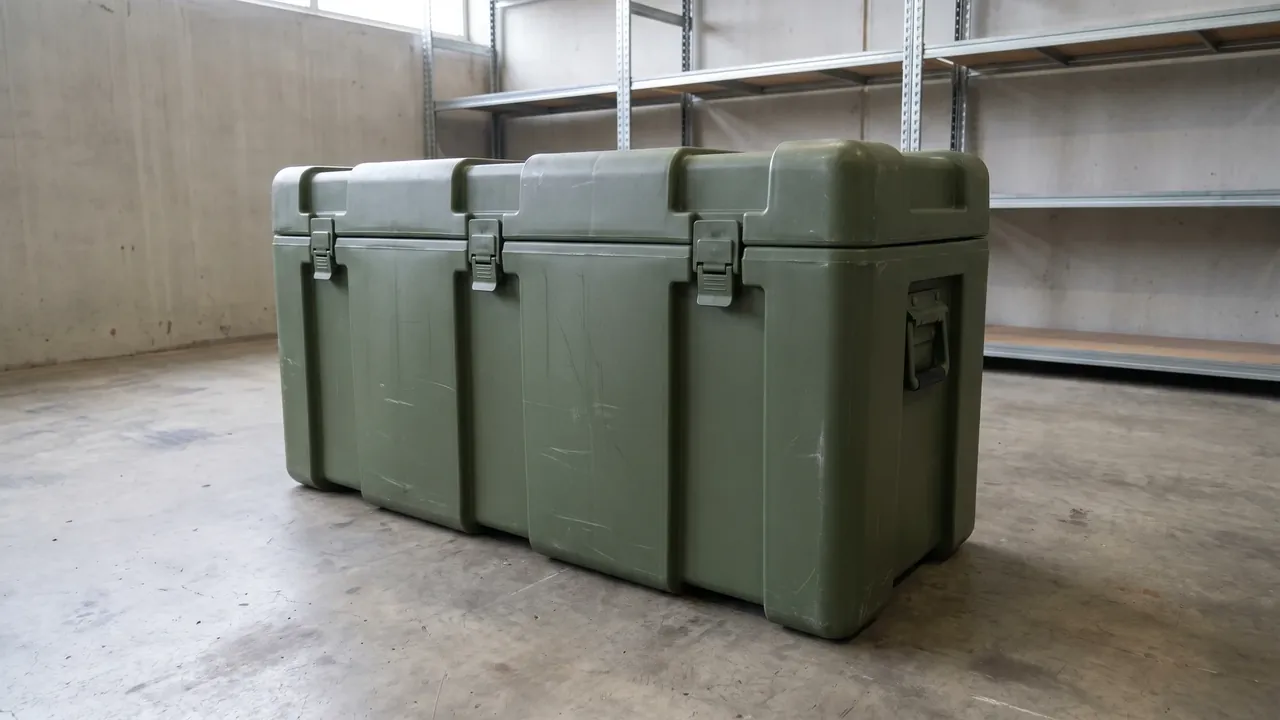
A tier-one cabinet is normally a folded and welded steel structure, where door, side panels and back panel form a rigid frame through folded edges and stiffening ribs. The design priority is resistance to prying and to overall distortion. The door gap must be held inside a controlled band so that closure stays smooth while a pry bar finds no purchase point. Inside, bearers and dividers run along the height so that long and short items store on separate levels, preventing adjacent items from striking each other the moment the door opens. Structurally, the cabinet's own weight and the contents pass through the feet or base plate into the floor, so the base needs enough contact area, and adjustable feet need a locking feature.
JUNZHIJIA recommends checking door-frame rigidity and cabinet torsional rigidity separately. The door frame is the most concentrated load path, and long-term cycling creates stress concentration on the hinge side. Torsional rigidity of the cabinet body decides whether the door gap stays consistent when the floor is not level. Only when both pass does the door keep closing smoothly across its whole service life. The same structural lessons feed into the wider military security case family.
Door Rigidity and Hinge Selection
The door is the most frequently moving part of any cabinet, and its life is practically the life of its hinges. The larger the door panel, the higher the stiffness per unit area must be, because the door's own weight will otherwise make it sag once open and throw the bolt alignment out. The engineering answer is to add stiffening ribs to the inner face, turning a flat plate into a ribbed shell so that a small weight penalty buys a large gain in bending stiffness.
Hinge selection comes down to three things: load capacity, clearance control, and resistance to removal. Exposed hinges are easy to inspect and replace but present an external pry point. Concealed hinges look cleaner and resist prying better, but are harder to replace and adjust. For a high-cycle garrison cabinet, replaceable hinges make more sense for whole-life maintenance; for a security-first fixed cabinet, concealed hinges with travel stops are the better match. Across its protective case range, JUNZHIJIA fits stainless or galvanised hinge hardware and reserves access clearance at the design stage, so that maintenance never forces a complete door replacement.
Locks and Access Control: Mechanical, Dual-Custody and Tamper Seals
Locks are the central variable of tiering and the interface between container engineering and management policy. A mechanical key lock is simple, reliable and immune to power failure, which makes it a sound base layer. Dual custody uses two independent locks in series or parallel so that two authorised people must be present together, the most common access method in an armoury. The key engineering question here is the mechanical independence of the two locking points: each lock must carry load on its own, and the bolt of one must never be able to disable the other.
A tamper-evident seal is a one-time evidentiary measure. Its purpose is not to prevent opening but to leave an unmaskable trace of any unauthorised attempt. Seal numbers should be tied to the cabinet register and checked on every issue and return. Where traceability is required, an electronic lock with open-close logging can be added, but power supply, water resistance and servicing all have to be assessed, and introducing electronics typically pushes the whole sealing requirement up a grade. For the detailed breakdown see lock selection for ammunition boxes and custom lock configurations.
| Access method | Strengths | Limits | Suitable tier |
|---|---|---|---|
| --- | --- | --- | --- |
| Mechanical key lock | No power, reliable | High key-management burden | Tier 1, Tier 2 |
| Dual custody | Forces two-person presence | Longer opening process | Tier 1 |
| Tamper-evident seal | Traceable, low cost | Single use | Tier 2, Tier 3 |
| Electronic lock and log | Auditable, reviewable | Needs power and servicing | Tier 2, Tier 3 |
RFID and Asset Traceability Within the Tiering Model
Once storage containers multiply beyond a single room, the register stops being a paper problem and becomes a system problem. RFID creates a unique mapping between container, slot and item, so stocktaking shifts from item-by-item checking to batch reading. The engineering challenge is reliable tag reading. Metal items shield radio frequency energy, so tags must be metal-tolerant types with a defined mounting face. A steel cabinet forms an effective shielded cavity, so read points belong at the door opening or on an external antenna.
The other half of traceability is the marking system. Asset labels on the outside of a container must survive weather and abrasion, stay attached and sit in a fixed, scannable position. Inside, every zone needs a clear position number so that a specific item in a specific cabinet, shelf and slot can be located quickly by a non-specialist in an emergency. JUNZHIJIA offers tracing configurations from printed labels and silk screening to embedded inserts, matched to the customer's stocktaking frequency and the ability of their information system to integrate, so that traceability never inflates container cost beyond its value.
Liners and Restraint: From Felt to CNC-Moulded EVA
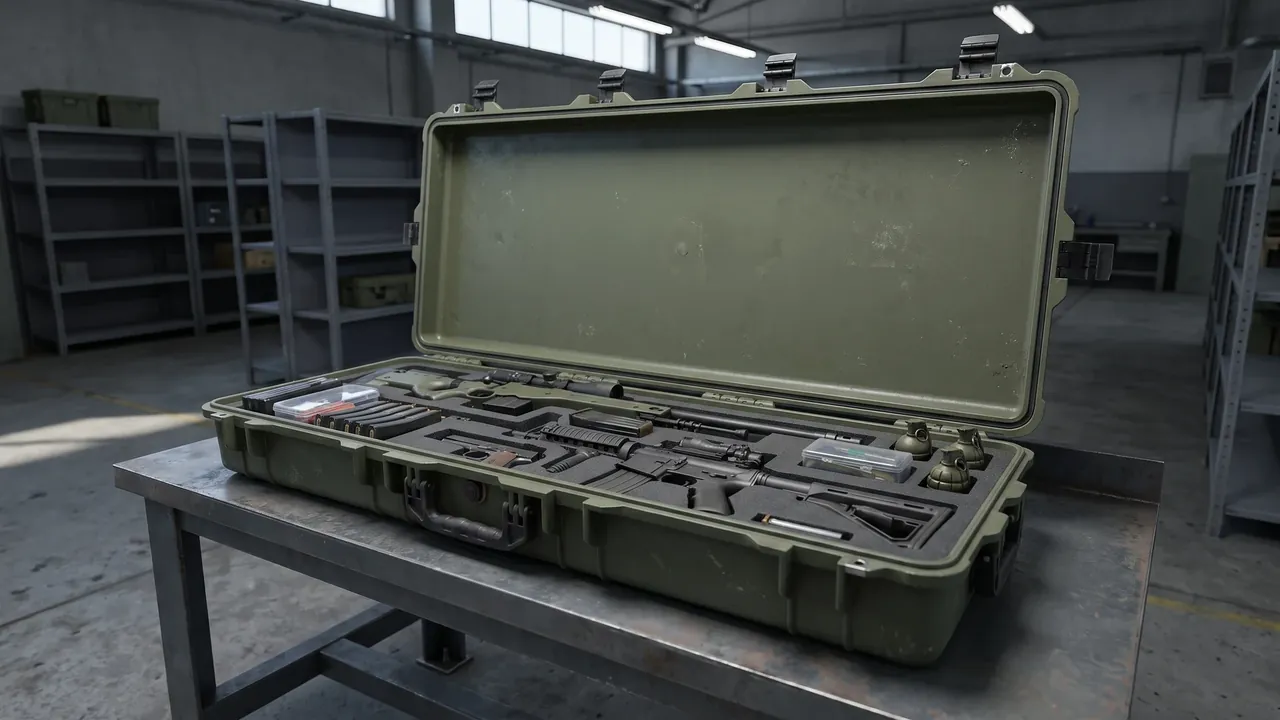
A liner does three jobs: absorb vibration, restrain movement and protect surfaces. A tier-one cabinet stores items statically, so its liner leans toward surface protection and moisture control, typically felt, non-woven fabric or halogen-free foam. A tier-two unit must balance retrieval against restraint, which calls for divider bars and removable partitions. A tier-three field armoury must survive transport vibration and drop impact, so it needs closed-cell material machined by CNC to the actual profile of the contents, leaving almost no freedom to shift inside the case.
On materials, felt feels good and costs little but readily absorbs moisture and can develop mould, so it suits dry environments and needs periodic replacement. EPE and EVA are closed-cell foams that combine moisture resistance with cushioning; EVA is denser and rebounds better, which suits precision items. Rigid PE foam is stiff and better used as a bearer than a facing. The core logic is a graded transfer of stiffness: the outer shell takes the impact, the mid-layer foam absorbs the energy, the inner facing protects the surface, and no impact reaches the item directly. Where layouts must be reconfigured repeatedly, a modular case system with removable dividers is usually the better starting point.
Sealing and IP Grades by Tier
A tier-one fixed vault rarely needs a high seal grade, though dust and insect exclusion still matter. A tier-two garrison cabinet should be specified between IP54 and IP65 according to its environment. A tier-three field armoury should reach IP65 or better, and IP67 where immersion or sustained humidity is expected. IP grades are defined by IEC 60529 and GB/T 4208, which govern dust and water ingress on a consistent scale. Sealing depends on three factors working together: gasket material, compression ratio and the flatness of the sealing face. Too little compression and the seal fails; too much and it ages faster.
Temperature change creates a pressure difference across the wall, and a well-sealed container can become hard to open or can deform its gasket under air freight, at altitude or across steep temperature swings. A pressure-equalisation valve permits slow gas exchange while maintaining waterproofing and dust protection, keeping the gasket inside its designed compression band. Any seal, however, is vulnerable to trapped grit, so daily maintenance should prioritise cleaning the sealing face rather than adding gasket thickness.
VCI Rust Prevention and Humidity Management
For metal items parked long-term in humid or coastal conditions, corrosion risk comes mainly from condensation rather than direct rain. VCI vapour-phase protection forms a film on metal surfaces through slow release of inhibitor molecules, and suits machined surfaces in sealed containers over the medium term. Its effectiveness tracks sealing: VCI belongs with a sealed container, and in a well-ventilated fixed vault its benefit falls away, at which point the priority shifts to whole-room dehumidification.
Humidity management also covers desiccant and indicator cards. Desiccant quantity must match internal volume and opening frequency, and frequently opened cabinets need higher replacement rates. Indicator cards give an unambiguous reading so that replacement is not a matter of guesswork. Where conditions allow, dehumidifying the entire vault is more economical than repeatedly replacing desiccant in individual cabinets, a good example of how environmental-control responsibility can move flexibly between building and container.
The Field Armoury as a Mobile Structure: Stacking, Lifting and Fork Handling
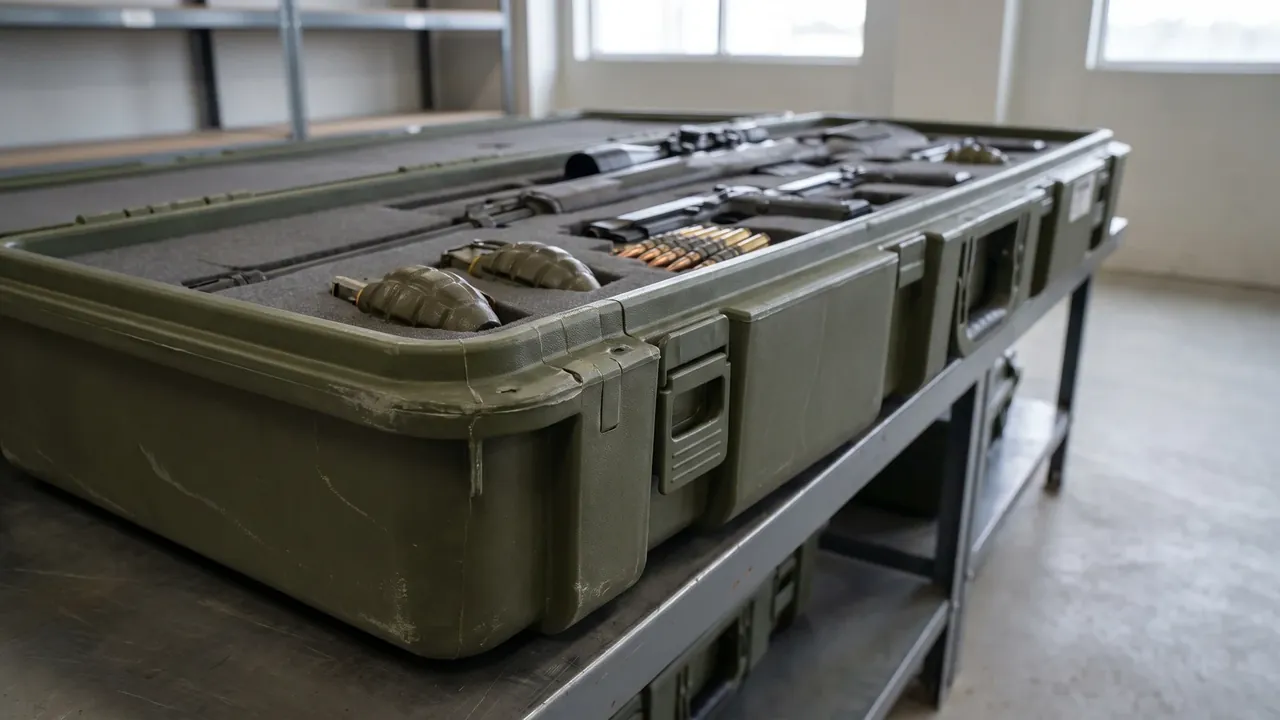
A tier-three container differs in kind from the two grades above. It must protect its contents, but it must also survive being lifted, stacked and fork-handled itself. Stacking capacity comes from the joint design of wall, lid and stacking feature. External stiffening ribs should route the upper load down the walls straight to the floor rather than through the contents. The lid needs enough bending stiffness, and where necessary a double wall or an embedded stiffening plate. More layers is not automatically better: permitted stack height follows from case strength and pallet footprint together, and the permitted number of layers belongs on the case itself.
Lifting and fork handling need clearly defined pick-up points. Lifting eyes or sling slots belong at symmetric positions around the centre of gravity so the case does not tilt as it rises. The underside structure of the fork channel must take the localised pressure of the fork tines without collapsing, and a bottom reinforcing beam is the usual answer. JUNZHIJIA lays out lifting points, fork channels and stacking features as one set of geometric features in field armoury design, so that an operator can follow the instructions without extra training.
Palletised Loading and Transport Securing
Once a container leaves the store, the first external constraint is the pallet and the vehicle. Palletised loading must solve three problems: centre of gravity, securing and accessibility. The centre of gravity should sit low and near the geometric centre of the pallet to prevent vehicle roll. Securing uses stretch wrap, strapping and corner protectors. Wrap provides overall cohesion, strapping resists longitudinal inertia, and neither substitutes for the other. Corner protectors spread the strap pressure across the case corner so that prolonged vibration does not wear through it.
Accessibility is often overlooked. Multiple containers on one vehicle should be arranged in unloading order, with the first to come off nearest the tail. Containers that may be opened en route belong on the aisle side, not buried innermost. Where items are transhipped several times, the container and pallet are best secured and marked as one unit to avoid re-stowing at every transfer. Established storage and stacking practice can be taken directly from the layering and height-limit principles in warehouse storage rules for protective cases.
Testing and Certification: MIL-STD-810H, GJB and Export Packaging
Tiered design must finally be proven by testing. Protective containers for international customers commonly reference the environmental test methods of MIL-STD-810H, covering vibration, shock, temperature, humidity and salt spray. Products for domestic military supply can set test requirements against the relevant GJB series standards. Basic tests for transport packages can follow the GB/T 4857 series and ISTA procedures. Export scenarios also involve UN packaging regulations and destination-country import packaging certifications, and the exact clauses that apply must be confirmed against the nature of the goods and the mode of transport. Useful detail is collected in MIL-STD-810H compliance points.
The point of testing is not to hold a certificate but to state clearly the conditions under which a container fails. JUNZHIJIA recommends fixing test items, severity levels and acceptance criteria in the procurement specification, and retaining test records for each production batch so that design intent is reproducible in mass production. An empty-case test validates only an empty case; what carries real value is a loaded test that follows the actual weight and centre of gravity of the contents.
Acceptance, Delivery and Whole-Life Maintenance
Acceptance should separate appearance, dimensions, function and documentation. Appearance covers coating and welds. Dimensions cover door-gap consistency, mating clearances and the alignment of stacking features. Function covers lock operation, gasket compression and hinge smoothness. Documentation covers material certificates, test records and operating instructions. Sampling plans can be combined with AQL, but safety-critical functions such as seals and locks justify tightened or even full inspection.
Whole-life maintenance centres on seals and locks. A gasket showing permanent set, cracking or hardening should be replaced as a complete run, not patched locally. Hinges should be lubricated at intervals and checked for clearance. Locks should be checked for bolt travel and key wear. Field containers also need a post-mission check of lifting points, fork channels and stacking features for deformation, corrected promptly to prevent accumulated damage. Maintenance records are themselves part of tiered management, because they keep a container at the grade it was designed to carry.
The Compliance Boundary for Defence Trade and Export Packaging
In defence trade and export, the container is packaging and storage equipment, but the nature of the goods it accompanies triggers export-control and importing-country requirements. It should be stated clearly: local regulations and export-control requirements take precedence, and this article discusses only the structure and testing of packaging containers, not the handling, processing or storage thresholds of any item. In a specification, the buyer should list container material, seal grade, test standards and traceability marking as separate clauses rather than mixing them with the properties of the goods, so that customs and compliance review can address each on its own terms.
FAQ: Weapon Storage Cabinet and Field Armoury Questions
Q: How do a Weapon Storage Cabinet and a Field Armoury actually relate to each other? A: They are three tiers on one custody chain rather than interchangeable products. A fixed armoury cabinet puts static security and centralised control first, is usually anchored to the building and carries dual-custody locks and pry-resistant structure. A garrison readiness cabinet balances retrieval speed against access control and emphasises internal layout and traceability marking. A Field Armoury must move by vehicle, vessel or pallet, so shock resistance, sealing, stacking and lifting capacity are raised to the same level of importance as security. JUNZHIJIA advises deciding first how much environmental duty the container carries alone, then setting the grade of lock, seal and liner, so that tiering does not collapse into a comparison of wall thickness and capacity. For one management team all three usually coexist, dispatched on a principle of centralised storage in peacetime and forward positioning when readiness demands, which is the arrangement that actually holds up in service. State the tier explicitly on drawings, labels and stock records, so a case designed for one tier is never borrowed into another where its locking, sealing or stacking basis no longer applies.
Q: Why do fixed armouries insist on dual custody instead of simply fitting a stronger lock? A: Dual custody solves process control, not just physical protection. However strong a single lock is, if the key sits with one person, the management risk does not fall when the lock grade rises. Dual custody uses two independent locks in series or parallel so that two authorised people must be present together, turning the act of opening into a witnessed procedure. The engineering point is mechanical independence of the locking points: each lock must carry load on its own, and neither bolt may disable the other, because a parallel arrangement that shares load unevenly can end up with only one effective barrier under stress. JUNZHIJIA defines the mounting datum and load path of both locks in the cabinet structure, giving each bolt its own bearing face. Key registers and seal numbers should also be reconciled at intervals, so that procedure and structure reinforce rather than undermine each other over years of use.
Q: How should the sealing grade of a field armoury be decided? A: The grade should follow actual exposure rather than habit. A fixed vault has a building for shelter, so dust and insect exclusion is the main concern. A garrison cabinet specified between IP54 and IP65 covers most rain and airborne dust conditions. A Field Armoury that truly travels by vehicle, vessel or field deployment should reach IP65 or better, and IP67 where immersion, standing water or prolonged humidity is expected. IP grades are defined by IEC 60529 and GB/T 4208, so a buyer should ask the supplier for the specific test conditions and results rather than a bare number. Sealing depends on gasket material, compression ratio and sealing-face flatness working together; too little compression fails and too much accelerates ageing. JUNZHIJIA recommends evaluating pressure-equalisation valves at the same time, so the seal stays inside its designed compression band during air freight, at altitude and across steep temperature swings, and insists on cleaning the sealing face rather than thickening the gasket during maintenance.
Q: Should a liner be felt or EVA, and does the tier change the answer? A: Liner choice follows the protective task the container carries, not the inherent merit of a material. Felt feels good and costs little, and suits surface protection in static storage, but it absorbs moisture and can develop mould, so it only belongs in dry environments and needs periodic replacement. EPE and EVA are closed-cell foams that combine moisture resistance with cushioning; EVA is denser and rebounds better, which suits precision items and repeated handling, and JUNZHIJIA typically uses CNC-moulded EVA cavities shaped to the item profile in tier-three field armouries so the contents have almost no freedom to shift. Rigid PE foam is stiff and better suited to bearing structures than facings. The core logic is a graded transfer of stiffness: the shell takes the impact, the foam absorbs the energy, the facing protects the surface, and no impact reaches the item directly. Combining materials by tier usually balances cost and protection better than using one material throughout.
Q: Which storage scenarios suit VCI vapour-phase rust prevention? A: VCI suits machined metal surfaces in sealed containers over the medium term. Inhibitor molecules release slowly and form a protective film on the metal, delaying corrosion during storage even if the container is briefly opened or the seal is challenged. Effectiveness tracks sealing closely, so VCI normally accompanies a well-sealed cabinet or field armoury; in a well-ventilated fixed vault its benefit falls away, and whole-room dehumidification becomes the better investment. VCI has limited effect on surfaces that have already corroded, so items should be loaded immediately after machining, clean and dry, because cutting fluid or fingerprints left on the surface prevent an even film from forming. JUNZHIJIA sets the configuration against storage duration and transport route, and recommends enhanced provision for high-salinity sea freight or humid storage. VCI components have their own service life, so a container left unopened for long periods needs its inhibitor parts renewed on a schedule, or the protection quietly expires.
Q: How can the stacking capacity of a tier-three container be assessed reliably? A: Stacking capacity cannot be extrapolated from a single static compression test; it has to be assessed from the load path. The weight of an upper container should travel through external stiffening ribs down the walls to the floor rather than pressing on the contents, so the joint design of wall, lid and stacking feature sets the usable number of layers. The lid needs sufficient bending stiffness, and where necessary a double wall or embedded plate, because prolonged stacking will otherwise let the lid sag in the middle and gradually break the seal. Assessment should also account for dynamic load in transit, since vehicle vibration lifts instantaneous load well above the static value, so permitted layers must retain a safety margin and be marked clearly on the case. JUNZHIJIA lays out lifting points, fork channels and stacking features as one geometric set in field armoury design, so that handling and stacking both follow the intended method. Projects should validate with a loaded stack that reflects real weight and centre of gravity, not empty-case data.
Q: How should a buyer choose between tamper-evident seals and electronic locks? A: The two solve different problems, so the choice is usually a combination by tier rather than either-or. A tamper-evident seal is a one-time evidentiary measure whose purpose is not to prevent opening but to leave an unmaskable trace of an unauthorised attempt. It costs little, needs no power and suits garrison and field use, provided the seal number is tied to the cabinet register and reconciled on every issue and return. An electronic lock with open-close logging offers auditable traceability and suits managers with system support and high stocktaking frequency, but it brings power, water-resistance and servicing requirements and often pushes the container's sealing grade up a whole step. JUNZHIJIA suggests establishing basic seal-based evidence first, adding electronics only where audit demand justifies it, and never compromising on sealing grade to do so. Either way, a clear degraded-mode plan should exist so that a failed electronic component cannot leave the whole storage system unable to open.
Q: What parameters belong in a specification for a Weapon Storage Cabinet or Field Armoury? A: The specification should separate container parameters from the properties of the contents, which helps both compliance review and acceptance. Items worth stating include: tier and use scenario, shell material and plate thickness, door-frame and body rigidity requirements, hinge type and load capacity, lock grade and redundancy, liner material and whether it is CNC-moulded, the standard and test conditions behind the sealing grade, whether a pressure-equalisation valve is fitted, permitted stacking layers and the lifting and fork points, the form and position of traceability marking, and the tests to be completed before shipment with their severity levels and acceptance criteria. JUNZHIJIA recommends agreeing a sampling plan alongside tightened inspection of safety-critical functions, and requiring batch test records. Splitting acceptance into appearance, dimensions, function and documentation avoids delivery disputes. For export projects, destination-country packaging certification and marking requirements should be listed separately, with the responsible party named.
Related Reading
- Structure and selection points for military security cases
- Safety design points for firearm storage cases
- Lock selection guide for military ammunition boxes
- Custom lock configurations and grade options
- Tiered selection methods for military protective cases
- Warehouse storage and stacking rules for protective cases
- Modular case systems and liner layouts
- Protective case solutions for special operations