

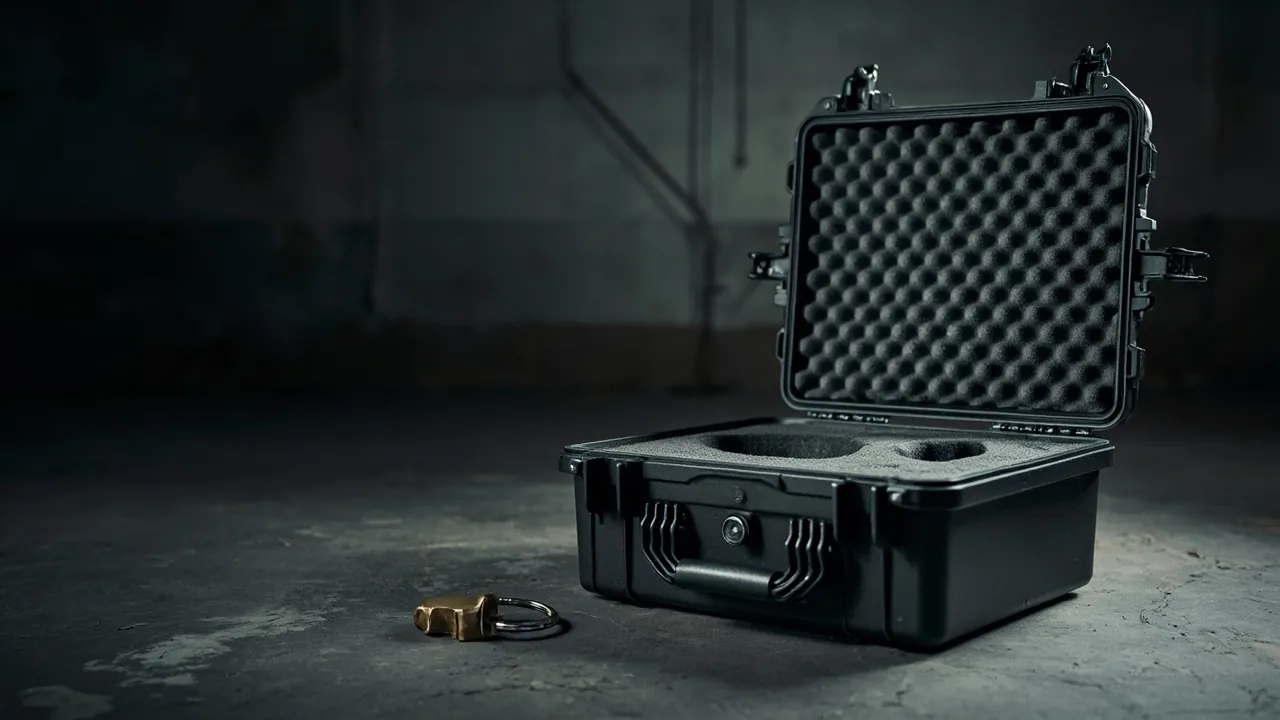
Short answer: a compliant firearm storage case derives its security from five engineering features that can each be inspected and accepted on their own — a lockable closure, pry-resistant latch and hinge geometry, a foam liner that actually locates the contents, shell rigidity proven by drop testing, and a seal and moisture-control system that stays stable over years. These five are not marketing claims; they are quantifiable parameters: the lock's pry resistance, the latch's cycle life and clamping-force decay, the foam's density and cushion curve, the drop height and number of drops, and the ingress rating along with the seal's compression set. A buyer does not need to judge a case by its appearance. They need evidence for five words: lock, latch, liner, structure, report.
One definitional point comes first. In industrial packaging and storage-equipment language, what is often called a firearm case or tactical case is fundamentally a long-format, high-protection, lockable rigid container for storage and transport. Its design purpose is to protect long equipment under unattended storage, repeated transport and long dwell times, while restricting unauthorized opening. This article discusses only the container itself — shell material, lock architecture, liner configuration, impact performance and sealing system — and does not address the use, operation or performance parameters of any equipment. All figures are typical or empirical values; actual projects should follow the supplier's drawings and third-party test reports.
Table of Contents
- The direct answer: five safety features determine whether a case is acceptable
- Setting the terms: this is a lockable long-format rigid container
- Safety feature one: lockable structure and padlock interface
- Safety feature two: latch, hinge and pry-resistant geometry
- Safety feature three: foam liner and equipment location
- Safety feature four: drop-resistant and impact-resistant design
- Safety feature five: sealing, moisture control and long-term storage
- Key tests: how drop, vibration, stacking and cycle life are performed
- Parameters and a selection comparison table
- Common mistakes and a pitfall checklist
- Compliance and documentation: what to request during procurement
- Sourcing and OEM/ODM: how to write the clauses
- FAQ
- Conclusion and further reading
The direct answer: five safety features determine whether a case is acceptable
Unpack the word "safe" and two distinct objectives appear: protect the contents from environmental and impact damage, and restrict unauthorized opening. The first is a packaging engineering problem; the second is a structural and lock-design problem. Both can be described in engineering terms.
- A lockable closure. The lock must be matched to the structural strength of the shell. If the plastic area carrying the lock point snaps off with one pry, the most sophisticated lock cylinder is irrelevant. A compliant design keeps the lock point on the load path, engages metal parts in carrying the load, and installs the lock without disturbing seal compression.
- Pry-resistant latch and hinge geometry. Latches should be metal cam or lever designs with an over-centre self-locking action. Hinges should be through-pinned metal axles running in wear-resistant bushings. Together they resist torsion and prying.
- A foam liner that locates the contents. The liner's job is not to "be soft" but to hold equipment in a fixed position, so that during handling and drops nothing shifts, strikes the wall, or collides with something else.
- Shell rigidity proven by drop testing. The case must survive corner-first drops at low temperature without structural cracking, and its seal must still recover. This depends on ribs, corner bumpers and radiused transitions.
- A seal and moisture-control system that stays stable. The dominant long-term threat is moisture. Groove-compressed sealing with replaceable seals is the precondition for still keeping moisture out years later.
These five are coupled. Without structure, the lock is unreliable. Without a proper liner, even the best lock cannot protect the contents. Without sealing, long-term storage loses its meaning. Selection therefore has to be holistic rather than a checklist of add-ons.
Setting the terms: this is a lockable long-format rigid container
Within storage-equipment classification, this product belongs to the family of high-protection storage and transport containers for long-format equipment. Every meaningful property is a measurable physical quantity:
- Internal dimensions and length-to-width ratio: which set the maximum length that can be accommodated and the internal layout;
- Effective depth: usable depth after deducting liner thickness;
- Ingress protection rating: the two digits of the IP code;
- Lock type: integrated cylinder, external padlock, or dual lock points;
- Drop performance: structural integrity and seal retention at a defined height and attitude;
- Tare and gross weight: which determine the handling method;
- Seal service life: measured in open-close cycles or years.
Treating this product as a container specification is correct and professional. Procurement should discuss internal length, depth, number of lock points, liner thickness and test items, not the product name. For the conceptual background, see firearm transport case requirements.
It is worth stressing that the value of this container concentrates in two words: protection and control. Protection means impact resistance, moisture exclusion, dust exclusion and resistance to stacking loads. Control means lockability, padlock compatibility and identifiable ownership. Everything in this article addresses those two words.
Safety feature one: lockable structure and padlock interface
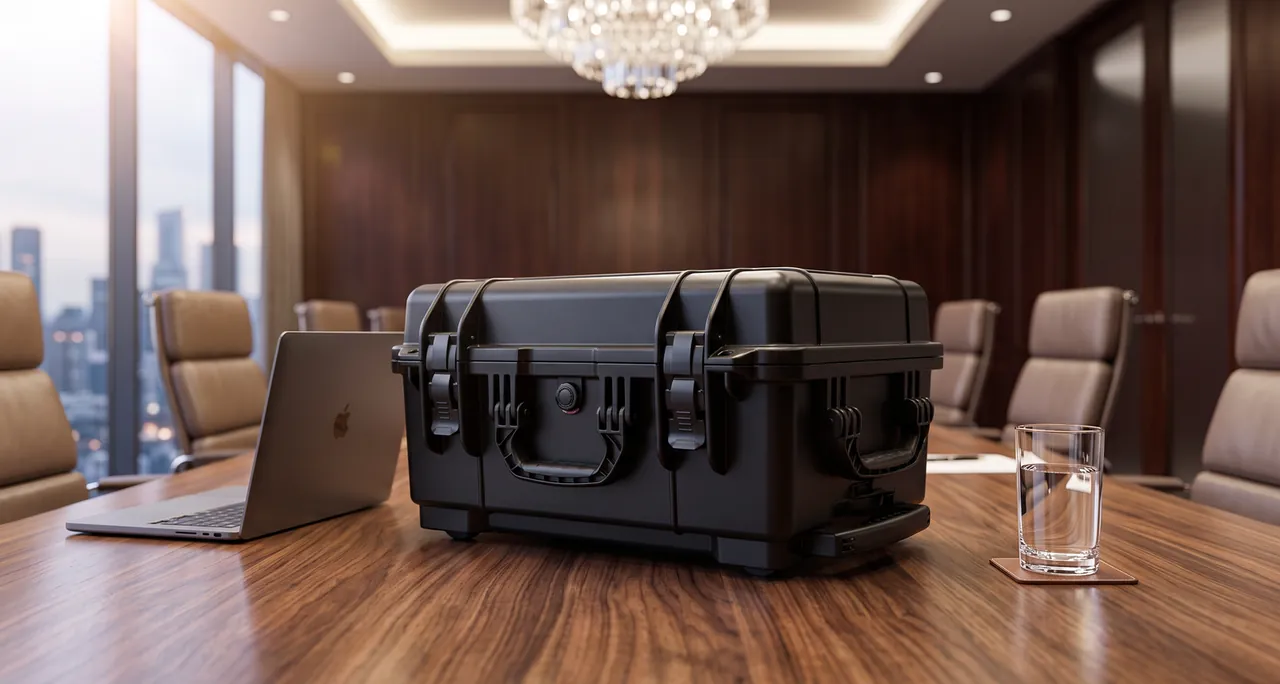
The lock is the most visible dividing line between this class of container and an ordinary storage box, and also where superficial design is easiest to hide.
Three common lock approaches:
- Integrated cylinder. A keyed or combination cylinder built into the shell or the latch. It is convenient and visually clean, but the cylinder itself has limited load capacity and must be backed by external structure to resist prying. Confirm an all-metal housing, drill resistance and key-change capability.
- External padlock interface. A through hole in the latch accepts a standard padlock or cable lock. The advantage is that the user chooses the security grade and can upgrade it; the disadvantage is that an exposed shackle can be cut, so the hole's steel section and hardness matter.
- Dual lock points. One lock point at each end of the case, which avoids the "single point locked, one end pried open" failure mode. For a long-format case, dual lock points are close to mandatory — a long case locked at only one point can have its unsecured end pried open with ease.
Engineering points:
- The lock point must sit on the load path. The ideal structure forms a continuous load chain of latch, metal seat and reinforced shell region, so that a prying load is carried by the primary structure rather than by a small piece of plastic.
- The lock must not compromise seal compression. A common design error is lifting the latch to give the lock more travel, which leaves the seal under-compressed. The correct approach coordinates both the lock and the seal travel requirements within one geometry.
- Standardize the padlock hole. It should accept the shackle diameter of common padlocks with clearance to operate, so buyers do not end up with a lock that will not fit.
- Serviceability. Locks and latches should be replaceable parts. Cylinder wear and latch deformation over years are normal; replaceability determines the life of the whole case.
The complete latch selection logic appears in case latch selection.
Safety feature two: latch, hinge and pry-resistant geometry
The lock secures, the latch compresses and the hinge constrains. Together they determine how the case behaves under torsion and prying.
Latches. Three common types:
- Metal cam latch: stamped from stainless or zinc-plated steel with a cam profile that produces an over-centre self-locking action, giving stable and adjustable clamping force.
- Lever compression latch: long travel, able to generate higher seal compression, suited to thick-section gaskets.
- Moulded plastic latch with metal pin: balances light weight and service life and is common on HDPE cases, but it must be confirmed not to become brittle in the cold.
Life is assessed on two measures: cycle count and clamping-force decay curve. A common empirical benchmark is that a compliant metal cam latch withstands several thousand cycles with limited clamping-force decay, whereas a plastic catch of the same size may crack after a few hundred cycles in low temperature. Buyers should ask directly for the initial clamping force and the percentage retained after a specified number of cycles.
Hinges. Hinges are an overlooked weak point. Ordinary cases often use thin plastic hinges or piano-style leaves that become loose after repeated opening, allowing the lid to shift and the sealing face to misalign. A compliant design uses a through metal pin running in a wear bushing or reinforced boss, keeping the lid stable when fully open and allowing one-handed access.
Pry-resistant geometry. Three structural details govern pry resistance:
- Distance between the latch seat and the rim edge: if too close, a pry bar acts directly on the sealing face; a sound design directs the prying load into the reinforced region first.
- Thickened rim or rolled rim: the rim is the most easily deformed area, and a thicker rim or an added circumferential rib keeps the sealing face flat and makes deformation predictable under prying.
- Corner bumpers and radiused transitions: these avoid stress concentration and remove the crack initiation points that appear during drops and prying.
Insufficient structural rigidity is the hidden precondition for pry failure. When a case is pried or twisted from one side, the rim goes out of alignment diagonally and the gasket locally lifts. The test is simple: close and latch an empty case, have two people grip opposite corners and slowly apply opposing twist, then watch the rim gap. If a visible gap opens or a latch pops by itself, torsional rigidity is insufficient.
Safety feature three: foam liner and equipment location
The liner is the primary executor of the protection objective. Its real function is not to pad, but to hold equipment in a fixed position — during handling, stacking and drops, nothing may shift, strike the wall, or collide with other items.
Liner types and applicability:
| Liner type | Typical density | Cushioning | Locating ability | Suitable application |
|---|---|---|---|---|
| --- | --- | --- | --- | --- |
| Open-cell PU sponge | 15-30 kg/m³ | Fair, slow recovery | Fair | Dry indoor, temporary transit |
| Closed-cell EVA foam | 30-80 kg/m³ | Good, stable recovery | Good | Outdoors, long-term storage (recommended) |
| Closed-cell PE foam (XPE/IXPE) | 25-60 kg/m³ | Stiff, compression-resistant | Good | Applications needing structural support |
| Pre-cut conforming foam | Depends on base | Depends on base | Very good | Repeat delivery of a fixed model |
| Rigid dividers plus foam pads | Not applicable | Carried by structure | Very good | Mixed contents needing separation |
Design points:
- Full-surround location beats local padding. Equipment should be constrained in length, width and depth at the same time. A single thin layer under the item still leaves it free to slide in transit.
- A long-format container needs end stops. Inside a long case, equipment is most likely to slide along the length. Limit blocks or locating slots at both ends should hold lengthwise movement to a few millimetres.
- Leave clearance at critical points. A locating slot must not be a zero-clearance fit, or it becomes hard to load and, once damp, the foam swells and grips the equipment. A practical allowance is 1-3 mm.
- Laminated layers create a cushion gradient. A low-density outer layer absorbs large deflections while a medium-to-high density inner layer provides support. The cushion curve is set by item weight and expected drop height: heavier and more shock-sensitive items need thicker, lower-density foam within a sensible range, to lengthen the deceleration distance.
- Moisture and corrosion control. For long-term storage, add VCI film or paper alongside the foam and include a replaceable desiccant. Open-cell sponge that has absorbed water becomes an internal moisture source, and in dusty or humid conditions it becomes a contamination source as well, so it should be avoided.
A full comparison of foam types appears in case internal foam types, design variables in pre-cut foam design tips, and sourcing factors in custom foam factors.
Safety feature four: drop-resistant and impact-resistant design
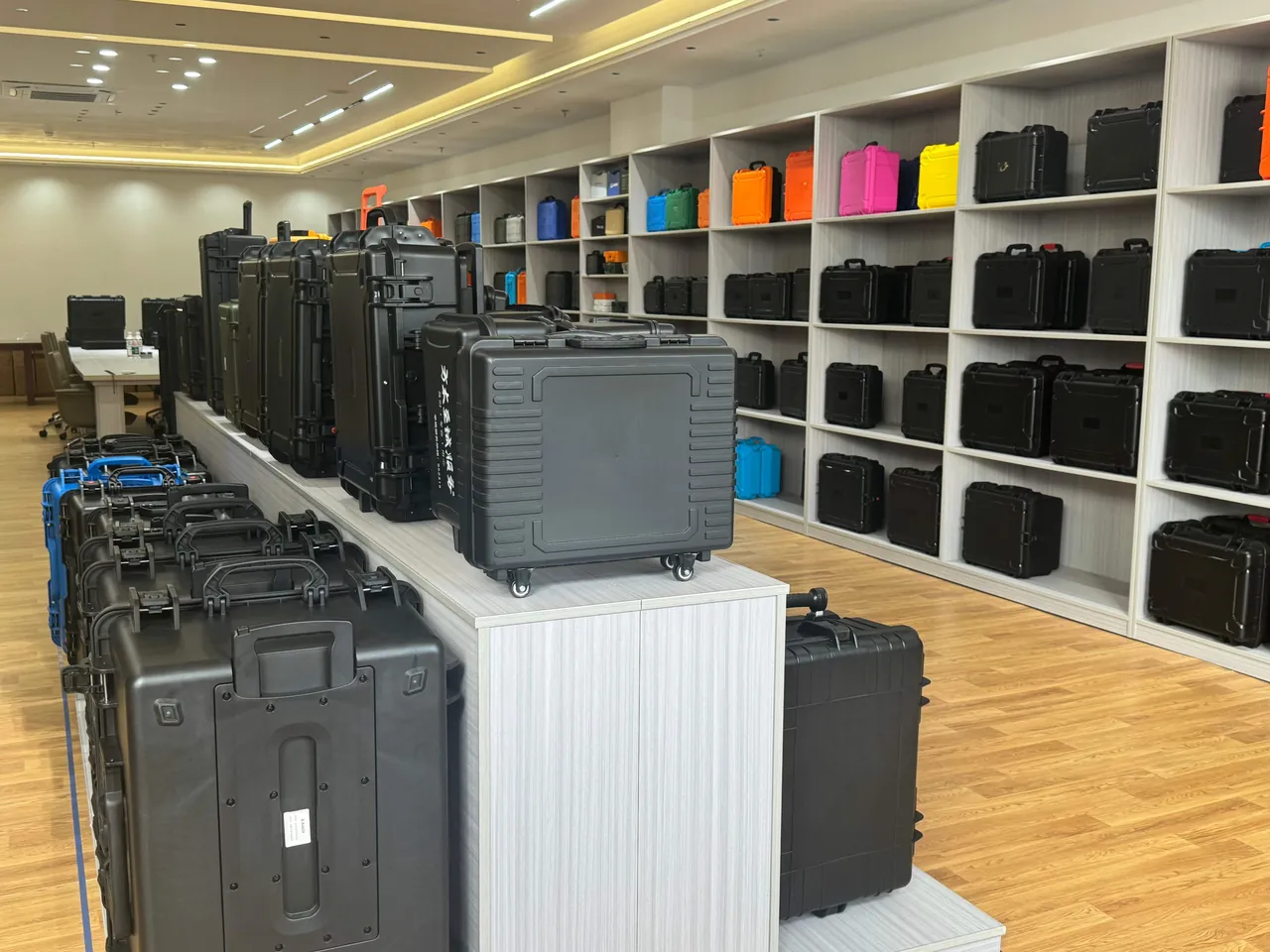
Dropping is one of the harshest and most frequent conditions for this class of container: slipping off a tailgate, being dropped while carried, being knocked off a stack. The goal of drop-resistant design is that at a defined drop height and attitude the shell shows no structural cracking and the seal still recovers.
Five structural points:
- Wall thickness is only the entry-level metric; section moment of inertia governs rigidity. A 3 mm flat wall may bend more easily than a 1.5 mm wall carrying a 20 mm longitudinal rib. Rib design is covered in case reinforcement ribs.
- Grid ribs. An egg-crate or honeycomb rib pattern on the inner wall, with typical rib heights of 3-8 mm and spacing of 40-80 mm, divides a large panel into small spans and dramatically improves resistance to bulging and local denting.
- Corner bumpers and thickened corners. On a drop, the corner contacts the ground first and concentrates the impact energy. Bumpers, thickened corners and radiused transitions spread that load over a larger area.
- Rolled or thickened rim. The rim carries the sealing face and is the least rigid region. Reinforcing it prevents rim deformation after a drop from destroying the seal.
- Reinforced hinge and latch seats. These are impact load concentrations and typically need local thickening or metal inserts. A hinge without reinforcement lets the lid shift after a drop.
Low temperature is the hidden variable in drop design. Plastics lose toughness in the cold and crack more readily on impact. Drop acceptance therefore has to include low-temperature drops — commonly by conditioning the sample at a specified low temperature until it is uniform, then dropping it from the defined height in the defined attitude. On material selection, HDPE is markedly better than homopolymer PP in low-temperature impact and retains toughness at -30 °C to -40 °C, which is one reason HDPE is preferred for outdoor and vehicle-mounted duty.
The complete structural design set appears in high-strength case structure.
Safety feature five: sealing, moisture control and long-term storage
For long-term storage, moisture control matters no less than the lock. Metal equipment corrodes in humid air, electronic components fail, and optical devices grow fungus. Sealing is the only way to control internal humidity stably over years.
Sealing principle. A compliant design uses groove-compressed sealing: a U-shaped or rectangular groove machined into the rim, into which an O-ring or profile extrusion seal is fitted. The groove limits lateral movement of the seal while the latch travel provides a defined vertical compression, commonly designed into the 20%-30% range.
Compared with flat sealing, where self-adhesive foam is applied to the rim or the two lips simply meet, the advantage of groove sealing is decisive:
| Comparison | Flat sealing | Groove-compressed sealing |
|---|---|---|
| --- | --- | --- |
| Compression control | Not controlled; depends on latch stiffness | Set by groove depth and latch travel |
| Resistance to lateral movement | Poor | Good, limited by the groove |
| Replaceability | Mostly one-time | Seal can be replaced separately |
| Long-term rebound | Declines as foam ages | Rubber retains elasticity for years |
| Typical protection level | Around IPX4 to IPX5 | Around IP65 to IP67 |
Seal compounds. Nitrile (NBR) resists oil well at moderate cost; EPDM offers the best weather, water and ozone resistance and is the mainstream choice outdoors and for long-term storage; silicone (VMQ) has the widest temperature window (roughly -50 °C to +200 °C) but poor oil resistance; fluoroelastomer (FKM) offers the best chemical and temperature resistance at higher cost. Hardness commonly falls between 50 and 70 Shore A, and groove dimensions, hardness and compression set must be designed as a set — none can be changed in isolation. A comparison appears in case seal materials.
Ingress rating. Per IEC 60529, with the Chinese national equivalent GB/T 4208-2017. For dust, require at least IP6X (dust-tight). For water, match the scenario: rain alone is satisfied around IPX5, while washdown or standing-water risk calls for IPX7 (commonly 1 m for 30 minutes). Full explanations appear in what is an IP67 rating and IP67 submersion test.
Moisture management. Sealing only stops external moisture; moisture already inside the case will still condense. The correct response is not to open the lid to ventilate, which forfeits the rating, but to load items dry, use a replaceable desiccant pack with a humidity indicator card, and limit temperature swings. A pressure equalization valve reduces the pressure differential but cannot replace desiccant.
Key tests: how drop, vibration, stacking and cycle life are performed
Turning "safe" into an acceptable metric requires four test families.
1. Drop testing. Common references are the ISTA series, ASTM D4169 and the drop methods within GB/T 4857. The essentials are the drop height, which relates to weight and transport mode; the attitude, whether corner, edge or face; and the preconditioning, whether ambient, low temperature or humid heat. For this class of container, corner drop combined with low-temperature preconditioning is the most informative combination.
2. Vibration testing. Per ASTM D4169, ISTA or GB/T 4857.7 and GB/T 4857.23. The purpose is twofold: to verify structural integrity under sustained vibration, and to confirm that latches and hinges have not loosened or shifted. Seal and latch function must be re-tested after vibration, a point that is often skipped.
3. Stacking testing. Per GB/T 4857.3 or the stacking item in ASTM D4169. The engineering statement is that the bottom case carries the total weight above it for a specified storage period without deformation that impairs function. Short-term compression strength and long-term stacking strength must be distinguished: plastic creeps under sustained load, so surviving a short-term load does not mean it will stand up long term. A practical estimate takes long-term stacking strength as 30%-50% of short-term compressive strength.
4. Cycle-life testing. A functional verification: after a specified number of cycles, commonly graded at 1,000 / 5,000 / 10,000, measure clamping-force decay, hinge play and seal retention. This directly determines how many years the case will serve.
| Test | Common reference | Key acceptance criteria | Typical practice |
|---|---|---|---|
| --- | --- | --- | --- |
| Drop | ISTA, ASTM D4169, GB/T 4857.5 | Structural integrity, seal retention | Corner drop with low-temperature preconditioning |
| Vibration | ASTM D4169, GB/T 4857.7 | No cracks, no latch loosening | Re-test seal after vibration |
| Stacking | GB/T 4857.3, ASTM D4169 | No function-impairing deformation | Load set by storage period |
| Cycle life | Company standard / agreed | Clamping-force decay ratio | Retain at least 80% after 5,000 cycles |
| Ingress protection | IEC 60529, GB/T 4208 | Pass digit by digit | IP6X + IPX5 + IPX7 |
| Salt spray | ISO 9227, GB/T 10125 | No red rust for a specified duration | Graded inland / coastal |
Parameters and a selection comparison table
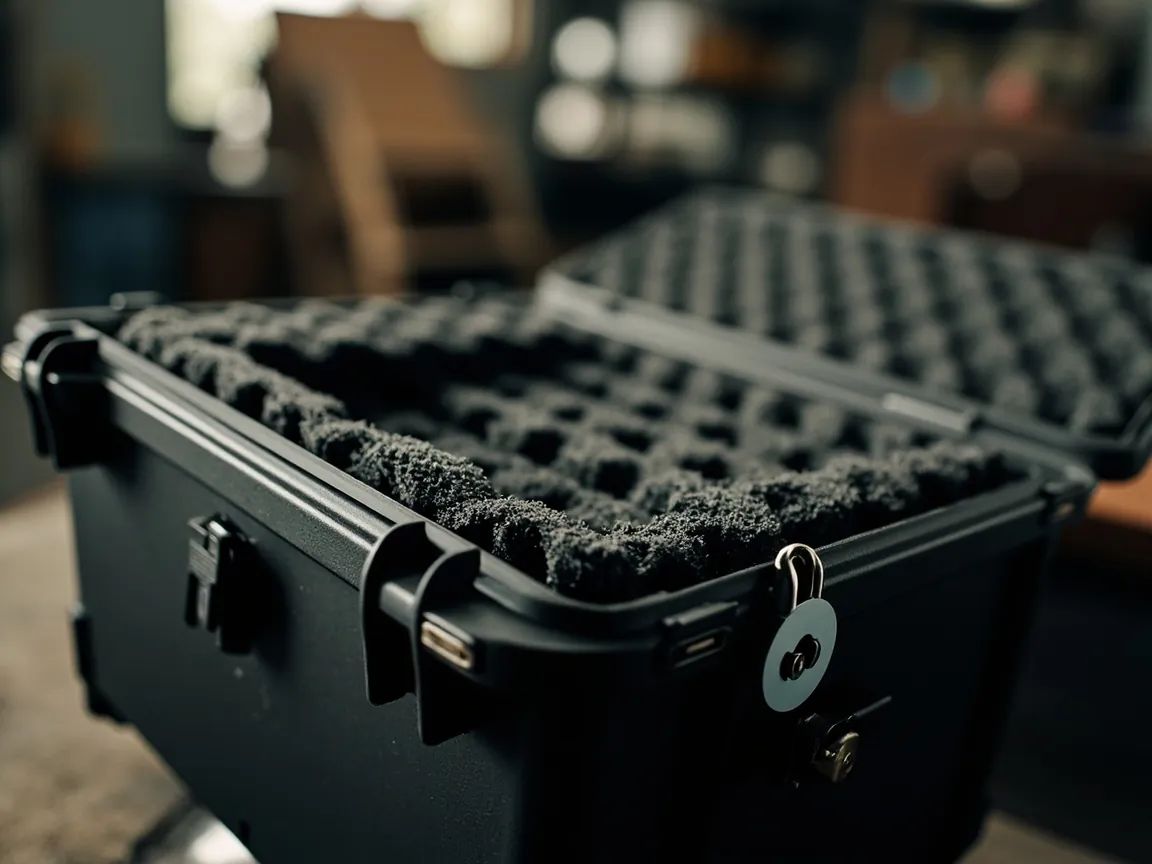
The preceding analysis condenses into a single selection table.
| Decision | Baseline configuration | Advanced configuration | Procurement advice |
|---|---|---|---|
| --- | --- | --- | --- |
| Shell material | Copolymer PP | HDPE / steel | For cold or vehicle duty, always HDPE |
| Lock | Single padlock point | Dual points plus metal cylinder | Prefer dual points on long cases |
| Latch | Plastic catch with pin | Stainless cam latch | Ask for clamping-force decay data |
| Hinge | Plastic leaf | Through metal pin with bushing | Watch lid alignment after cycling |
| Liner | Open-cell sponge | Pre-cut closed-cell EVA | Long items need end stops |
| Seal | Flat foam | Groove plus EPDM O-ring | State compound and hardness |
| Ingress rating | Untested / IPX4 | IP65-IP67 | State each digit; reject X |
| Drop resistance | Unverified | Low-temperature corner drop verified | Require a report for the first shipment |
| Documentation | Verbal assurance | Third-party report plus spare parts list | Model and photos must match the goods |
Three procurement recommendations that can be applied immediately:
- Write requirements as acceptance clauses. For example: "IP6X + IPX5 + IPX7; EPDM seal, 60 ± 5 Shore A; stainless cam latch retaining at least 80% of initial clamping force after 5,000 cycles; dual lock points with holes accepting an 8 mm shackle."
- Send the first shipment for third-party re-testing. Ingress protection per IEC 60529 / GB/T 4208-2017, drop and vibration per GB/T 4857 or ASTM D4169, salt spray per ISO 9227. The model and photographs on the report must match the actual product.
- Request spares and drawings at the same time. Gaskets, latches, hinges and cylinders are consumables; confirming they can be ordered separately and that replacement instructions are supplied extends the life of the case significantly.
Common mistakes and a pitfall checklist
Mistake one: treating "it has a lock" as "it is secure". The value of a lock depends on the structure around the lock point. If the point is a small plastic boss on the wall, one pry breaks it and the cylinder grade is irrelevant. Test it: try to flex the lock point sideways and see whether it is integrated with the primary structure.
Mistake two: using a single lock point on a long case. A long case locked only in the middle can have either end pried open. Dual points are close to a necessity for this format.
Mistake three: a liner that pads but does not locate. A case with a single foam layer lets equipment slide and collide in transit. The liner must constrain in three axes and provide end stops.
Mistake four: ignoring low-temperature brittleness. Winter outdoor, cold-store and high-altitude drop conditions differ entirely from room temperature. Acceptance must include drops after low-temperature preconditioning.
Mistake five: open-cell sponge for long-term storage. Open-cell sponge absorbs ambient moisture and retains it, actually accelerating corrosion of metal parts.
Mistake six: judging static strength but not creep. Plastic cases deform slowly under long-term stacking, and once the rim loses flatness the seal fails. Stacking capability must be assessed against the storage period.
Mistake seven: non-replaceable seals. Seals are consumables. A seal that cannot be replaced means the whole case is scrap once the seal fails.
Compliance and documentation: what to request during procurement
For B2B procurement and corporate storage management, documents convert "safe" into a traceable chain of responsibility. Five categories should be requested:
- Product drawings and specification sheet: internal dimensions, wall thickness, rib pattern, lock point positions, and a dimensioned cross-section of the sealing groove with tolerances.
- Material certificates: base polymer system (HDPE or copolymer PP), recycled content and limits, UV additive statement, and the seal compound and hardness certificate.
- Third-party test reports: ingress protection (IEC 60529 / GB/T 4208-2017), drop and vibration (ASTM D4169 / ISTA / GB/T 4857), salt spray (ISO 9227 / GB/T 10125), and flammability (UL94) where required.
- Functional verification records: the initial clamping force and decay curve from cycle-life testing.
- Spare parts list and replacement instructions: model designation, lead time and method for gaskets, latches, hinges and cylinders.
Verification tip: the model designation, photographs and test conditions on a report must match the actual product. Be wary of vague wording such as "similar reference model" or "same-platform product" — different configurations on the same platform can have entirely different seals and locks, and cannot be cross-referenced.
Sourcing and OEM/ODM: how to write the clauses
For distributors and brand owners, customisation of this container concentrates in three places: structure, lock system and liner. Requirements should be written across six blocks:
- Material: base polymer system, recycled content limit, colour and colour tolerance, UV requirements.
- Structure: internal dimensions, wall thickness, rib pattern, rolled rim, corner bumpers, hinge type.
- Lock system: number and position of lock points, padlock hole dimensions, whether a cylinder is integrated, and whether keys can be changed.
- Seal and protection: groove geometry, seal compound (NBR/EPDM/VMQ/FKM), hardness, compression set, and the ingress rating stated digit by digit.
- Liner: foam material, density, thickness, locating slot dimensions, end-stop method, tolerances.
- Documentation and spares: type test reports, material certificates, spare parts list and lead time, packaging and marking.
JUNZHJIA is manufactured by KeXin New Materials (Guangdong) Co., Ltd., covering protective cases, toolboxes, long-format storage cases and waterproof junction boxes, serving wholesale, agency, OEM/ODM and global supply. Within the clause framework above, material systems, lock configurations, sealing structures and custom liners — including pre-cut foam and end stops — can be tailored to the customer's operating conditions, with corresponding test documentation and spare parts support.
FAQ
Q: If I fit a padlock to the case, is the safety design acceptable?
A: No. A padlock is only one element of a lockable structure, and the real security level depends on three things. First, whether the lock point sits on the load path: the ideal structure forms a continuous load chain of latch, metal seat and reinforced shell region, so a prying load is carried by the primary structure rather than a small plastic boss. Second, whether there are dual lock points: a long case locked only in the middle can have either end pried open, and dual points are close to a necessity for this format. Third, whether the lock installation has compromised the seal: some designs lift the latch to give the lock more travel, leaving the gasket under-compressed, so the case is "locked but humidity still gets in". Note also that an exposed padlock shackle can be cut, so the steel section and hardness at the lock hole are themselves acceptance items. Write the number of lock points, the hole dimensions (for example, accepting an 8 mm shackle), the cylinder grade and the key-change requirement into the technical agreement, rather than simply stating "lockable".
Q: What foam material is best for the liner?
A: It depends on the application, but one general rule holds: for long-term storage and outdoor use, always choose closed-cell material. Closed-cell EVA foam, commonly 30-80 kg/m³, does not absorb water, recovers consistently and can be CNC pre-cut, making it the best overall choice. Closed-cell PE foam in the XPE/IXPE family is stiffer and more compression-resistant, suiting applications that need structural support. Open-cell polyurethane sponge is the cheapest, but its open structure absorbs water and oil, degrades into crumbs, loses support over time and becomes a contamination source in dusty or humid conditions; it suits only dry indoor use and short transit. Beyond material, the more important factor is locating design. The liner must constrain equipment in length, width and depth simultaneously, and a long-format case must have end stops that hold lengthwise movement to a few millimetres. A practical approach leaves 1-3 mm of clearance in the locating slot, avoiding both difficult loading and foam swelling that grips the equipment once damp. If metal items are stored long term, add VCI corrosion-inhibiting material alongside the foam.
Q: How should the height and attitude be set for a drop test?
A: Fix the transport mode first, then the parameters. Drop height relates to package weight and transport method — manual handling, pallet transfer and container shipping represent different severities — and the distribution cycle frameworks in the ISTA series and ASTM D4169 can guide the choice. On attitude, the most informative combination for this class of container is the corner drop: the corner contacts the ground first, concentrating impact energy and simultaneously testing corner bumper design, rib layout and rim rigidity. A face drop, by contrast, yields far less information. The third key variable is preconditioning: plastics lose toughness in the cold and crack more readily, so low-temperature preconditioning, bringing the sample to a uniform temperature before the drop, is essential and much closer to winter outdoor or cold-chain reality than an ambient drop. There are two acceptance criteria: structural integrity, meaning no cracks and no rim instability, and seal retention, meaning a submersion or jet test after the drop. Many suppliers simply report "passed drop testing" without stating height, attitude or conditioning temperature, which makes the report incomparable; procurement should require all test parameters to be stated.
Q: For long-term storage, how often should the gasket be replaced?
A: It depends on compound, duty cycle and cycling frequency, but the criterion is condition, not elapsed time. Seal ageing shows up as slower rebound, surface hardening or tackiness, and permanent compression marks. Inspect visually and by feel every 6-12 months: check that the gasket is continuous with no cuts or flash; check that it rebounds promptly when pressed; close the lid without latching and slide thin paper around the perimeter to check for even resistance. If it is clearly hardened or the compression marks do not recover, replace it. Compound choice directly affects life: EPDM lasts longest in outdoor moisture and ozone and suits long-term storage; NBR resists oil but has moderate weather resistance; silicone VMQ has the widest temperature window but poor oil resistance; FKM offers the best chemical resistance at higher cost. When replacing, the groove cross-section, seal profile and Shore hardness, commonly 50-70 Shore A, must match the original; substituting a harder or softer seal breaks the compression design. A continuously moulded ring is most reliable; if a strip must be joined, the joint must be flush and must sit away from a corner. Confirm at the procurement stage that spares can be ordered separately.
Q: If the case can be pried open, does the seal still matter?
A: These are two independent but coupled performance dimensions, and neither substitutes for the other. Sealing addresses environmental protection — moisture, dust and immersion resistance — keeping contents usable over time. The lock addresses access control — restricting unauthorized opening. Even in a high-control setting, sealing remains necessary, because equipment damage usually comes from moisture and impact rather than from being opened. Conversely, good sealing does not imply pry resistance, because the two follow entirely different structural paths: sealing is governed by groove geometry and gasket compression, while pry resistance is governed by the lock point load chain, latch type, rim rigidity and hinge strength. A compliant design makes them work together: when a prying load is applied, rim deformation should stay within the recoverable range of the seal, meaning the rim does not become permanently misaligned after being pried. This is why torsional rigidity matters so much — torsion misaligns the rim diagonally and locally lifts the gasket. Write the two as separate acceptance clauses in the technical agreement rather than merging them into one statement about being "safe and reliable".
Q: How can I verify a supplier's ingress and drop claims?
A: Verify in three tiers. Tier one is visual and tactile inspection on receipt, done for every batch: check that the gasket is continuous with no cuts or flash and that it rebounds promptly; close the lid without latching and use thin paper around the perimeter to check gap evenness; close each latch and confirm consistent force with a definite engagement; check that hinges, handles, pressure valve and nameplate penetrations have independent sealing; and try to flex the lock point sideways to see whether it is integrated with the primary structure. Tier two is a simple spray screen for first articles and periodic sampling: use an ordinary spray gun at 2-3 m, spraying each face for at least one minute from all directions and concentrating on latches, hinges, handle roots and corners, with dry paper tissue and a humidity indicator card inside and inspection immediately afterwards. Tier three is third-party re-testing of ingress protection to IEC 60529 / GB/T 4208-2017, drop and vibration to GB/T 4857 or ASTM D4169, and salt spray to ISO 9227. In every tier, check that the model, photographs and test parameters on the report match the actual product, and be wary of wording that refers to a "similar reference model".
Q: What is a sensible internal layout for a long-format storage case?
A: The central tension is satisfying two needs at once: locating long equipment and organizing accessory items. Consider three layers. The first is main equipment location: end stops or locating slots at both ends hold lengthwise movement to a few millimetres, and closed-cell foam should cover the full area beneath the main item to avoid local loading. The second is accessory zoning: removable dividers carve the remaining space into separate areas organized by purpose, such as maintenance supplies, tools and spares, keeping them clear of the main equipment. The third is access efficiency: frequently used items belong near the rim so the main equipment does not have to be removed first. If the case will be stacked or carried often, leave a little cushioning allowance around the main equipment so that a drop produces controlled movement, but the total movement must stay within the deceleration design range — which is exactly what the cushion curve resolves. The divider-versus-foam trade-off is covered in case divider versus foam. JUNZHJIA can provide pre-cut foam and divider zoning plans based on equipment outline drawings, together with cushioning recommendations.
Q: In B2B bulk procurement, how should lock and hardware durability be assessed?
A: With two supports: quantified data and repeatable re-testing. On quantification, request three figures: the initial latch clamping force; the percentage retained after a specified number of cycles, with an empirical benchmark of at least 80% after 5,000 cycles; and the hinge clearance change after cycling. On hardware, request the cross-section drawing and material statement for the lock point, confirming that the lock point, latch seat and hinge seat all sit in reinforced regions or have metal inserts. On re-testing, commission third-party cycle-life and low-temperature drop tests for the first shipment — these two most readily expose cost-cutting, since low-temperature drop reflects material and structure while cycle life reflects hardware and assembly quality. Pay attention to two hidden criteria as well. First, seal replaceability: seals are consumables, and a non-replaceable seal means the whole case is scrap when it fails. Second, spare parts lead time: long-term users need a dependable supply of gaskets, latches and cylinders. Writing these four items into the technical agreement and acceptance criteria greatly reduces later disputes.
Conclusion and further reading
Back to the title question: the safety design of a firearm storage case is the overlay of two engineering lines, protection and control. The protection line comprises liner locating, shell rigidity, drop-resistant structure and the sealing system, with the goal of keeping contents intact through moisture, impact, stacking and long storage. The control line comprises the lockable structure, dual lock points, pry-resistant geometry and hardware service life, with the goal of restricting unauthorized opening and ensuring the case still locks properly years later. The two lines converge at the rim — the rim carries both seal compression and prying loads, which makes rim thickness, latch seat position and hinge reinforcement the three most critical structural details.
Three actionable recommendations. First, write safety as acceptance clauses — number of lock points, padlock hole dimensions, seal compound and hardness, ingress rating digit by digit, and clamping-force decay ratio; every omission becomes a dispute later. Second, make low-temperature drop and cycle life mandatory first-shipment tests — these two most reliably expose the true level of material and process quality. Third, manage seals and hardware as consumables — buy spares alongside the case and set an inspection interval; for a modest cost, the life of the case can be doubled.
JUNZHJIA is manufactured by KeXin New Materials (Guangdong) Co., Ltd., covering protective cases, toolboxes, long-format storage cases and waterproof junction boxes, serving wholesale, agency, OEM/ODM and global supply. Material systems, lock configurations, sealing structures and custom liners can be configured to the customer's operating conditions, with corresponding test documentation and spare parts support.
Further reading