

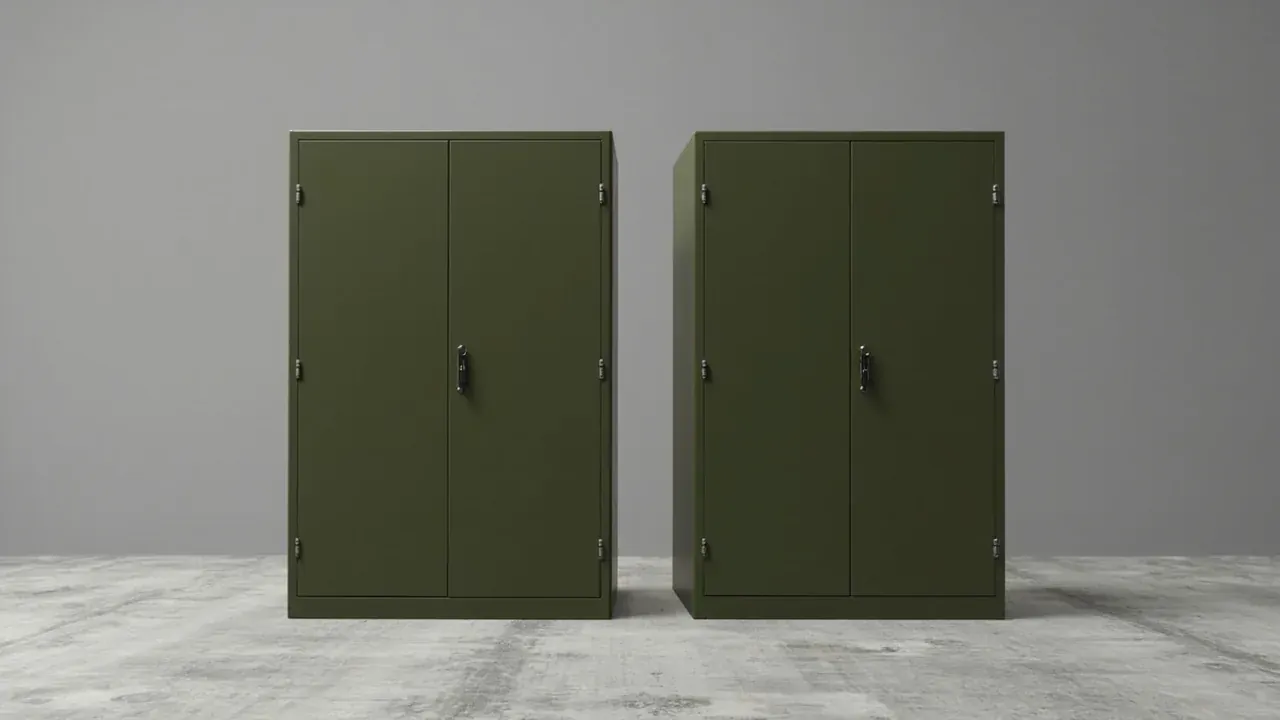
Quick answer: Choose a field armoury in a fixed order: deployment, capacity, lock type, then mobility and exposure. Deployment decides whether the cabinet needs floor anchors, castors or four lifting eyes. Capacity comes from usable compartments and shelf pitch, not outer volume. Lock type follows door width and seam length, while mobility rests on wheel load, lifting points and aisle clearance.
Table of contents
- Field armoury deployment: fixed, semi-fixed or moved whole
- Working out capacity: compartments and shelf adjustment
- Locking and opening: single point, three point, dual hasps
- Mobility: castor load, lifting points and aisle width
- Exposure: dust, moisture and weather
- FAQ
1. Field armoury deployment: fixed, semi-fixed or moved whole
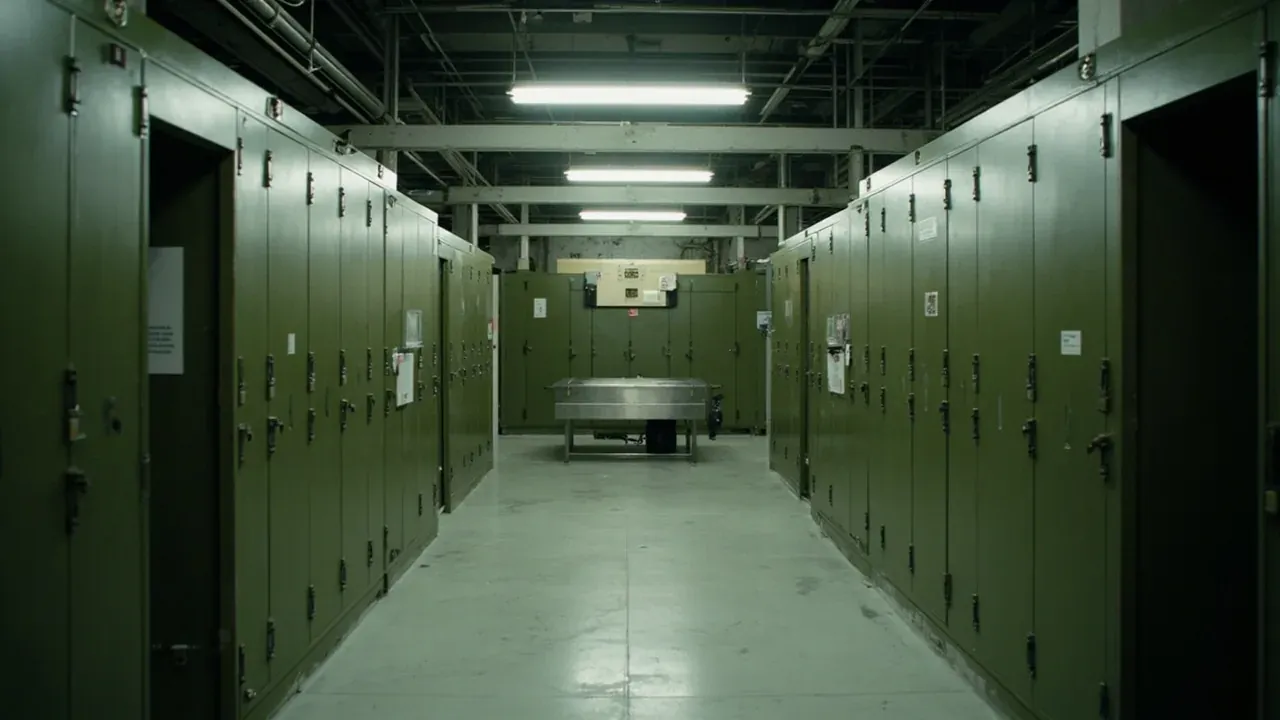
Deployment is the first decision because it fixes every later interface. A field armoury standing in one room wants floor anchors, shims and a wall bracket, and no castors. A semi-fixed unit moves between rooms, so braked castors and a doorway-sized footprint matter more. One that travels with a team must be lifted whole, putting corner eyes and a pallet base first.
| Role | Test on site | Interface to specify |
|---|---|---|
| Fixed | Same room for years | Anchors, shims, wall bracket |
| Semi-fixed | Moves between rooms | Braked castors, door footprint |
| Whole-cabinet | Loaded out repeatedly | Corner eyes, pallet base |
The roles are easy to tell apart, but their hardware is not interchangeable. Castors on a fixed-duty base leave the frame too thin for lifting, and eyes on a light base distort it. Anchors stop movement without straightening a twisted base, so shims fill the gap first.
2. Working out capacity: compartments and shelf adjustment
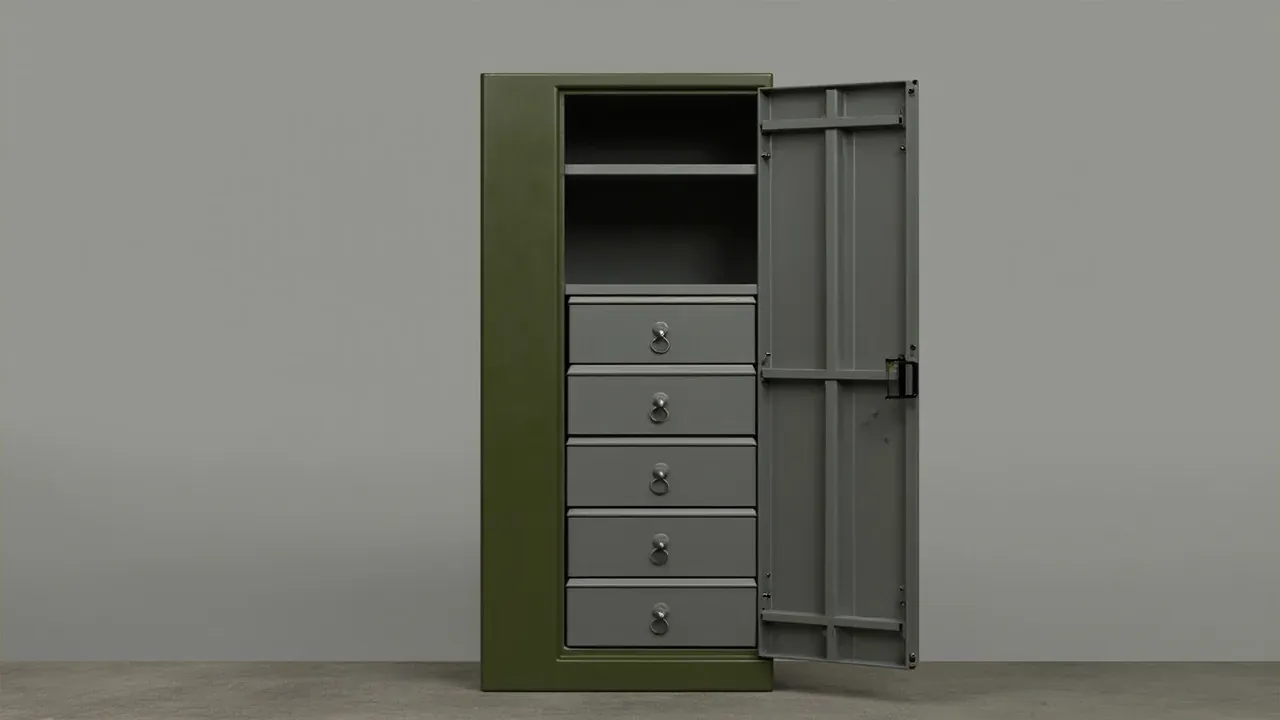
Count capacity in usable compartments rather than litres. Two field armoury cabinets of similar outline can differ by a third once uprights and runners are subtracted. Measure clear width after the uprights and depth behind the door panel.
Vertical layout decides how much of that space can be divided. A closer shelf pitch matches more heights, yet every added hole removes steel from the upright. Drawers cost depth and cannot be re-pitched, so they belong low, with shelves above.
3. Locking and opening: single point, three point, dual hasps

Lock type follows door width and seam length, not price. Past roughly 1.5 metres, the corners sit too far from a single latch, so a three-point linkage is the only way to pull the leaf flat. A single latch suits a narrow field armoury door that opens often.
Dual hasps are hardware first: two hasps side by side take one padlock each, so the door cannot open until both are released. Specify centre spacing, shackle clearance and the leaf-to-frame gap. An exposed hinge pin that can be driven out from outside defeats the lock entirely.
4. Mobility: castor load, lifting points and aisle width
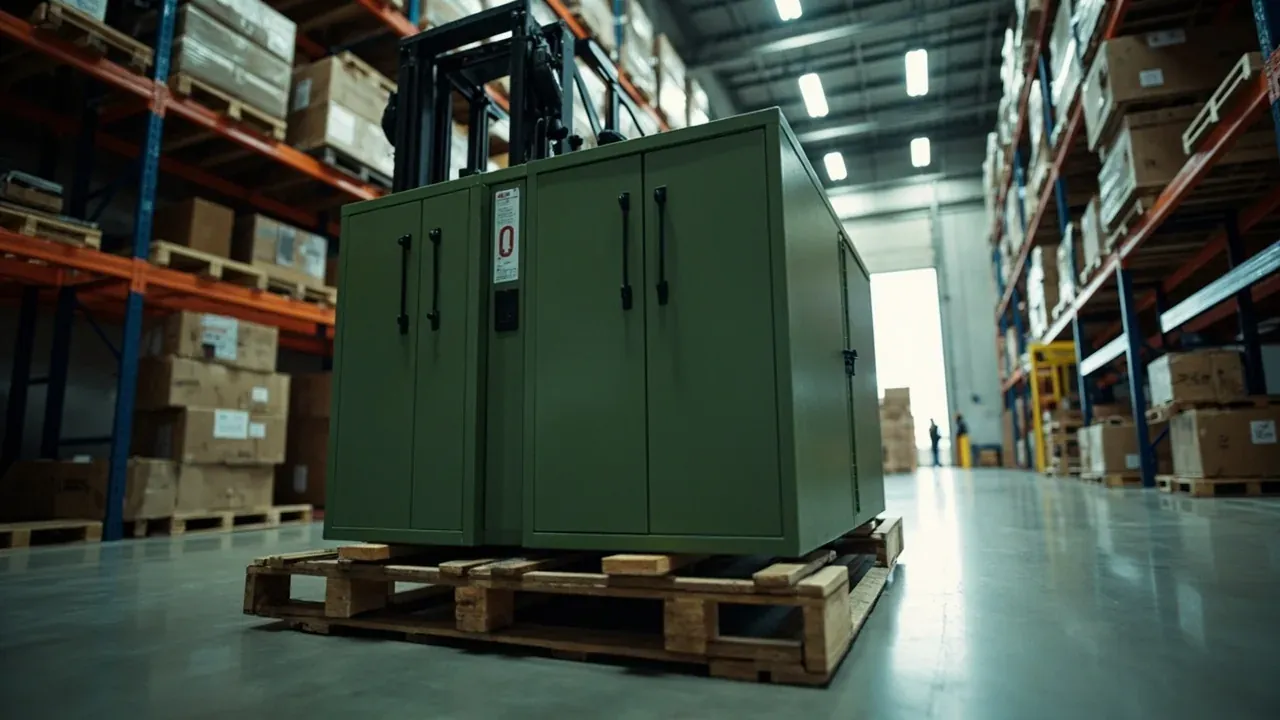
Mobility for a field armoury rests on three numbers: load per castor, position of lifting points, and the narrowest clear width on the route. All three use loaded weight, never empty weight. Castor figures are usually static, while pushing adds starting, turning and threshold loads.
Lifting eyes are checked per point, not per cabinet. Four corner eyes are the minimum, and a wider sling angle raises horizontal force where a long side buckles first. Doors stay latched through the lift, and aisle width follows the diagonal.
5. Exposure: dust, moisture and weather
Exposure should be graded in three steps, not specified at the top by default. Indoor, sheltered and open ground call for different seals, hardware and coatings. Grading above that adds weight and opening resistance.
| Exposure | Sealing | Hardware |
|---|---|---|
| Indoor | Single lip, straight seam | Zinc-plated body |
| Sheltered | Double lip, drip edge | Stainless latches |
| Open ground | Two seals, sloped top | Stainless fittings |
Dust enters through the seam, keyway and any vent, so a louvre panel cancels a good gasket. Moisture follows temperature difference: a field armoury moved from cold into humid air condenses inside, and a tighter seal traps that water. Weather resistance sits in coating and fittings.
Before delivery, check:
- Deployment role matches the base fittings
- Clear width, depth and height suit the compartment plan
- Lock type matches door width, hasp spacing checked
- Four-wheel rating at loaded weight
Conclusion
Select in four steps: fix the deployment role, derive capacity from compartments, choose the lock by door width, then check mobility and exposure. Each step feeds the next, and interfaces are what a field armoury cannot change after delivery.
This article covers container-side specifications and design implications only.
Related Reading
- What a field armoury is and where its form ends
- Stacking design for containers: load, interlock and stability
- Military Ammo Case vs Ordinary Storage Box: A Full Compari…
- Heavy-duty case load ratings, wall thickness and reinforcement
Related Products
- 8 Series — Gun Cases; Military Equipment Cases; Camera Equipment Cases; Drone Cases; Watch Cases; Knife Cases; First Aid Cases; Electronics Equipment Cases
- WL8-2812 PP Gun Case — model WL8-2812
- All protective cases and toolboxes: 7 series, 158 models