

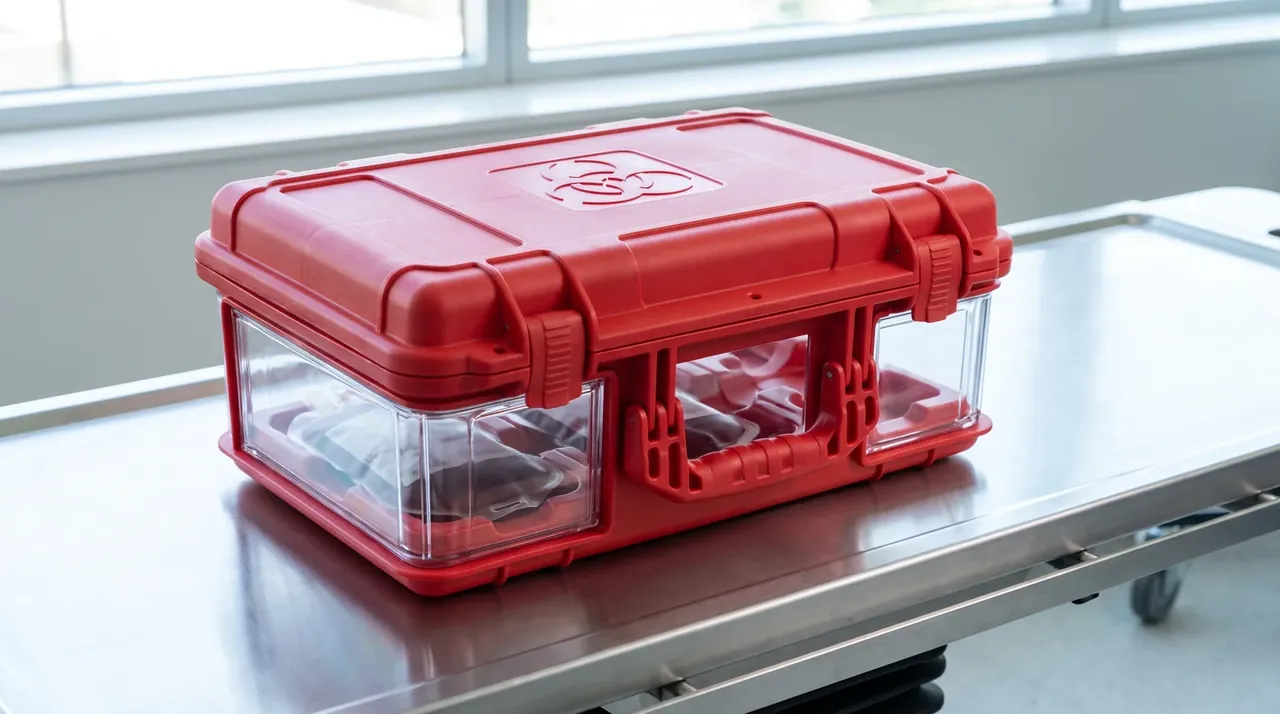
Quick answer: Field Medical Equipment Case design follows four field stresses: thermal swing, dust, rain and vehicle vibration. Each strikes another face.
Table of contents
- Temperature swings: condensation inside the lid
- Dust: abrasive wear on the seal lip and the latches
- Rain and brief immersion: where the IPX rating stops
- Vehicle vibration: where the strap anchors belong
- Opening and packing up: the time budget
- FAQ
Temperature swings: condensation inside the lid
A swing from minus ten to forty-five degrees Celsius in one day is ordinary field weather. Air sealed in at closing time carries a fixed moisture load. The walls heat by day and internal pressure sits slightly above ambient; at night pressure falls back, and vapour condenses on the largest cold surface, which is the inside of the lid. The water does not fail anything at once. It pools in rib channels and runs down the rim at the next opening.
The battery is the weakest link. Cold raises cell resistance, and the coldest hour before dawn is when a device refuses to cooperate. Heat drives electrolyte breakdown faster, so a Field Medical Equipment Case stored under a summer roof ages quicker than one kept in a store room. The case is not asked to insulate but to flatten the curve: two to three millimetres of solid wall slows how fast the interior follows the outside.
| Ambient | Device response | Case response |
|---|---|---|
| −10 ℃ | Resistance climbs, runtime halves | Wall mass buffers the swing |
| 0 ℃ | Condensation peaks | Wipe the lip dry before closing |
| 45 ℃ | Electrolyte ages faster | Keep it off the roof liner |
ABS holds shape to a heat deflection of 80 ℃ to 105 ℃, so forty-five degrees is harmless; at minus twenty the notched impact falls to 40–120 J/m and a corner knock can split the shell, which is what corner bumpers are for.
Dust: abrasive wear on the seal lip and the latches
The standard dust test uses talcum powder below 75 micrometres, at 2 kg/m³, for eight hours under negative pressure. Talc sits at Mohs 1; field dust usually carries quartz at Mohs 7. Passing the test says fine powder stays out, nothing more; it says nothing about grit.
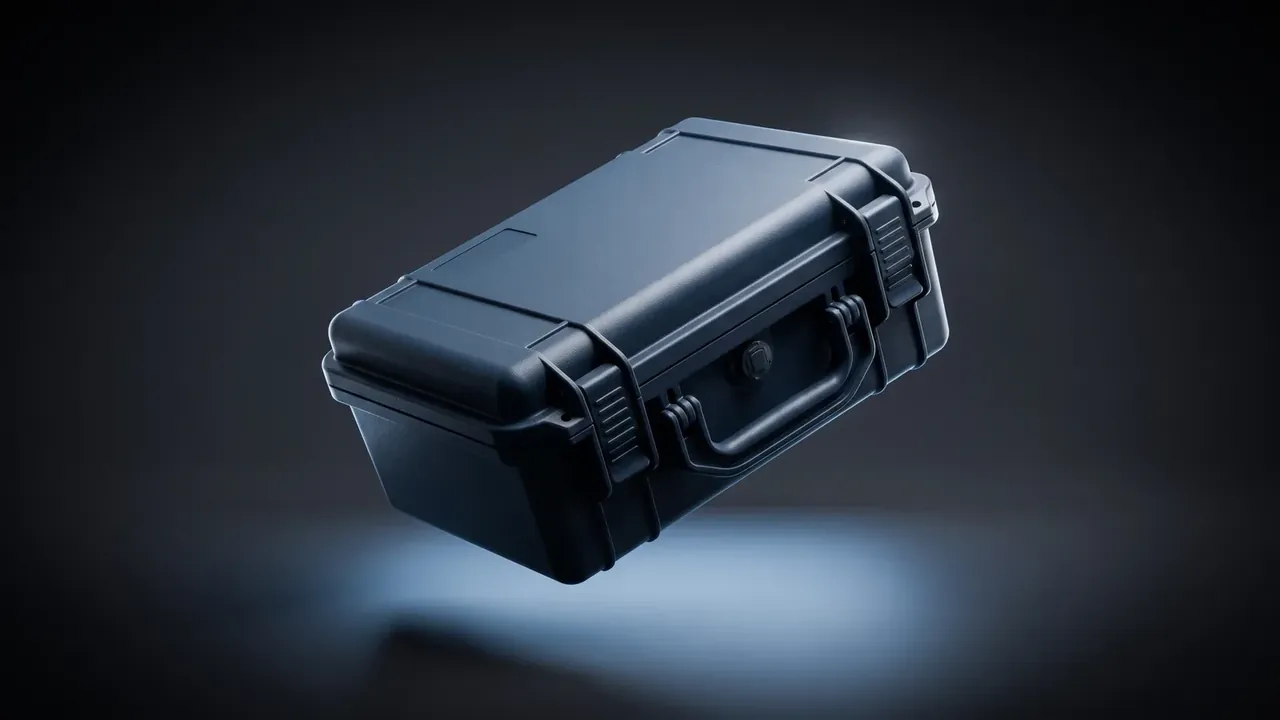
On a Field Medical Equipment Case the seal lip wears first. It presses on the rim flange across a band one to two millimetres wide, and that band holds water out. Trap a sand grain and every closing stroke drags abrasive across the rubber. After a few dozen cycles the band carries scoring no one can see, and water finds the capillary path along it.
The latch wears second. Holding force typically lands between 200 N and 400 N, generated by a cam riding over centre. Grit in the pin and groove stiffens the stroke, the closing force rises, and the hand can only supply so much, so the latch ends up one notch short. A replaceable lip is the cheapest fix: swap the strip, not the lid. Dust and temperature also conspire, pushing air out by day and pulling grit in behind the lip at night, twice a day, seven hundred times a year.
Rain and brief immersion: where the IPX rating stops
IPX7 is reproducible: the lowest point sits 1000 mm below the surface, a sample of 850 mm or more has its highest point 150 mm under, the soak lasts 30 minutes, and sample and water stay within 5 K. A Field Medical Equipment Case rated IPX7 therefore covers static immersion only, not jets, which belong to the second digit 5 and 6.
| Second digit | Condition | Covers a jet |
|---|---|---|
| 5 | Water projected from any direction | Yes |
| 6 | Powerful jets, larger volume | Yes |
| 7 | 1 m static soak, 30 min | No |
| 8 | Depth and time set by maker | No |
The trouble comes after the rain stops. Lid faces crown outward, so water collects in the latch pockets; open the case and that pocket drains across the rim onto the compartments. Close the Field Medical Equipment Case with a film still on the lip and the film has nowhere to go but inward. Field judgement is blunt: a visible water film inside after pack-up fails the shell, whatever the label claims.
Coastal routes and de-iced roads add salt fog. Neutral fog at 5% NaCl for 48 hours is the usual screen, judged on pitting of latches and hinge pins. Pitting is localised, a small mouth over a deep pit; once it opens on a load-bearing latch seat, holding force falls away in a few cycles.
Vehicle vibration: where the strap anchors belong
Loads in a moving vehicle are cyclic. Road input arrives through the tyres, and the case is pushed and pulled against the bay dozens of times a second while the strap tensions and relaxes. Anchor on a thin mid-wall and force lands where there is no rib, so a pale wear ring appears after a few hundred kilometres. Anchor on handle bosses, hinge bosses and feet and the load enters the frame.
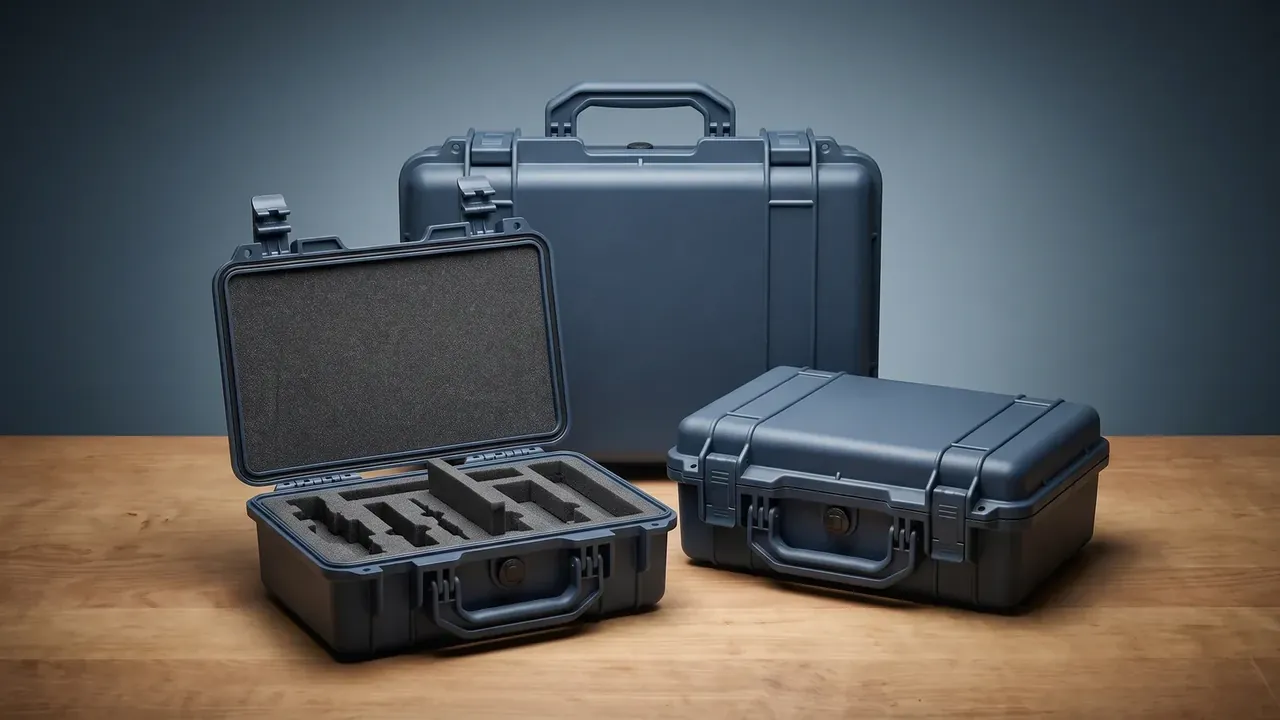
Four anchors, not two. Two points restrain translation only; the Field Medical Equipment Case can still rotate about the line between them, and under braking a high centre of gravity rotates furthest. Four crossed anchors press the shell onto the bay floor and cut the tipping arm. A packed case often carries a dozen instrument types, so the strap has to pass over the lid, not cup the base.
Twelve kilograms on two shoulder straps bounces with every step, so the handle bosses see repeated tension rather than a steady pull. Size the static rating at twice the packed weight.
Opening and packing up: the time budget
Opening is easy to underestimate. Lay the Field Medical Equipment Case flat, release the latches, lift the lid, take items in compartment order, close: the sequence must finish inside ninety seconds, and what buys that is compartment order and lid angle. Too little lid swing and the innermost instrument is fished out sideways.
Packing up costs more, because it adds checking. Instruments go back in place, wrappers leave with the team, and the rim is wiped before closing. If a Field Medical Equipment Case gives no prompt, pack-up becomes recall, and recall is where things get left behind. At two call-outs a day, every second saved on opening is saved again on closing.
Conclusion
Water ingress is the stress most often over-engineered, and dust plus strapping the ones most often under-served. Draining the latch pockets, making the lip replaceable and anchoring four points on thickened bosses outlast any extra digit on the water rating. The value of a Field Medical Equipment Case shows the morning after a wet night, when the inside of the lid is dry.
This article discusses the enclosure side of specifications and design intent only, not the handling, loading or use of anything carried inside.
Related Reading
- Field configuration standards for medical cases
- Emergency and first-response equipment cases
- Storing and sealing first aid equipment
- Plastic cases versus wooden crates in field transport
Related Products
- 8 Series — Gun Cases; Military Equipment Cases; Camera Equipment Cases; Drone Cases; Watch Cases; Knife Cases; First Aid Cases; Electronics Equipment Cases
- WL8-2812 PP Gun Case — model WL8-2812
- All protective cases and toolboxes: 7 series, 158 models