

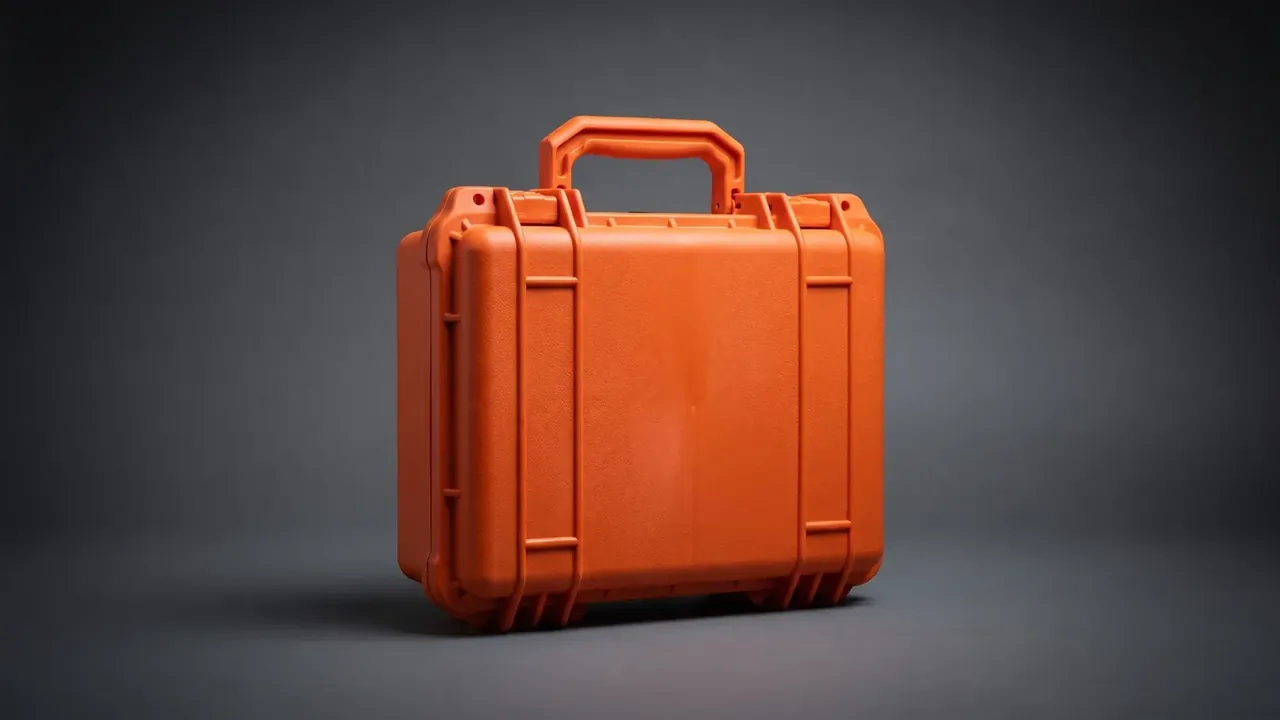
Quick answer: A Field Testing Equipment Case opens one-handed at the kerb: 430×330×180 mm outside, 3.4 kg loaded, lid resting at 105°, 120×90 mm access opening.
Table of contents
- Arrival Rhythm for a Field Testing Equipment Case
- One-Handed Opening and the Lid Stay Angle
- Access Opening Size and Liner Recovery
- Document Sleeve and Label Window in the Lid
- How a Crew Judges Reset
- FAQ
1. Arrival Rhythm for a Field Testing Equipment Case
The van stops on the shoulder, the meter is still inside, and the first problem is not a reading — it is getting the lid up with one hand.
There is no bench: beyond the barrier is a drain, underfoot gravel, so the case rests on the thigh while the other hand works the catches.
At 430×330×180 mm it weighs 3.4 kg loaded, held in one hand about 20 s before the wrist shakes; a 4.2 mm wall does not dish under a thumb, and the lid does not jam when one side takes the load.
Cavity runs 385×285×140 mm; a 30 mm base liner leaves 110 mm of clear height, so the meter travels flat.
| Open timing | One-person sequence | Where it holds up |
|---|---|---|
| 25 s band | Set down, release two catches, swing to 105°, lift the meter | Shoulder, barrier edge, no bench |
| 40 s band | A second person braces the shell, or the bonnet becomes a bench | Load over 4 kg, or a two-piece liner |
| 60 s band | Ground-level opening, mat laid first | Rain, mud, night work |
2. One-Handed Opening and the Lid Stay Angle
The stay angle on a Field Testing Equipment Case decides whether the hand can be freed. At 105° the lid mass has passed the hinge axis and will not drop back; near 90° a side gust closes it.
The figure is not arbitrary: the 330 mm lid carries about forty percent of 3.4 kg with its centre 140 mm from the hinge, and below 98° it falls inboard.
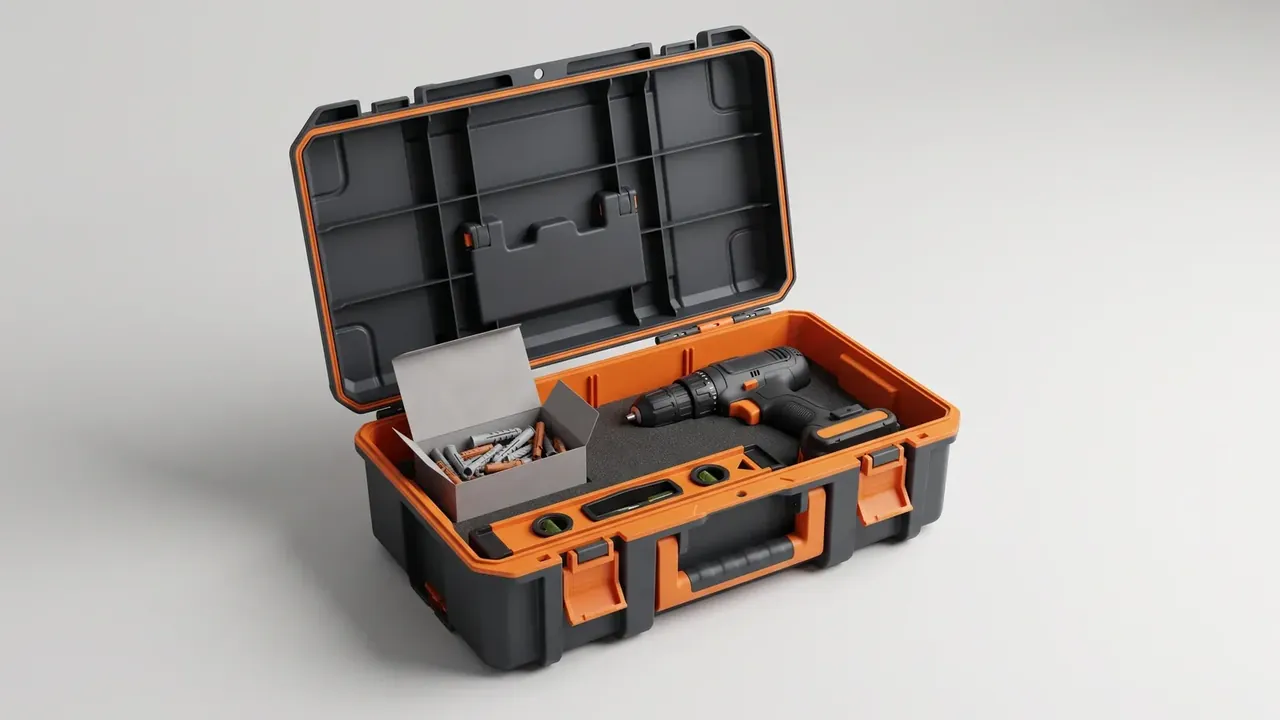
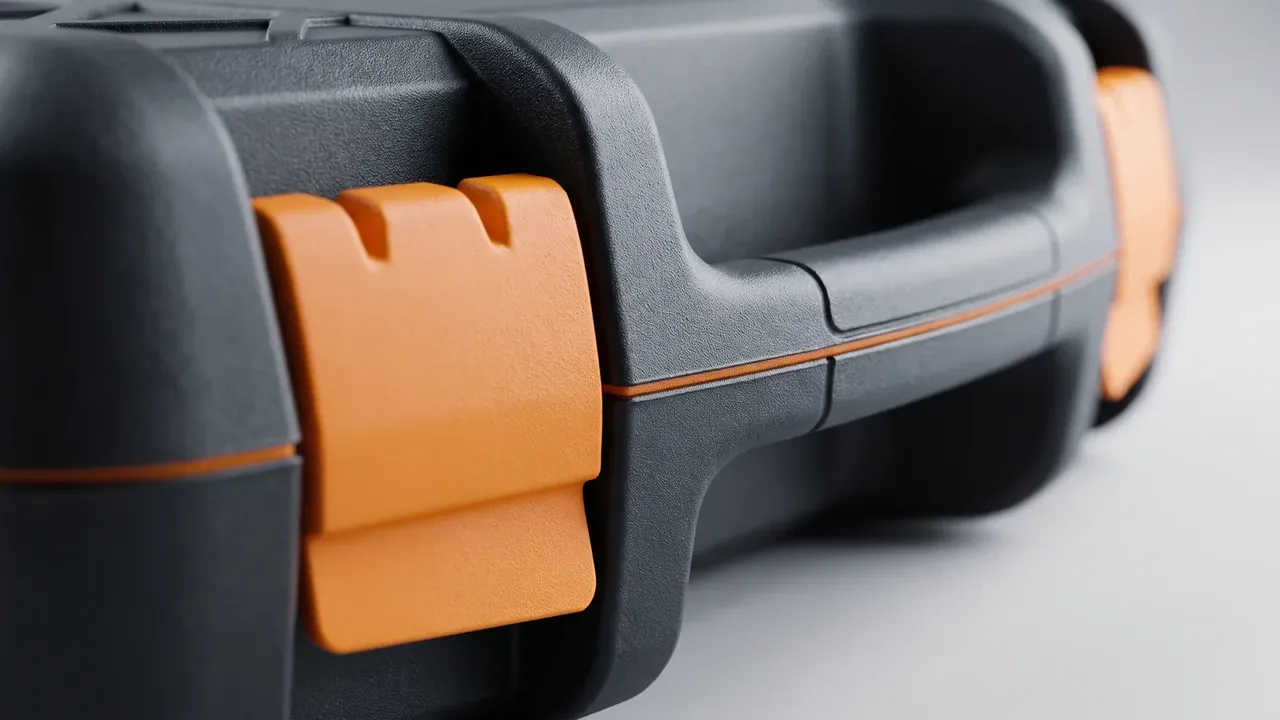
Two catches at 300 N each put 600 N on a 1520 mm seal line, an average under 0.4 N/mm; compression sits in a 200 mm band either side of each catch, the long-edge middle carried by a rib. Two transport figures attach to the shell: stacking 5 high, and 1.2 m drops onto 6 faces.
Opening force is the other constraint: 30 to 80 N, below which a rucksack pops the case open, above which a glove cannot work the lever.
Cycling is rated at 5000 at 25 per minute; read sag at the lid front edge every 1000 cycles and stop past 1.2 mm. A 4 mm pin develops play around 2000 cycles, and the lid rocks before it stops sealing.
3. Access Opening Size and Liner Recovery
The access opening on a Field Testing Equipment Case is cut in the liner, not the wall. At 120×90 mm it fits a gloved hand: an 85 to 90 mm palm plus 5 mm of glove each side, and anything smaller drags the meter out until the foam tears.
Position fails more often than size: centred, it forces fingers over the meter, while 30 mm at the body-side rim keeps the wrist easy.
Liner stock is EVA at 30 mm, 45 to 60 kg/m³, set under 5%. An opening that slumps by the thirtieth extraction points at density, not thickness; 10 s on, walls should be back above 95%.
| Retrieval path | How the opening is cut | Recovery demand |
|---|---|---|
| Straight lift | 120×90 mm facing up, aligned to the palm | 95% thickness within 10 s |
| Side draw | 90×70 mm side slot backed by board | Wall carries it, read the slot mouth |
| Layered lift | Two 30 mm EVA sheets stacked | Upper sheet recovers before closing |
4. Document Sleeve and Label Window in the Lid
An 80×50 mm label window sits inside the lid: exterior labels smear after two trips through mud, this one holds the sheet to the card.
Depth keeps the card still on a Field Testing Equipment Case: a 1.2 mm clear sheet in a 1.6 mm recess traps a 0.3 mm card, and a 0.5 mm closed-cell pad stops a pen impression showing through.
The sleeve is the second recess, 6 mm deep, for an A4 sheet folded twice, kept 15 mm inboard of the rabbet: that strip is gasket compression zone, and a bump drops squeeze.
Window and sleeve take 8 mm of lid depth; subtract that and allow 5 mm over 110 mm.
5. How a Crew Judges Reset
Reset on a Field Testing Equipment Case is not the lid coming down. A crew checks whether the catches went over centre, what is trapped at the rim, and whether the liner seated.
Over centre has a feel and a sound; without that detent the case is not shut. A 0.05 mm feeler walked round the rim should not enter; a liner lip 2 mm proud was dropped in crooked.
Latching takes a practised crew 8 s and a newcomer 15 s; that 7 s over 30 points a day is more than three minutes.
Service temperature runs -20 to 60 ℃: in cold the EVA stiffens and recovers slower, so allow 3 s more, and in heat the rim needs a press.
Open timing settles where one person completes opening, extraction and reset inside 25 s, not faster.
| Reset check | Gauge | Passing reading |
|---|---|---|
| Catch position | Feel and detent sound | Both levers past centre |
| Rim gap | 0.05 mm feeler | Will not enter anywhere |
| Liner flush | Eye and fingertip at the rim | Step under 2 mm |
| Window facing | Eye | Square to the operator |
Conclusion
A Field Testing Equipment Case comes down to three readings: lid at 105°, 300 N per catch, opening at 120×90 mm. Those map onto lift, latch and retrieve; once the moves flow, the 25 s opening holds. Enlarge any of them and the arrival needs a second pair of hands. Put all three on the drawing and the rest follows.
This article covers container-side specifications and design intent only. It does not address any handling, loading or use of the contents.
Related Reading
Related Products
- 8 Series — Gun Cases; Military Equipment Cases; Camera Equipment Cases; Drone Cases; Watch Cases; Knife Cases; First Aid Cases; Electronics Equipment Cases
- WL8-2812 PP Gun Case — model WL8-2812
- All protective cases and toolboxes: 7 series, 158 models