

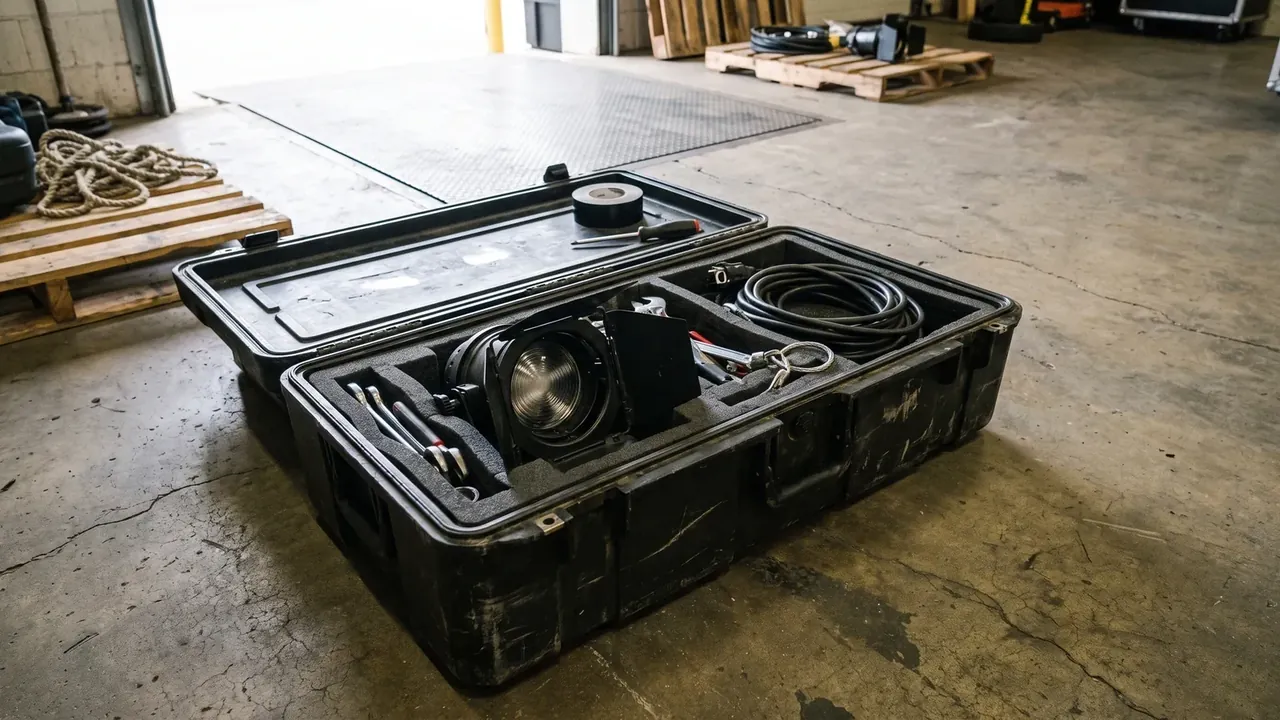
Quick answer: A fire and rescue equipment case at 0.82 solar reflectance with 15 mm of aerogel holds a two-hour soak to a 9 ℃ rise inside and 65 ℃ at the latches.
Table of contents
- The Thermal Envelope of a Fire and Rescue Equipment Case
- Solar Reflectance and Insulation Thickness
- Surface Temperature at the Metal Latches
- Silicone Seal Rebound Under Heat
- The Insulation Figures a Crew Works To
- FAQ
1. The Thermal Envelope of a Fire and Rescue Equipment Case
A roof deck can burn the palm while the air inside a case stays mild; the gap is insulation and reflectance. A fire and rescue equipment case rides a roof rack where the steel wall hits 60 ℃ at noon, while the cavity must hold a 9 ℃ rise. PP conducts at 0.2 W/(m·K), so a 4.5 mm wall is a small share of the path.
Heat arrives three ways. Wall conduction after the skin absorbs sun sets the floor of the steady rise; the metal latches bridge the shell and short-circuit the insulation; an uneven gasket lets air carry heat in.
Outside it measures 620 × 460 × 280 mm, inside 565 × 405 × 235 mm, on a 4.5 mm wall and 9.2 kg empty. Racks stack four high; offset ribs sag the mid-panel and slacken the gasket.
2. Solar Reflectance and Insulation Thickness
Reflectance is the cheapest length of the path. Under the SRI convention a white reference at 0.80 sits about 10 ℃ above ambient at 1000 W/m² peak irradiance and low wind, against 50 ℃ at 0.05. The shell is moulded at 0.82 with light pigment and a UV stabiliser, no gloss.
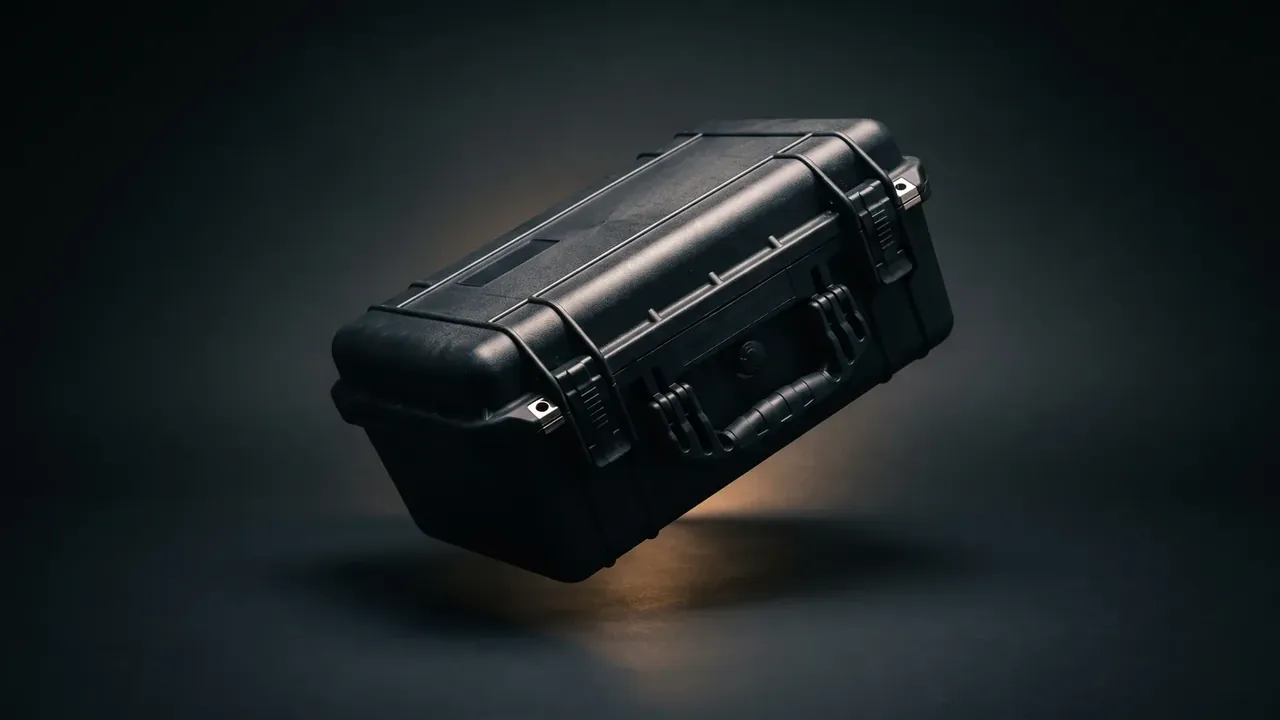
The insulation on a fire and rescue equipment case is aerogel blanket at 15 mm, conducting at 0.018 to 0.023 W/(m·K) at 25 ℃ and weighing 160 to 240 kg/m³. Joints are staggered and corners mitred at 45°.
Three tiers differ only in thickness, chosen by duty cycle.
| Insulation tier | Blanket | Duty cycle | Cavity taken |
|---|---|---|---|
| Short sortie | 8 mm | One run under 1 h | Lid, sun face |
| Standard | 15 mm | Half-day standing | Sun face |
| Standing watch | 25 mm | All-day mounted | Four, 50 mm |
At 8 mm other faces stay bare and the cavity barely shrinks; at 25 mm the 565 mm width ends at 515 mm. Standard trim covers both main faces and halves the shaded side, so the rise still lands under 9 ℃.
3. Surface Temperature at the Metal Latches
The latch burns first because of its material. Stainless 304 conducts at 16 W/(m·K) against 0.1 for PP, so the metal tracks wall temperature while the inner face is still warm. Each latch sits in a recessed pocket on a 2 mm pad, meeting the wall at the stud.
As the window lengthens on a fire and rescue equipment case, the wall climbs fastest, the latch is held back, the cavity slowest.
| Window | Outer wall | Latch face | Cavity rise |
|---|---|---|---|
| Start | 60 ℃ | 60 ℃ | 0 ℃ |
| 30 min | 74 ℃ | 62 ℃ | 3 ℃ |
| 1 h | 82 ℃ | 64 ℃ | 6 ℃ |
| 2 h | 88 ℃ | 65 ℃ | 9 ℃ |
The metal also passes salt spray. GB/T 10125 neutral spray, 5% sodium chloride at 35 ± 2 ℃ and pH 6.5 to 7.2, lists 480 h as a duration; bare 304 shows red rust between 200 and 500 h, and passivation carries it to 480 h clean. The pad also keeps water out of the joint.
4. Silicone Seal Rebound Under Heat
The O-ring is 70 Shore A silicone and the case is rated −30 ℃ to +90 ℃. A fire and rescue equipment case seals by compression: hardness sets the lid force, rebound decides whether squeeze pushes back.
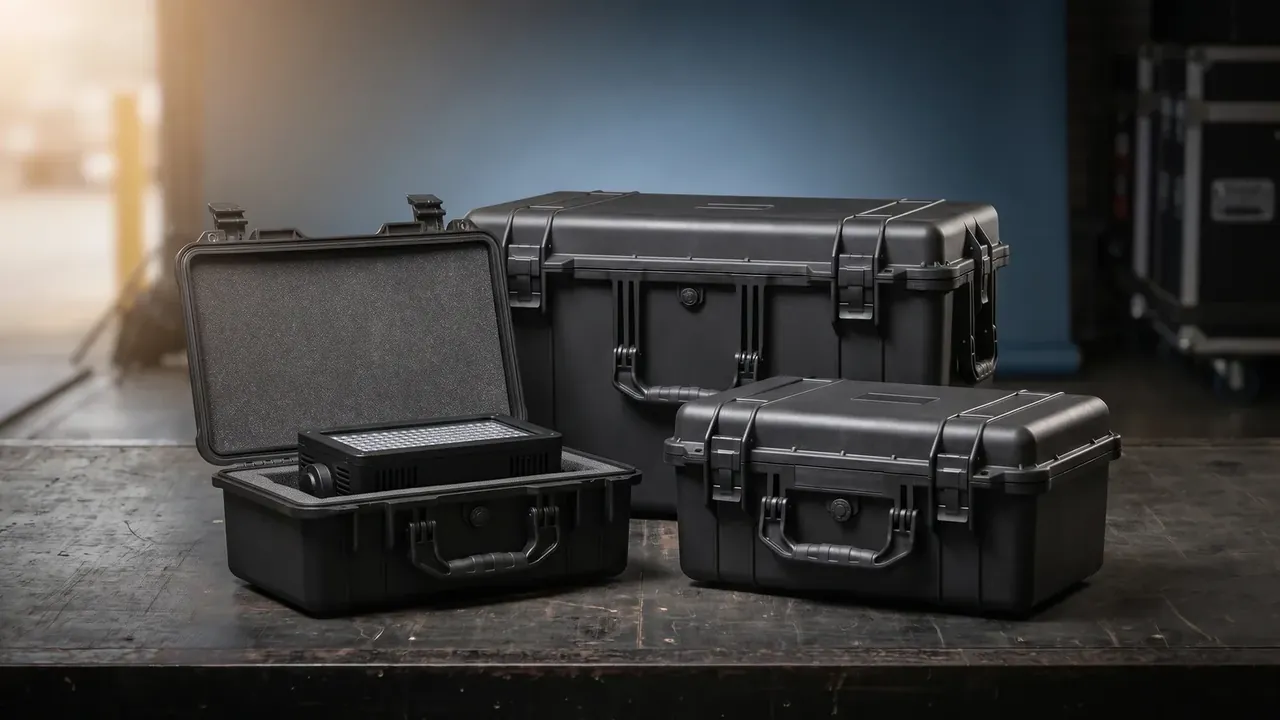
Rebound reads as compression set. Under ASTM D395 Method B a 70 Shore A platinum-cured compound at 25% deflection for 22 h sets 8% at 100 ℃, 15% at 150 ℃, 22% at 175 ℃ and 34% at 200 ℃. Most seal designs draw the failure line at 25%, past which squeeze cannot absorb face roughness. The lid joint on a fire and rescue equipment case runs a dozen degrees above the cavity, so the compound is picked on the 15% figure.
Groove width follows cord diameter, compression 20% to 25%. Below 20% the ring merely rests and the IP66 jet test fails; above 30% it flattens and rebound drops visibly after 4,500 cycles. A 0.5 mm chamfer guides the ring in. Those 4,500 cycles stand for six openings a day over two years.
5. The Insulation Figures a Crew Works To
The tier on a fire and rescue equipment case is the thinnest blanket that holds the cavity under a 9 ℃ rise after two hours; thinner is for short sorties.
| Rise reading | Verdict | Action |
|---|---|---|
| 6 ℃ or less | Spare margin | Try one tier down |
| 6 to 9 ℃ | Pass | Freeze the tier |
| 9 to 12 ℃ | Marginal | Add a layer, sun face |
| Above 12 ℃ | Over | Recheck the bridge |
Readings come from a lamp-array chamber, not a vehicle: sun face square to the array, 1000 W/m², ambient 60 ℃. The wall-to-latch difference reads the bridge; the cavity curve reads the insulation. A 2 ℃ spread in a batch sends the check back to blanket cutting.
The pre-load check looks at structure: four latches must close, or the pad shifted; the gasket line must run unbroken; lid ribs must meet the ribs below.
Conclusion
A fire and rescue equipment case holds heat off in three layers: 0.82 of reflectance turns radiation away, 15 mm of aerogel slows conduction, and the recessed pocket thins the latch bridge. The figures are a 9 ℃ rise after a two-hour soak, 65 ℃ at the latch face, and 15% set for a 70 Shore A ring at 150 ℃. The 4,500 cycles and 480 h of salt spray are its life lines.
Related Reading
- Internal Layout of Fire Equipment Cases
- Hard Case and Carton in Transit
- Weighing Wooden Crates Against Plastic Cases
Related Products
- 8 Series — Gun Cases; Military Equipment Cases; Camera Equipment Cases; Drone Cases; Watch Cases; Knife Cases; First Aid Cases; Electronics Equipment Cases
- WL8-2812 PP Gun Case — model WL8-2812
- All protective cases and toolboxes: 7 series, 158 models