

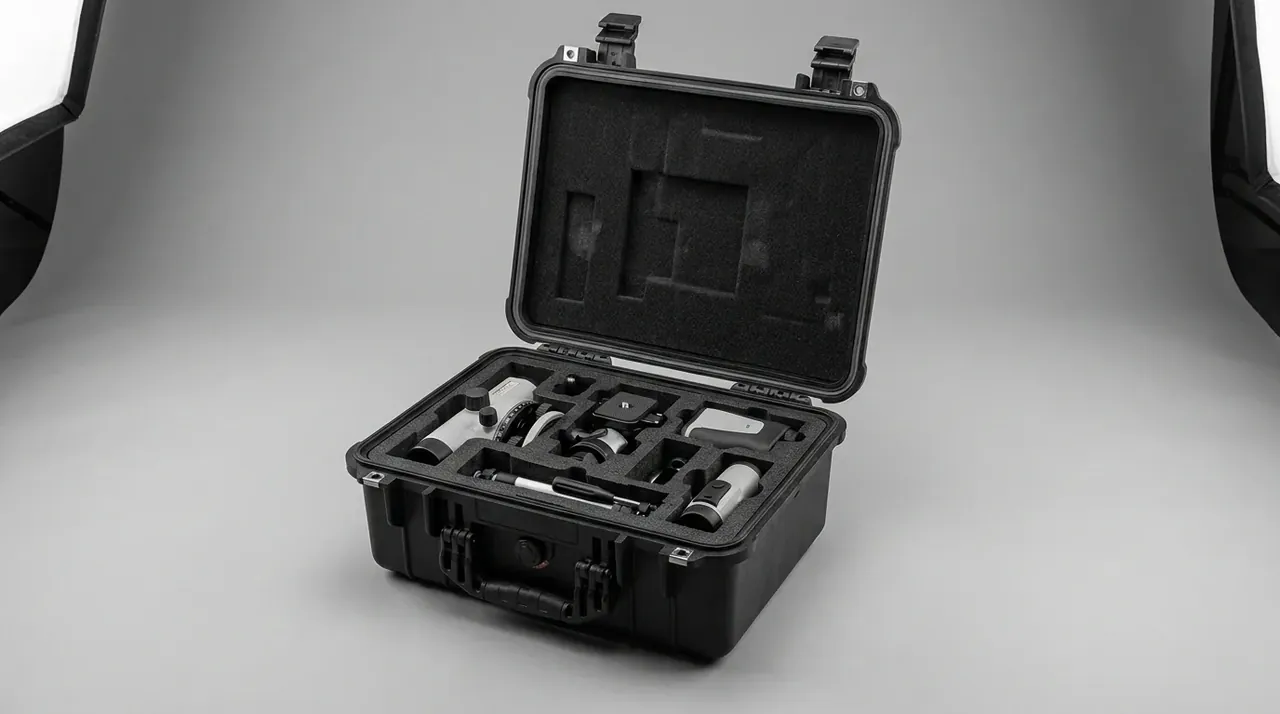
Quick answer: A fire equipment case is paced by its compartments, not its size: the same 65 mm hose and breaching tools went from 52 s to 26 s once six cells replaced one trough.
Table of contents
- Why first-item access stalls at 52 s
- Hose coil volume into compartment size
- Tool cells and quick-release straps
- Lid angle, one-hand opening, mounting
- Converting 30 s into a layout
- FAQ
1. Why first-item access stalls at 52 s
Timing covers one stretch: call to first tool leaving the case. The old layout burned 52 s, 14 s of it lifting the upper hose coil to the floor and 12 s pulling an axe from between two layers. Unlatching, lifting and closing the case took 26 s. Half the total was layout, not shell.
Both runs used the same tools in the same 128 L case; a trough became six cells.
| Action | Old (s) | Six cells (s) | Delta (s) |
|---|---|---|---|
| Locate, clear 600 mm in front | 3 | 2 | 1 |
| Release the first latch | 6 | 2 | 4 |
| Lift the lid to 105 degrees | 5 | 3 | 2 |
| Move the hose coil off the top | 14 | 0 | 14 |
| Draw the axe and confirm | 12 | 6 | 6 |
| Close, check the latches | 12 | 13 | −1 |
| Total | 52 | 26 | 26 |
Search and shuffle took 26 s; latch count and hinge damping pin the other 26 s to under 3 s of savings.
2. Hose coil volume into compartment size
A 65 mm hose, 20 m long, coils to 380 mm outside diameter and 110 mm thick, near 12 L. That sets the cell: 400 mm by 400 mm clear, 130 mm deep.
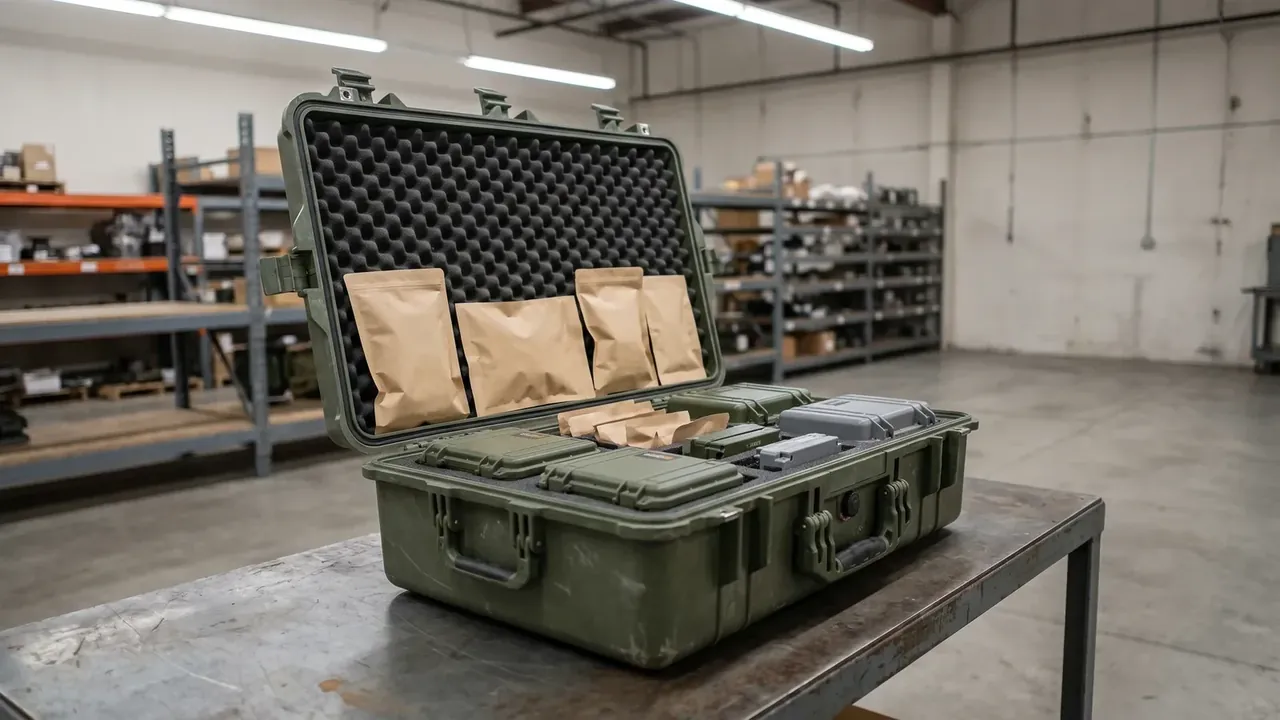
In a 400 mm cell the coil leaves 10 mm a side, too tight for a glove; at 430 mm the gap is 25 mm and one motion grips the edge, separating 8 s from 3 s.
The cavity takes two coils side by side: 820 mm wide, 520 mm deep, 300 mm high, 128 L, with 41 L for coils and 87 L for tools.
| Hose bore | Coil OD | Thickness | Cell clear size | Coils |
|---|---|---|---|---|
| 65 mm, 20 m | 380 mm | 110 mm | 430 × 430 × 140 mm | 1 |
| 65 mm, 20 m paired | 380 mm | 110 mm | 880 × 430 × 140 mm | 2 |
| 80 mm, 20 m | 460 mm | 140 mm | 510 × 510 × 170 mm | 1 |
An 80 mm bore grows the coil to 460 mm, so the cell needs 510 mm and one fits where two did. The lid needs its own arithmetic: 90 mm deep with 20 mm foam leaves 70 mm, pressing a 110 mm coil, so cut a 40 mm relief pocket.
3. Tool cells and quick-release straps
The tool side is set by the longest item: axe 900 mm, pry bar 700 mm, spreader 780 mm × 210 mm × 180 mm. At 900 mm the axe exceeds the 820 mm cavity width and rides the diagonal, where 968 mm corner to corner leaves 34 mm at each end at 45 degrees. Diagonal storage eats two cells, which is why the tool block sits in a corner.
The lining is 30 mm EVA, harder than PE foam, one item per cell; the spreader cell runs 800 mm × 230 mm × 200 mm with 10 mm all round to absorb movement on a drop.
Straps are 25 mm nylon on side-release buckles, 1.2 s one-handed at 40 N, crossing the grip rather than the cutting edge. Four in total, since seven adds three unlatching actions and 3 s. Tongues face up; a downward tongue costs 2 s in gloves.
4. Lid angle, one-hand opening, mounting
A 105 degree lid is enough: wider and the lid mass passes the hinge line, narrower and the lid cells block the view.
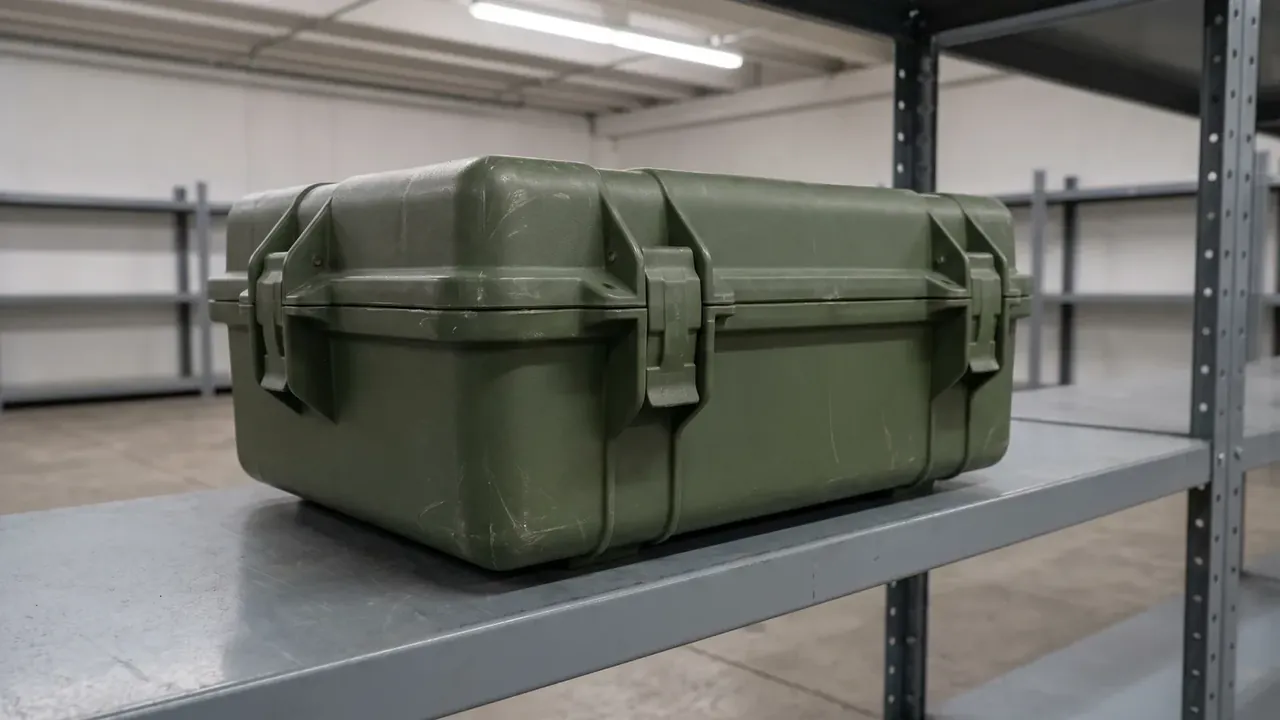
Two latches at 45 N and 18 mm of travel open in one gloved pull, where 60 N needs two hands; the hinge pin runs damped at 8 N over the last 90 degrees, so the lid holds itself in transit.
The test is crude: hold the handle, release, lift, draw, never set the case down.
Mounting uses four M8 tie points under 3 g vertical and 1.5 g lateral, holding movement under 5 mm and foam compression under 15%.
5. Converting 30 s into a layout
A 30 s target reduces to three rules: one item per cell, one exit direction, everything visible when the lid rises. Meet all three and access lands at 20 s to 26 s; miss one and it drifts past 35 s.
The arithmetic: 30 s minus 9 s of open and close leaves 21 s, of which 3 s goes to picking a cell and 4 s to the reach, leaving 14 s in reserve. Under 8 s of reserve will overrun in the field.
Six cells in 128 L average 21 L: hose 41 L, tools 87 L, the axe cell 32 L on the diagonal. At nine cells the average falls to 14 L and the spreader no longer fits.
Conclusion
A fire equipment case earns its speed in the lining, not the shell: the 52 s to 26 s gap came entirely from compartments, while the case gave 2 s of unlatching, 3 s of lid lift and 13 s of closing. Measure the longest tool and derive the diagonal from 900 mm, add 50 mm to the coil diameter for the hose cell, then run a 10-draw blind test and revise any cell off target by more than 4 s. The table maps target time to compartments, so a specification reads off by row.
| First-item target | Compartments | Lining build | Case actions |
|---|---|---|---|
| Under 20 s | One layer, one item per cell | 30 mm EVA, 10 mm clearance | One lid lift, nothing moved |
| 20 s to 30 s | Two layers, tools on top | 20 mm EVA plate, four straps | One lid lift, two latches |
| 30 s to 45 s | Trough with dividers | PE dividers, no cells | Two searches, top moved |
| Over 45 s | Mixed load, no lining | Single foam pad | Layers lifted, three latches |
This article discusses container-side specifications and design implications only, and does not cover any handling, loading or use of the contents.
Related Reading
- Fire pump case structure and load path
- Rescue case configurations by scene
- Breaching tool case access design
- How fire equipment cases are laid out
Related Products
- 8 Series — Gun Cases; Military Equipment Cases; Camera Equipment Cases; Drone Cases; Watch Cases; Knife Cases; First Aid Cases; Electronics Equipment Cases
- WL8-2812 PP Gun Case — model WL8-2812
- All protective cases and toolboxes: 7 series, 158 models