

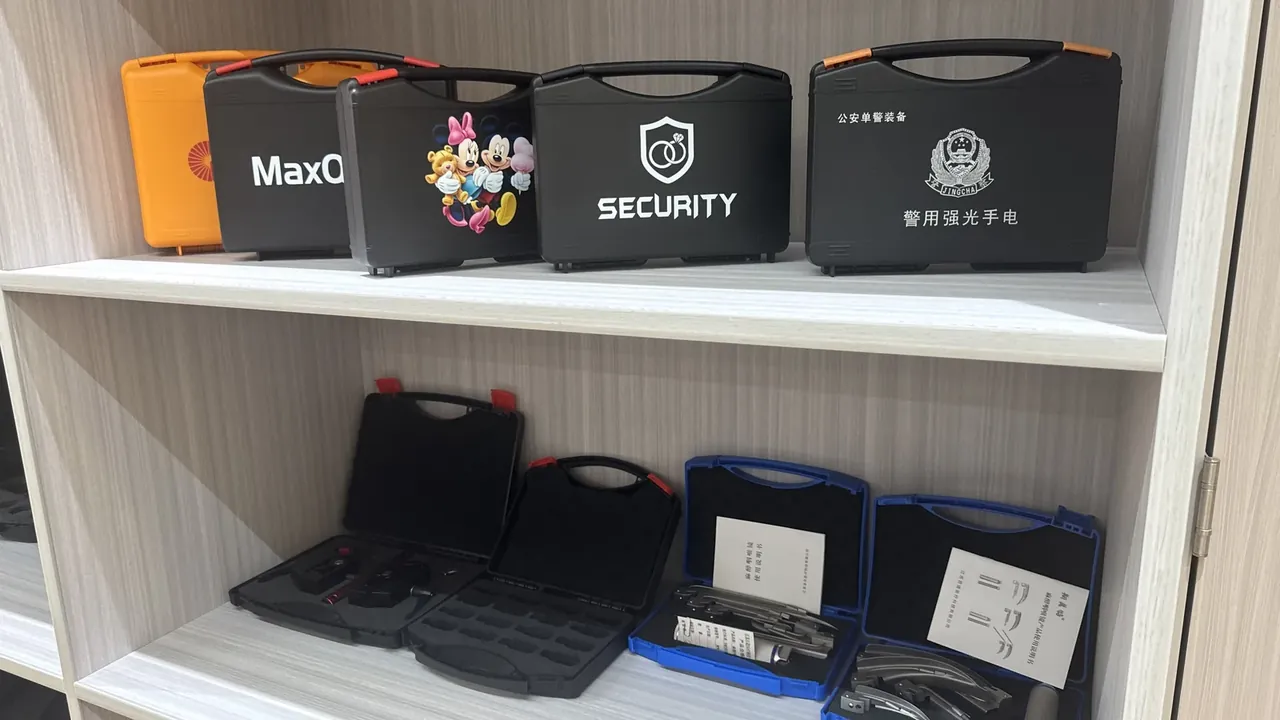
Quick answer: Against aluminium flight cases, plywood crates, soft gun bags and plastic bins, a firearm protective case separates on five measurable points: unit cost, carry weight, impact survival, sealing and service life. Over five years, the cheapest option is usually the most expensive.
Table of contents
- Five Dimensions of Comparison
- Cost and Weight: Unit Price Versus Five Years
- Impact and Sealing
- Service Life and Repair
- When Another Option Wins
- FAQ
1. Five Dimensions of Comparison
A comparison needs a yardstick before an opinion. Five dimensions settle it: unit cost, carry weight, impact survival after a fixed-height drop, sealing class, and life to first structural failure. All readings assume a 12 to 15 litre cavity.
| Option | Unit cost (CNY) | Weight (kg) | Impact | Sealing | Life (years) |
|---|---|---|---|---|---|
| Firearm protective case, moulded PP, 12 L | 180–320 | 2.6 | 26 drops from 1.8 m, intact | 30 minutes at 1 m | 8 |
| Aluminium flight case, 1.2 mm skin | 620–950 | 4.9 | Corners dent, seal fails | Falls a class after a knock | 12 |
| Plywood crate, 15 mm, 12% moisture | 90–150 | 5.8 | Split corners, nails out | None, dust only | 3 |
| Soft gun bag, 600D, 8 mm foam | 45–80 | 0.6 | Absorbs knocks, no puncture | None | 2 |
| Plastic bin, 1.8 mm wall | 28–45 | 1.1 | Corner cracks at 1.8 m | None, overlap lid | 2–4 |
The firearm protective case sits mid-spread: six times a plastic bin on cost, four times a soft bag on weight, close to aluminium on impact, longer-lived than plywood or fabric.
2. Cost and Weight: Unit Price Versus Five Years
On the shelf, a firearm protective case costs six times a plastic bin. Across five years, replacements, inserts and seal work close the gap to under double. The soft bag wins the ledger, but only for short, hand-carried, unstacked trips; the crate and the bin pay twice for their low price.
| Cost line | Firearm protective case | Aluminium case | Plywood crate | Soft bag | Plastic bin |
|---|---|---|---|---|---|
| Units bought in five years | 1 | 1 | 2 | 3 | 2 |
| Insert replacement | CNY 60 | CNY 80 | none fitted | CNY 60 | CNY 20 |
| Five-year total (CNY) | 240 | 700 | 260 | 195 | 90 |
Weight decides travel. A 2.6 kg case of 12 litres goes 200 metres in one hand; the 4.9 kg aluminium case needs two changes; the 5.8 kg crate wants a trolley. Past 12 kg loaded, every option needs wheels.
3. Impact and Sealing
Impact is not shell thickness but whether a firearm protective case still works after the drop. Frozen four hours at minus 20 degrees Celsius, then dropped from 1.8 m onto corner, edge and face, the five options fail in five places: latch keeper, corner welds, joints and nail lines, zip pull, thinnest corner.
Sealing separates them faster. A gasket on a machined lip holds 30 minutes at one metre; an aluminium lid seals by deflection, so a knock opening the gap from 0.2 mm to 0.8 mm costs a class. Plywood and fabric seal nothing.
The seal costs something. Roughly 6 kPa builds across a 40 degree Celsius swing, so the lid needs a purge valve or it will not open after a flight.
4. Service Life and Repair
Service life turns on returning to factory condition, not on still closing. Latches, gasket and hinge pins are replaceable, which is how one firearm protective case reaches eight years; an aluminium case cannot be straightened once deformed, a crate never recovers from damp, and a plastic bin hinge is its own body.
A latch pair at CNY 25 and a gasket at CNY 18 stay under a fifth of case cost; drilling eight rivets out of an aluminium corner often costs half its residual value.
5. When Another Option Wins
Three questions decide whether a firearm protective case is the right buy: how long the unit stays away, how often it opens, and whether it is stacked. A short hand-carried move suits a soft bag, a dry store room suits a plastic bin, and display or air freight still favours aluminium at 4.9 kg. Stack three high, move in rain, cross a 30 degree Celsius swing, or fit a padlock: any two of those and the firearm protective case pays for itself.
Conclusion
Set the five side by side and the answer is plain: the money buys a structure that can be restored and wear parts that can be swapped, not a thicker skin. Aluminium wins on rigidity, plywood on price, fabric on weight, and each carries one weakness it cannot design away. Price the failure alongside the five-year ledger, and renewal decides the firearm protective case.
This article discusses only the container (case body) side of specifications and design intent, and does not cover any handling, loading or use of the contents.
Related Reading
- How material and moulding choices differ
- Military firearm cases against ordinary bins
- Long weapon cases and what they replace
- firearm-protective-case-procurement
Related Products
- 8 Series — Gun Cases; Military Equipment Cases; Camera Equipment Cases; Drone Cases; Watch Cases; Knife Cases; First Aid Cases; Electronics Equipment Cases
- WL8-2812 PP Gun Case — model WL8-2812
- All protective cases and toolboxes: 7 series, 158 models