

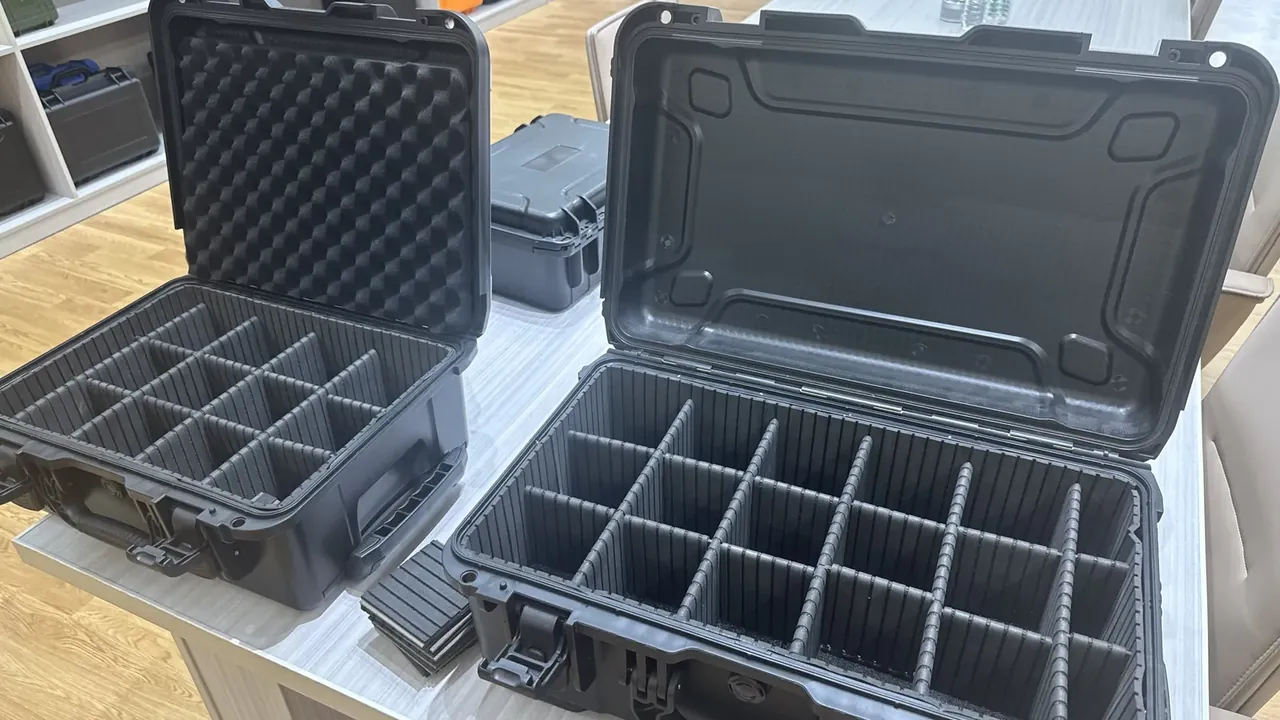
Quick answer: A firearm protective case standard fixes three things: what gets inspected, how the sample is drawn, and how a defect is graded. Pressure hold, drop count and retention years belong in the contract as numbers.
Table of contents
- What a Firearm Protective Case Standard Must Inspect
- Sampling and Acceptable Quality Limits
- Defect Grading and Verdict Rights
- Pressure Hold, Drop and Vibration Tests
- Reports, Retention and Re-inspection
- FAQ
1. What a Firearm Protective Case Standard Must Inspect
Acceptance starts by replacing adjectives with readings: "charged to 20 kPa, held 60 seconds, decay under 0.6 kPa" leaves one verdict where "seals well" leaves two.
| Check | Method | Limit | Record |
|---|---|---|---|
| Appearance | Visual, 600 mm, D65 | No flash or white weld line | Sheet |
| Dimensions | Tape and caliper, 3 points | Within drawing tolerance | Log |
| Wall thickness | Ultrasonic, eight points | Minimum above floor | Log |
| Sealing | Air charge and hold | Decay under 0.6 kPa | Curve |
| Latch | 5000 cycles, then retention | At least 150 newtons | Log |
| Drop, vibration | 1.2 m, 12 drops; 10 to 55 Hz | No crack, no loosening | Record |
Nine blocks belong in a full firearm protective case standard, each with a method, a limit and a record; a block without a record is not an inspection. Fix the environment: 23 Celsius plus or minus 2, humidity 50 percent plus or minus 10, gauges calibrated.
2. Sampling and Acceptable Quality Limits
Sample by batch, never by pallet. A firearm protective case batch means one mould, one resin grade and one shift; mixed pallets are split first.
Use general inspection level II, with AQL 1.5 for appearance and AQL 0.65 for function. Destructive checks sit outside the count: two units for drop, one each for vibration and salt spray, from different cavities.
| Batch | Sample | Appearance | Function |
|---|---|---|---|
| 1 to 120 | 5 | 0 accept, 1 reject | 0 accept, 1 reject |
| 121 to 500 | 8 | 0 accept, 1 reject | 0 accept, 1 reject |
| 501 to 2000 | 13 | 1 accept, 2 reject | 0 accept, 1 reject |
Record the sampler, time, stack position and cavity, drawing units from top, middle and bottom. The buyer names the sampler.
3. Defect Grading and Verdict Rights
Grade before you judge. Critical covers seal failure, a wall below the drawing floor and a broken latch; major covers oversize that still assembles and rust beyond 5 percent; minor covers colour shift and flow marks.
| Grade | Typical case | Verdict | Who signs |
|---|---|---|---|
| Critical | Seal failure, thin wall, broken latch | Reject | Quality manager |
| Major | Oversize but assemblable, rust over 5 percent | Concession or rework | Project lead |
| Minor | Colour shift, flow mark | Counts as pass | Inspector |
Rights attach to a named person, not a department: an inspector may pass minor items, a project lead may sign a major concession, a critical defect has no route. The form states quantity, scope and expiry, capped at 45 days, with three working days to object. Rejecting a firearm protective case batch needs the same evidence.
4. Pressure Hold, Drop and Vibration Tests
The order cannot be shuffled: pressure, vibration, drop. Test the seal after a drop and the data describes a broken product.
Charge a closed firearm protective case to 20 kPa, hold 60 seconds, read the decay; past 0.6 kPa it fails. Keep the whole curve, since an endpoint cannot separate a gasket leak from a valve leak. Vibration runs 10 to 55 Hz at 2 g for 30 minutes per axis, fixtured as stacked, because hanging free hides loose latches.
Drop from 1.2 m onto concrete: four corners, three edges, five faces, 12 drops. Accept no through crack, no released latch and no lid shift beyond 1.0 mm. Cold batches repeat three drops after four hours at minus 20 Celsius.
5. Reports, Retention and Re-inspection
A firearm protective case report is worth the readings it preserves: report number, sample tied to batch, a verdict per item, gauge numbers with calibration dates, two signatures, the decay curve and time-stamped drop photos.
| Use | Retention | Format |
|---|---|---|
| Domestic routine | 3 years | Electronic, by batch |
| Export orders | 6 years | Electronic plus paper |
| Key projects | 10 years | Signed original plus backup |
Re-inspection starts within three working days on double the sample, covering the failed item and what it affects: thin walls bring the stack load, a seal failure brings the latch. Two consecutive failures move the supplier into review, with cause analysis inside ten working days and three clean batches after.
Conclusion
An acceptance standard is measured by how easily a third person reproduces each line. Pair each check with a method and a record, sample by batch at a stated level, attach each grade to a signature, set retention by use. Then a firearm protective case standard decides batches instead of describing them.
This article discusses only the container (case body) side of specifications and design intent, and does not cover any handling, loading or use of the contents.
Related Reading
- Auditing how a gun case is produced
- Acceptance clauses for transport cases
- Incoming inspection for supply cases
- Specifying a weapon storage cabinet
Related Products
- 8 Series — Gun Cases; Military Equipment Cases; Camera Equipment Cases; Drone Cases; Watch Cases; Knife Cases; First Aid Cases; Electronics Equipment Cases
- WL8-2812 PP Gun Case — model WL8-2812
- All protective cases and toolboxes: 7 series, 158 models