

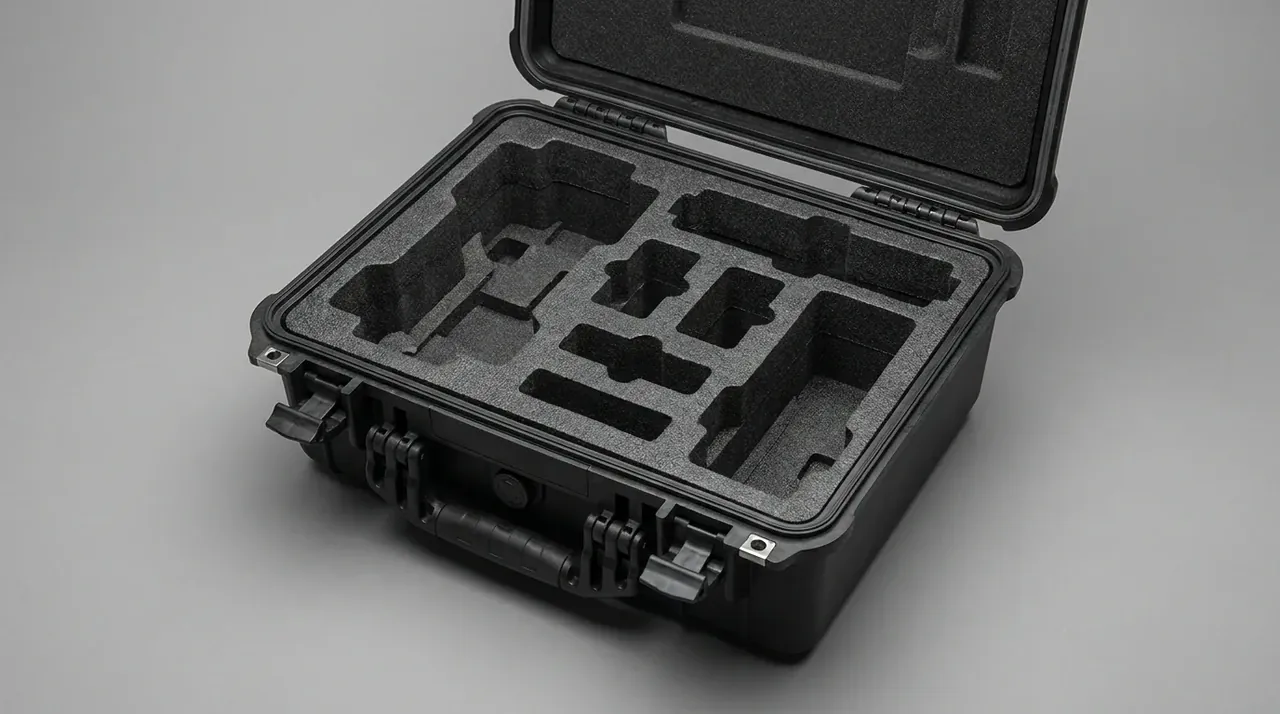
Quick answer: In a 40 L cavity a foam density case at 25 kg/m³ takes 450 g of foam and at 45 kg/m³ takes 810 g, a 360 g gap worth 7.8% of the shell weight.
Table of contents
- The Gram Gap Between 25 and 45 kg/m³
- Compression Strength at 25% and 50%
- Rebound and Set After 72 Hours
- Matching Density to Weight
- FAQ
1. The Gram Gap
Same 40 L cavity: 450 g of 25 kg/m³ foam goes in, or 810 g at 45 kg/m³, a 360 g difference. On a 4.6 kg empty shell that is 7.8% of total weight, and handle load per side moves from 23 N to 25 N.
The arithmetic is one line. About 18 L of the cavity is solid foam, 0.018 m³, so 25 kg/m³ gives 0.45 kg and 45 kg/m³ gives 0.81 kg. Density rises 1.8 times and mass follows at 1.8 times whatever the cut shape.
Mass travels downstream. One case at plus 360 g across 4000 units adds 1.44 t, which air freight bills directly, and a shoulder-carried 0.36 kg over an 8-hour shift becomes fatigue.
Density has to be measurable, too. Under ISO 845 a 100 mm × 100 mm × 50 mm sample is weighed and divided by volume, with the 25 kg/m³ grade accepted at ±2 kg/m³ and 45 kg/m³ at ±3 kg/m³. Cell size tracks it as well, 0.4 mm average pores against 0.25 mm, so the denser sheet seats against equipment more evenly. Mass alone never picks a grade; compression strength and set do.
2. Compression Strength at 25% and 50%
At 25% deflection, compression strength reads 35 kPa for 25 kg/m³ and 85 kPa for 45 kg/m³; at 50% the pair reads 70 kPa and 165 kPa. Both lines run about 2.4 times apart, near 22 kPa of gain per 10 kg/m³.
| Property | 25 kg/m³ | 45 kg/m³ |
|---|---|---|
| 25% compression strength, kPa | 35 | 85 |
| 50% compression strength, kPa | 70 | 165 |
| Compression set, % | 8.0 | 4.5 |
| Resilience, % | 46 | 38 |
| Thickness loss after 1000 cycles, mm | 3.2 | 1.4 |
| Fill weight in 40 L, g | 450 | 810 |
| Indicative price, CNY/kg | 18 | 22 |
Static pressure shows where the margin sits. A 12 kg device on a 200 mm × 150 mm footprint, 0.03 m², loads the foam at 4 kPa, so 35 kPa holds a factor of 8.7 and 85 kPa holds 21. Both carry the load; the split appears under impact and creep.
Stacking is the second stress line. Three 20 kg cases put 40 kg on the bottom lid, and 25 kg/m³ foam creeps 6% in 30 days at 35 kPa, so the pocket stops touching the device. At 45 kg/m³ the same 30 days creep 2.4% and it holds.
Impact exposes transfer rather than strength. A 50 cm drop peaks at 68 g on 25 kg/m³ and 81 g on 45 kg/m³, because denser foam is stiffer, travels less and passes shock through faster.
Specify the methods. Compression strength follows GB/T 8813 on 100 mm × 100 mm × 50 mm samples at 5 mm/min, read at 25% and 50%, while set runs 22 hours at 70 °C and 25% compression.
3. Rebound and Set After 72 Hours
Resilience reads 46% at 25 kg/m³ and 38% at 45 kg/m³, and compression set after 22 hours at 70 °C comes to 8.0% against 4.5%. On a 30 mm pad that is 2.4 mm of permanent collapse against 1.35 mm.
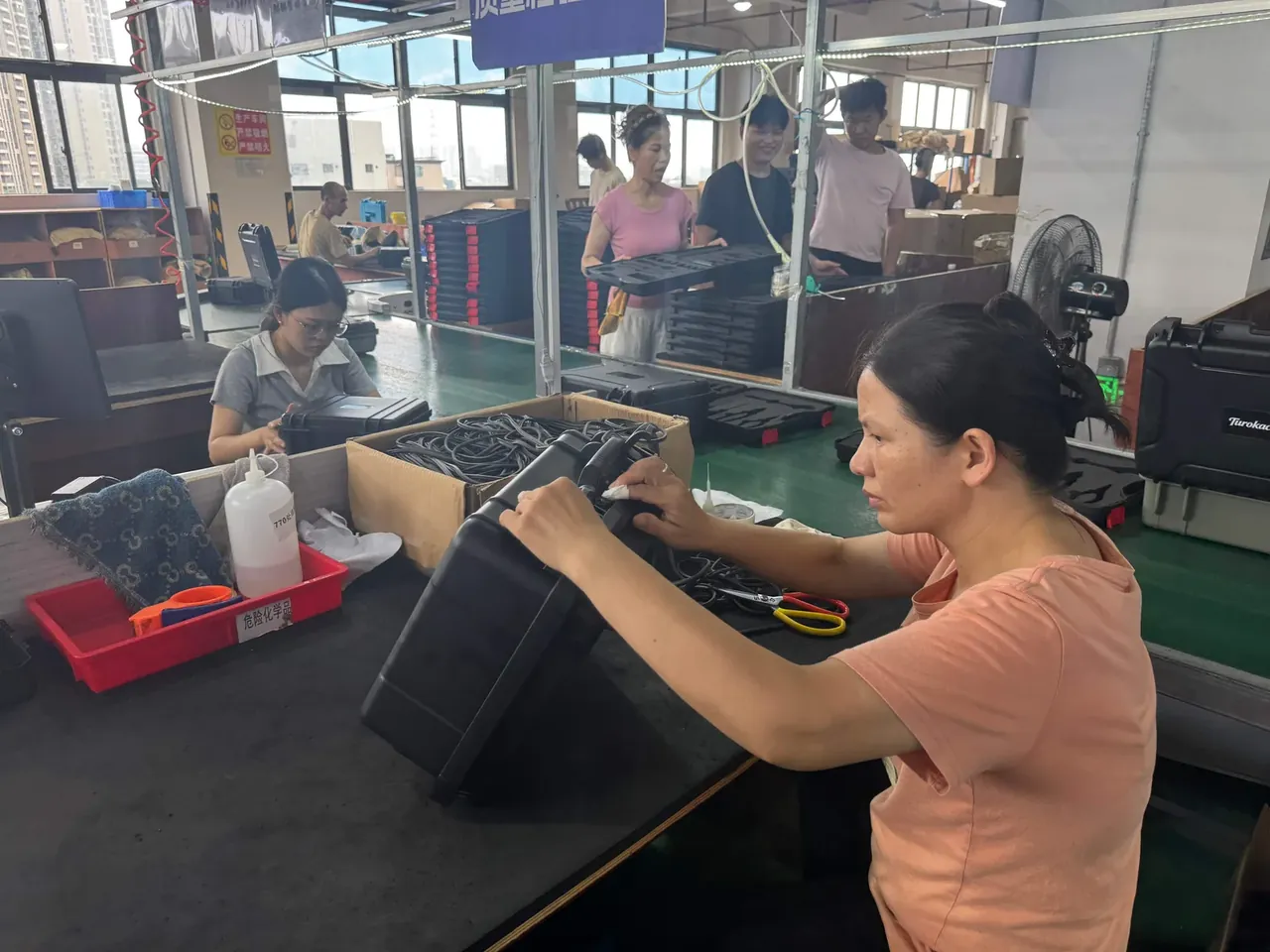
A 72-hour bench test makes it visible. A 30 mm sample pressed to 24 mm recovers to 29.1 mm and 29.6 mm within a day, and to 29.4 mm and 29.8 mm at 72 hours, so the lighter sheet stays 0.6 mm short.
A thousand cycles widen the gap: the 25 kg/m³ pocket loses 3.2 mm and 22% of grip, against 1.4 mm and 9%. At four loadings a day, 1000 cycles is about eight months, and year two needs a new liner.
Temperature pulls the curves together. At -20 °C the 25% strength rises to 41 kPa and 99 kPa, leaving less travel, and 7 days at 60 °C costs another 1.1 mm of thickness against 0.6 mm. Cold stores and hot workshops each step one grade up.
4. Matching Density to Weight
Calculate interface pressure first, weight divided by contact area, then hold 25% compression strength at four times that value so the foam keeps travel during a 1.2 m drop.
| Device weight | Density | Pad thickness | Fill weight in 40 L |
|---|---|---|---|
| Up to 1 kg | 25 kg/m³ | 20 mm | 450 g |
| 1–3 kg | 30 kg/m³ | 25 mm | 540 g |
| 3–6 kg | 38 kg/m³ | 30 mm | 700 g |
| 6–12 kg | 45 kg/m³ | 30 mm | 810 g |
| 12–20 kg | 60 kg/m³ | 40 mm | 1080 g |
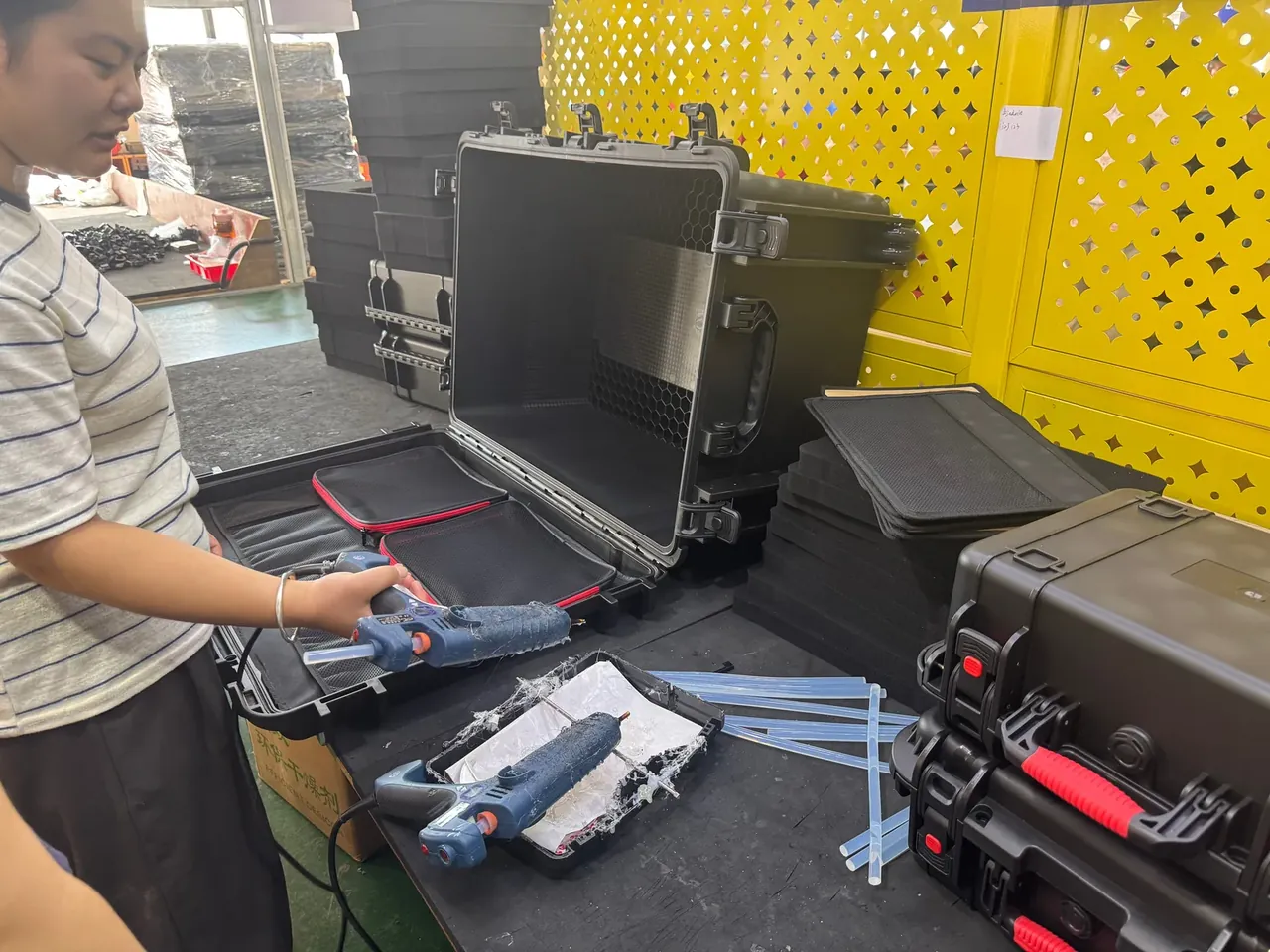
Two rules apply. Size to the heaviest component: an 8 kg device with a 5 kg casting takes the 38 kg/m³ grade, cut from one sheet rather than mixed grades. Then check the centre of gravity: more than 40 mm off centre means 5 mm more pad on the heavy side and no change in density.
Thickness and density are separate knobs. At 45 kg/m³ a 30 mm pad gives 10 mm more travel than 20 mm and drops peak acceleration from 81 g to 64 g, so adding thickness often saves more weight than raising density.
One liner can carry two densities: 45 kg/m³ at 30 mm on corners and base, 25 kg/m³ at 20 mm on locating walls, for 610 g overall, 200 g lighter than an all-45 build. Pocket tolerance goes on the drawing with the grade, ±1.0 mm at 25 kg/m³ and ±0.6 mm at 45 kg/m³.
Conclusion
Choosing density means matching one grade to one weight. Up to 1 kg takes 25 kg/m³ at 20 mm, 1 to 3 kg takes 30 kg/m³ at 25 mm, 3 to 6 kg takes 38 kg/m³ at 30 mm, 6 to 12 kg takes 45 kg/m³ at 30 mm and above 12 kg takes 60 kg/m³ at 40 mm. Once the grade of a foam density case is fixed, pad thickness, pocket depth and total weight follow. Measure the contact area, compute interface pressure, hold compression strength at four times that value, then confirm with one 1.2 m drop that peak acceleration stays under 100 g. Denser is not safer and heavier is not tougher.
This article discusses container-side specifications and design implications only, and does not cover any handling, loading or use of the contents.
Related Reading
- Comparing foam material density and rebound
- Inner cushion layout for outdoor cases
- Drop height versus packed weight
Related Products
- 8 Series — Gun Cases; Military Equipment Cases; Camera Equipment Cases; Drone Cases; Watch Cases; Knife Cases; First Aid Cases; Electronics Equipment Cases
- WL8-2812 PP Gun Case — model WL8-2812
- All protective cases and toolboxes: 7 series, 158 models