

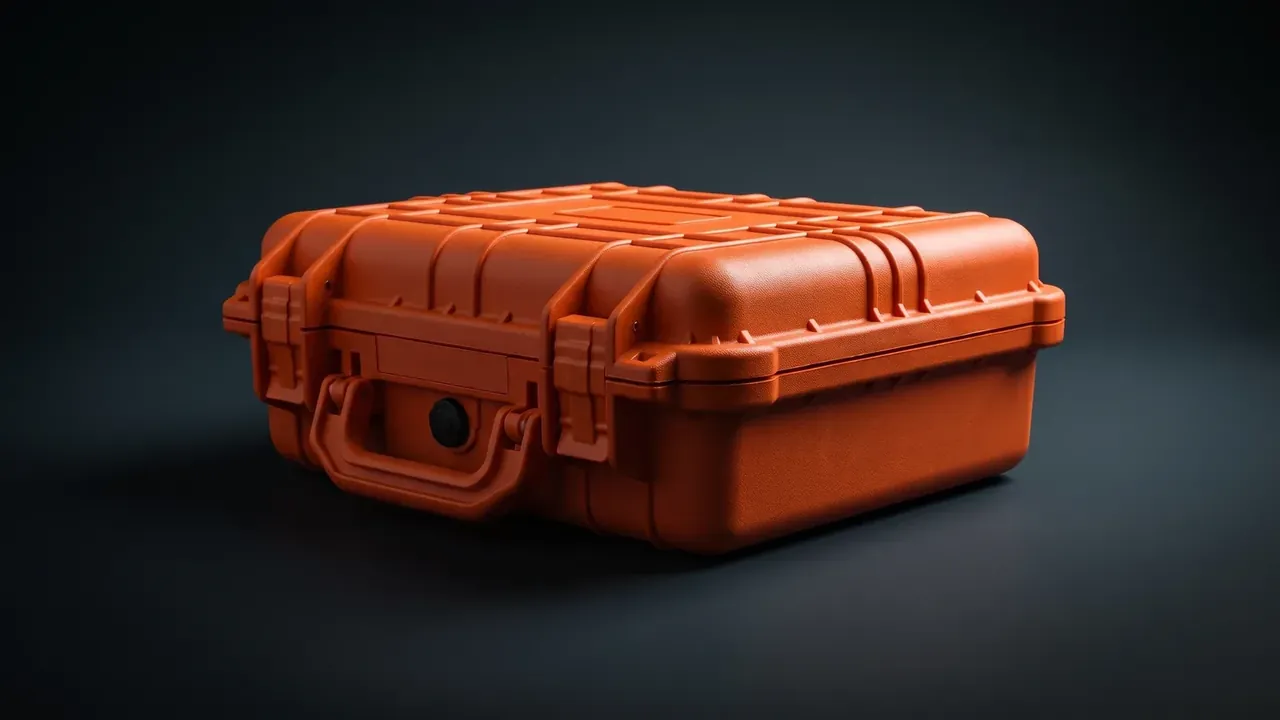
Quick answer: Foam inserts for automotive equipment cases are chosen on density and compression set: EVA at 25 to 45 kg/m³, set under 20%, 0.5 to 1.0 mm per side.
Table of contents
- Weighing Density Against Rebound
- How Much Die-Cut Clearance
- Multi-Layer Lamination and Zoning
- Static and Outgassing
- Cleaning and Replacement Intervals
- FAQ
1. Weighing Density Against Rebound
An insert fails slowly. The first fifty openings feel alike; by the fiftieth the cavity has sunk a millimetre and the instrument rocks. Foam inserts for automotive equipment cases are judged over that span, not on delivery day.
Density makes the first split in foam inserts for automotive equipment cases. EVA spans 25 to 45 kg/m³ and PE insert foam 25 to 35 kg/m³. Low density conforms well and recovers badly; high density absorbs more and returns slowly. Two foams both marked 30 kg/m³ can differ by 20% in ball rebound once one is cross-linked.
Compression set predicts service life better than density does. Measured at 25% deflection, 23 °C for 22 h, EVA lands between 10% and 20%. It is never zero; above 20% the part is finished. An earlier batch put 5% on a drawing, copying a rubber gasket value onto foam.
Thickness and density travel together. At equal material, 20 mm absorbs more than 10 mm but leaves less room to the shell wall, and a top-heavy instrument prefers a thin base under a hard face.
| Material | Density kg/m³ | Compression set | Parts it suits |
|---|---|---|---|
| Cross-linked EVA | 38 to 45 | 12% to 16% | Screened units, lenses, optics |
| Plain EVA | 25 to 32 | 16% to 20% | Harness, adaptors, brackets |
| PE insert foam | 25 to 35 | 10% to 15% | Base pads, dividing walls |
2. How Much Die-Cut Clearance
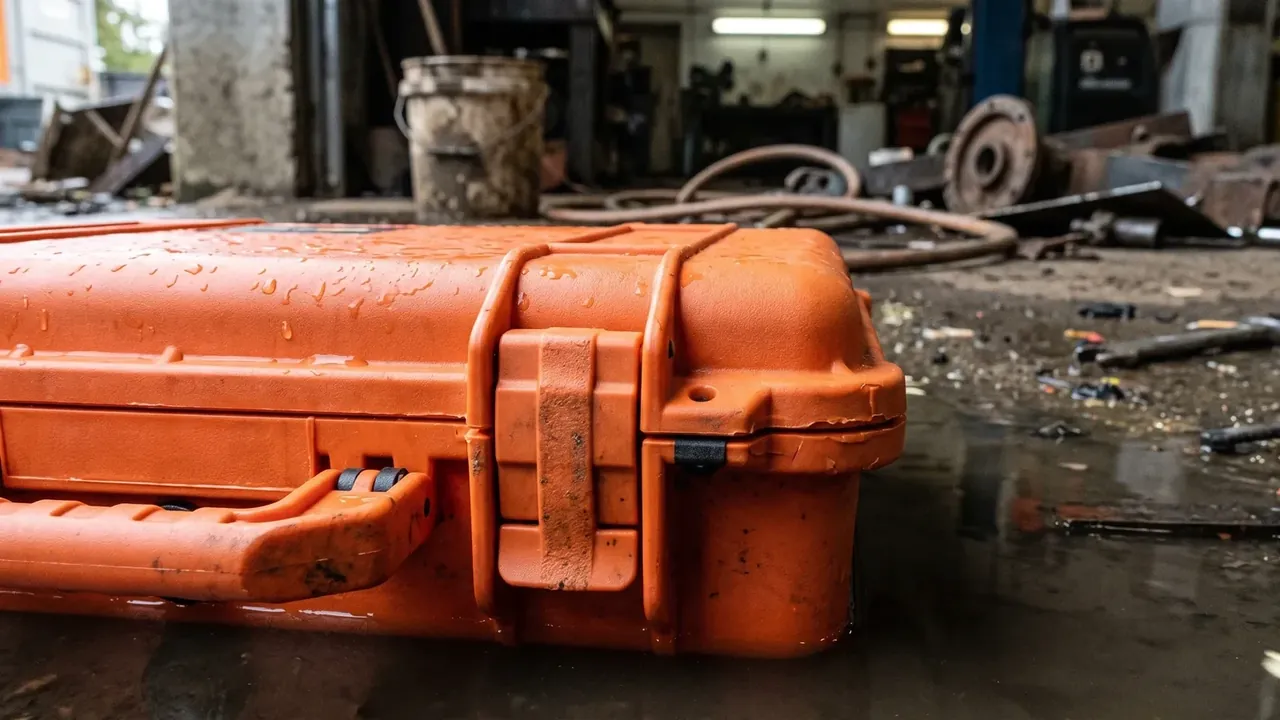
Clearance is the tolerance most often skipped. Foam inserts for automotive equipment cases allow 0.5 to 1.0 mm per side. Under 0.5 mm the device will not enter and the wall tears on removal; over 1.0 mm it travels, strikes the wall and rebounds, which is no insert at all.
Set clearance from the part tolerance, not from feel. An aluminium housing held to ±0.2 mm takes 0.6 mm; sheet metal at ±0.5 mm takes 1.0 mm. With rubber corner bumpers, measure to the bumper rather than the metal body.
Cutting parameters show in the wall finish. At 35 kg/m³ a single-edge blade at 300 mm/min leaves a vertical wall; at 45 kg/m³ the edge scorches, so slow the feed and add air.
Deep cavities need draft: above 40 mm of depth the side wall wants 2°, or the cut part will not release and the floor traps swarf until it is no longer flat.
| Step | Parameter | Tolerance | Check |
|---|---|---|---|
| Layout | 0.5 to 1.0 mm per side | ±0.1 mm | Vision measuring machine |
| Cutting | Feed 300 mm/min | ±20 mm/min | Machine log |
| Stack cutting | Three layers at once | Base 0.2 mm smaller | Caliper sample |
| Corner clean-out | R2 radius | No sharp corner | Template and eye |
3. Multi-Layer Lamination and Zoning
Foam inserts for automotive equipment cases often need three layers. A 2 mm face at 45 kg/m³ resists tearing, a 20 mm core at 30 kg/m³ absorbs, and a 3 mm PE base holds shape; 25 mm total still has travel at 10% compression.
Lamination runs two ways. Glue is simple, builds a 0.1 to 0.15 mm bond line and holds to 60 °C. Heat lamination fuses the interface and takes more heat, but prints platen marks through to the face, so foam inserts for automotive equipment cases that are heat bonded need a 3 mm face to bury them.
Zoning beats thickening. A main cavity for the instrument, an accessory cavity for harness and adaptors, a 15 mm wall between them cut down but not through, leaving 5 mm of base so the block stays one piece.
Add a finger notch. Every cavity needs a 15 mm grab on its long edge and 25 mm on deep ones; without it technicians reach for forceps and loosen the cavity mouth.
4. Static and Outgassing
Static and outgassing are the hidden costs in foam inserts for automotive equipment cases. Plain EVA sits above 10¹² Ω, an insulator that can hold several kilovolts of triboelectric charge. Specify 10⁶ to 10⁹ Ω dissipative foam, or bond a dissipative film to the face.
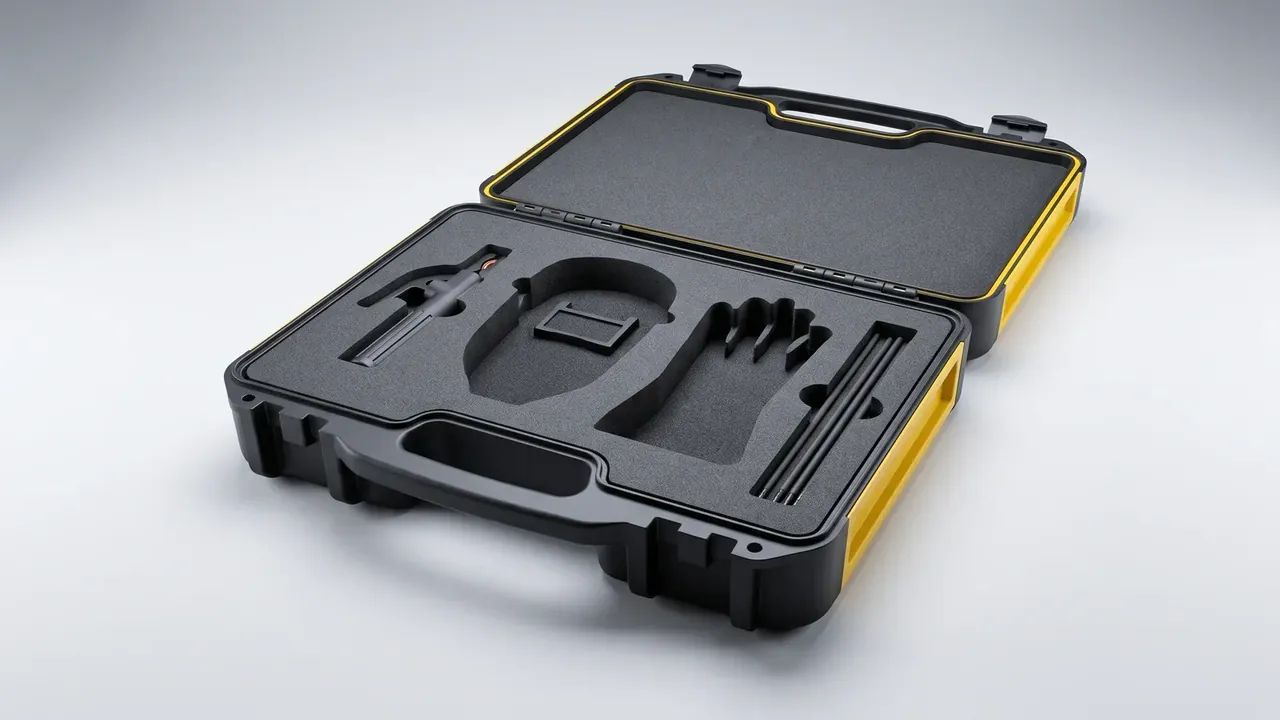
Outgassing is harder to see. Antioxidants and processing aids migrate at 60 °C and lay a film on gold contacts, lifting contact resistance from 10 mΩ into the hundreds. Ask whether the compound carries sulphur or chlorine; a RoHS sheet will not answer.
Cleanliness belongs on the drawing. Blow off swarf, neutralise with ionised air, then bag. One 0.5 mm chip left in a cavity becomes a scratch across a lens.
Smell is a signal as well. A sour note on opening means residual blowing agent: air the part for 24 h, and reject a lot that never clears, because a closed case transfers the odour to the housing.
5. Cleaning and Replacement Intervals
Clean foam inserts for automotive equipment cases by material. EVA is closed cell, so wipe it with neutral detergent under 40 °C and dry at once, never soak. PE insert foam is open cell and needs 24 h of air drying.
Replace on numbers, not on age. The rejection line is a compression set above 20% or a cavity gap over 1.0 mm on one side; either one means new foam and a fresh cut.
A material change reopens the die. A 3 kg/m³ shift in EVA moves spring-back enough to change clearance by 0.2 mm, so foam inserts for automotive equipment cases carry a batch record tied to the die number, not to the packing date.
Store flat. Stacking five deep loads the bottom insert into a permanent set, and any part older than 12 months gets its thickness checked before it is fitted.
Conclusion
The ledger for foam inserts for automotive equipment cases closes on four figures: 25 to 45 kg/m³, a set of 10% to 20%, 0.5 to 1.0 mm per side, three layers. Put them on the drawing and the die has a basis, a material change has a reference. JUNZHIJIA asks for part tolerance and transport mode before density and layer count, because the reverse order means cutting again.
This article discusses only the container (case body) side of specifications and design intent, and does not cover any handling, loading or use of the contents.
Related Reading
- Custom EVA foam-lined case for precision instruments
- Hard plastic equipment case with pick-and-pluck foam
- Industrial hardware protective box with foam lining
Related Products
- 8 Series — Gun Cases; Military Equipment Cases; Camera Equipment Cases; Drone Cases; Watch Cases; Knife Cases; First Aid Cases; Electronics Equipment Cases
- WL8-2812 PP Gun Case — model WL8-2812
- All protective cases and toolboxes: 7 series, 158 models