

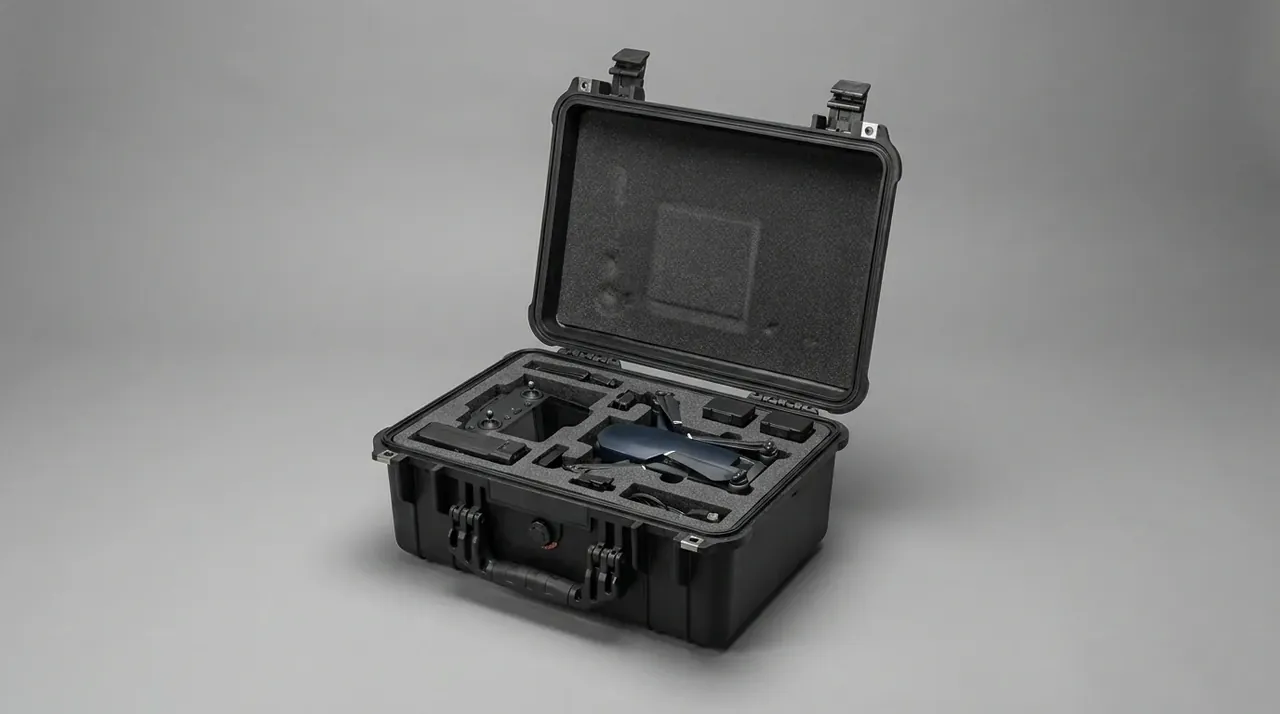
Quick answer: A Custom EVA foam lined precision instrument case uses a 45 kg/m3 base pad with +/-0.5 mm slots, holding set to 3% under 12 kg and 4 g over 5-200 Hz.
Table of contents
- Density grading inside the Custom EVA foam lined precision instrument case
- Milling tolerance and cavity wall squareness
- How base-pad compression set is measured
- Transmitted acceleration across the sweep band
- Cavity re-check after lid-cycle ageing
- FAQ
1. Density grading inside the Custom EVA foam lined precision instrument case
The liner is two layers split by load path, not one uniform block. A Custom EVA foam lined precision instrument case has an outer size of 560 x 410 x 260 mm, a cavity of 495 x 345 x 200 mm and a wall of 3.8 mm; an empty 5.4 kg and a rated 12 kg load define the static burden on the base pad. An EVA density of 45 kg/m3 supports that load without passing vibration straight through: the 35 mm base pad carries weight and isolates, while the 20 mm lid foam only limits lid pressure. Shell and lid clearance is set from these two thicknesses so preload stays even across the case.
| Liner part | Thickness and density | Function |
|---|---|---|
| Base pad | 35 mm / 45 kg/m3 | Load and isolation |
| Lid foam | 20 mm / 45 kg/m3 | Lid pressure limit |
| Mouth surround | 3.8 mm wall | Lateral restraint |
| Cavity floor | Set by slot depth | Puncture margin |
2. Milling tolerance and cavity wall squareness
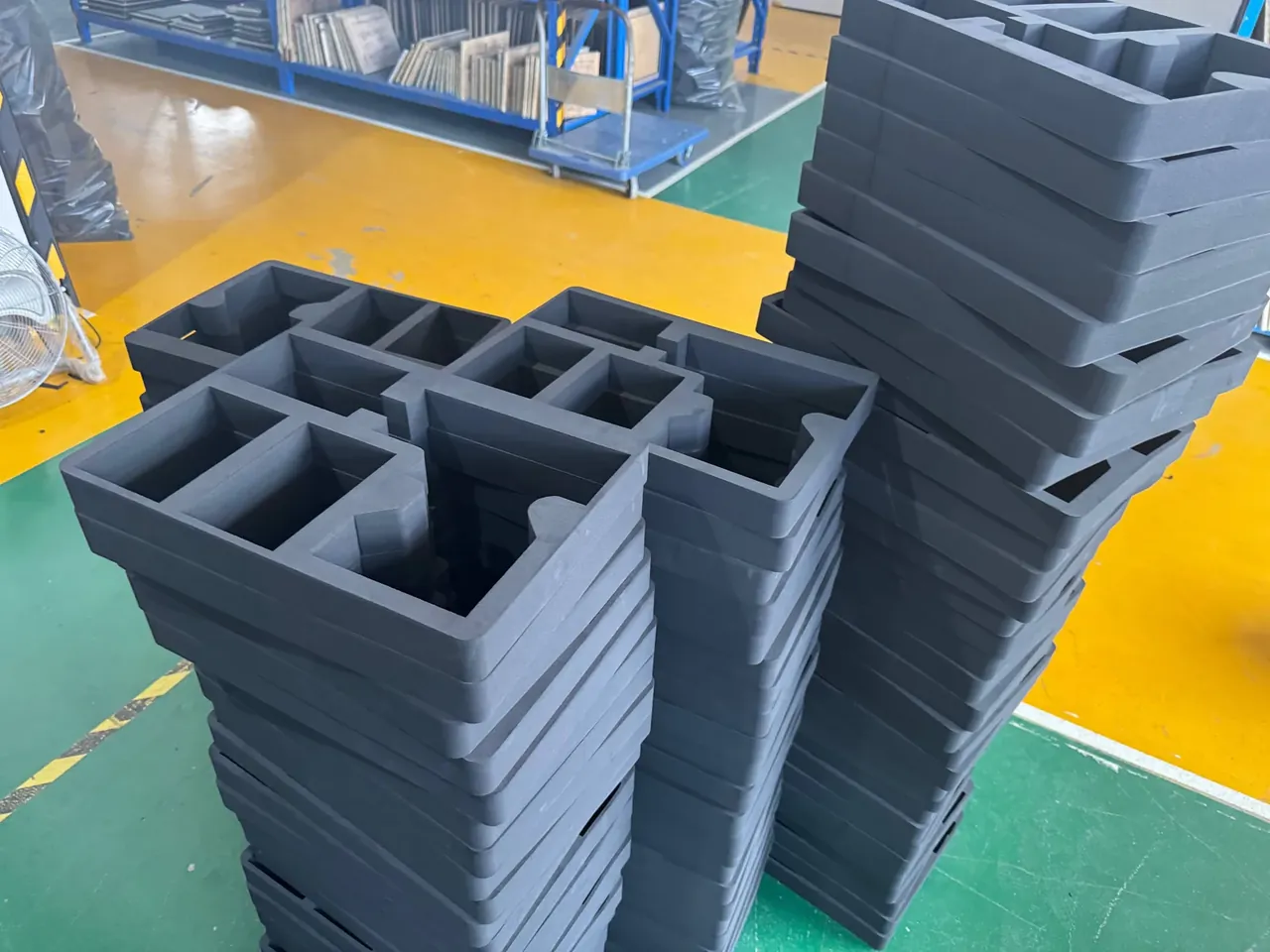
The cavity is the only locating feature, so the +/-0.5 mm milling tolerance and wall squareness are read together. Cavities in a Custom EVA foam lined precision instrument case are milled to nominal size within a +/-0.5 mm band, keeping the gap around a seated part even; a wall out of square looks fine at the mouth but is skewed at the floor, where the part binds on one side. A plug gauge reads the top, middle and bottom of the slot, and the three-depth spread says more about squareness than any single value.
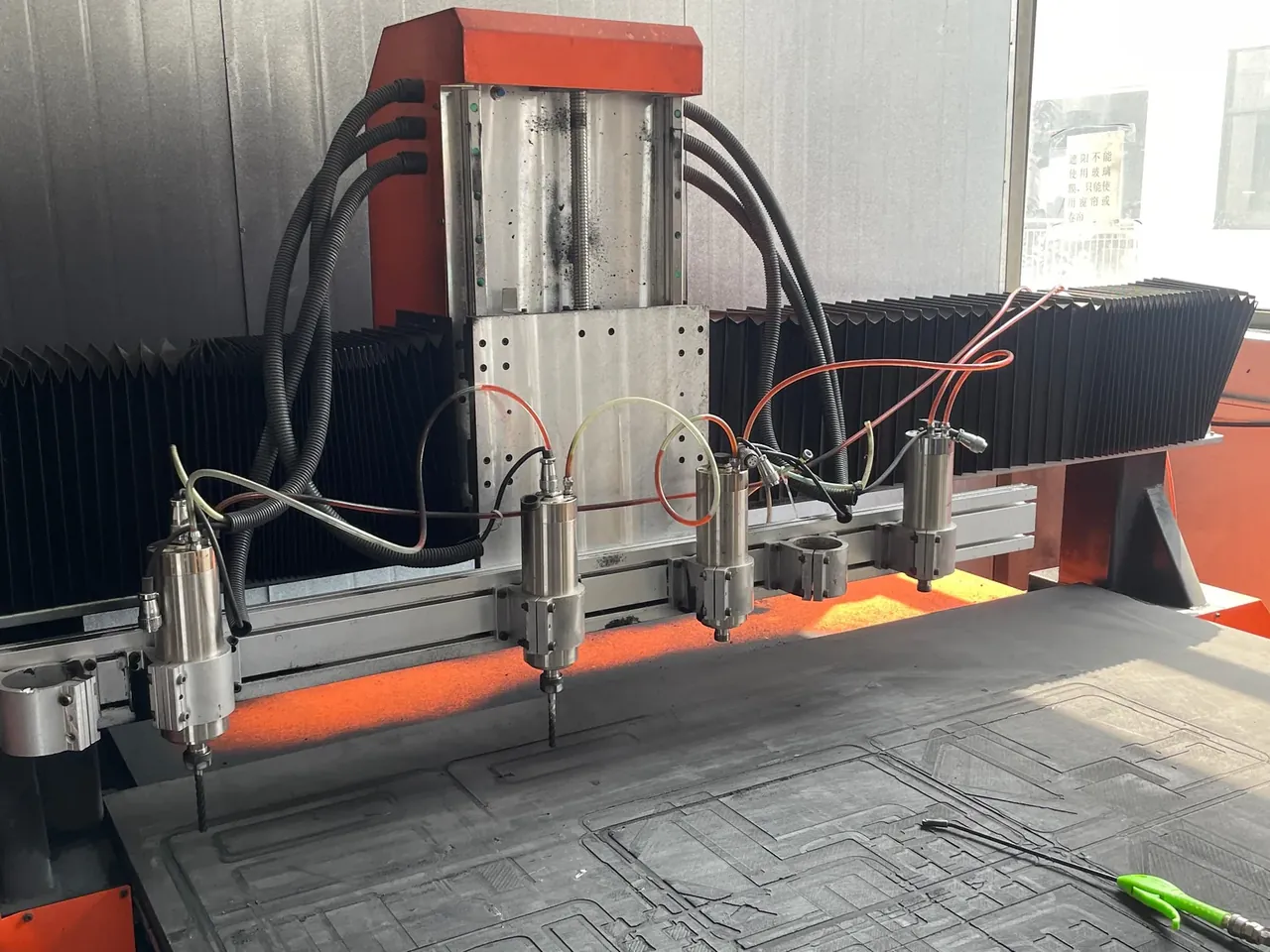
Milling leaves a compacted skin on the cell walls that can shift mouth size as foam rests, so liners are re-measured within +/-0.5 mm before assembly; corners show tool deflection first and are logged apart from straight edges.
| Milling specification | Control value | Measuring position |
|---|---|---|
| Mouth tolerance | +/-0.5 mm | Top, middle, bottom |
| Wall squareness | Set by slot depth | Corner and straight edge |
| Cavity floor | Puncture margin | End of slot depth |
| Compacted skin | Re-measure after rest | Cell-wall surface |
3. How base-pad compression set is measured
Long-term load is judged by compression set, not the springy feel on day one. A Custom EVA foam lined precision instrument case presses a rated 12 kg onto the base pad for a fixed hold, unloads, and measures the share of thickness that does not return; the criterion is 3% or less. At 45 kg/m3, a compound that is too soft lets cell walls buckle and leaves permanent settling, and once set passes 3% the cavity clearance shifts with it.
The reading covers pad thickness alone, excluding shell deflection.
Press-head area, hold time and rest time stay fixed. Six points on one pad give a mean for rejection, and the same head and hold time are reused after 4000 open-close cycles.
4. Transmitted acceleration across the sweep band
Isolation is stated over a band, not at one convenient frequency. A Custom EVA foam lined precision instrument case is swept from 5-200 Hz with input at the case base and response read above the cavity, and transmitted acceleration must stay within 4 g across the run. Base-pad density of 45 kg/m3 and 35 mm thickness place the resonance inside that band: raise density and stiffness climbs, the resonance moves later, and low frequencies are amplified instead.
The sweep runs through 5-200 Hz and logs the peak. A second pass with the lid closed confirms the 20 mm lid-foam preload has not changed the base-pad boundary. The 4 g figure is a whole-band envelope, so a brief spike still fails.
| Deformation reading | Condition | Acceptance rule |
|---|---|---|
| Compression set <=3% | 12 kg static load | Mean of six points |
| Transmitted acceleration <=4 g | 5-200 Hz sweep | Whole-band envelope |
| Cavity tolerance | After 4000 cycles | +/-0.5 mm not widened |
| Density check | 45 kg/m3 | Measured per layer |
5. Cavity re-check after lid-cycle ageing
Lid-cycle life ties the earlier items into one timeline. A Custom EVA foam lined precision instrument case runs 4000 open-close cycles, each closing bringing lid foam to its designed position and each opening reaching the stop, and cavities are measured only after the run. The mouth is read first, with top, middle and bottom values compared against the pre-assembly +/-0.5 mm records to see whether fatigue widened the band. The cavity floor comes next, confirming repeated lid pressure has not thinned the puncture margin. Base-pad thickness is re-measured so compression set can be placed beside the earlier 3% figure as a delta. A 5-200 Hz sweep follows to confirm transmitted acceleration still sits inside the 4 g envelope with no resonance drift. Shell-to-lid clearance is checked as well, since wear that lets the lid sit lower changes lid-foam preload. The mouth seal is finally compared against the IP65 method and filed as background, not used for cavity rejection. With this order fixed, a bad reading points to foam fatigue, tool deflection or hardware wear rather than a vague liner-ageing claim.
JUNZHIJIA keeps this re-check as the last outgoing step, with cavity data and sweep curves filed per batch.
Conclusion
Reliability in the Custom EVA foam lined precision instrument case rests on density grading, milling tolerance and long-term load together. Compression set within 3% under 12 kg and transmitted acceleration within 4 g across 5-200 Hz are two measurable lines, and the cavity re-check after 4000 cycles keeps the +/-0.5 mm band from widening with foam fatigue. JUNZHIJIA files density, cavity and sweep records as three separate checks, each judged on its own reading rather than offset against another.
Related Reading
- Foam lining materials and density selection
- Allocating inner height and foam thickness
- Pre-cut foam grids versus milled cavities
- Dividers compared with foam liners
Related Products
- 8 Series — Gun Cases; Military Equipment Cases; Camera Equipment Cases; Drone Cases; Watch Cases; Knife Cases; First Aid Cases; Electronics Equipment Cases
- WL8-2812 PP Gun Case — model WL8-2812
- All protective cases and toolboxes: 7 series, 158 models