

Quick answer: Case inner height equals device height plus lid foam plus base foam plus 3 mm clearance, minus lid ribs, then checked against 10%–15% compression.
Table of contents
- How to Calculate Case Inner Height
- Splitting Foam Between Lid and Base
- Access Clearance and Lid Ribs
- Foam Compression and Headroom
- FAQ
1. How to Calculate Case Inner Height
A 175 mm handheld terminal with 20 mm of base foam, 25 mm of lid foam and 3 mm of top clearance needs a case inner height of 223 mm. That is not the cavity depth on a data sheet; it is the net figure left between two foam faces once the lid is latched.
Four terms enter the sum: tallest point of the device, base foam, lid foam, clearance. Measure the tallest point first, because antennas, knobs and connectors usually sit 8–15 mm above the shell, and one missed protrusion skews everything after it. Too little case inner height and the foam gets shaved; too much and the device rattles.
| Component | Typical value | Measured as | Common error |
|---|---|---|---|
| Device height | 120–320 mm | Tallest point, knobs included | Protrusions missed by 8–15 mm |
| Base foam | 10–30 mm | Natural thickness, no adhesive | Adhesive counted as 1 mm |
| Lid foam | 15–30 mm | Inside usable lid depth | Pressed onto ribs |
| Clearance | 3–5 mm | Per side, all four sides | Long edges only |
The 235 mm a supplier quotes is cavity height. Deduct a 12 mm lid rib, 4 mm of floor ribs and 1 mm of adhesive and 218 mm remain, five short of 223 mm. In practice that shows up as a lid pad cut from 25 mm to 20 mm, with a corner impact landing straight on the device top.
Field check: seat the device on the base foam and tape from its top to the lowest point inside the closed lid.
2. Splitting Foam Between Lid and Base
Lid foam holds the device down and base foam carries it, so the layers need not be equal. Handheld terminals usually take 20 mm below and 25 mm above; a benchtop instrument with a high centre of gravity inverts that to 30 mm below and 15 mm above, keeping mass near the case floor.
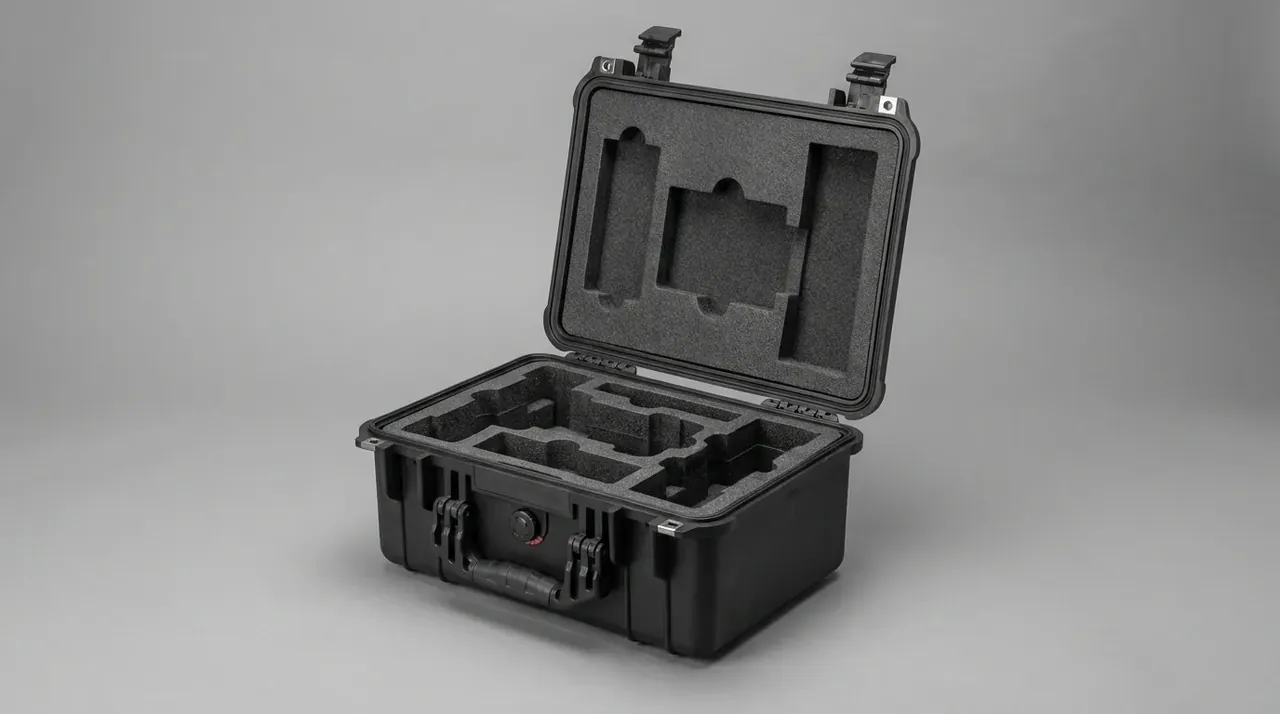
Lid foam is capped by the ribs. With a 12 mm rib the pad tops out near 30 mm; go thicker and the lid rests on foam instead of the gasket, dropping gasket compression below the 30% a seal needs.
Base foam has a floor set by drop height. A 6 kg unit dropped from 1.2 m with less than 20 mm underneath compresses past 40% and passes shock into the case floor.
| Device type | Base foam | Lid foam | Height required | Verdict |
|---|---|---|---|---|
| Handheld terminal, 175 mm | 20 mm | 25 mm | 223 mm | A 235 mm cavity works |
| Benchtop instrument, 300 mm | 30 mm | 15 mm | 348 mm | Needs 350 mm or more |
| Controller with knob, 210 mm | 25 mm | 20 mm | 258 mm | Pocket another 15 mm deep |
Once both thicknesses are fixed, the cavity that meets the case inner height is locked. A 235 mm cavity with 20 mm and 25 mm leaves 187 mm for the device; at 30 mm and 30 mm the same cavity offers 172 mm, and the unit no longer fits.
Firmness can differ as long as rebound matches: harder foam underneath, softer on top, so the upper pad loads first. On panelled instruments the 10 mm frame around a display is the weakest zone, where 5 mm of misalignment can crack the glass.
3. Access Clearance and Lid Ribs
Three millimetres per side is the usual lateral clearance, applied to all four sides. The vertical direction needs more, because fingers must reach the device: 20 mm for a flat-lay item, 30 mm for anything dropped into a deep pocket, or a 15 mm pull strap in place of fingers.
Lid protrusions come in two kinds. Ribs cross the lid at 8–15 mm high; latch bosses sit on the side walls and intrude about 10 mm, landing exactly where the shoulders of the device sit, so they touch first.
Measure with the lid closed. A tape pushed to the lowest point of the closed lid gives the true deduction; with the lid open the reading sits on the rib crest and under-deducts by 5–8 mm. Relocate a rib if the mould allows it, otherwise the millimetres come out of the foam.
Clearance belongs on all four sides, not just the corners. At 3 mm on the corners the long edges open by 5–8 mm and the device slides sideways, so the pocket needs another 2 mm trimmed. Past 40 mm of pocket depth fingers cannot grip either, which calls for a 10 mm void under the pocket or walls tapered wider than the floor.
4. Foam Compression and Headroom
Compression is the share of foam thickness lost when the lid is latched. PE runs 10%–15% and EVA 5%–10%; too little and the device shifts, too much and the latches strain while the hinge carries torque.
A 25 mm lid pad at 12% compression occupies 22 mm, leaving 3 mm of headroom. Below 2 mm, foam rebound slows at -20 ℃ and the lid feels stuck on opening. Above 8 mm the device travels 4 mm, hits foam, then hits the case wall, and the two shocks stack. Two to five millimetres is the stable band for case inner height.
Cycles matter as much as temperature. Eight openings a day across three years is close to 9000 compressions; rebound falls 10%–15% and a 3 mm margin narrows under 1 mm, at which point the foam is replaced rather than the case.
Heat and cold shift the figure too: four hours at 60 ℃ recovers 1–2 mm, while four hours at -20 ℃ removes about 1 mm and raises latch force by 15%, which is why latches feel stiff in winter.
Conclusion
Run the figures as a check sheet and the decision takes one pass. A 235 mm cavity minus a 12 mm lid rib and 4 mm of floor ribs leaves 219 mm. A 175 mm device plus 20 mm of base foam, 25 mm of lid foam and 3 mm of clearance needs 223 mm. Since 219 minus 223 is -4 mm, case inner height is four millimetres short. Those millimetres can only come out of the foam: trim the lid pad to 21 mm, raise compression to 15%, and the 3 mm margin returns. Add a 12 mm knob and the pocket needs another 15 mm of depth, which flips the answer to a larger cavity. Judge case inner height after ribs and compression are deducted, never from the catalogue figure.
This article discusses container-side specifications and design implications only, and does not cover any handling, loading or use of the contents.
Related Reading
- How interior case dimensions are measured
- Configuring a foam case lining
- Cushion design for outdoor case interiors
- How to size a protective case
Related Products
- 8 Series — Gun Cases; Military Equipment Cases; Camera Equipment Cases; Drone Cases; Watch Cases; Knife Cases; First Aid Cases; Electronics Equipment Cases
- WL8-2812 PP Gun Case — model WL8-2812
- All protective cases and toolboxes: 7 series, 158 models