

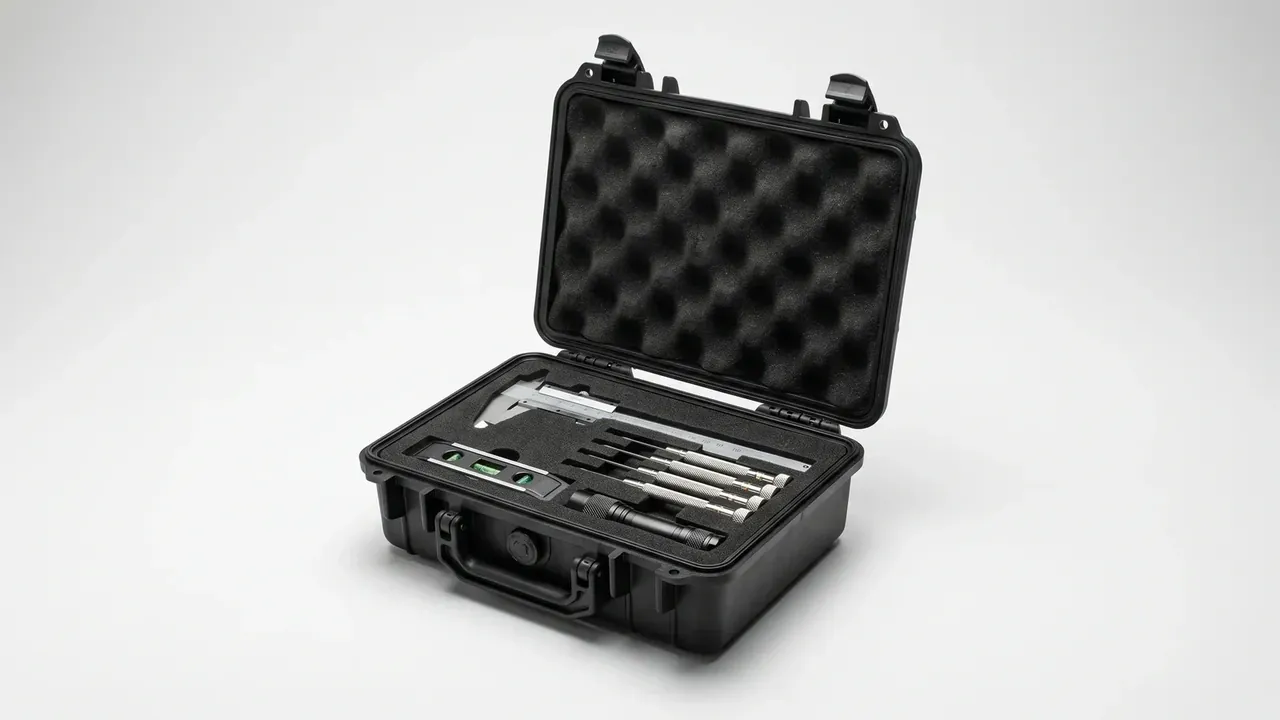
Quick answer: Foam inventory management starts with four numbers that can be weighed or read off a label: piece weight, batch, location and age. Line those four up and the rack matches the ledger.
Table of contents
- What foam inventory management really counts
- Weighing and conversion: kilos, cubic metres and sheet counts
- Batch and location codes that pin stock to a rack
- Where the parameters land: density, thickness, rebound and age
- Goods-in to goods-out: how one data stream runs
- FAQ
1. What foam inventory management really counts
In most plants foam inventory management stops at one spreadsheet row: the name says foam, the quantity says some. That row cannot be executed. Swap a 30 mm sheet for a 40 mm one and every cut pocket deepens by 10 mm, so the part no longer sits still.
So the first step is to turn a sheet into a number. A 1.2 m by 2.4 m sheet at 30 mm and 38 kg/m³ measures 0.0864 m³ and weighs 3.28 kg. Once booked, volume, count and value all have a root. The data splits into four layers: item, geometry, batch and place.
2. Weighing and conversion: kilos, cubic metres and sheet counts
Weighing beats counting. Thickness tolerance runs at plus or minus 0.5 mm, so 60 stacked sheets can hide a 30 mm gap no pair of hands will feel; a platform scale reads to 0.05 kg, holding the error on a 3.28 kg sheet below 1.5%.
Conversion uses one formula: volume, then density. A 1.2 m by 2.4 m sheet at 40 mm measures 0.1152 m³ and weighs 5.18 kg at 45 kg/m³; the same size in 25 kg/m³ material drops to 2.88 kg. Stack the two together and the picker will grab the wrong one.
Sheet count per pallet is limited from both ends. The pallet weighs 18 kg and is rated to 800 kg; under a 1.2 m height cap, 40 mm sheets stack 26 layers, two to a layer, for 52 sheets at 269 kg, so height bites before weight does.
| Size (m) | Volume (m³) | Density (kg/m³) | Sheet weight (kg) | 52-sheet load (kg) |
|---|---|---|---|---|
| 1.2×2.4×0.03 | 0.0864 | 38 | 3.28 | 171 |
| 1.2×2.4×0.04 | 0.1152 | 45 | 5.18 | 269 |
| 1.2×2.4×0.05 | 0.1440 | 30 | 4.32 | 225 |
| 1.0×2.0×0.02 | 0.0400 | 60 | 2.40 | 125 |
Column four is weighed, column five is calculated. When they disagree the label is wrong: nominal 45, measured back at 41, a gap worth 21 kg on one stack, which surfaces at quarter-end as negative stock.
3. Batch and location codes that pin stock to a rack
The batch code owns time, the location code owns space. Batches run six digits, so 2610-03 reads as the third batch of October 2026. Locations run four segments, zone to slot, so B-04-2-1 means zone B, row 4, level 2, slot 1.
Label size matters more than people expect. A 60 mm by 40 mm thermal label at 900 mm above the floor scans standing up; below 300 mm the fork lift shears it off, which is how a store reprints 200 labels a month. Pallets get swapped, so the label on the sheet edge is the last proof and needs a solvent-resistant face that holds print for 12 months. Rewriting the rule in foam inventory management means relabelling the whole store.
| Field | Format | Applied to | Maintained by |
|---|---|---|---|
| Item code | Material, density, thickness | Pallet side | Receiving clerk |
| Batch | Six digits, year-month plus serial | Pallet and sheet edge | Receiving clerk |
| Location | Four segments, zone to slot | Rack end and card holder | Put-away operator |
| Age | Arrival date plus 90-day flag | Card holder | Planner |
4. Where the parameters land: density, thickness, rebound and age
Parameters are not for the test lab; they set thresholds on ledger fields. The 38 kg/m³ band needs its own item code, and 30 mm must sit on a line separate from 40 mm. Merge them and a count-based issue releases 25% too much material.
Rebound is the hard measure of whether stored foam is still usable. Compress a 50 mm square sample to 75% of its height, hold 24 hours, release: above 92% ships normally, 88% to 92% becomes void fill, below 88% leaves available stock. Age thresholds sit at 90 days for a yellow tag and 24 months for a clear-out. The costliest item in foam inventory management is the stack found two years late at 85% rebound.
| Parameter | Ledger field | Threshold | Action past it |
|---|---|---|---|
| Density | Second segment of item code | 38 kg/m³ | Open a new item code |
| Thickness | Third segment of item code | 30 and 40 mm split | Re-code as two lines |
| Rebound | Quarterly recheck log | 88% | Remove from available stock |
| Age | Arrival date field | 90 days | Yellow tag and review |
5. Goods-in to goods-out: how one data stream runs
The receiving dock starts the stream. Count first, then weigh, and post both figures: inside 2% goes against the document, beyond 2% gets a photo and a discrepancy note. Put-away scanning writes the location into the ledger, and one location carrying one batch turns first-in-first-out into a physical fact.
Month-end stocktaking is verification, not repair. Auditing 20% of locations passes when variance stays under 2%; beyond that the store is recounted. Variances trace to three causes: a broken stack never scanned, offcuts never booked in, samples taken without a note. Four actions carry foam inventory management end to end: weigh, scan, deduct, count.
Conclusion
On paper, foam inventory management is four numbers: sheet weight, batch, location and age. Weighing turns a physical quantity into a figure, coding pins it to a rack, and thresholds split usable stock from dead stock. With all four layers filled a count no longer means opening every box; with one missing, the tidiest ledger is an estimate, which is why foam inventory management deserves its own fields.
This article discusses only the container (case body) side of specifications and design intent, and does not cover any handling, loading or use of the contents.
Related Reading
- How roll stock becomes cut pockets
- Temperature, humidity and stack height on the rack
- Where custom insert dimensions come from
Related Products
- 8 Series — Gun Cases; Military Equipment Cases; Camera Equipment Cases; Drone Cases; Watch Cases; Knife Cases; First Aid Cases; Electronics Equipment Cases
- WL8-2812 PP Gun Case — model WL8-2812
- All protective cases and toolboxes: 7 series, 158 models