

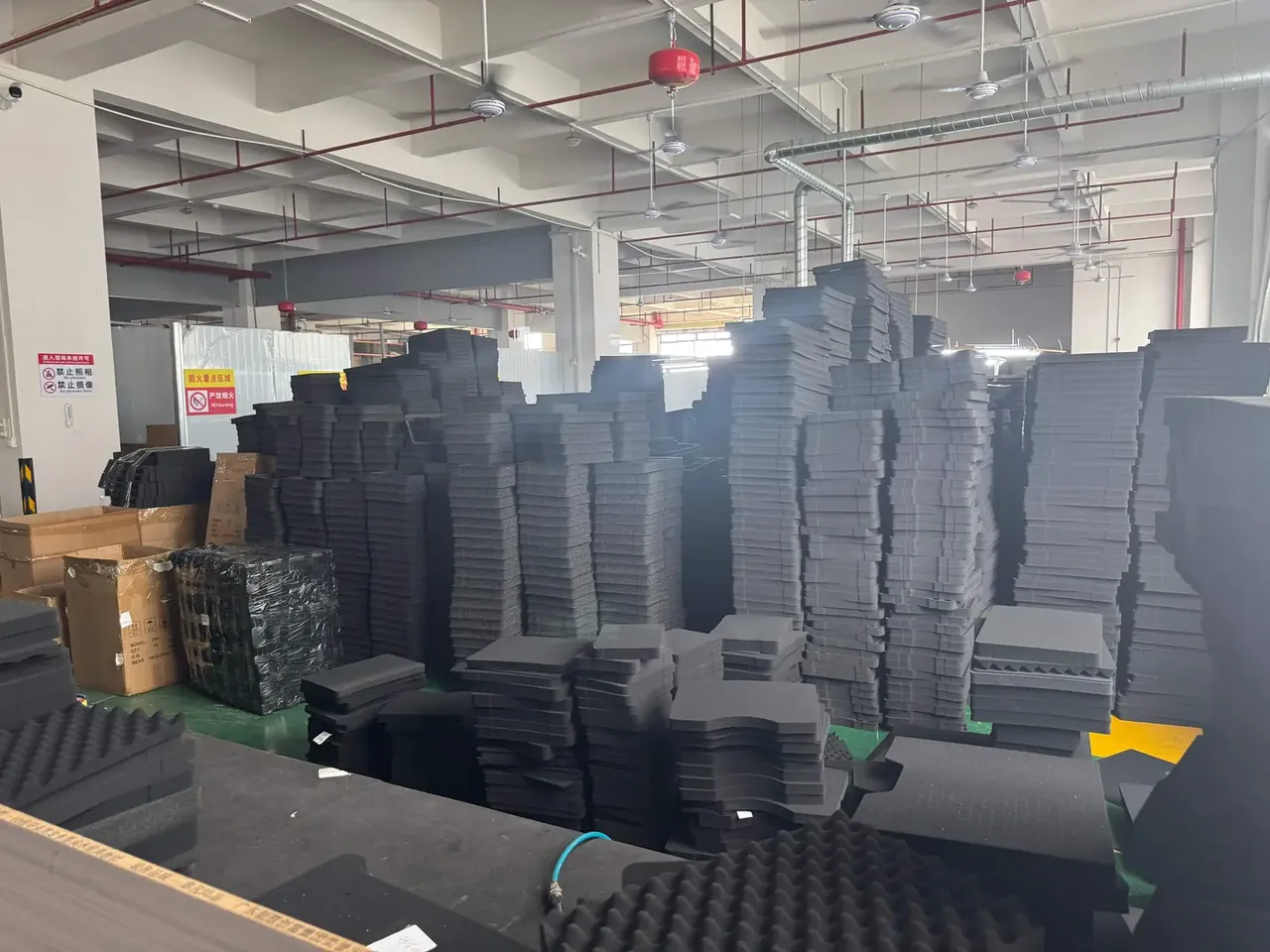
Quick answer: Foam Inventory Management reduces storage to three checkable lines: hold the room between 5 and 35 degrees Celsius, cap every stack at 1.2 m, and release stock in batch order. Written as numbers, all three can be audited.
Table of contents
- Where Foam Inventory Management standards start
- Temperature, humidity and dew point
- Stack height from thickness
- FIFO: batch codes, bins and colours
- Checks and deviation handling
- FAQ
1. Where Foam Inventory Management standards start
A storage standard is three measurable lines: temperature and condensation, stack geometry, and release order.
Each fails differently. Over temperature, the sheet softens or turns brittle and pockets drift off size. Over height, a 50 mm board measures 47 mm at the bottom. Out of order, the oldest pallet waits at the back for two years.
The usual mistake in Foam Inventory Management is folding all three into one phrase about damp. Numbers travel better: 35 degrees, 1.2 m, lowest batch first. Post them at the rack end.
2. Temperature, humidity and dew point
Ethylene vinyl acetate softens above 35 degrees Celsius, and long storage can move it 0.3 percent in dimension, which makes a cut pocket tight. Below 5 degrees the sheet hardens and corners chip.
The room runs 5 to 35 degrees with 35 as the alarm. Bins under the roof or against a west wall measure 6 to 8 degrees warmer in summer, so foam never goes there.
Read humidity as dew point: when room temperature minus dew point falls below 3 degrees, condensation starts on the sheet. With a dew point of 24 degrees the room must hold 27.
In Foam Inventory Management, log at nine and three; three days below the margin moves the stack to the centre.
| Bin type | Temperature | Dew point margin | Rule |
|---|---|---|---|
| Centre of room | 5–35 C | 3 C or more | normal storage |
| Under roof, west wall | often above 35 C | unstable | no foam |
| Door and loading bay | swings over 10 C | narrow in wet season | transit stock only |
| Closed cabinet | 20 C plus or minus 5 | 5 C or more | precision sheet |
3. Stack height from thickness
Foam Inventory Management caps the stack at 1.2 m including the pallet. A 150 mm pallet leaves 1.05 m, so the layer count is 1.05 m divided by thickness: twenty-one layers of 50 mm, thirty-five of 30 mm, always rounded down.
Mixed thicknesses count on the thickest sheet; a leaning stack doubles the load underneath. Density changes width, not height: soft stock at 25 to 30 kg per cubic metre fails to recover past 10 percent compression.
Break a stack monthly and gauge the lowest sheet: within 2 mm it stays, beyond 3 mm it drops to gap filling.
| Density, kg/m3 | Sheet | Layers | Stack height |
|---|---|---|---|
| 25–30 | 50 mm | 21 | 1.20 m |
| 35–40 | 40 mm | 26 | 1.19 m |
| 45–60 | 30 mm | 35 | 1.20 m |
| 60–90 | 20 mm | 52 | 1.19 m |
4. FIFO: batch codes, bins and colours
First in, first out in Foam Inventory Management needs a batch code, a bin address and a colour.
The code runs six digits, year, month and serial: 2610-03 is the third batch of October 2026. Stencil it on the pallet side and the end face, which survives the pallet swap.
Bins run zone, row, position, such as A-03-02: one batch per bin, never split, picked outermost. Colour tags rotate through twelve colours, so a glance down the aisle dates every stack.
| Item | Format | Location | Updated |
|---|---|---|---|
| Batch | six digits, year, month, serial | pallet side and sheet end | on receipt |
| Bin | zone, row, position | rack end and card | on put-away |
| Colour | twelve-colour monthly cycle | pallet face | first of month |
| Card | density, thickness, batch, date | fixed sleeve | on every move |
5. Checks and deviation handling
In Foam Inventory Management, count by stack at month end: variance within 2 percent, or recount against the last issue note.
The quarterly sample gauges bottom compression and thickness recovery: after 24 hours out of the film, 97 percent of nominal passes, and below 95 percent the batch is barred from precision work.
Deviations leave a trace: two days above 35 degrees, a dew point margin under 3 degrees, a stack above 1.2 m lowered on the spot. The log finds the bin that fails repeatedly, not blame.
Fix in order: environment, then geometry, then time; lowering a stack in a hot corner only moves the problem down one pallet.
Conclusion
Storage standards in Foam Inventory Management come down to three measured lines: 35 degrees, 1.2 m, and batch order on the pallet card. Write them down, test them weekly, and Foam Inventory Management stops being paper.
This article covers container-side specifications and design implications only, not the handling, loading or use of the contents.
Related Reading
- General rules for stacking and storage
- How condensation forms inside a case
- Labelling and asset traceability
- Sampling in incoming batch inspection
Related Products
- 8 Series — Gun Cases; Military Equipment Cases; Camera Equipment Cases; Drone Cases; Watch Cases; Knife Cases; First Aid Cases; Electronics Equipment Cases
- WL8-2812 PP Gun Case — model WL8-2812
- All protective cases and toolboxes: 7 series, 158 models