

Quick answer: Folding Wheeled Storage Bins live or die on five numbers: a 3.0 mm wall, 560 × 400 × 330 mm open, 95 mm folded, a 105° door and 3000 folds.
Table of contents
- The Front-Access Structure of Folding Wheeled Storage Bins
- Door Hinging and Opening Angle
- Folded Thickness and Shipping Volume
- Casters Paired with Front-Door Load
- Shelf-Ready Presentation Coming Out of the Carton
- FAQ
1. The Front-Access Structure of Folding Wheeled Storage Bins
A front door keeps the cabinet in place and swings one panel down, so the deepest layer is reachable without dragging the unit out. Folding Wheeled Storage Bins split that into three jobs: a panel that swings clear, a frame that keeps the body stiff, and a latch that survives daily use. A 55 L body opens to 560 × 400 × 330 mm on a 3.0 mm wall, with a 12 mm return the panel closes onto.
Body and panel are two moulding problems: the body wants a thin wall that resists bulging, the panel wants to stay flat, so both cavities run in one tool and each shrinks before assembly decides whether the seam lines up.
| Folded thickness | Open volume | Wall | Structural intent |
|---|---|---|---|
| 85 mm | 52 L | 2.8 mm | Light duty, front door only |
| 95 mm | 55 L | 3.0 mm | Front plus side doors, mainstream |
| 110 mm | 58 L | 3.2 mm | Five doors, ribbed walls |
The visible difference across those rows is thickness; the real one is door count, and Folding Wheeled Storage Bins need more room to fold as panels multiply. A shop showing stock through the front needs only the middle row.
2. Door Hinging and Opening Angle
A 105° opening is the margin between swinging clear and springing back. At 90° the panel sits square and a hand works around the edge; at 105° it tips down and clear height grows by about 18 mm, which is the whole difference. Past 120° the panel's weight loads the hinge root and the door hangs crooked.
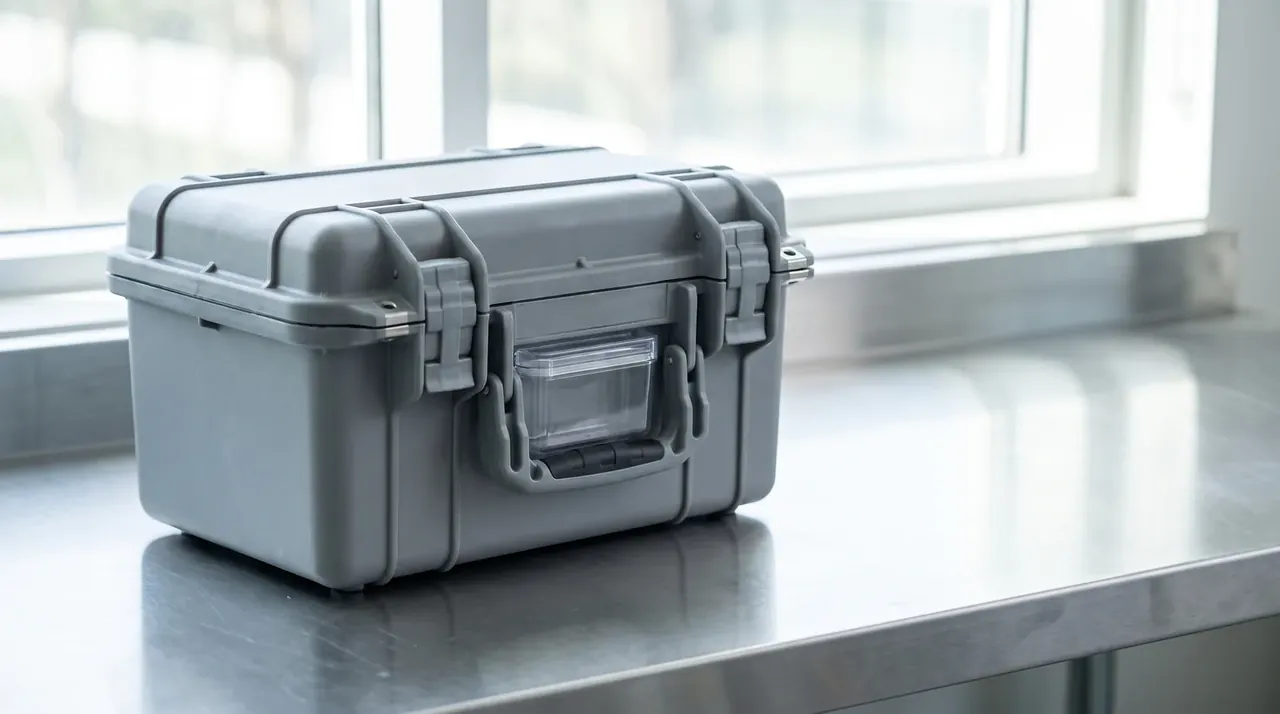
The hinge is two pins plus a stop rib. Each pin runs 4 mm diameter, pressed 6 mm into the body at both ends with 0.2 mm of axial clearance. The stop rib meets the frame opening to fix the angle, so 105° comes from geometry, not pin friction.
| Door opening angle | Clear height gain | Panel sag | Where it suits |
|---|---|---|---|
| 90° | 0 mm | 0.3 mm | Full-lid access only |
| 105° | 18 mm | 0.8 mm | Front access, mainstream |
| 120° | 34 mm | 2.4 mm | Display units, short term |
The sag column is the long-run reading. At 105°, 0.8 mm is still absorbed by latch compression; at 120°, 2.4 mm leaves the latch short of its catch on these Folding Wheeled Storage Bins.
3. Folded Thickness and Shipping Volume
Folded, the unit measures 560 × 400 × 95 mm, 235 mm less height than open. That gap changes container loading: 780 units fit in a 40HQ against roughly 220 shipped open, and the whole difference is height.
Folding runs along three crease lines as front and back walls meet, sides tuck in and the lid lands on top. Wall thickness falls to 2.4 mm on the crease and outer ribs restore stiffness, so 3000 folds without whitening is the pass mark for Folding Wheeled Storage Bins. At 2.9 kg empty one person lifts it with one hand.
Rejection is measured on thickness: above 95 mm folded, a 40HQ carries 180 fewer units, and the freight per unit eats the premium the front door was meant to earn.
At 85 mm the crease is down to 2.2 mm, whitening starts after 3000 folds, and the next run brings doors that will not fold flat.
4. Casters Paired with Front-Door Load
The caster set decides whether the front door keeps working. Folding Wheeled Storage Bins carry four casters, two swivelling at the door end and two fixed at the back, on 50 mm wheels rated 40 kg each in motion, leaving headroom over the 20 kg working load. The door end takes the heavier share: a hand pressing down sends that force through the frame into the front casters.
| Caster set | Steering behaviour | Load at the door end | Ground it suits |
|---|---|---|---|
| Four swivel | Pivots on the spot | Spread over four points | Flat floor, showroom |
| Two swivel, two fixed | Tracks straight, turns on a push | Concentrated at the front pair | Warehouse aisle, dock |
| Four fixed | Straight push only | Even front to back | Line stations, loading |
The latch holds at 180 N, matched to the caster rating. Crossing a floor joint, the shock reaches the wheels, then the body, then the latch; below 180 N a single bump pops it. Both front casters carry brakes with an 8 mm contact pad, so the wheel does not flat-spot.
5. Shelf-Ready Presentation Coming Out of the Carton
Folding Wheeled Storage Bins arrive folded. Three moves open them. Lift the lid. Raise the walls. Push the sides out until they lock. No tools, and it takes under ten seconds.
On shelf the front faces out with a clear panel, so stock shows through. At 95 mm folded two rows fit on one shelf depth, and at 330 mm open the unit leaves the sightline clear.
The −15 ℃ to +55 ℃ range marks the working window. Unloaded into an unheated warehouse in winter, the joints stay tough; parked beside a glass door in summer, the wall does not soften.
Conclusion
The economics of Folding Wheeled Storage Bins sit on three figures: folded thickness, door angle and caster set. A 95 mm fold buys 780 units per 40HQ, 105° lets a hand reach in without working around the edge, and two swivel casters steer while two hold the line, at 40 kg each over a 20 kg rating. Hold the 3.0 mm wall, the 180 N latch and 3000 folds, and the door will not loosen within half a year. Thickness, angle and casters are decided together.
Related Reading
- Hard Case and Carton in Cross-Border Transit
- The Usable-Volume Calculation
- Three Criteria for Latch Selection
Related Products
- 8 Series — Gun Cases; Military Equipment Cases; Camera Equipment Cases; Drone Cases; Watch Cases; Knife Cases; First Aid Cases; Electronics Equipment Cases
- WL8-2812 PP Gun Case — model WL8-2812
- All protective cases and toolboxes: 7 series, 158 models