

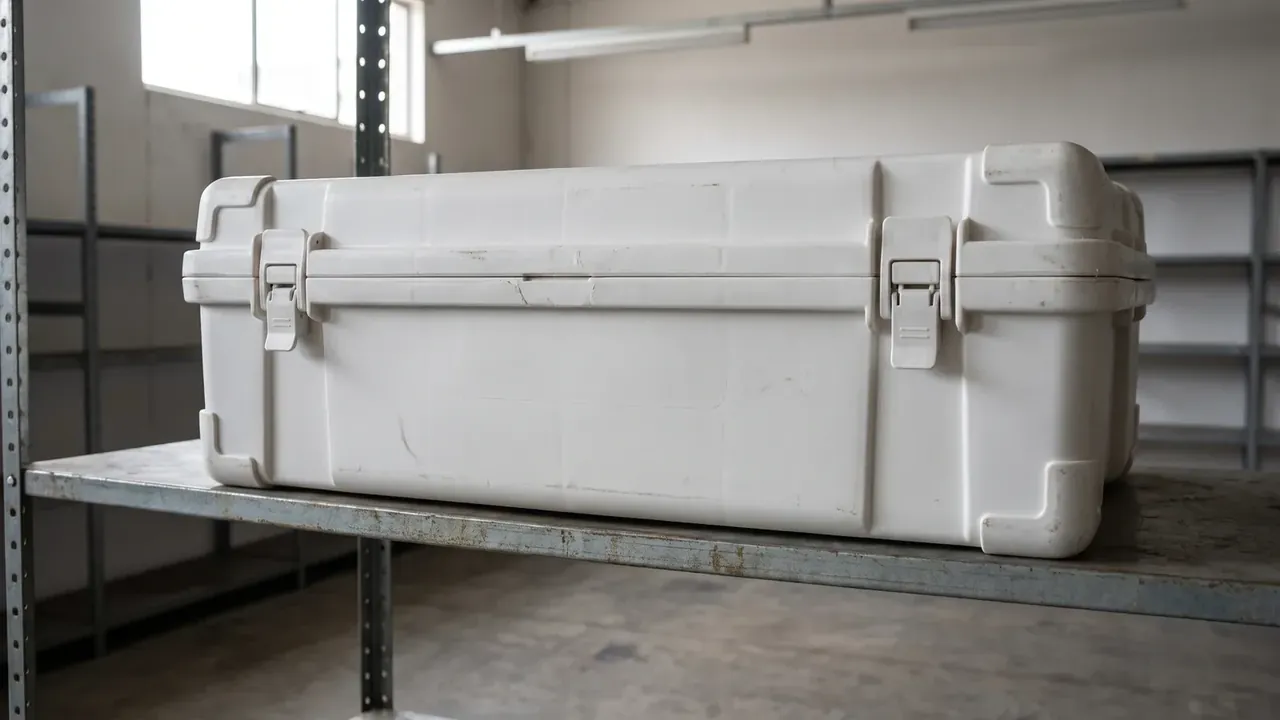
Quick answer: A food plant tool case earns its place in a production hall only when three documents arrive together: a resin grade that maps to FDA 21 CFR 177.1520, a wall held at Ra 0.8 µm or better, and a latch that still holds after 500 wash cycles. The first two cover material and geometry, the third covers service life, and a buyer who supplies only the resin letter sees the shipment turned away.
Table of contents
- The compliance path a food plant tool case has to walk
- Three geometry rules that decide whether it cleans
- What wash chemistry asks of the body
- Colour coding and foreign-body control
- Inspection intervals and the retirement line
- FAQ
1. The compliance path a food plant tool case has to walk
Three checks stand between a moulded box and a hygiene zone: the resin grade against a permitted list, the colour masterbatch and release agent against an additive list, and the finished moulding against a migration test run at its real contact condition.
Grade first. A homopolymer PP has to sit inside the olefin section of 21 CFR 177.1520 or Annex I of (EU) 10/2011. A typical food plant tool case runs a 480×360×200 mm cavity on a 3.2 mm wall, weighs 2.6 kg and is moulded at 215 °C to 235 °C; every 20 °C added at the barrel lifts degradation products and drags migration with them.
Additives second. The masterbatch carrier must match the base resin and stay under 2%, and calcium stearate beats silicone, which leaves a film that alkali lifts and soil then hides under.
Finished-article testing third. Short ambient contact means 2 hours at 70 °C plus 10 days at 40 °C, both declared on the sheet.
2. Three geometry rules that decide whether it cleans
Hygiene design comes down to three numbers: roughness, inside radius and floor slope.
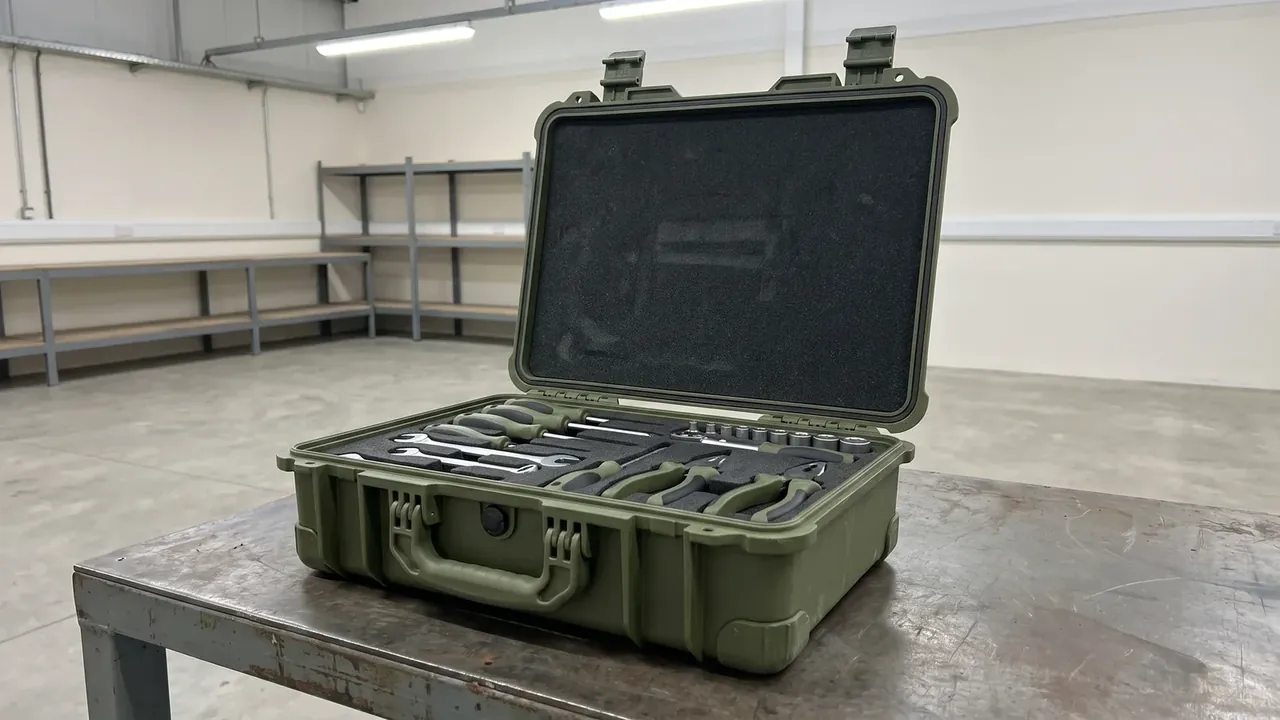
Roughness leads. A polished cavity holds the wall at Ra 0.8 µm, where a fingertip finds no tool marks. At 1.6 µm the wall still looks bright, yet a 0.5 mm scratch traps wash liquor and dried residue fights the rinse.
Radius follows: R3 minimum in corners, R5 at the floor transition, so spray sweeps the corner instead of stopping at it. A sharp R1 corner under 0.25 MPa spray is a dead zone.
Drainage closes the set: a 3° floor to an 8 mm drain plug, 100 mm feet so rinse water passes underneath, ribs on 40 mm pitch with an R2 root fillet. A 12 mm square handle pocket holds water for days; a through slot does not.
3. What wash chemistry asks of the body
Four routines run in most plants: alkaline foam, CIP spray, a hand lance and a quat sanitiser, spanning ambient to 65 °C and pH 2 to pH 12.
| Routine | Chemistry and temperature | Dwell | What the body must show |
|---|---|---|---|
| Alkaline foam | 1.5% sodium hydroxide, 60 °C | 15 min | ΔE ≤3 and Ra growth ≤0.2 µm after 500 cycles |
| CIP spray | 0.25 MPa, 65 °C | 3 min | No ingress at the lid seam, no retention in corners |
| Hand lance | 80 bar at 300 mm | ≤10 s per spot | No pitting, Ra stays under 1.2 µm |
| Quat sanitiser | 400 ppm, ambient | 10 min | Latch retention ≥30 N |
Alkali is the honest test. PP survives 1.5% sodium hydroxide at 60 °C for 15 minutes, but organic pigments are extracted and 300 cycles leave the colour chalky; once the antioxidant is spent, a body shuttling between a −20 °C freezer and ambient air loses about a fifth of its notched impact strength.
CIP is about angle, not pressure: a spray ball at 0.25 MPa reaches a corner only because the corner is round.
The hand lance does the most damage: at 80 bar and 300 mm, one spot held past 10 seconds pits the wall and pushes Ra from 0.8 µm past 2 µm.
4. Colour coding and foreign-body control
Colour is the cheapest foreign-body tool a plant owns: blue, white and yellow, so a fragment in product is visible at a glance and detectable on a metal detector.
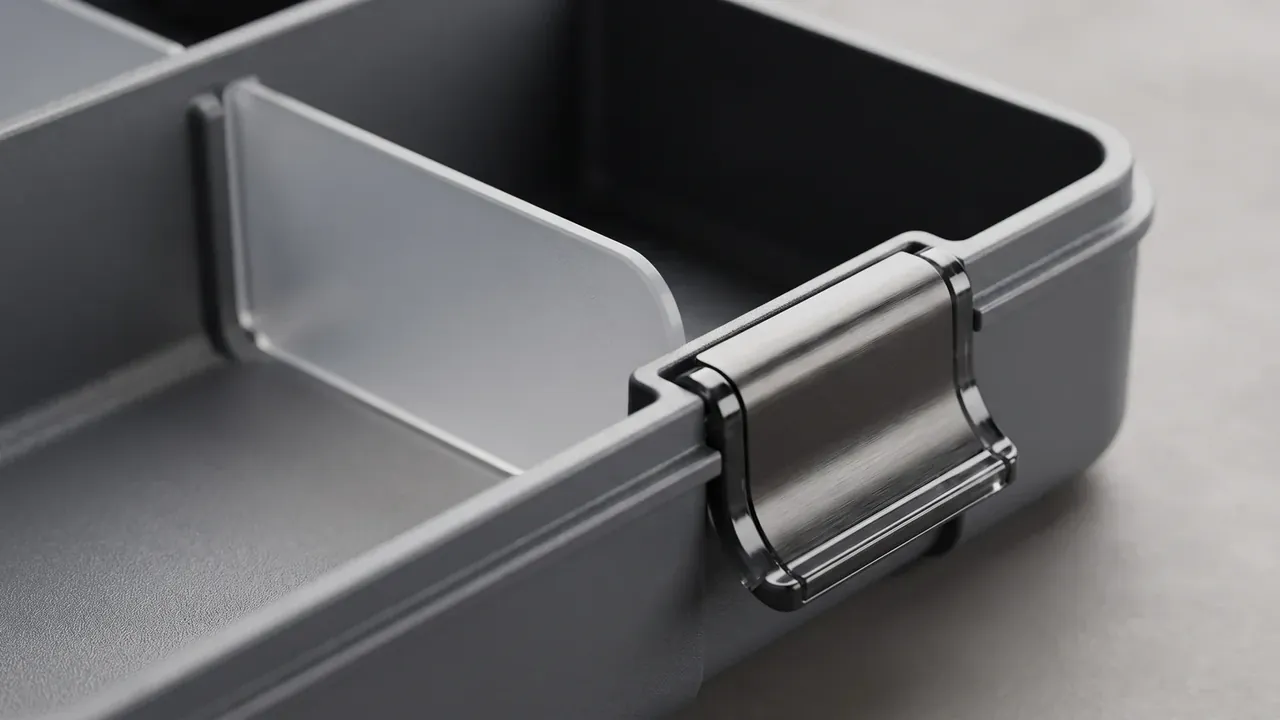
Blue carries the load. Almost nothing edible is naturally blue, so a 1 mm chip reads at 500 mm against flour or pale sauce. Masterbatch must be food-contact grade under 21 CFR 178.3297.
Detectable compound is the second route: 1.5% ferrite in PP lets a 2.6 kg body trip a conveyor detector at Fe 1.5 mm, non-ferrous 2.0 mm and 316 stainless 2.5 mm, at the cost of a darker grey and 8% impact strength.
Zoning then fixes the palette; the failures are fading and cross-zone borrowing:
| Zone | Colour | Marking | Re-check |
|---|---|---|---|
| Raw intake | White | Black on white, prefix W | ΔE every quarter |
| Cooked area | Blue | White on blue, prefix B | ΔE every quarter |
| Allergen area | Yellow | Black on yellow, prefix Y | Legibility monthly |
| Waste and rejects | Red | White on red, hatched band | Integrity monthly |
5. Inspection intervals and the retirement line
Five items cover a shift check: cracks, soil in corners, latch effort, gasket compression and marking legibility.
Frequency follows risk: visual every shift, 2 bodies a week on the profilometer, and 500 open-close cycles a month watching latch retention slide from 45 N toward 30 N.
Retirement needs hard numbers. A crack over 10 mm, rim distortion over 3 mm, Ra above 1.2 µm or ΔE above 5 each retire the body, and at 18 months the batch is re-checked even when every unit looks sound.
Give every food plant tool case a 6-digit code with its wash cycles and verdict, so the auditor reads history instead of guessing.
Conclusion
Compliance for a food plant tool case is a chain rather than a certificate: a grade inside 21 CFR 177.1520 and (EU) 10/2011, an article tested at 70 °C for 2 hours and 40 °C for 10 days, walls at Ra 0.8 µm, corners at R3, a 3° floor and 100 mm feet, plus a colour system that never crosses zones.
This article discusses only the container (case body) side of specifications and design intent, and does not cover any handling, loading or use of the contents.
Related Reading
- How food-contact compliance is judged
- Resin grades and additive limits for food-grade cases
- Wash interfaces on a processing line
Related Products
- 8 Series — Gun Cases; Military Equipment Cases; Camera Equipment Cases; Drone Cases; Watch Cases; Knife Cases; First Aid Cases; Electronics Equipment Cases
- WL8-2812 PP Gun Case — model WL8-2812
- All protective cases and toolboxes: 7 series, 158 models