

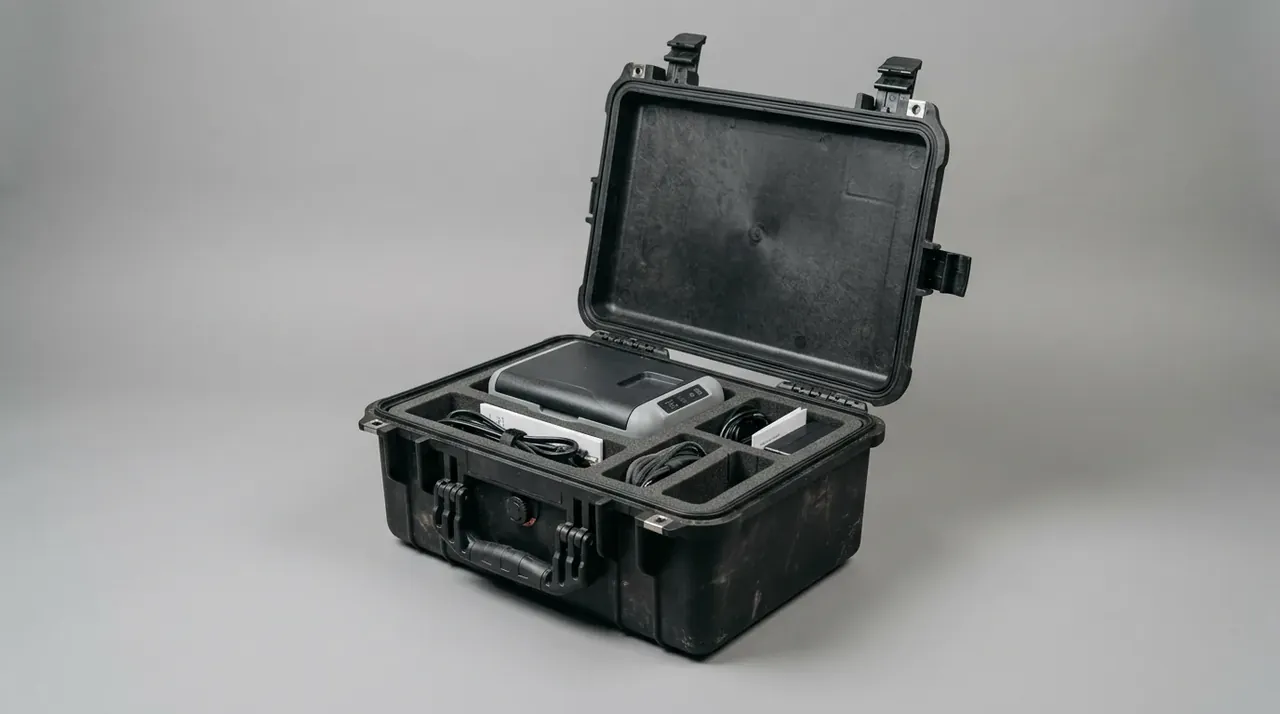
Quick answer: Case vehicle securing needs four corner points in crossing diagonals, because two parallel straps let an 80 kg case tip instead of slide.
Table of contents
- Why Case Vehicle Securing Needs Four Points
- Turning 0.8 g into a Strap Rating
- Matching Floor Rings to Strap Capacity
- Cross Angles and the 20 mm Gap
- What Two Points Do Instead
- FAQ
1. Why Case Vehicle Securing Needs Four Points
Four anchors belong at the corners of the base, not at the midpoints of the edges. A 600 mm × 400 mm × 300 mm case weighing 80 kg has a 721 mm base diagonal, and only a corner-to-corner run loads both axes at once. Routed through edge midpoints the straps run parallel, and one axis is left to friction.
That parallel pair acts like a band around the case. Lateral motion is blocked and the case is pressed down, but fore-aft restraint drops to friction alone: 0.3 against 80 kg gives 235 N, one third of the 628 N that 0.8 g produces.
Tipping arrives before sliding. A case rolls about the line joining its anchors once horizontal acceleration passes g·b/(2h), with b as resisting width and h as centre-of-gravity height. A 400 mm base with a 300 mm centre of gravity gives 6.5 m/s², or 0.67 g. Shrink b toward zero and 0.5 g is enough.
| Layout | Points | Fore-aft | Lateral | Combined | Width |
|---|---|---|---|---|---|
| Cross | 4 | 157 N | 98 N | 185 N | 400 mm |
| Parallel | 2 | 314 N | 196 N | 371 N | near zero |
2. Turning 0.8 g into a Strap Rating
The envelope is quoted in three directions: 0.8 g forward, 0.5 g lateral, 1.5 g vertical shock. An 80 kg case turns those into 628 N, 392 N and 1177 N, and forward load counts both ways.
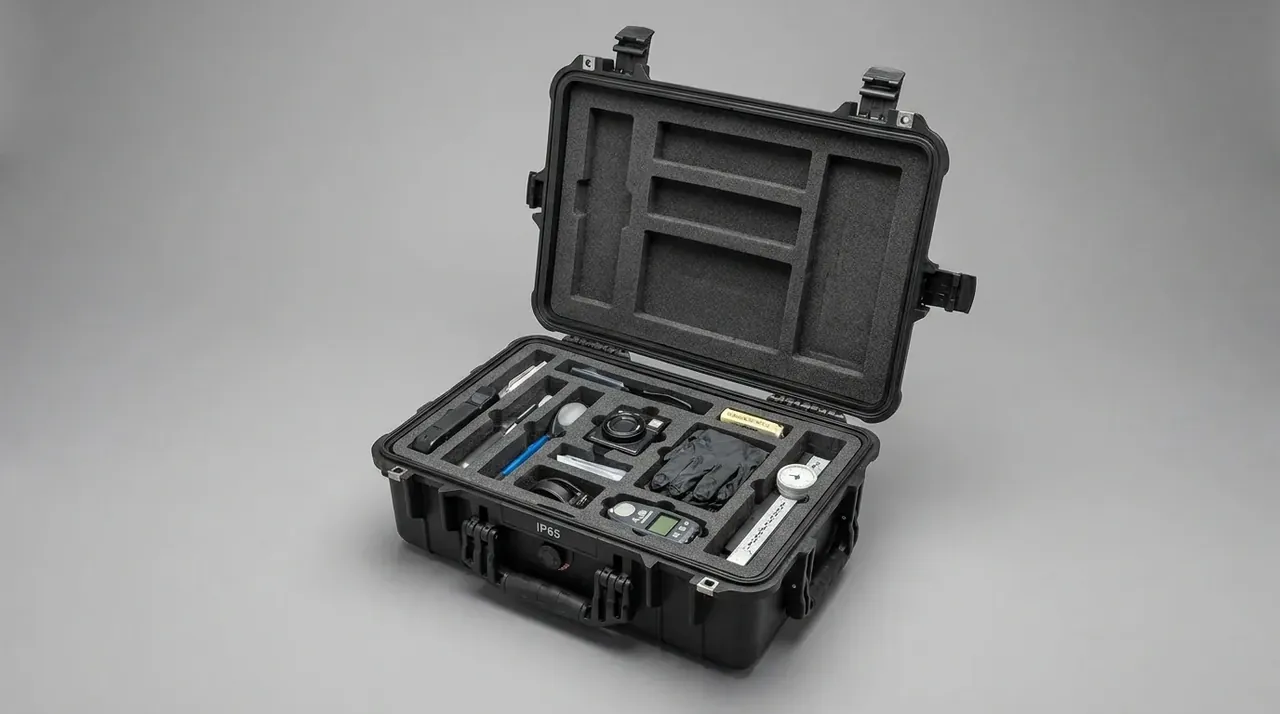
Only the per-point vector sum tells you which strap to buy. Four crossing points split the forward load into 157 N each and the lateral load into 98 N each; the two are perpendicular, giving 185 N. Apply a dynamic factor of 2 and specify 370 N.
A 25 mm polyester strap breaks at 1500 daN, so its working load is 500 daN, or 5000 N. Against 370 N the factor reads 13. Slack eats most of it: 10 mm lets the case reach 0.4 m/s before the webbing engages, pushing the peak past four times the static figure.
Tensioning matters more than the datasheet. Ratchet until the webbing stops sinking into the foam, then two clicks more, and flick each strap: a dull note means travel remains, a sharp note means it is loaded.
| Item | Spec | Rating | Case per point | Four-point |
|---|---|---|---|---|
| Strap | 25 mm, 1500 daN | 500 daN | 637 kg | 2548 kg |
| Ring | M8 bolt | 500 kg | 500 kg | 2000 kg |
| System | Four-point | weaker link | 500 kg | 2000 kg |
| Recommended | 50% margin | — | 250 kg | 1000 kg |
Those totals are a weakest-link figure, not a sum: the floor ring sets the capacity, not the heaviest strap.
3. Matching Floor Rings to Strap Capacity
A 500 kg ring is a single-point rating, and four rings never add up to a 2000 kg distributed capacity. Sharing is uneven: with the centre of gravity toward one corner, the loaded point takes about 60% and the other three roughly 13% each.
Fixing torque is 8 N·m, not whatever the handle happens to stop at. An M8 bolt in a 3 mm floor needs a 40 mm × 40 mm × 3 mm backing plate; driven into 1.5 mm sheet, the panel dishes first.
Torque scatter is larger than crews expect: ten pulls by one hand measured between 5 N·m and 11 N·m. Above 11 N·m an 8.8 bolt is pulled toward yield; below 5 N·m the fixing walks loose.
Three conditions condemn a ring: an eye opened past 2 mm, a crack at the weld or bend, corrosion over 10% of the surface. Any one means replacement, not repair.
4. Cross Angles and the 20 mm Gap
Keep the strap at 30° to 45° to the base. At 45° the horizontal component is 0.707, at 30° it is 0.866, and the crossing pair then meets at roughly 60° to 90° in plan. Past 60° the component falls to 0.5 and half the tension presses down.
| Angle | Horizontal | Hold at 500 N | Verdict |
|---|---|---|---|
| 30° | 0.866 | 433 N | tight |
| 45° | 0.707 | 354 N | general |
| 60° | 0.5 | 250 N | press only |
| 75° | 0.259 | 130 N | reject |
The four runs must be paired: two forward, two aft, each end split between a case corner and a floor ring. Pull everything one way and the case travels into the bulkhead, the straps acting as a limit stop.
Leave 20 mm between case and wall. Under 20 mm the shell rubs the panel at the first stop, losing paint first and material next. Over 20 mm the case runs back and forth between start and stop, and 20 mm of gap becomes a 60 mm run within two cycles. Fill it with a 20 mm block cut to just touch.
Add corner protectors where webbing crosses an edge. A strap bent over an R3 corner contacts under 8 mm of surface and chafes through under vibration, dropping 1500 daN to below 900 daN.
5. What Two Points Do Instead
Sliding has a threshold you can feel. At 0.3 friction the case holds to 0.3 g, then travels at constant speed, visibly and audibly. Tipping gives no warning: with two-point anchoring the resisting width is near zero, so 0.2 g starts the rotation and the lid reaches the floor 0.3 s later.
A 40 km/h stop produces about 0.9 g, past the 0.8 g design value. The forward pair takes the load, the aft pair was slack, and the case rotates 90° about the forward pair and lands on its lid. The catch absorbs that impact on a shear section of roughly 2 mm × 8 mm.
The damage stays hidden. After the lid lands the gasket takes a permanent set, the sealing line no longer compresses evenly, and the water resistance that left the factory is gone. The case still opens and closes, which is why it returns to service.
The field test takes a minute: push each top corner and none should move more than 5 mm, with all four straps sounding alike when flicked.
Conclusion
Judge case vehicle securing against six numbers rather than against experience. Position: four anchors at the base corners, straps crossing in an X, never at edge midpoints. Angle: 30° to 45°, and re-route anything past 60°. Torque: 8 N·m on M8 fixings with a 40 mm backing plate behind each ring. Condition: no eye open past 2 mm, no crack, no corrosion over 10%. Gap: 20 mm to the wall, filled by a block that only removes travel. Proof: push all four corners, confirm under 5 mm of movement and four matching strap notes. A layout that passes all six carries an 80 kg case through 0.8 g without it becoming a projectile; one that fails a line has tied two points and left two as decoration.
This article discusses container-side specifications and design implications only, and does not cover any handling, loading or use of the contents.
Related Reading
- Vehicle repair case layout and internal fittings
- Portable transport box shell and handle design
- Vibration and drop items in transport certification
- Drone transport case shell shape and castors
Related Products
- 8 Series — Gun Cases; Military Equipment Cases; Camera Equipment Cases; Drone Cases; Watch Cases; Knife Cases; First Aid Cases; Electronics Equipment Cases
- WL8-2812 PP Gun Case — model WL8-2812
- All protective cases and toolboxes: 7 series, 158 models