

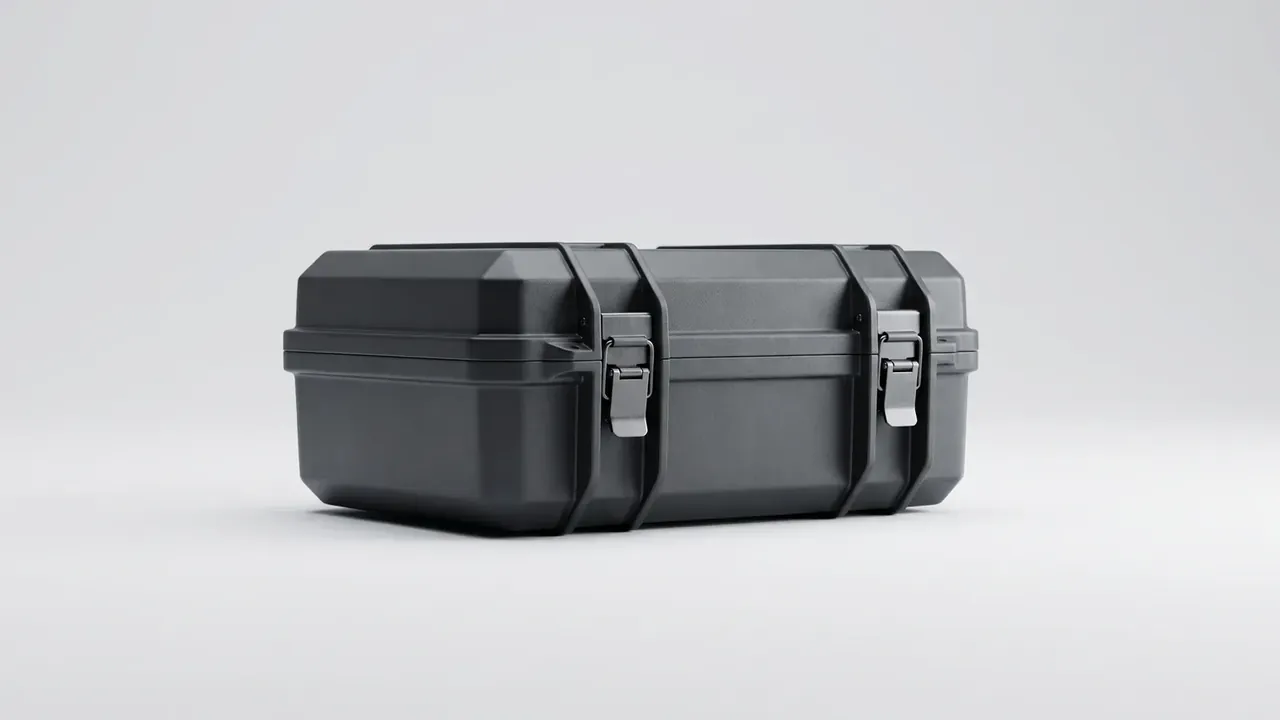
Quick answer: A gear case is a rigid case that carries load through its own shell, is lined for a matched set of equipment, and locks so the set moves as one unit. What separates it from a toolbox is load path and liner logic; what separates it from an equipment case is the unit of configuration, one item per slot rather than one category per compartment. Three checks settle it: a self-supporting shell, a per-item liner, and handling rated for loaded weight.
Table of contents
- Definition and where the name comes from
- Gear case versus toolbox
- Gear case versus equipment case
- Structural features
- Where a gear case fits
- FAQ
1. Definition and where the name comes from

A gear case carries load through its own shell, holds a liner laid out for a matched set, and locks so the set moves as one piece. The name comes from use: a set is assembled for a job, and the case stands for that set.
The corner shows the logic: a pillar turns bending moment into compression, two ribs limit panel deflection, and an outward rim spreads a drop across the perimeter. A soft bag absorbs impact by padding; a hard shell by geometry.
- Self-supporting shell: walls and base take load without contents holding shape.
- Lockable closure: latches clamp, padlock ears give a seal point.
- Handling matched to gross mass, not empty weight.
Remove any one of the three and it becomes a storage box or temporary packaging.
2. Gear case versus toolbox
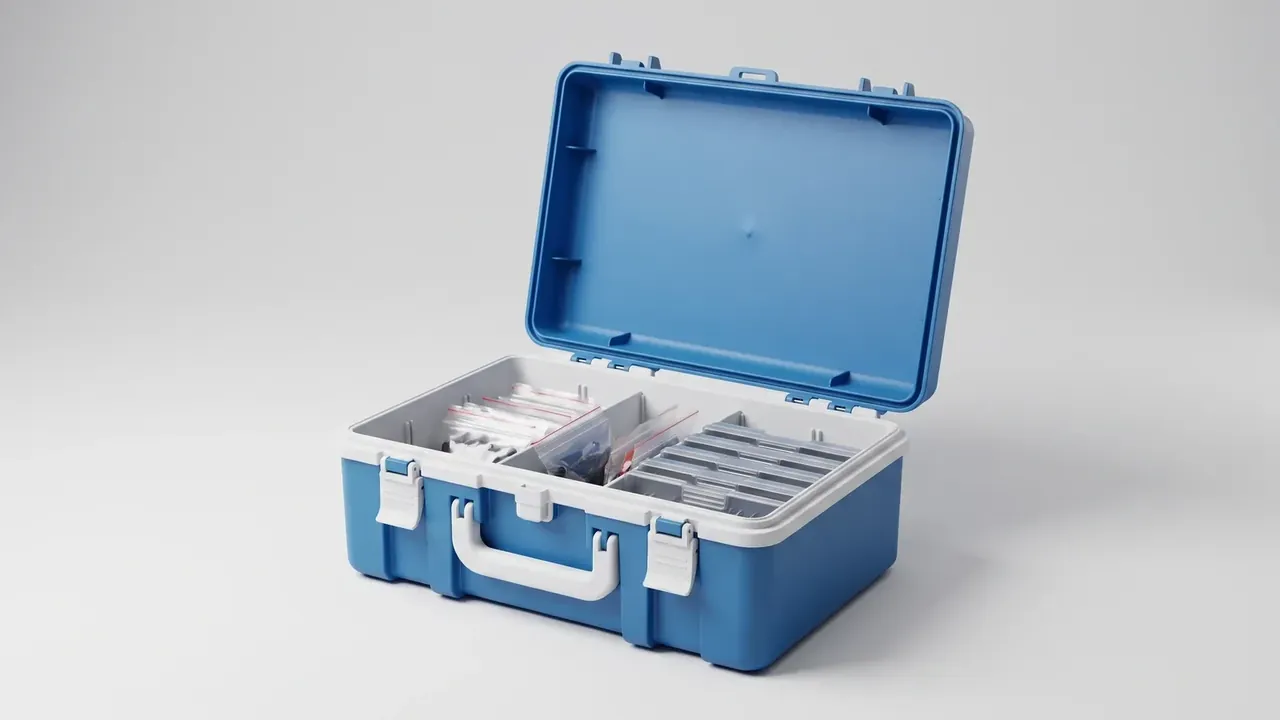
The difference lies in load path, liner logic and opening geometry, not silhouette. A toolbox is laid out around tool mass; a gear case around one item's shape and attitude.
| Criterion | Toolbox | Gear case |
|---|---|---|
| Load path | Base plate, handle | Shell frame, walls |
| Liner | Trays by category | Slots by outline |
| Opening | Shallow, one latch | Deep, two latches |
The blue case uses a toolbox-style liner: a white insert divided into compartments of clear parts trays, plain lid, no foam. Categories are separated but items are not located; the same shell would accept a foam block cut per item.
Depth sets latch count: a deep lid lifts at the far rim under one latch, so two latches are used.
3. Gear case versus equipment case
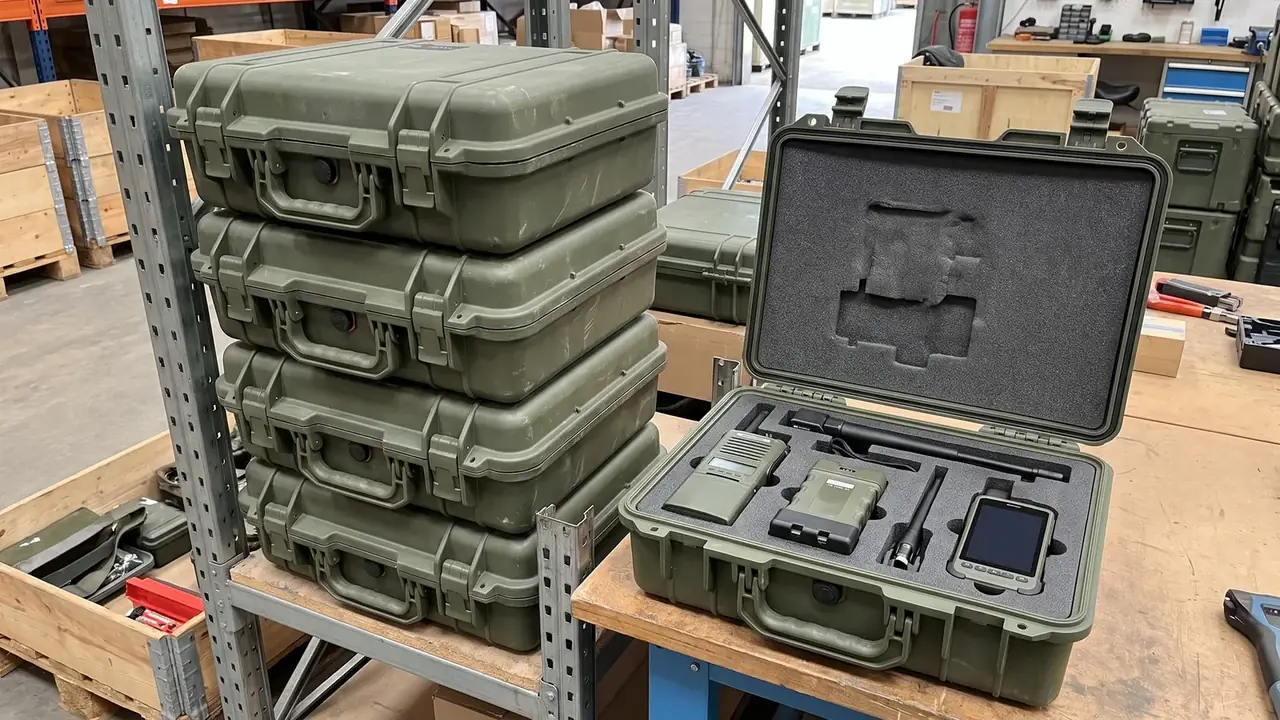
A gear case is configured one item per unit, an equipment case one category per unit. That choice drives counting method, replacement cost and liner life.
The open case holds foam cut for a handset, an antenna, a display terminal and a long rod, so a missing piece shows at once. At left, four closed cases sit squarely with latches outward, as a set travels.
- Counting: empty pockets read faster than units counted one by one.
- Replacement: one pocket against one compartment.
- Liner life: a slot is tied to one outline.
4. Structural features
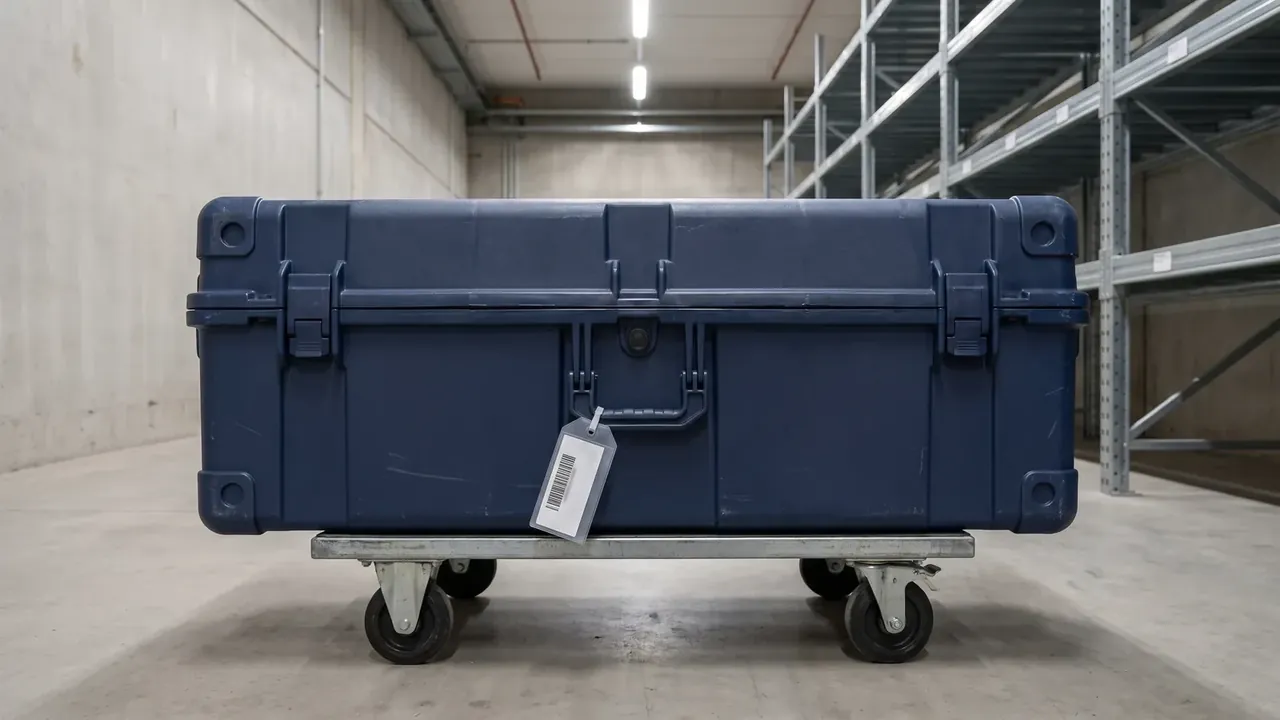
Four groups of parts constrain one another.
- Shell: PP, PC or rotomolded polyethylene; walls and ribs set impact resistance, rim overlap sets sealing.
- Latches: over-centre draw latches counted by length and depth, padlock ears for a seal point.
- Liner: foam, moulded plastic or dividers, thickness shared between cushioning and usable depth.
- Handling: handles, wheels, lifting points sized from gross weight.
The navy case lies across a four-wheel dolly, barcode label on its handle. Handling need not be attached to the body: a flat base seating squarely on a cart face is part of the same decision.
Thicker walls raise self-weight and force a stronger handle; extra latches lengthen every opening.
5. Where a gear case fits
It suits loads with a fixed attitude travelling as a complete set, not loose parts handled daily.
| Situation | Verdict | Reason |
|---|---|---|
| Few high-value items, attitude fixed | Fits | Slots limit movement |
| Loose small parts, constant access | Does not fit | Trays work faster |
| One category in bulk, counted | Equipment case | Cheaper to build |
| Long manual carry | Care needed | High self-weight |
- Clear boundary around the set
- Any item needing a fixed attitude
- Daily openings under ten
- Moved by hand, wheel or lifting gear
The first line decides membership; the rest decide depth.
Conclusion
Ask three questions in order: does the shell carry load alone, is the liner laid out per item, and is handling sized against gross weight? Only when all three answer yes do grade and impact class matter; if any is no, a toolbox or an equipment case is cheaper to specify.
This article covers container-side specifications and design implications only.
Related Reading
- Gear case versus alternatives: rigid, soft and modular
- Equipment case selection: load, liner and handling
- Rotomolded Cases: Rotational-Moulded Shell Structure & Pro…
- Tactical hard case selection guide
Related Products
- 8 Series — Gun Cases; Military Equipment Cases; Camera Equipment Cases; Drone Cases; Watch Cases; Knife Cases; First Aid Cases; Electronics Equipment Cases
- WL8-2812 PP Gun Case — model WL8-2812
- All protective cases and toolboxes: 7 series, 158 models