

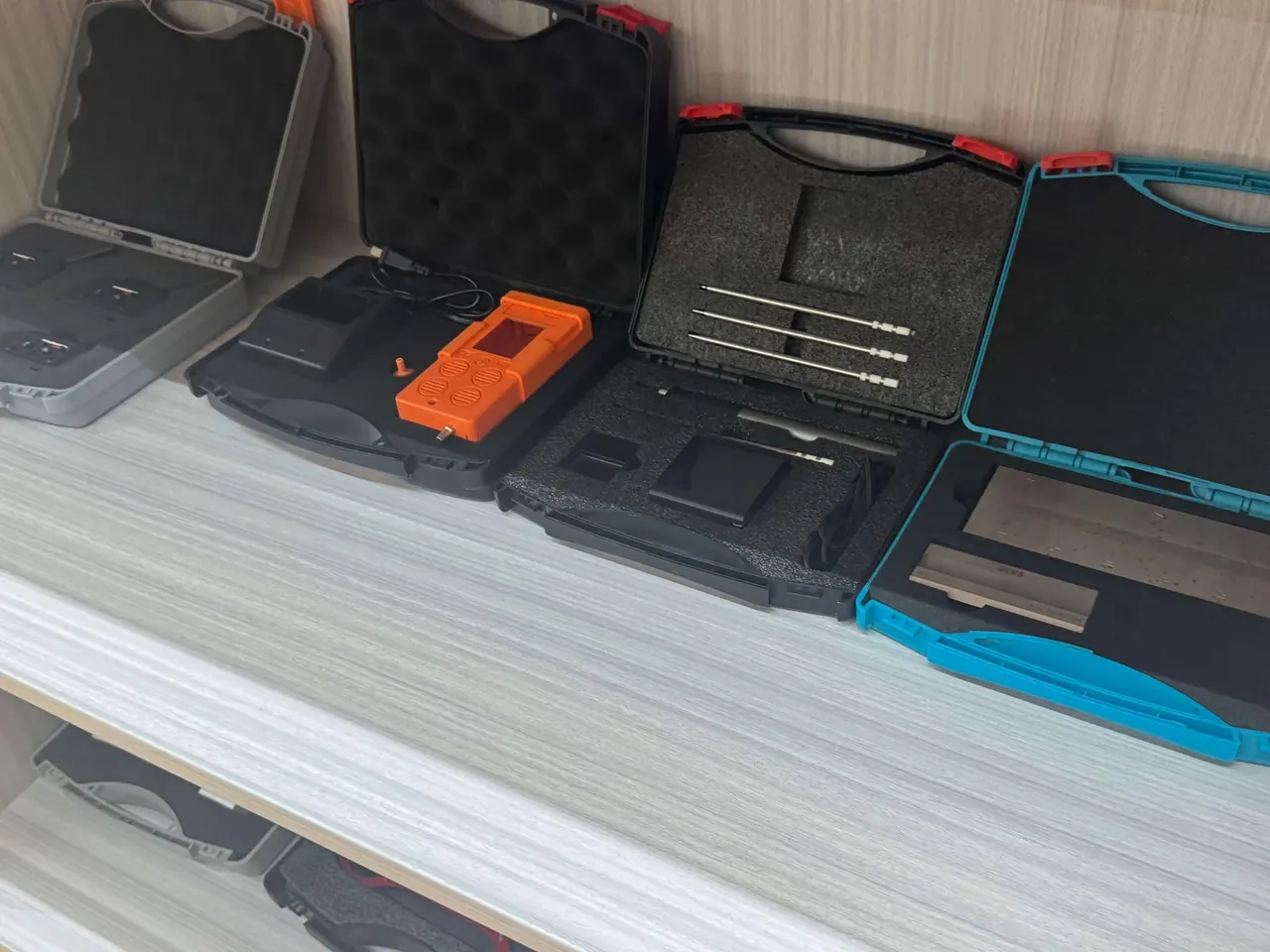
Quick answer: A grenade storage container lives closed and stacked, so five details decide whether it still seals after five years: lid-to-rim fit, divider layout, moisture path, stacking load path through the feet, and marking that survives cleaning.
Table of contents
- Lid and Rim Fit
- Dividers and Shelf Layout
- Sealing and Moisture Path
- Stacking Load and Feet
- Marking and Batch Traceability
- FAQ
1. Lid and Rim Fit
A transport case rim resists pull; a grenade storage container rim resists compression. Closed and stacked for years, it sees steady clamp load rather than impact, and inward creep lets the gasket lose uniform compression.
The usual build leaves a solid 8 mm by 16 mm shoulder inside the rim, with a 6 mm wide, 9 mm deep groove for an 11 mm hollow gasket. The lid edge carries a 15 degree lead-in so it centres before compressing the gasket instead of shearing a notch into it.
| Feature | Size | Function |
|---|---|---|
| Rim shoulder | 8 by 16 mm, solid | Carries clamp load, resists creep |
| Gasket groove | 6 mm wide, 9 mm deep | Limits gasket travel |
| Lid lead-in | 15 degrees | Centres lid, protects gasket |
A hollow shoulder shows up three months later as 0.5 mm of creep, uneven gasket contact and humidity rising from 40 to 65 percent RH.
2. Dividers and Shelf Layout
Most grenade storage container bodies open from the top into a grid. Dividers run 6 mm thick on a 20 mm pitch. Thicker is not better: across 180 mm a 6 mm polypropylene divider deflects 0.8 mm, enough for one cell load, while 8 mm adds 0.4 kg and buys little.
| Layout | Divider | Cell | Best for |
|---|---|---|---|
| Fixed grid | 6 mm, moulded in | 120 by 90 by 180 mm | Uniform items |
| Slotted panels | 6 mm inserts, 20 mm pitch | Adjustable | Mixed sizes |
| Pull-out trays | 4 mm wall, 70 mm layer | Stacked layers | Frequent access |
A fixed grid sends load straight to the base but needs 1.5 degrees of draft. Slotted panels are flexible, yet the slot root concentrates stress and cracks when the fillet is under 1 mm. Cabinet bodies use shelves on 8 mm ribs at 60 mm pitch.
3. Sealing and Moisture Path
Gasket compression decides service life. An 11 mm hollow gasket squeezed to 7.7 mm sits at 30 percent, where rebound reserve peaks. Past 60 percent it takes a permanent set within two years.
Sealing alone does not hold humidity down. A grenade storage container also needs a 120 by 80 by 30 mm desiccant pocket in the lid under a breathable membrane, set clear of the gasket band so closing cannot tear the film.
Thermal swing is the third factor. Across a 40 K cycle the pressure difference reaches 8 kPa, and the better the seal the harder the lid opens. A one-way vent set at 8 kPa balances pressure without admitting moist air.
4. Stacking Load and Feet
Stacking is a load path, not a pile. A grenade storage container is designed five high, bottom unit under 480 kg, height change within 3 mm after 24 hours.
| Layers | Load per unit | Allowed deflection |
|---|---|---|
| 3 | 240 kg | 1.5 mm |
| 4 | 360 kg | 2.2 mm |
| 5 | 480 kg | 3.0 mm |
Feet stand 45 mm high, bear at the corners and carry 2 mm of draft. Under 30 mm, forklift tines cannot enter and every move becomes a manual lift. Stacking posts must line up with dividers; a divider spanning between posts bows the lid and leaves stress marks by the third restack.
5. Marking and Batch Traceability
Marking on a grenade storage container must survive five years, which rules out a paper label. Three layers work together: colour moulded into the resin, a 100 by 60 mm recess 0.8 mm deep so a label sits flush, and a 12 by 12 mm QR block cut into the mould.
Silk screen suits added text, judged by three tape passes with no ink lift. Storerooms are washed with mild alkali, so two-component ink is required.
A batch code carries year and month, cavity number, shift and resin lot. Cavity number matters most: wall thickness across one mould varies by up to 0.3 mm, so a defect is traced to a cavity.
Conclusion
The quality of a grenade storage container hides in five details: a solid rim shoulder, divider thickness matched to span, gasket compression near 30 percent, stacking posts aligned with dividers, and a moulded batch code. Get all five right and the box still seals and traces after five years. Check any drawing against these five points before discussing process detail on a grenade storage container.
This article discusses only the container (case body) side of specifications and design intent, and does not cover any handling, loading or use of the contents.
Related Reading
- Where a grenade storage container is used
- Routine checks and replacement limits
- Comparing material routes for the same box
- Inspection items and acceptance calls
Related Products
- 8 Series — Gun Cases; Military Equipment Cases; Camera Equipment Cases; Drone Cases; Watch Cases; Knife Cases; First Aid Cases; Electronics Equipment Cases
- WL8-2812 PP Gun Case — model WL8-2812
- All protective cases and toolboxes: 7 series, 158 models