

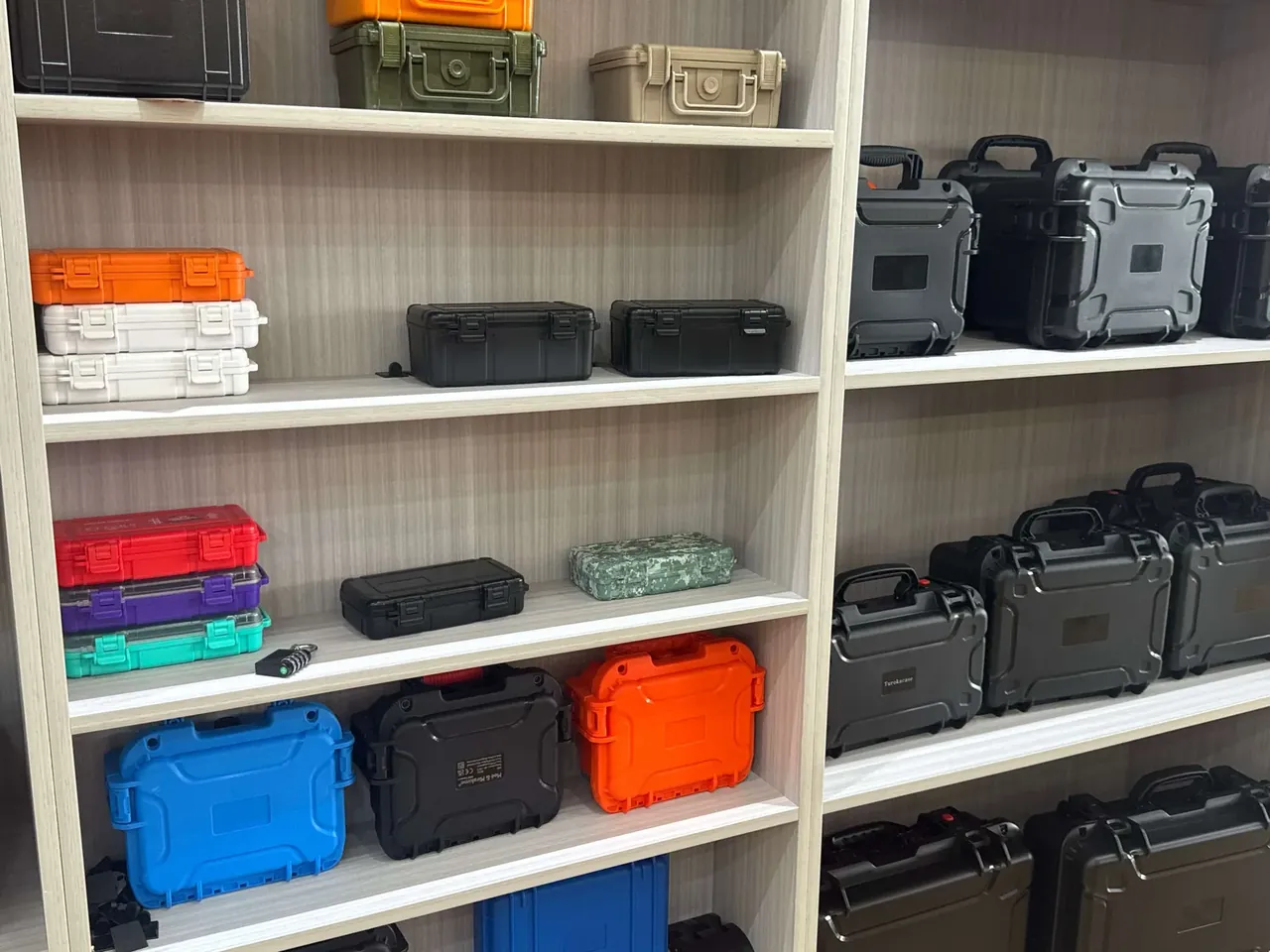
Quick answer: A grenade storage container quotation splits into six blocks: resin, moulding, hardware, insert, assembly and tooling. The minimum order follows tooling ownership, the lead time follows the critical path. Put all three on one inquiry sheet before arguing about unit price.
Table of contents
- What the quotation is made of
- MOQ, tooling and unit price
- How lead time is built
- Samples and first-article approval
- Price negotiations and acceptance
- FAQ
1. What the quotation is made of
A grenade storage container quote showing one lump sum hides where the money goes. Ask for six blocks, each with a calculation base and a checkable document; the gap between three factories on one drawing usually sits in moulding and hardware, not resin.
| Cost block | Basis | Share |
|---|---|---|
| Resin | Shot weight plus regrind | 34%–40% |
| Moulding | Hourly rate times cycle | 18%–24% |
| Hardware | Latches and hinges | 10%–14% |
| Insert | Foam volume times density | 8%–11% |
| Assembly | Labour plus cartons | 9%–13% |
| Tooling | Per batch | Varies |
A 620 mm × 440 mm × 210 mm body with a 3.2 mm wall weighs 3.4 kg, regrind booked at 6%. Moulding runs on a 1600-tonne machine at triple the hourly rate of a 400-tonne unit with no matching gain in cycle, which explains the small-batch premium. Inserts vary widest: 45 kg/m³ moulded foam against 25 kg/m³ flat foam differs by half again.
2. MOQ, tooling and unit price
Three variables pull against each other: tool ownership, how the tool is paid for, how low the cycle goes. An existing tool with a colour change allows 300 pieces; a new one pushes the minimum past 1,000, or its cost never leaves the unit price.
A 620 mm class grenade storage container tool is quoted at RMB 68,000 to RMB 160,000 with a 300,000 shot life. Spread over 500 pieces it adds RMB 136 each, which the market will not carry.
| Batch | Tooling | Price vs base | Lead time |
|---|---|---|---|
| 300 pcs | Existing, colour change | +12% | 20–25 days |
| 500 pcs | Existing, colour and logo | Base | 15–18 days |
| 1,000 pcs | Existing, one hardware change | −8% | 20–22 days |
| 3,000 pcs | New tool, amortised | −14% | 45–60 days |
3. How lead time is built
Lead time counts backwards from the order date. The critical path runs drawing release, tool change or build, trial shot, first-article approval, production and packing. Only production answers to pressure.
On 1,000 grenade storage containers with an existing tool: 3 days for drawing approval, 2 for the colour trial, 5 for first article, 8 for production, 2 for packing, about 20 days. A new tool adds 30 to 35 days for the trial shot and 7 for rework. Freight is forgotten: a box to a European base port books 28 to 32 days, and peak season slides the slot by 10 days.
4. Samples and first-article approval
Sampling fails most often because quoted parameters and the arriving article disagree. Copy the six parameters into the first-article sheet so every block has a physical check beside it.
The grenade storage container sheet carries 12 items: external and internal dimensions, wall thickness, latch force, hinge stiffness, gasket compression, valve pressure, foam density, colour, plating and weight. Hardware is referenced to 48 hours of neutral salt spray. Five working days covers dimensions, insert fit, latch cycles, drop and stack, then signature.
5. Price negotiations and acceptance
Leverage sits in the clauses that decide who carries risk. Moving from full advance to 30% deposit with 70% against a bill of lading copy costs 1.5% to 2.5% and buys real protection.
| Clause | Wording | Common gap |
|---|---|---|
| Validity | 90 days, 5% cap | Open to market |
| Tool ownership | Buyer owns it once paid | Later uplift |
| Tolerance | ±5%, over-shipment at 80% | No shortfall cover |
| Acceptance | AQL 2.5, key sizes 100% | Sample only |
Acceptance of a grenade storage container against a sample carries little weight in a dispute. Put key dimensions, wall thickness, weight and latch force in a table, name the gauges and sampling ratio, and the clause becomes enforceable.
Conclusion
Price, MOQ and lead time belong on one sheet: a quotation becomes comparable only once split into six blocks, the minimum follows tooling ownership rather than goodwill, and the lead time is counted back along the critical path. The savings rarely come from haggling; they come from writing down tool ownership and acceptance method first. Run one inquiry this way and the landed cost of a grenade storage container typically lands 10% below a price-only comparison.
This article discusses only the container (case body) side of specifications and design intent, and does not cover any handling, loading or use of the contents.
Related Reading
- How grenade storage container configurations differ by scenario
- Inspection items and replacement lines for grenade storage containers
- Dimensions and compartment layout for grenade transport cases
- Material and strength comparison for grenade transport case bodies
Related Products
- 8 Series — Gun Cases; Military Equipment Cases; Camera Equipment Cases; Drone Cases; Watch Cases; Knife Cases; First Aid Cases; Electronics Equipment Cases
- WL8-2812 PP Gun Case — model WL8-2812
- All protective cases and toolboxes: 7 series, 158 models