

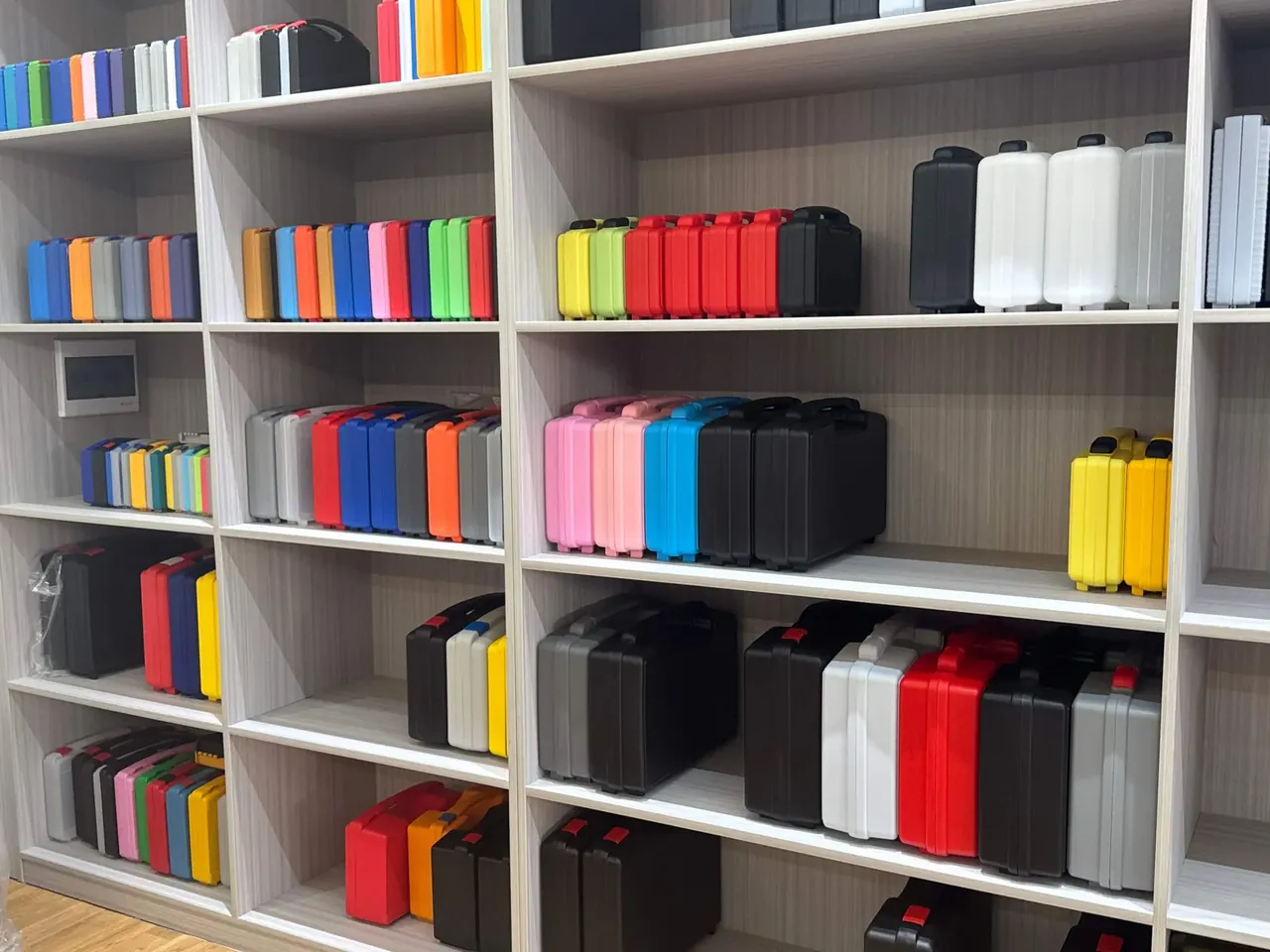
Quick answer: A Grenade Storage Container specification turns use conditions into measurable numbers: cavity and compartment size, wall and rib pitch, mass and stack load, tolerance and tare weight. Each line needs a value, a gauge and a test method.
Table of contents
- Sizing a Grenade Storage Container from Use Conditions
- Cavity and Compartment Dimensions
- Wall Thickness and Rib Layout
- Load Ratings and Stacking
- Tolerances and Tare Weight on the Drawing
- FAQ
1. Sizing a Grenade Storage Container from Use Conditions
A specification starts with four questions, not a drawing: units per box, who carries it, stack height, storage location. A Grenade Storage Container drawing should open with a condition table, or the tool gets cut twice.
Six units laid flat give a compartment of 116 x 116 x 230 mm. Two-person handling caps full mass at 38 kg, six-high storage puts 190 kg on the bottom box, and a winter depot at minus 32 C sets drop height at 1.0 m.
| Use condition | Item | Value | How it is checked |
|---|---|---|---|
| Six units, laid flat | Compartment size | 116 x 116 x 230 mm | Dummy fit, feeler gauge |
| Six-high stacking | Base compression | 190 kg, 380 kg at 2.0x | Static press, 12 hours |
| Winter depot | Cold drop | minus 32 C, 1.0 m | 4-hour soak, six faces |
Rank the list once filled: load, sealing and latch retention are firm; colour and handle shape are open.
2. Cavity and Compartment Dimensions
State three clear dimensions for the Grenade Storage Container cavity: 480 x 360 x 250 mm, split 2 by 3 into six compartments with 5 mm dividers moulded in the body tool. Lid depth of 32 mm leaves 218 mm usable height.
Derive compartment size from resting position: 8 mm each side of the diameter when laid flat, 12 mm added to length when upright. Equal splits look tidy but foul the lever.
Allow 1.8 percent shrinkage, so a 480 mm edge is cut 8.6 mm oversize and lands on nominal at room temperature. Datum the outer base as A, the rim as B.
3. Wall Thickness and Rib Layout
Thickness follows location: 3.5 mm side wall, 5.0 mm base, 3.2 mm lid. The base takes stacking and drop loads, so it is heaviest. One uniform wall moulds easier but adds mass and cooling time.
A Grenade Storage Container uses rib pitch 110 mm, height 7 mm, root radius R2.5. Vertical ribs resist side squeeze, horizontal ribs stop panel bulge, and ribs carried into the dividers add stiffness without resin.
| Zone | Thickness | Rib pitch | Function |
|---|---|---|---|
| Side wall | 3.5 mm | 110 mm | Vertical ribs against squeeze |
| Base | 5.0 mm | 95 mm | Egg-crate grid, four pads |
| Lid | 3.2 mm | 125 mm | Central rib against dishing |
Moulding data belongs in the notes: 1.0 degree draft, 42 C tool temperature, 185 second cycle, 1,300 tonne press. Without them the trial depends on the operator.
4. Load Ratings and Stacking
A full box weighs 38 kg, so six high puts 190 kg of boxes on the bottom unit. Test at 2.0x, 380 kg for 12 hours, then measure set one hour after release and hold it under 1.0 mm. Too low a factor lets a thin base pass; too high buys structure nobody needs.
Base geometry follows that load: egg-crate grid, four corner pads 10 mm tall, 60 mm clear at the fork entry. Pads steer load into the corners, so thickening the floor without ribs raises mass and barely moves deflection.
Lateral stability needs its own number: no tipping at 20 mm eccentricity, which fails more often than compression on uneven pallets. A 5 mm spigot on the lid self-centres the stack inside 3 mm. Handles are rated 600 N at a 1.2x proof load; hinges must survive 3,000 cycles uncracked.
5. Tolerances and Tare Weight on the Drawing
Tolerance every ring, not the total: cavity plus or minus 1.0 mm, divider 0.3 mm, lid depth 0.4 mm, wall 0.15 mm. That accumulates to about 1.9 mm, so clearance is set worst case.
| Item | Nominal | Tolerance | Gauge |
|---|---|---|---|
| Cavity length and width | 480 x 360 mm | 1.0 mm | Caliper, three points |
| Lid depth | 32 mm | 0.4 mm | Depth gauge |
| Wall thickness | 3.5 to 5.0 mm | 0.15 mm | Ultrasonic gauge |
| Tare weight | 4.6 kg | 3 percent | Platform scale |
Weigh the first shot off the tool. A Grenade Storage Container running 3 percent heavy adds freight cost the buyer sees as a higher quote. Write colour as a code number and give label position in coordinates, because centred on the front cannot be inspected.
Conclusion
Five items decide whether a specification holds: cavity and compartment size, wall and rib layout, mass and stack load, tolerance chain, and the gauge for each. Attach that table to the purchase contract, and the Grenade Storage Container specification becomes enforceable.
This article discusses only the container (case body) side of specifications and design intent, and does not cover any handling, loading or use of the contents.
Related Reading
- Acceptance items and verdicts for storage boxes
- How the case body is built and moulded
- Sizing rules for the transport variant
- Labels, stock-taking and inspection routine
Related Products
- 8 Series — Gun Cases; Military Equipment Cases; Camera Equipment Cases; Drone Cases; Watch Cases; Knife Cases; First Aid Cases; Electronics Equipment Cases
- WL8-2812 PP Gun Case — model WL8-2812
- All protective cases and toolboxes: 7 series, 158 models