

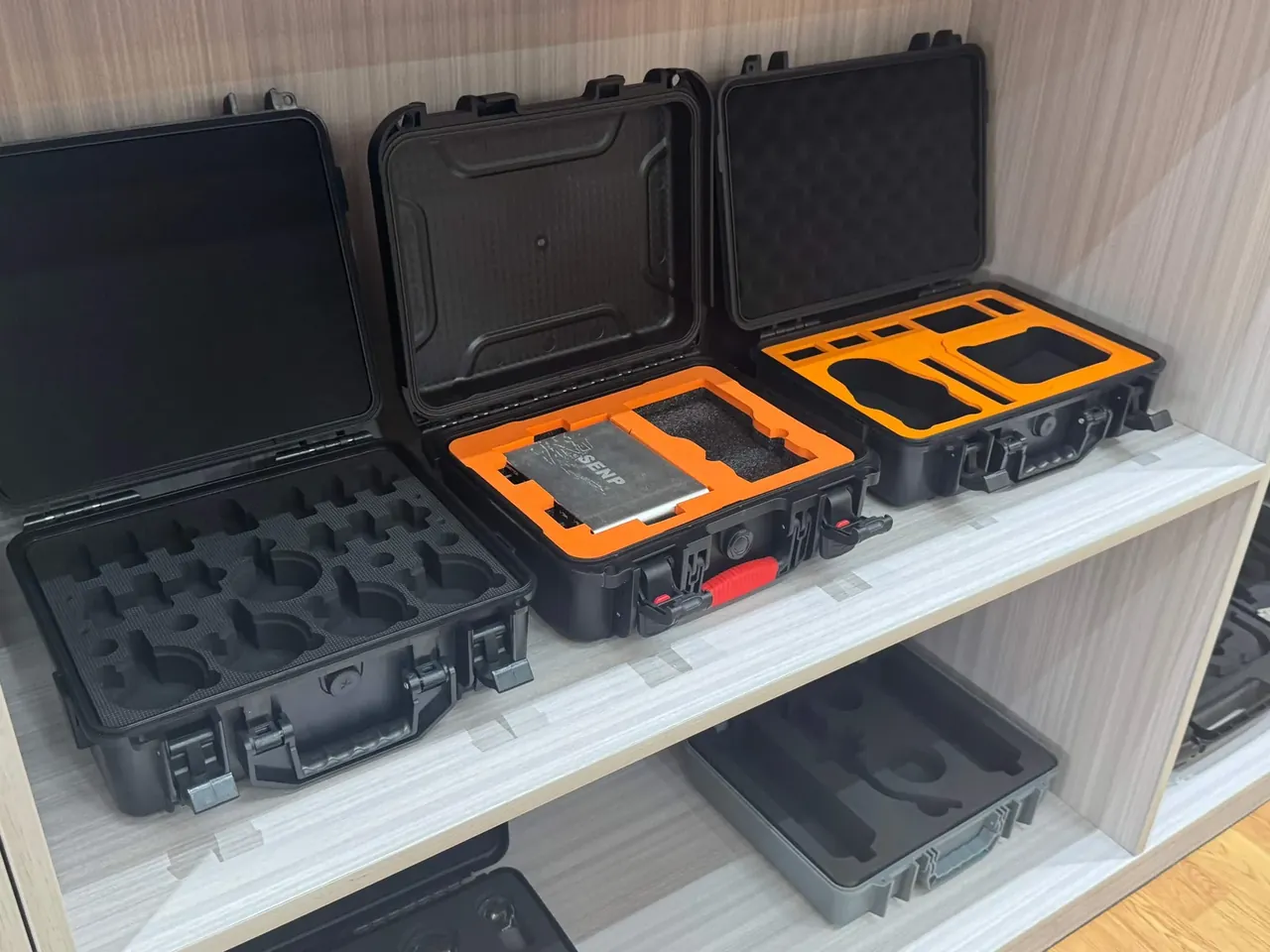
Quick answer: A grenade transport case differs from a soft bag, a folding crate, a honeycomb carton and a general tool case in four measurable ways: shape retention when empty, sealing class, stack depth and trips per body. Converted to cost per trip, cheaper options win only on one-way routes.
Table of contents
- Grenade Transport Case and Four Alternatives at a Glance
- Against a Soft Carry Bag on Shape and Compression
- Against a Folding Plastic Crate on Sealing and Stacking
- Against a One-Way Honeycomb Carton on Reuse and Damage
- Turning the Gaps into Cost per Trip
- FAQ
1. Grenade Transport Case and Four Alternatives at a Glance
Draw the boundary first. Wooden and welded steel boxes have their own comparison, so this piece covers four substitutes: soft carry bags, folding plastic crates, one-way honeycomb cartons and general injection-moulded tool cases.
The baseline is usability per trip, not purchase price. A body at three times the price still wins if it survives ten times the moves; on a route that runs twice a year, no durability spend pays back.
| Option | Sealing | Trips |
|---|---|---|
| Grenade transport case | IP67 | 260 |
| Folding crate | IP54 | 150 |
| Soft carry bag | None | 90 |
| Honeycomb carton | None | 3 |
The trip column is a service window, not a warranty figure.
2. Against a Soft Carry Bag on Shape and Compression
A soft bag wins on empty volume. At 1.6 kg it weighs 17 percent of a case body and folds flat, so the return leg costs almost nothing. The trade is stiffness near zero, and other freight will bulge it along the seams.
Once the section goes out of square, the next tier rests on cargo, not a wall. Seams fail near 3,000 flexes, while a 4.2 mm base and 6 mm rim keep a case body flat at tier six.
| Item | Grenade transport case | Soft bag |
|---|---|---|
| Empty stiffness | 4.2 mm base, 6 mm rim | Near zero |
| 30 min immersion | IP67, no ingress | Damp inner wall |
3. Against a Folding Plastic Crate on Sealing and Stacking
A folding crate sells on the empty return. Folded to 1:3.4, one truck brings back four times the empties. The fold is the weakness: four hinge channels are four water paths.
Sealing on this class stops at IP54, splash-proof rather than immersion-proof. Walls bow at 25 kg static load, tier four needs a pallet, and an 0.8 m corner drop cracks the hinge channel first.
A grenade transport case keeps a continuous rim with no moving channel, passes six tiers of load through base ribs into the corners, and is released against a 0.9 m six-face drop with function retained.
4. Against a One-Way Honeycomb Carton on Reuse and Damage
A honeycomb carton is the budget answer, with edge crush around 7.2 kN/m and burst strength of 1,400 kPa.
At 90 percent humidity the board absorbs moisture for four hours and loses roughly 40 percent of its compression strength, so the bottom carton dents inward. Reuse stops at three, and damage runs near 6.8 percent against 0.4 percent for a case body.
| Metric | Grenade transport case | Honeycomb carton |
|---|---|---|
| Compression | Structural ribs | 7.2 kN/m edge crush |
| 4 h at high humidity | Unchanged | Down about 40 percent |
| Damage rate | 0.4% | 6.8% |
5. Turning the Gaps into Cost per Trip
Price, repair hours and life only mean something together. The conversion here is purchase price plus ten years of repair, divided by total trips, in yuan per trip.
A grenade transport case costs the most up front and about 3.1 yuan per trip, with 0.4 repair hours a year. General tool cases reach 4.6 yuan, folding crates 5.2 yuan, soft bags 8.4 yuan, and the carton 11.6 yuan since it counts once.
| Option | Cost per trip | Main penalty |
|---|---|---|
| Grenade transport case | 3.1 yuan | Large when empty |
| Folding crate | 5.2 yuan | Hinge channels leak |
| Soft carry bag | 8.4 yuan | No shape retention |
| Honeycomb carton | 11.6 yuan | One trip only |
The crossover is sharp: above 100 trips a year the body wins, below 20 a crate or carton is sensible.
Conclusion
Each substitute has a route where it holds up: bags save return volume, crates save empty space, cartons save first cost. What separates them from a grenade transport case is whether the same parameters survive repeated handling, and total cost is decided by how often the grenade transport case can be used again.
This article discusses only the container (case body) side of specifications and design intent, and does not cover any handling, loading or use of the contents.
Related Reading
- Material comparison for grenade transport case bodies
- Grenade Transport Case and Storage Box: Retaining and Cush…
- Reusable crate cost against alternatives
- Common shipping case damage and fixes
Related Products
- 8 Series — Gun Cases; Military Equipment Cases; Camera Equipment Cases; Drone Cases; Watch Cases; Knife Cases; First Aid Cases; Electronics Equipment Cases
- WL8-2812 PP Gun Case — model WL8-2812
- All protective cases and toolboxes: 7 series, 158 models