

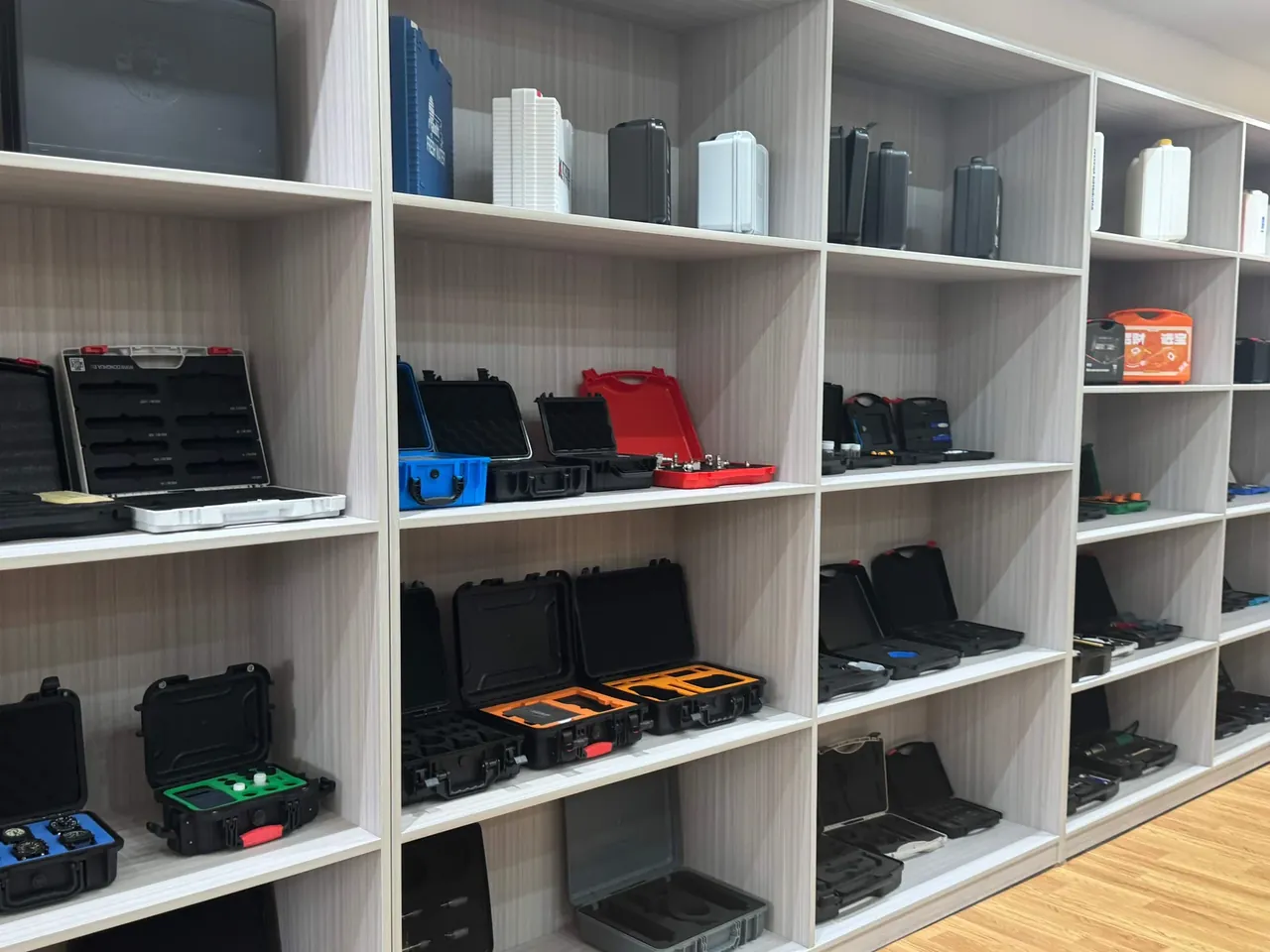
Quick answer: Choose a grenade transport case by working backwards from five criteria: load count and compartment clearance, filled weight and carrying method, footprint against pallet modules, stacking height and aisle width, and batch consistency. Each has a pass-or-fail line, and price only matters after all five pass.
Table of contents
- Criterion One: Load Count and Compartment Clearance
- Criterion Two: Filled Weight and Carrying Method
- Criterion Three: Footprint Against Pallet Modules
- Criterion Four: Stacking Height and Aisle Width
- Criterion Five: Batch Consistency and Sampling
- FAQ
1. Criterion One: Load Count and Compartment Clearance
Load count looks like the first question, but clearance decides usability. On a grenade transport case, compartment count follows the carrying unit used in the field, while the gap around each item sets both pick-up speed and rattle.
A 15 mm gap per compartment is a workable balance. Below 10 mm, gloved hands jam and crews strip gloves at the point of use; above 25 mm, items shift and the liner edge grinds into dust.
| Item | Range | Failure mode |
|---|---|---|
| Compartments | 8 to 16 | Too many shrink clearance |
| Clearance | 10 to 25 mm | Below 10 mm jams |
| Dividers | Removable or molded | Removable eats slot width |
2. Criterion Two: Filled Weight and Carrying Method
A grenade transport case weighs three to five times its empty figure once loaded, so judging by empty weight leads to boxes nobody can lift alone. Single-person continuous carry is usually capped at 18 kg.
Handles need a full margin: 30 kg static for 2 hours without permanent set is a fair acceptance line. The handle joint fails first, and rivets hold better than screws under repeated lifting.
Once the method is fixed, the shape follows. A two-person case needs handles centred over the load and mirrored left to right; a wheeled case needs a mounting face moulded into the base.
3. Criterion Three: Footprint Against Pallet Modules
Footprint on a grenade transport case is not a free dimension. It has to land inside pallet, truck and shelf modules, or every stage pays again for wasted space.
On a 1200 by 800 mm pallet, a 600 by 400 mm base gives four cases per layer with no waste. Stretch it to 620 by 420 mm and only three fit, dropping pallet use to about seventy percent.
| Base | Per layer | Pallet use | Note |
|---|---|---|---|
| 600 × 400 mm | 4 | Near full | Module-friendly |
| 620 × 420 mm | 3 | About 70% | Loses a position |
| 500 × 400 mm | 4 | Near full | Narrow aisle fit |
Protrusions must be counted too. Latches, hinges and ribs stick out in finger shapes that never appear on a nominal drawing, so ask for the over-protrusion envelope.
4. Criterion Four: Stacking Height and Aisle Width
Stacking a grenade transport case decides the sustained load on the bottom unit, and that load decides how racks and aisles are laid out. Four layers is a normal warehouse figure; transport stacking stays at three.
The two cannot be swapped. Vibration turns stacking load into a cyclic one, so the same layer count fatigues the bottom case far faster than static storage does. Keep top-face pressure under 60 kg.
| Setting | Layers | Bottom load | Aisle |
|---|---|---|---|
| Warehouse rack | 4 | Under 60 kg | Over 1.2 m |
| Inside truck | 3 | Under 45 kg | Over 0.6 m |
| Temporary stack | 2 | Under 30 kg | Over 0.8 m |
5. Criterion Five: Batch Consistency and Sampling
The last criterion is consistency, because a grenade transport case is chosen as a production line, not as one sample. Sampling rules belong in the contract at selection stage.
Scale the sample to the batch: 8 cases up to 500 units, 13 from 500 to 2000, 20 above 2000. Hold dimensions to plus or minus 1.5 mm, colour to a delta E of 2.0, and latch effort to a smooth pull with no catch.
| Batch | Sample | Extra check |
|---|---|---|
| Up to 500 | 8 | Latches, liner fit |
| 500 to 2000 | 13 | Wall thickness, colour |
| Above 2000 | 20 | Assembly gap |
Conclusion
Choosing a grenade transport case means walking the five criteria in order: load count and clearance, filled weight and carrying method, footprint against pallet modules, stacking height and aisle width, then sampling written into the contract. A failed criterion cannot be recovered by a lower price, because the cost returns at the point of use. A grenade transport case picked this way rarely comes back for rework.
This article discusses only the container (case body) side of specifications and design intent, and does not cover any handling, loading or use of the contents.
Related Reading
- Dimensions, compartments and cushioning of a grenade transport case
- General standard requirements for grenade transport bodies
- How to use a supplier scorecard when comparing quotes
- What to read in an inquiry response
Related Products
- 8 Series — Gun Cases; Military Equipment Cases; Camera Equipment Cases; Drone Cases; Watch Cases; Knife Cases; First Aid Cases; Electronics Equipment Cases
- WL8-2812 PP Gun Case — model WL8-2812
- All protective cases and toolboxes: 7 series, 158 models