

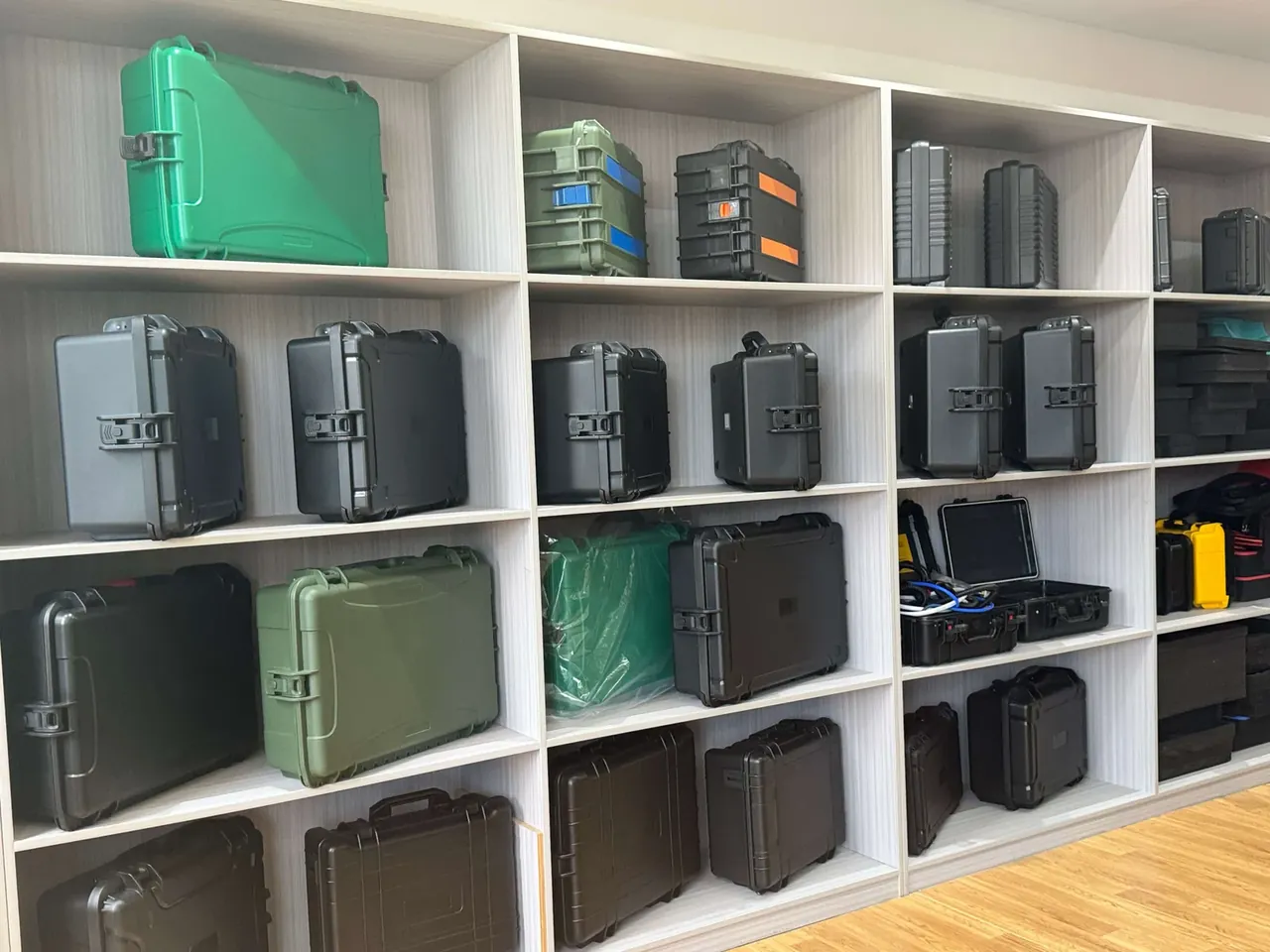
Quick answer: A grenade transport container rests on five measurable decisions: shell split and wall map, internal grid, seal and vent, latch fit, moulding and final test. Weakening any one caps the protection of the whole body.
Table of contents
- How the Shell Is Split and Thickened
- Grid Layout and Divider Fit
- Seals, Venting and Latch Fit
- Temperature and Time in Rotational Moulding
- Four Tests Before Shipment
- FAQ
1. How the Shell Is Split and Thickened
A grenade transport container is usually rotationally moulded in one piece, so the split sits only at the lid joint. The parting line runs about 30 mm below the waist, where a divider cannot catch on it.
A 5.0 mm side wall, a 7 mm base and 8 mm corners is the usual spread: the base carries stacking load, the corner takes the first impact in a drop.
| Zone | Wall | Why |
|---|---|---|
| Side wall | 5.0 mm | Resists pressure when stacked |
| Base | 7 mm | Carries unit and layer load |
| Corner | 8 mm | First contact in a drop |
Keep the spread within five percent of total weight, or the body hangs crooked when carried. A 380 × 280 × 220 mm cavity weighs 4.2 kg empty, handles sized for 30 kg loaded.
2. Grid Layout and Divider Fit
The cavity of a grenade transport container is a grid, not an open box. A 380 × 280 mm floor split four across and three down gives twelve cells at about 88 mm clear width, with 6 mm PE dividers seated in moulded slots. Impact spreads across twelve small volumes, so load in a cell does not move its neighbour.
Leave 1.5 mm between divider and wall as shrink allowance, not slop. A rotomoulded body keeps shrinking for about 48 hours; without the gap, dividers press on the wall by the third day, the side bulges into a hard spot, and that spot is where a drop starts a crack.
3. Seals, Venting and Latch Fit
Sealing rests on one continuous gasket, 6 mm across the section at 60 Shore, compressed by 25 percent. Below 15 percent it merely sits on the groove; above 35 percent the latches need force and the gasket takes a permanent set.
| Part | Specification | Fit |
|---|---|---|
| Gasket | 6 mm, 60 Shore | 25 percent compression, no joint |
| Vent | Opens at 0.12 bar | Lid face, away from handles |
| Latch | Four at 350 N each | Matched to lid stiffness |
The pressure vent is the part most often deleted. Moving from sea level to 2,000 m creates roughly 0.23 bar, so a body without a vent needs two people to break open. A 0.12 bar vent keeps opening effort under 50 N.
4. Temperature and Time in Rotational Moulding
The window is set by oven temperature, time and biaxial speed. A grenade transport container typically runs 260 °C for 12 minutes and cools for 8, with the major axis at 6 rpm against 8 on the minor.
| Stage | Setting | Cost of losing control |
|---|---|---|
| Heating | 260 °C, 12 minutes | Under-cured corners, or yellowing |
| Biaxial speed | 6 rpm major, 8 minor | Close ratio thins both ends |
| Demould | Below 60 °C mould | Early release ovalises the rim |
Below 210 °C the powder will not flow and unmelted granules sit in the corners; above 280 °C the surface yellows and impact strength falls by more than thirty percent. A 7 mm wall needs 15 minutes, not 12. A full cycle runs about 40 minutes, so one machine turns out roughly 30 bodies a day.
5. Four Tests Before Shipment
Four tests stand between the grenade transport container and the pallet: 30 kPa held for 60 seconds with no more than a 1 kPa drop; a 1.2 m drop onto each of six faces; 48 hours of salt spray; and 2,000 latch cycles with holding force down no more than fifteen percent.
Leak testing is the one most often softened. Drawing a slight vacuum and listening beats watching the gauge: a 0.5 mm misalignment at the gasket joint hisses within 60 seconds. On the drop test, watch the corner strike.
Conclusion
A grenade transport container holds no mystery, only five measurable decisions: a 5.0 mm wall with 8 mm corners, a four-by-three grid, 25 percent gasket compression, a 260 °C window of 12 minutes, a 30 kPa leak line. Simplify one and the body may still pass on the bench, with failure surfacing later under load. Put the five on the drawing, and the grenade transport container process holds to shipment.
This article discusses only the container (case body) side of specifications and design intent, and does not cover any handling, loading or use of the contents.
Related Reading
- Standards behind the grenade transport container
- Material comparison for the body
- How grenade transport case specs are read
- Where grenade storage containers are used
Related Products
- 8 Series — Gun Cases; Military Equipment Cases; Camera Equipment Cases; Drone Cases; Watch Cases; Knife Cases; First Aid Cases; Electronics Equipment Cases
- WL8-2812 PP Gun Case — model WL8-2812
- All protective cases and toolboxes: 7 series, 158 models