

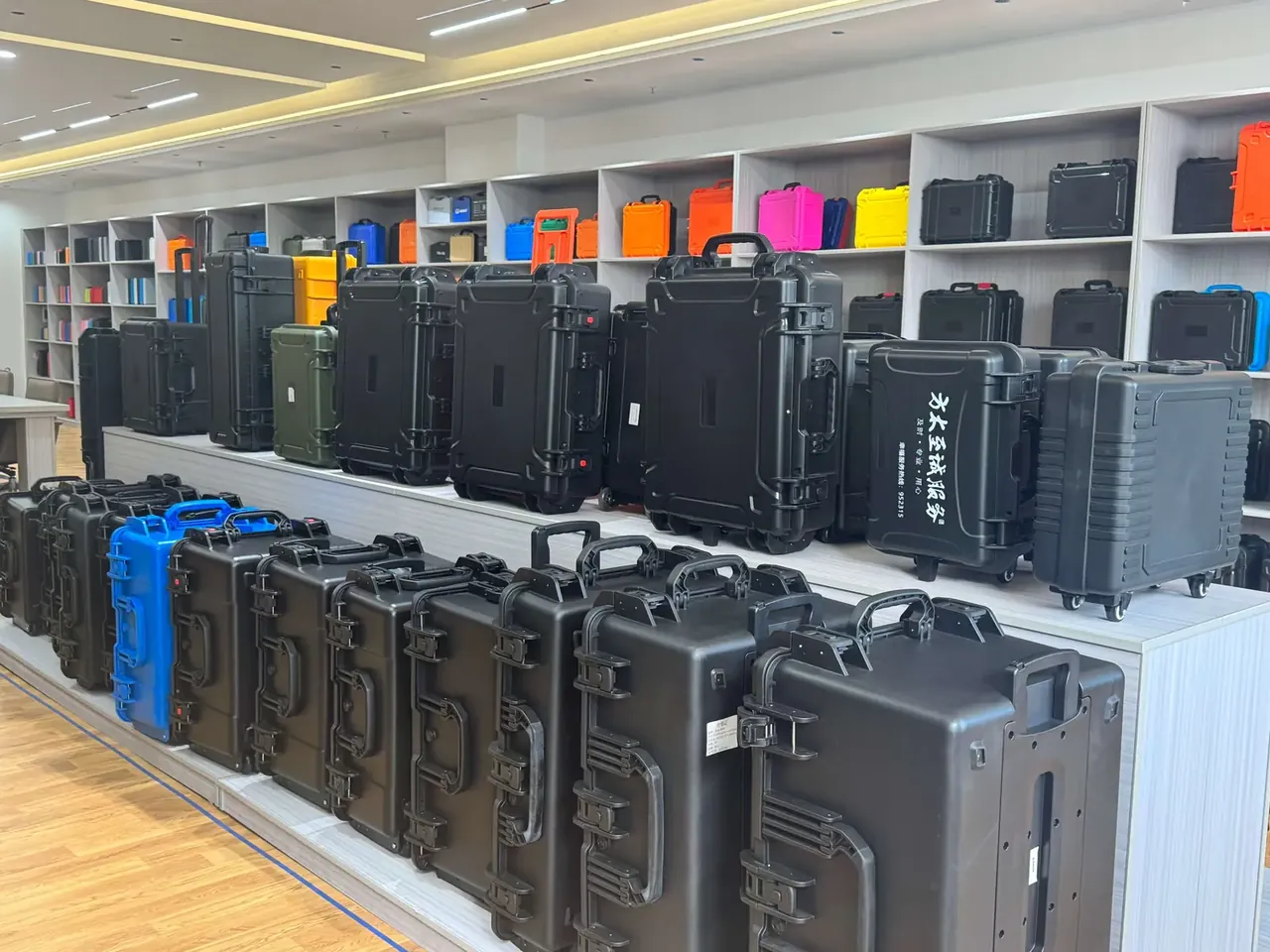
Quick answer: Choose a grenade transport container by working through five tests: payload and cavity layout, loaded weight and stacking height, latches and clamping force, sealing and venting, then carrying and marking. Skip one and the case still looks right in a quotation.
Table of contents
- Five Tests for Choosing a Grenade Transport Container
- Test One: Payload and Cavity Layout
- Test Two: Loaded Weight and Stacking Height
- Test Three: Latches and Clamping Force
- Tests Four and Five: Sealing, Carrying and Marking
- FAQ
1. Five Tests for Choosing a Grenade Transport Container
The difficulty with a grenade transport container is not the number of specifications but the way they pull against each other: more capacity means more loaded weight, more latches mean slower opening. Split the requirement into five tests, settle each, then merge.
Order matters: payload fixes the cavity, cavity fixes dead weight, weight decides handling, handling constrains handles and base. Run it backwards and only a forklift can lift the result.
| Test | Settle | Band | If wrong |
|---|---|---|---|
| Payload and cavity | units, pocket depth | 6 to 24 | pockets idle, lid misses the body |
| Weight and stacking | all-up mass, tiers | 12 to 26 kg, 3 to 5 | bottom tier collapses |
| Latches and clamping | count, closing force | 2 to 4, 90 to 150 N | lid springs back, gasket unseated |
| Sealing and venting | squeeze, vent | 25 percent, optional | vacuum holds the lid |
| Carrying and marking | handles, base, label | twin recessed, flat | load tips, label rubs away |
2. Test One: Payload and Cavity Layout
Payload is not how much will fit but how it is arranged. A twelve-unit case has a 560 by 340 by 290 mm cavity in a six-by-two pocket grid, each pocket locating one body with lid foam pressing down. Rebuild it as an open well with loose dividers and fourteen fit, but the dividers walk.
Depth is the variable buyers forget: 20 mm of clearance over the body height needs a matching 20 mm lid pad, or the first drop is taken by the contents.
3. Test Two: Loaded Weight and Stacking Height
Keep dead weight and all-up mass apart. A twelve-unit grenade transport container weighs 9.6 kg empty and 21 kg loaded, which decides one-person or two-person carry. Handling limits are usually drawn at 25 kg per item.
Stacking follows pallet footprint and rack clearance as much as case strength. At 21 kg across five tiers the bottom case carries 105 kg in storage, and a pitching vehicle often doubles it.
| Tiers | Load on the bottom case | Typical setting | Also needed |
|---|---|---|---|
| 3 | about 63 kg | shelf picking | shelf rated 80 kg or more |
| 5 | about 105 kg | palletised road transport | corner boards, stretch film |
| 7 | about 147 kg | sea freight | timber sheet underneath |
4. Test Three: Latches and Clamping Force
Two latches let the middle of the lid lift, and a hand pressed there makes a soft pop: the gasket failing to seat. Four along the long sides load it evenly at the cost of extra motions; three is the usual compromise.
Clamping force is measurable rather than debatable. A spring gauge at closing reads 90 to 150 N on a grenade transport container; below 90 N rain finds the seam, above 150 N the latch fights gloves. A latch eye takes a lead seal, so an opened load shows at a glance.
5. Tests Four and Five: Sealing, Carrying and Marking
The gasket is a wear item. An 8 mm silicone cord closing to 6 mm gives a 25 percent squeeze; less and the seal is nominal, more and the latches work loose. One that slides out in a piece is worth the cost.
A vent is optional until the route crosses a temperature band: load in the afternoon, cross a pass at night, and the grenade transport container holds the lid shut under vacuum until someone pries it. Twin recessed handles set the lift path, a flat base runs on a roller line, and the label has to clear latch travel.
Conclusion
The five tests form a chain: payload sets the cavity, cavity sets dead weight, weight sets stacking and handling, handling sets handles and base, and latches, gasket and marking finish the detail. Skipped in any order, the problem surfaces in the third month after delivery. Run in sequence, they turn a purchase into confirmations about a grenade transport container.
This article discusses only the container (case body) side of specifications and design intent, and does not cover any handling, loading or use of the contents.
Related Reading
- Industry standards for grenade transport containers
- Comparing case body materials
- Grenade transport case versus alternatives
- How artillery shell box specifications are set
Related Products
- 8 Series — Gun Cases; Military Equipment Cases; Camera Equipment Cases; Drone Cases; Watch Cases; Knife Cases; First Aid Cases; Electronics Equipment Cases
- WL8-2812 PP Gun Case — model WL8-2812
- All protective cases and toolboxes: 7 series, 158 models