

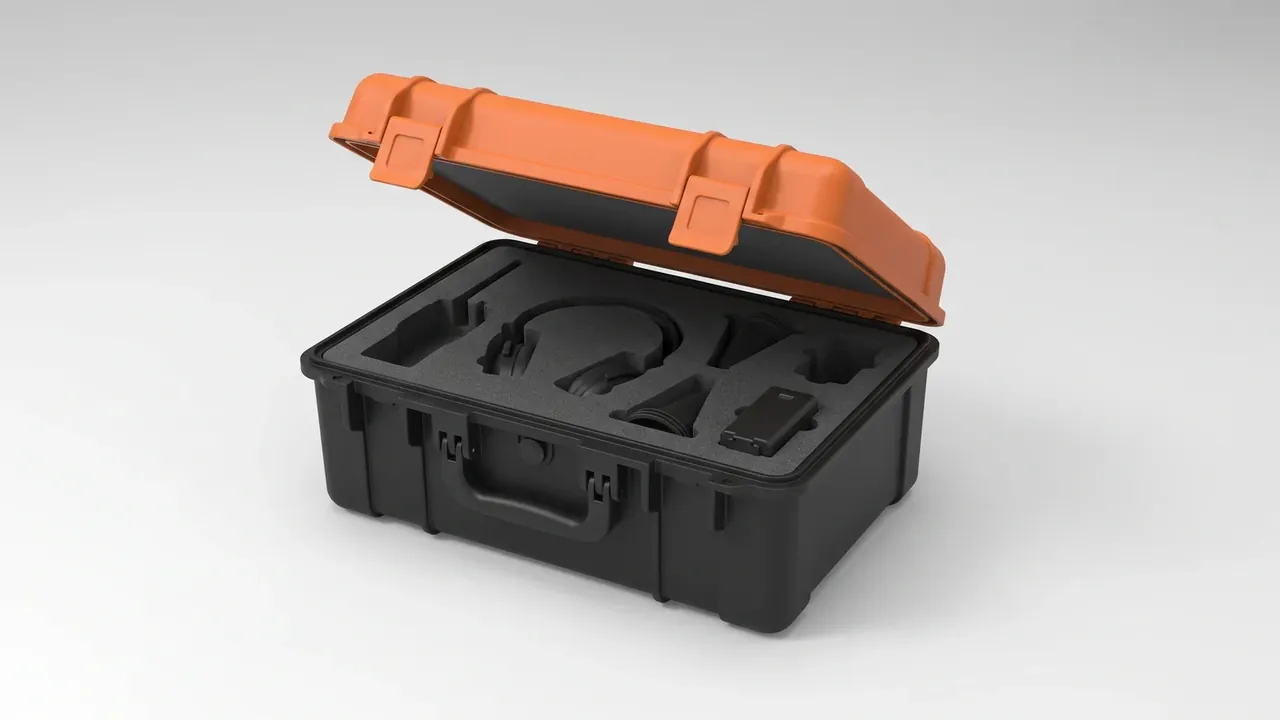
Quick answer: A ground support case rarely fails from water; it fails from three hits at 80 to 150 mm and from nobody recognising its crew tag at 12 m.
Table of contents
- Three Impact Points on the Apron
- Impact and Corners: IK08 to IK10
- Retroreflection, Numbering and Colour
- Wheels, Towing and Lid Angle
- FOD Storage and Counting
- FAQ
1. Three Impact Points on the Apron
Damage on the apron lands low. Forklift fork tips, tug hitch cross beams and baggage dolly angle iron all sit between 80 and 150 mm, the thin skirt of a ground support case.
Forks overshoot. A tip rides 60 mm off the ground, the driver's view is blocked, and insertion runs 40 mm past design: a 3 mm dent, wall thickness down from 2.8 mm to 1.9 mm.
Dolly frames hit harder. The angle iron stands 120 mm high and a 30 kg case at 5 km/h arrives with 29 J, between IK08 and IK10, where an ordinary moulding splits.
Lids are third: crew drag a ground support case with the lid open, it swings back, and the hinge takes bending; the four M4 studs under each hinge block shear first.
All three hits are low while most designs rib the lid and walls; a 3 mm bumper along the full skirt is the cheapest correction.
2. Impact and Corners: IK08 to IK10
Three ratings get confused. IK follows IEC 62262 with a 50 mm striker: IK08 is 5 J, IK10 is 20 J. Drop testing is 1.2 m onto six faces, three edges and a corner, loaded. Corner geometry is R10 with a 3 mm wall, a drawing note rather than a test.
The gap between 5 J and 20 J shows at the corner. On the same R10 of a ground support case, 5 J leaves a 0.8 mm dent; 20 J leaves 2.4 mm and a 15 mm whitened patch, which is crazing, and the next hit goes through.
A bumper routes force around the corner: a 3 mm TPE shell deflects 4 mm and cuts corner strain by 40%; too tight and it splits the moulding in cold weather.
The 1.2 m drop is the real case: off a dolly or pushed from a 1.1 m platform. Pass means no liner breakthrough, no latch release, no lid shift past 2 mm.
3. Retroreflection, Numbering and Colour
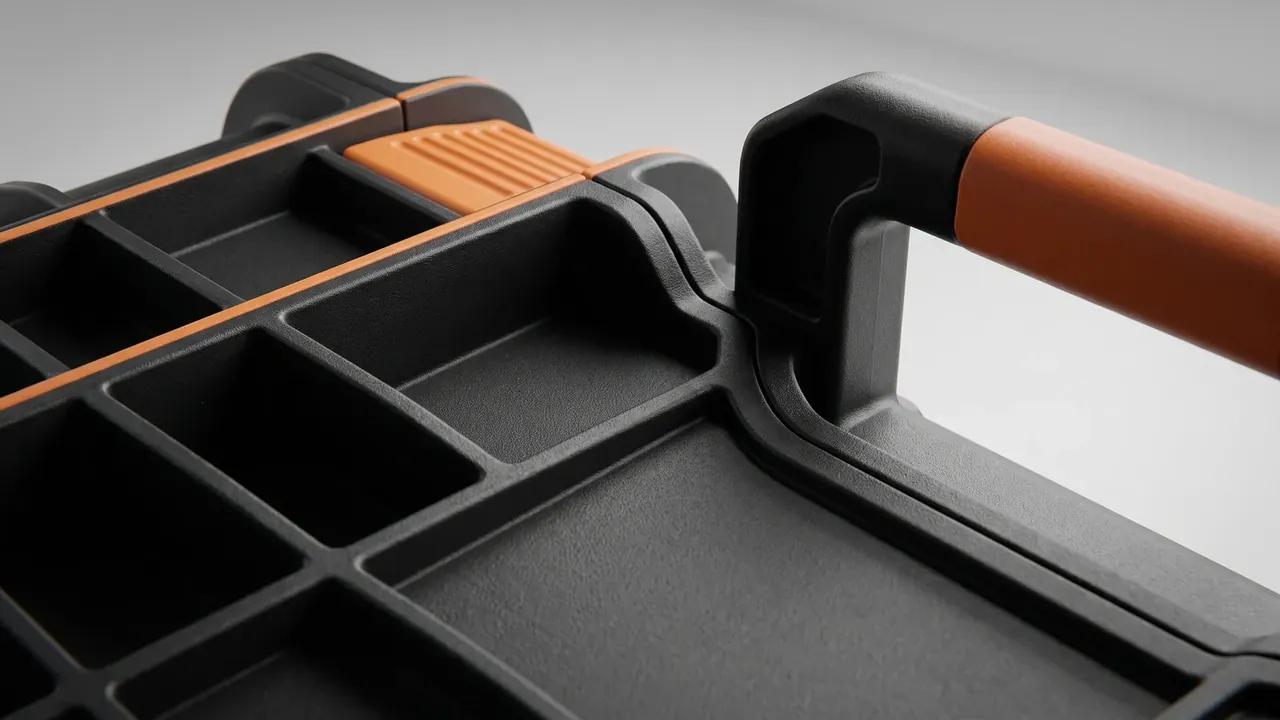
Film grades by coefficient: engineering 50 cd/(lx·m²), high-intensity 180, diamond 400. Apron light spans 20000 lx at noon to 20 lx at night, so daytime reading follows height, night reading follows coefficient.
Height runs about 1 mm per 0.25 m. A 50 mm character reads at 12 m, the usual forklift distance; the six-digit number sits at 50 mm on the sides and 80 mm on the lid, read from a cab 3 m up.
Module size sets scan distance: a 25 mm square with 0.5 mm modules reads at 0.3 to 0.8 m, while the 1.5 m apron scan needs 40 mm.
| Marking | Size | Read at | Position |
|---|---|---|---|
| Side number | 50 mm characters | 12 m | Both long sides |
| Lid number | 80 mm characters | 20 m | Centre of lid |
| QR code | 25 mm square | 0.8 m | Lower right |
| Reflective strip | high-intensity, 50 mm | 15 m at night | All four edges |
Colour separates crews: orange for line maintenance, blue for cargo, yellow for fuelling, held at ΔE 20 with patches above 0.02 m². A ground support case tagged by colour alone vanishes on a wet night; by number alone it fails at 5 m.
4. Wheels, Towing and Lid Angle
Pick the wheel for the floor, not the load. Joints step 8 mm and drain covers gap 12 mm, so φ100 mm climbs at 60% of φ75 mm resistance.
Twin brakes hold a ground support case still. One brake lets it pivot about the braked wheel on a 3% slope; two lock both front wheels and hold 30 kg for 24 h.
Towing is rolling plus steering: 12 N plus 15 N, so 27 N pulls 30 kg one-handed. At φ75 mm the figure is 38 N, past comfort, and crew drag the case by its corner.
Set the lid at 105°, where the centre of gravity passes 8 mm beyond the hinge and the lid rests on its own weight; a force 6 wind of 10.8 to 13.8 m/s gives 130 Pa over 0.28 m² and 9 N·m, so the damper needs 15 N·m.
| Item | Value | Note |
|---|---|---|
| Wheel diameter | 100 mm | climbs 8 mm step |
| Wheel width | 32 mm | clears 12 mm gap |
| Brakes | twin | 24 h on 3% slope |
| Lid angle | 105° | centre 8 mm past hinge |
| Hinge damper | 15 N·m | holds in force 6 wind |
Run a steel insert at 0.05 mm tolerance between axle and moulding; turn the axle straight in PP and the bore wears 0.4 mm in 2000 steering cycles.
5. FOD Storage and Counting
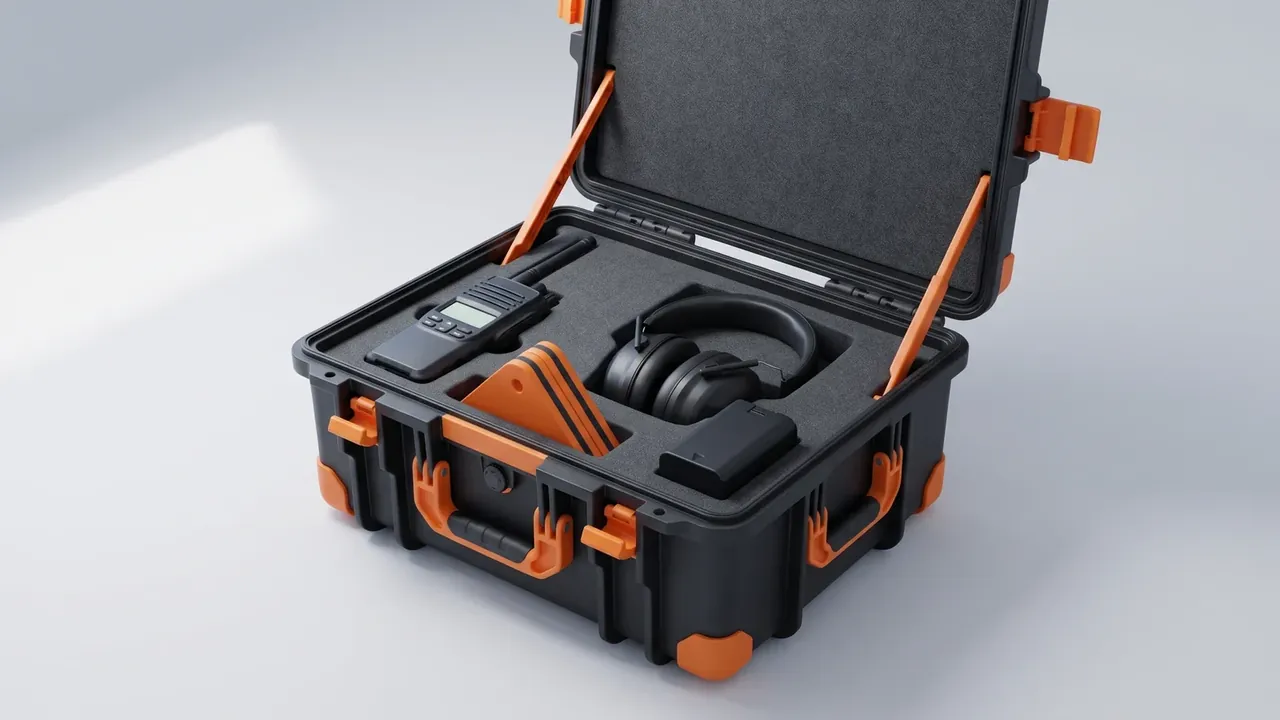
FOD is the costliest event on an apron, so the housing answer is keeping debris inside: a mesh pocket in the lid, foam cut to each item, and a 20 mm debris tray with a 5 mm lip.
Counting needs a shadow board, one pocket per tool, cut 1.5 mm oversize; tighter jams, looser lets tools jump out.
Leave a waste pocket, 100 mm by 100 mm, 30 mm from the tools; without it debris lands in the tool pockets and gets counted as kit on the way out.
On a ground support case the count runs open, draw, return, lock, ticked on a 0.2 mm PET label with UV-cured ink that survives 200 wipes of hydraulic oil.
Conclusion
Four figures summarise how a ground support case survives an apron. Impacts sit in the lower 80 to 150 mm, so the bumper needs R10 geometry and a 3 mm wall along the skirt. Rating goes to IK10 at 20 J, with a 1.2 m drop that must not break the liner. Marking pairs 50 mm characters with 12 m and 80 mm with 20 m. Wheels run φ100 mm on twin brakes at 27 N.
This article covers the container side only, meaning housing specification and design intent, not any handling, loading or use of the contents.
Related Reading
- Specifying cases for airport ground handling
- Structural design for aviation maintenance tool cases
- Protective cases across aviation equipment applications
Related Products
- 8 Series — Gun Cases; Military Equipment Cases; Camera Equipment Cases; Drone Cases; Watch Cases; Knife Cases; First Aid Cases; Electronics Equipment Cases
- WL8-2812 PP Gun Case — model WL8-2812
- All protective cases and toolboxes: 7 series, 158 models